On Sept. 12, PBS, WHYY, and the Penn Center for Science, Sustainability and the Media are set to gather a group of community leaders, journalists, science communicators, and scientists to explore the role of storytelling in climate change education.
(Image: iStock / Luke Chen)
Shifting the climate narrative
In a Q&A with Penn Today, Michael Mann of the Penn Center for Science, Sustainability, and the Media shares his views on the role of storytelling in the fight against climate change.
Led by Michael Mitchell and David Issadore of the School of Engineering and Applied Science, a team of researchers has developed a platform that could rapidly accelerate the development of mRNA-based lipid nanoparticle vaccines and therapeutics at both the small and large scale, SCALAR.
(Image: iStock / Anatoly Morozov)
SCALAR: A microchip designed to transform the production of mRNA therapeutics and vaccines
Researchers have developed a platform that could rapidly accelerate the development of mRNA-based lipid nanoparticle vaccines and therapeutics at both the small and largescale, SCALAR.
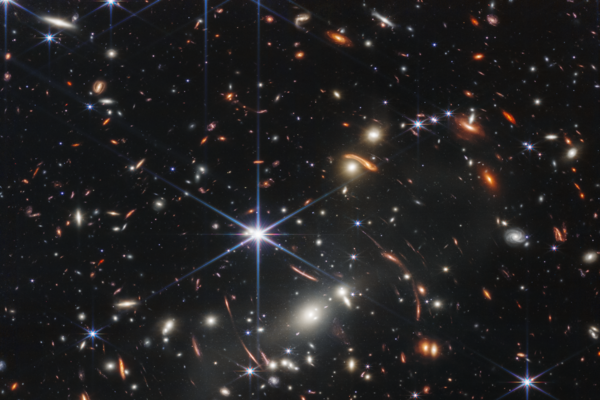
NASA’s James Webb Space Telescope has produced the deepest and sharpest infrared image of the distant universe to date. Known as Webb’s First Deep Field, this image of galaxy cluster SMACS 0723 is rich with detail.
Thousands of galaxies—including the faintest objects ever observed in the infrared—have appeared in Webb’s view for the first time. The image shows the galaxy cluster SMACS 0723 as it appeared 4.6 billion years ago. The combined mass of this galaxy cluster acts as a gravitational lens, magnifying much more distant galaxies behind it.
Webb’s Near-Infra Red Cam has brought those distant galaxies into sharp focus—they have tiny, faint structures that have never been seen before, including star clusters and diffuse features.
(Image: NASA, ESA, CSA, and STScI)
Could the age of the universe be twice as old as current estimates suggest?
Penn Professors Vijay Balasubramanian and Mark Devlin offer a broader understanding of a recent paper’s claim that the universe could be 26.7 billion years old.
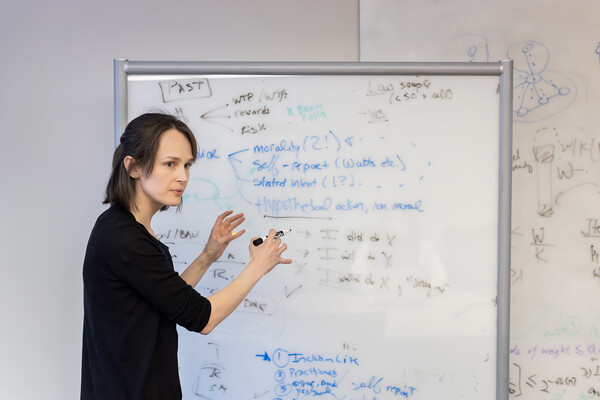
(On homepage) Gandhi also shares her lessons from industry with the students she teaches in her summer lab course. It equips the students with hands-on experience in applied behavioral science and experimentation, where small teams are paired with external organizations.
nocred
Nudge Cartography: Building a map to navigate behavioral research
Ph.D. candidate Linnea Gandhi of the Wharton School and research assistant Anoushka Kiyawat discuss the development of their team’s innovative research tool.
The rapid movement of lithium ions along the 2D vertical channels in the T-Niobium oxide (T-Nb2O5) thin film results in unique property changes and a chase transition. The blue and purple polyhedra show T-Nb2O5 lattices, without and with lithium, respectively. The bright green spheres represent lithium ions.
(Image: Max Planck Institute of Microstructure Physics / Patricia Bondia)
Leading the charge: new research unveils the future of energy-efficent power delivery
Penn’s Andrew Rappe and collaborators explore high-quality thin films to propel power into the future.
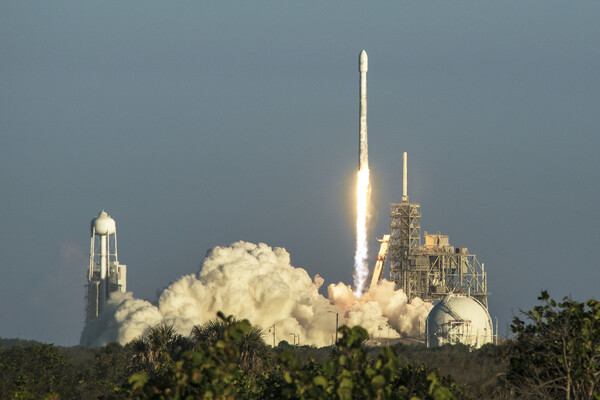
The European Space Agency’s latest astrophysics mission, Euclid, lifted off on a Space X Falcon 9 from Cape Canaveral in Florida, USA, at 17:12 CEST on 1 July 2023. Euclid has now started its month-long journey to Sun-Earth Lagrange point L2, located 1.5 million kilometers from Earth, in the opposite direction from the Sun.
(Image: iStock / Robert Michaud)
Euclid Space Telescope launches exciting new possibilities
Professors of physics and astronomy Bhuvnesh Jain, Mark Trodden, and Gary Bernstein discuss the coming research findings from the European Space Agency’s Euclid Space Telescope.
Masoud Akbarzadeh of the Weitzman School of Design leads a multidisciplinary group of architectural designers, structural engineers, computer scientists, and more in his Polyhedral Structures Laboratory. He explores ways in which polyhedral geometries that frequently occur in nature can be used to make stronger and lighter structures, all while using fewer materials. Akbarzadeh discusses a recent study drawing inspiration from dragonfly wings.
(Image: iStock / yanikap)
Nature-inspired designs give rise to stronger, lighter systems
Weitzman’s Masoud Akbarzadeh discusses a recent multidisciplinary study that draws inspiration from dragonfly wings to redesign a Boeing 777 to be lighter, stronger, and more sustainable.
Michael Mann, Penn’s inaugural Presidential Distinguished Professor in the Department of Earth and Environmental Science and collaborators has found that the effects of climate change on the intensity, frequency, and duration of extreme weather events like wildfires, could lead to massive increases in all three.
(Image: iStock/Marc Bruxelle)
Climate change’s impact on extreme weather events
Michael Mann and collaborators investigated the effects of climate change on the intensity, frequency, and duration of extreme weather events like wildfires, and found that “worst-case” scenario could lead to significant increases in all three.
The concept of a brain-computer interface was first proposed and experimented upon in the 1970s by Jacques Vidal, who demonstrated that humans could control a cursor on a computer screen using their brain waves.
(iStock /Tatiana Sozonova)
Challenges and advances in brain-computer interfaces
Following FDA approval for tech startups to begin human clinical trials for brain-computer interfacing technologies, Penn Today met with Anna Wexler of the Perelman School of Medicine to discuss the promising possibilities and potential pitfalls of neurotechnology.