Leading the charge: New research paves the way for energy-efficient power storage and electronics
Penn’s Andrew Rappe and collaborators explore high-quality thin films to propel power into the future.
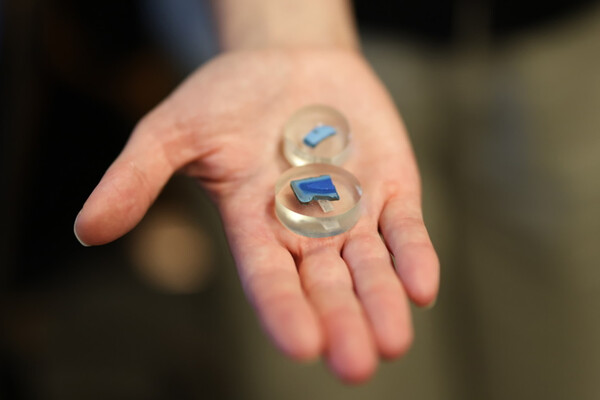
The rapid movement of lithium ions along the 2D vertical channels in the T-Niobium oxide (T-Nb2O5) thin film results in unique property changes and a chase transition. The blue and purple polyhedra show T-Nb2O5 lattices, without and with lithium, respectively. The bright green spheres represent lithium ions.
(Image: Max Planck Institute of Microstructure Physics / Patricia Bondia)
Since the 1940s, scientists have been exploring the use of niobium oxide, specifically a form of niobium oxide known as T-Nb2O5, to create more efficient batteries. This unique material is known for its ability to allow lithium ions, the tiny, charged particles that make batteries work, to move quickly within it. The faster these lithium ions can move, the faster a battery can be charged.
The challenge, however, has always been to grow this niobium oxide material into thin, flat layers, or “films,” that are of high enough quality to be used in practical applications. This problem stems from the complex structure of T-Nb2O5 and the existence of many similar forms, or polymorphs, of niobium oxide.
“This dramatic shift enables a range of potential applications, from high-speed battery charging to energy-efficient computing and more,” says Rappe.
“Our conventional modalities of lithium storage in cathodes usually rely on a process of recrystallization that tends to interfere with the structure, like the ones we see in today’s batteries,” says coauthor Zhen Jiang, a former postdoctoral researcher in the Rappe Group.
Aaron Schankler, a graduate student in the School of Arts & Sciences, adds, “What the team over at Max Planck and the University of Cambridge has done is find a way to move lithium ions in a way that doesn’t disrupt the crystal structure of our T-Nb2O5 thin film, and we helped to rationalize why the ions can move in and out quickly and reversibly.”
Rappe likens T-Nb2O5 to a multilevel car-parking structure wherein the lithium ions are cars and the structure of T-Nb2O5 forms open channels, or ramps, that allow the cars to move up and down between the levels.
“By growing the T-Nb2O5 so that these channels run vertically, or ‘up and down,’ our team made it possible for the lithium ions to move significantly faster, thereby allowing for fast and colossal changes in electrical properties of thin films by inserting the lithium ions between atoms in the negative terminal of our system,” says first author Hyeon Han of the Max Planck Institute.
Rappe notes that the researchers from the University of Cambridge worked closely with his team and discovered multiple previously unknown transitions in the material’s structure as the concentration of lithium ions changed.
These transitions change the electronic properties of the material, allowing it to switch from being an insulator to a metal, meaning that it goes from blocking electric current to conducting it. This is a dramatic shift; the resistivity of the material decreases by a factor of 100 billion.
The team from Penn developed the computational work in theorizing the conditions needed to give rise to the stability of transitions via density functional theory calculations, a quantum mechanical method used to investigate the electronic structure of many-body systems, especially atoms, molecules, and the condensed phases. Rappe says that with this method the team could calculate and predict material behavior under different conditions.
He says the theoretical calculations helped rationalize the multiple phase transitions they observed, as well as how these phases might be related to the concentration of lithium ions and their arrangement within the crystal structure. This understanding, in turn, allowed the researchers to effectively control and manipulate the electronic properties of the T-Nb2O5 thin films.
“Atomistic simulations calculations have great benefits in advancing the fundamentals of science in academia but also various technologies in industry,” says Arvin Kakekhani, a former postdoctoral researcher in the Rappe Group. “This work showcases how these calculations can complement experiments, elucidating the role of lithium diffusion in electric properties of important solid-state batteries and electronic materials.”
“The ability to control the orientation of these films allows us to explore directionally dependent transport in this technologically important class of materials, which is fundamental to understanding of how these materials operate,” says Clare P. Grey of the University of Cambridge.
By manipulating these phase transitions, the researchers demonstrated that they could repeatedly and reliably control the electronic properties of these thin films. In addition, by altering the chemical composition of the “gate” electrode, a component that controls the flow of ions in a device, they were able to tune the voltage at which the material becomes metallic, further extending the potential applications.
“This research is a testament to the power of interdisciplinary collaborations and unquenchable scientific curiosity,” says Stuart S. P. Parkin of the Max Planck Institute. “Our understanding of T-Nb2O5 and similar complex materials has been dramatically enhanced, setting the course for a more sustainable and efficient future.”
Zhen Jiang and Arvin Kakekhani are a former postdoctoral researcher in the Rappe Group in the School of Arts & Sciences at Penn.
Aaron Schankler is a graduate student in the School of Arts & Sciences at Penn.
Hyeon Han is a postdoctoral researcher in the Max Planck Institute of Microstructure Physics, in Halle, Germany.
Clare Philomena Grey is Geoffrey Moorhouse Gibson Professor in the Department of Chemistry at the University of Cambridge and a Fellow of Pembroke College, Cambridge.
Stuart S. P. Parkin is the director of the Max Planck Institute of Microstructure Physics, Halle, Germany, and an Alexander von Humboldt Professor at the Martin Luther University Halle-Wittenberg.
This research was supported by the European Union’s Horizon 2020 research and innovation program (Grant 737109); Alexander von Humboldt Foundation by the Federal Ministry of Education and Research; U.S. Department of Energy, Office of Science, Basic Energy Sciences (Award DE-SC0019281); Faraday Institution CATMAT project (FIRG016); Office of Naval Research, (Grant N00014-20-1-2701); National Energy Research Scientific Computing Center of the Department of Energy and the High-Performance Computing Modernization Office (HPCMO) of the U.S. Department of Defense.
On the move: Water quality and antimicrobial resistance testing goes mobile
Penn researchers have developed a mobile field laboratory allowing them to test water quality and track antimicrobial resistance in and around San Cristóbal in the Galápagos.
Penn researchers Vanessa and Alexis North are studying one of the largest collections of Egyptian blue objects ever found in the ancient Near East, shedding new light on how the world’s first synthetic pigment may have traveled far beyond Egypt.
A new role for dental providers? Rethinking where vaccines are given
Vaccinations have traditionally been administered in primary care settings or pharmacies. However, for about a decade, some states have authorized dentists to administer vaccines, and many others did so during the COVID-19 pandemic. The effectiveness of this approach has led some countries and states to expand or consider expanding the role of dental providers in delivering routine vaccines, including those against COVID-19 and the human papillomavirus (HPV), and in providing vaccine education.
Penn student develops a way for computer chips to run more efficiently
Fluid Silicon, a platform from President’s Sustainability Prize winner Nhlanhla Mavuso, allows computer chips to continuously monitor their health and self-tune as their characteristics change. The technology has the potential to reduce energy usage in data centers and improve reliability in mission-critical applications.