Could the age of the universe be twice as old as current estimates suggest?
Penn Professors Vijay Balasubramanian and Mark Devlin offer a broader understanding of a recent paper’s claim that the universe could be 26.7 billion years old.
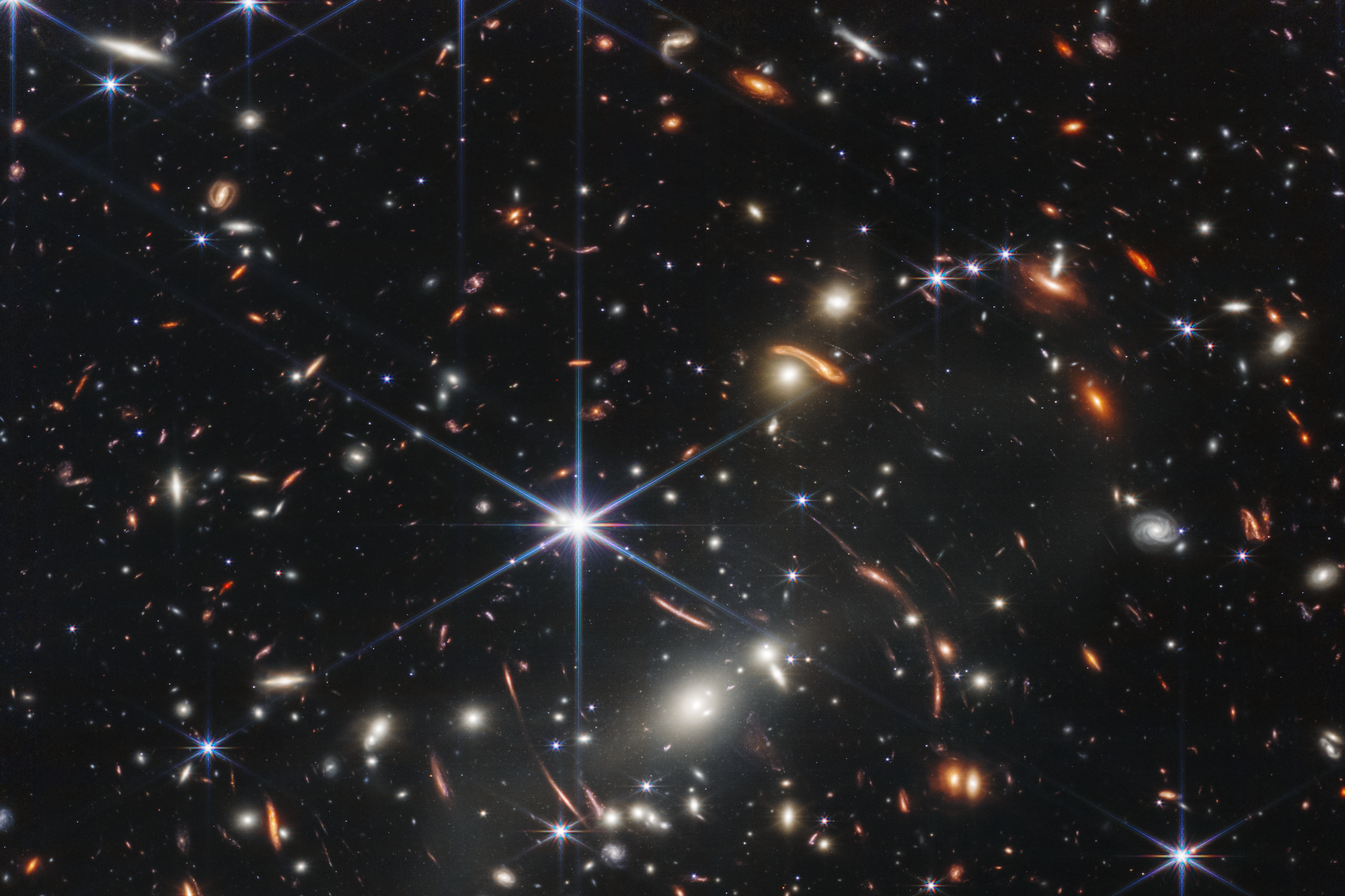
NASA’s James Webb Space Telescope has produced the deepest and sharpest infrared image of the distant universe to date. Known as Webb’s First Deep Field, this image of galaxy cluster SMACS 0723 is rich with detail.
Thousands of galaxies—including the faintest objects ever observed in the infrared—have appeared in Webb’s view for the first time. The image shows the galaxy cluster SMACS 0723 as it appeared 4.6 billion years ago. The combined mass of this galaxy cluster acts as a gravitational lens, magnifying much more distant galaxies behind it.
Webb’s Near-Infra Red Cam has brought those distant galaxies into sharp focus—they have tiny, faint structures that have never been seen before, including star clusters and diffuse features.
(Image: NASA, ESA, CSA, and STScI)
Could the universe be twice as old as current estimates put forward? Rajendra Gupta of the University of Ottawa recently published a paper suggesting just that. Gupta claims the universe may be around 26.7 billion years rather than the commonly accepted 13.8 billion. The news has generated many headlines as well as criticism from astronomers and the larger scientific community.
Penn Today met with professors Vijay Balasubramanian and Mark Devlin to discuss Gupta’s findings and better understand the rationale of these claims and how they fit in the broader context of problems astronomers are attempting to solve.
How do we know how old the universe actually is?
Balasubramanian: The universe is often reported to be 13.8 billion years old, but, truth be told, this is an amalgamation of various measurements that factor in different kinds of data involving the apparent ages of ‘stuff’ in the universe.
This stuff includes observable or ordinary matter like you, me, galaxies far and near, stars, radiation, and the planets, then dark matter—the sort of matter that doesn’t interact with light and which makes up about 27% of the universe—and finally, dark energy, which makes up a massive chunk of the universe, around 68%, and is what we believe is causing the universe to expand.
And so, we take as much information as we can about the stuff and build what we call a consensus model of the universe, essentially a line of best fit. We call the model the Lambda Cold Dark Matter (ΛCDM).
Lambda represents the cosmological constant, which is linked to dark energy, namely how it drives the expansion of the universe according to Einstein's theory of general relativity. In this framework, how matter and energy behave in the universe determines the geometry of spacetime, which in turn influences how matter and energy move throughout the cosmos. Including this cosmological constant, Lambda, allows for an explanation of a universe that expands at an accelerating rate, which is consistent with our observations.
Now, the Cold Dark Matter part represents a hypothetical form of dark matter. ‘Dark’ here means that it neither interacts with nor emits light, so it’s very hard to detect. ‘Cold’ refers to the fact that its particles move slowly because when things cool down their components move less, whereas when they heat up the components get excited and move around more relative to the speed of light.
So, when you consider the early formation of the universe, this ‘slowness’ influences the formation of structures in the universe like galaxies and clusters of galaxies, in that smaller structures like the galaxies form before the larger ones, the clusters.
Devlin: And then taking a step back, the way cosmology works and pieces how old things are is that we look at the way the universe looks today, how all the structures are arranged within it, and we compare it to how it used to be with a set of cosmological parameters like Cosmic Microwave Background (CMB) radiation, the afterglow of the Big Bang, and the oldest known source of electromagnetic radiation, or light. We also refer to it as the baby picture of the universe because it offers us a glimpse of what it looked like at 380,000 years old, long before stars and galaxies were formed.
And what we know about the physical nature of the universe from the CMB is that it was something really smooth, dense, and hot. And as it continued to expand and cool, the density started to vary, and these variations became the seeds for the formation of cosmic structures.
The denser regions of the universe began to collapse under their own gravity, forming the first stars, galaxies, and clusters of galaxies. So, this is why, when we look at the universe today, we see this massive cosmic web of galaxies and clusters separated by vast voids. This process of structure formation is still ongoing.
And, so, the ΛCDM model suggests that the primary driver of this structure formation was dark matter, which exerts gravity and which began to clump together soon after the Big Bang. These clumps of dark matter attracted the ordinary matter, forming the seeds of galaxies and larger cosmic structures.
So, with models like the ΛCDM and the knowledge of how fast light travels, we can add bits of information, or parameters, and we have from things like the CMB and other sources of light in our universe, like the ones we get from other distant galaxies, and we see this roadmap for the universe that gives us it’s likely age. Which we think is somewhere in the ballpark of 13.8 billion years.
How did Gupta get 26.7 billion?
Devlin: In thinking about the evolution of the universe and the parameters we’ve used to develop the understanding we have, we could use the term ‘roadmap’ and extend it to a metaphor.
For instance, say I drove from my office at David Rittenhouse Labs here in Philadelphia to the Griffith Observatory in Los Angeles. There are many different paths I could have used to get there, but you’re interested in the one I actually used. To figure that out, you would probably say, ‘He can’t just drive in a straight line towards Los Angeles; he needs to pass through five specific cities or checkpoints.’
And once you constrain the potential path to those checkpoints, you get a hypothetical path that more precisely maps my specific route. Then you could define it more precisely by adding more and more cities, which would give you an even closer approximation to the exact path I used.
And so, much like how you would approximate my path from Philly to Los Angeles, what we can reliably do with the universe is come up with a prediction of what its state would have been like at a certain epoch, then we can check to see how close our approximation was and it’s usually really close. It’s like saying you know I went through Chicago and Denver and then predicting all the other cities and getting it all correct.
The speed of light is a critical constant we use to determine these checkpoints. Since light takes time to travel, observing it from distant cosmic objects lets us kind of look back in time. Essentially, the further away an object is, the longer its light has taken to get to us, and therefore the older the state we observe it in. This idea forms the basis for determining the checkpoints in our cosmic journey, with each unique observation of light corresponding to a specific era in the universe's history.
By measuring the universe’s state at these different epochs, we piece together its evolutionary path. The more measurements we make—or, extending our metaphor, the more ‘cities’ we add—the more accurately we can chart the universe’s journey from its inception to its current state.
And, much like our hypothetical cross-country journey, there’s always room for discovery and refinement in this cosmic roadmap, which is what this paper has attempted—sort of.
He’s offering an explanation for some recent James Webb Space Telescope (JWST) observations that suggest distant galaxies are more mature than ΛCDM would allow for.
Balasubramanian: The issue this paper is trying to address is called the impossible early galaxy problem, and he is proposing a hybrid model that affixes the ΛCDM to a theory that posits light gets ‘tired’ as it travels over billions and billions of years, namely that it loses energy through various mechanisms.
Other versions of this idea include theories that fundamental constants like the speed of light varied over time. In essence, the paper suggests that redshift—a phenomenon where light or other electromagnetic radiation from an object increases in wavelength, or ‘shifts’ towards the red end of the spectrum, indicating that the object is moving away from the observer—has been calibrated incorrectly.
The tired light idea isn’t new, and it’s been around for a while; it was proposed in 1929 by Fritz Zwicky soon after Edwin Hubble first recorded how the redshift of a galaxy was correlated with its distance away from the observer, meaning us. This tired light idea was devised at a time when the expanding universe theory wasn’t as commonplace and was partly intended to explore the possibility that Hubble’s observations could be consistent with a static universe. But the idea was later largely refuted and ruled out in favor of the ΛCDM model.
However, in this paper, the researchers aren’t claiming the universe is static. They’re saying that the redshift of the light from faraway galaxies could be caused by both the expansion of the universe and tired light under a specific set of conditions from their hybrid model. By combining these models and making tweaks to the parameters for ΛCDM, you get a figure that better explains the JWST data.
Essentially, they’re changing the calibration between redshift and the length of time that the light has been traveling for.
So, instead of a redshift of 10, which means that the light has been traveling for around 13 billion years after being emitted by the Big Bang when the universe was around 380 million years old, the paper suggests that the light has been traveling for 21 billion years and was emitted when the universe was around 5 billion years old.
Does anyone believe this claim?
Balasubramanian: This is the wonderful thing about the scientific process; we make our claims publicly and leave it to the community to counter or corroborate them. The discussion is open, and that’s what we’re going to see play out with this paper. And the rate at which claims are validated or not is directly proportional to how many people decide if the claim is interesting enough to work on. This claim is interesting, so I suspect the debate will be settled quite quickly.
Devlin: Regardless of all this cosmology stuff, you can literally measure the age of rocks on the earth and rocks in our solar system and calculate age of globular clusters by looking at their physical partners, and there isn’t anything anywhere near that old. If there were something or anything close to 20 billion years old, we would have seen it by now, so I think this claim isn’t likely to pick up much more steam or change things. The problem with this work is that it requires messing with all that we know about the universe to accommodate this new JWST image.
Two things become an issue: The new ‘fix’ has not demonstrated all the above; and the data are not nearly convincing enough to require it.
Overall, I think it’s very cool that we have this abundance of data and that our telescopes are allowing us to see more than ever before and draw new conclusions that challenge our understanding of the universe.
Vijay Balasubramanian is the Cathy and Marc Lasry Professor in the Department of Physics and Astronomy in the School of Arts & Sciences at the University of Pennsylvania.
Mark Devlin is the Reese W. Flower Professor of Astronomy and Astrophysics in the Department of Physics and Astronomy in the School of Arts & Sciences at Penn.
On the move: Water quality and antimicrobial resistance testing goes mobile
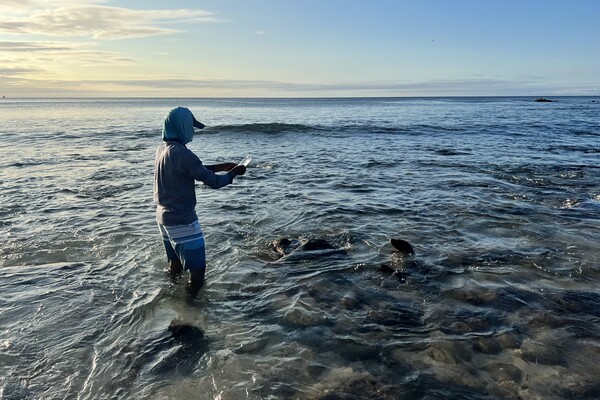
Penn researchers have developed a mobile field laboratory allowing them to test water quality and track antimicrobial resistance in and around San Cristóbal in the Galápagos.
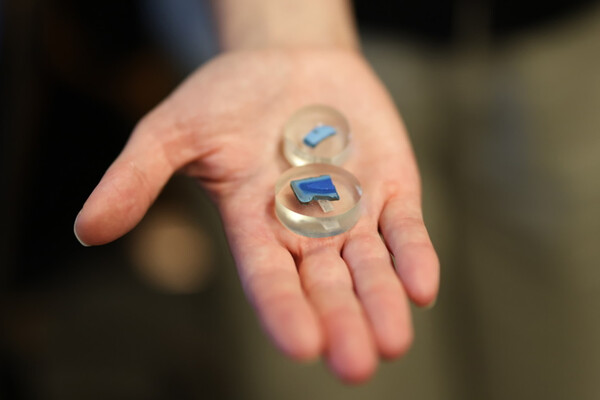
Penn researchers Vanessa and Alexis North are studying one of the largest collections of Egyptian blue objects ever found in the ancient Near East, shedding new light on how the world’s first synthetic pigment may have traveled far beyond Egypt.
A new role for dental providers? Rethinking where vaccines are given
Vaccinations have traditionally been administered in primary care settings or pharmacies. However, for about a decade, some states have authorized dentists to administer vaccines, and many others did so during the COVID-19 pandemic. The effectiveness of this approach has led some countries and states to expand or consider expanding the role of dental providers in delivering routine vaccines, including those against COVID-19 and the human papillomavirus (HPV), and in providing vaccine education.
Penn student develops a way for computer chips to run more efficiently
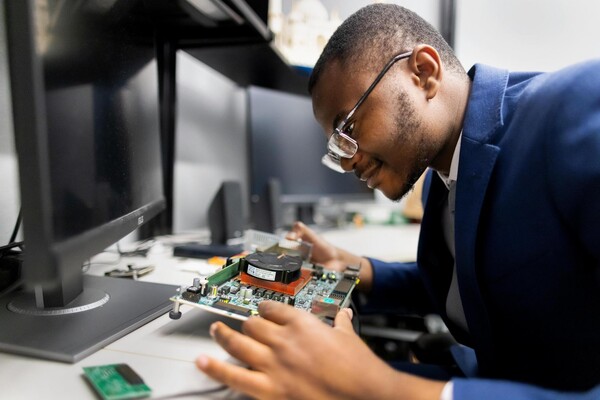
Fluid Silicon, a platform from President’s Sustainability Prize winner Nhlanhla Mavuso, allows computer chips to continuously monitor their health and self-tune as their characteristics change. The technology has the potential to reduce energy usage in data centers and improve reliability in mission-critical applications.