Penn Integrates Knowledge University Professor Philip Tetlock and researchers from the University of Waterloo, University of Toronto, and Yale, discuss AI and its application to their work.
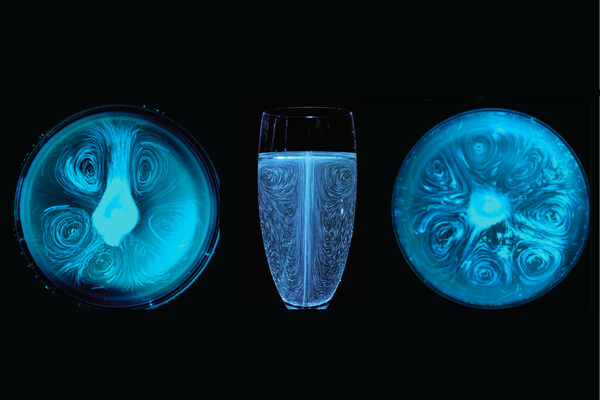
Laser tomography of champagne glasses: (left and right) counter-rotating convection cells self-organize at the air-champagne interface, and (center) stabilized eddies in a surface-treated glass.
(Image: FabienBeaumont, GérardLiger-Belair, and GuillaumePolidori)
Exploring the relationship between cooking and scientific discovery
Penn physicist Arnold Mathijssen and colleagues have authored a review article discussing the history of food innovations and the current scientific breakthroughs that are changing the way we eat.
“The air contains an enormous amount of electricity,” says Jun Yao, assistant professor of electrical and computer engineering in the College of Engineering at the University of Massachusetts Amherst, and the paper’s senior author. “Think of a cloud, which is nothing more than a mass of water droplets. Each of those droplets contains a charge, and when conditions are right, the cloud can produce a lightning bolt—but we don’t know how to reliably capture electricity from lightning. What we’ve done is to create a human-built, small-scale cloud that produces electricity for us predictably and continuously so that we can harvest it.”
(Image: iStock/Matt Grehan)
Three things to know about a sustainable energy breakthrough
Penn Engineering’s James Pikul explains how a new method of harnessing energy by using water trapped in the air is possible and discusses the implication of the research.
Research led by the School of Arts & Sciences’ Joshua Plotkin and Taylor Kessinger sheds light on the impact of social contexts and multilayered societies on promoting cooperative behavior.
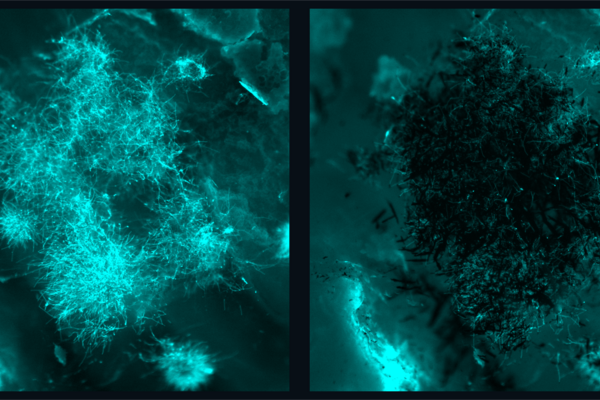
Candida albicans is a species of yeast that is a normal part of the human microbiota but can also cause severe infections that pose a significant global health risk due to their resistance to existing treatments, so much so that the World Health Organization has highlighted this as a priority issue. The picture above shows a before (left) and after (right) fluorescence image of fungal biofilms being precisely targeted by nanozyme microrobots without bonding to or disturbing the tissue sample.
(Image: Min Jun Oh and Seokyoung Yoon)
Nanorobotic system presents new options for targeting fungal infections
Researchers from Penn Dental and Penn Engineering have developed a nanorobot system that precisely and rapidly targets fungal infections in the mouth.
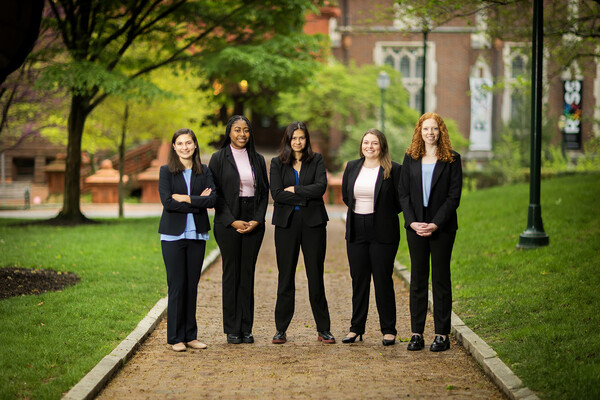
Recipients of the 2023 President’s Innovation Prize, team Sonura, five bioengineering graduates from the School of Engineering and Applied Science, have created a device that filters out disruptive environmental noises for infants in neonatal intensive care units. Their beanie offers protection and fosters parental connection to newborns while also supporting their development.
nocred
Safe and sound: Sonura supports newborn development by sequestering disruptive noise
A team of five recent graduates from the School of Engineering and Applied Science and recipients of the 2023 President’s Innovation Prize have developed a beanie that filters out harmful noises for infants in neonatal intensive care units.
Understanding the decline in racial disparities in COVID
The School of Arts & Sciences’ Irma Elo and Samuel Preston, with a collaborative team of researchers, assessed racial disparities in U.S. COVID-19 deaths, calling for continued efforts to better understand and implement targeted strategies for addressing health inequalities.
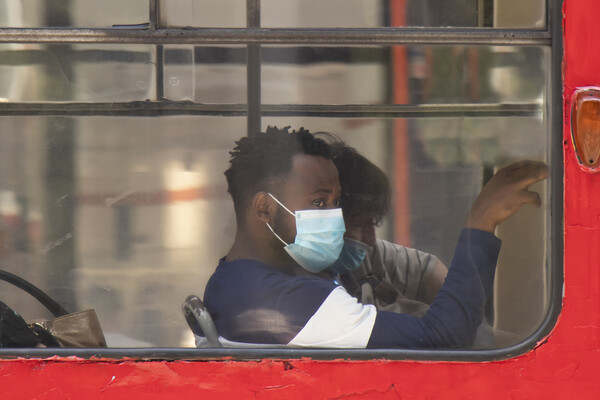
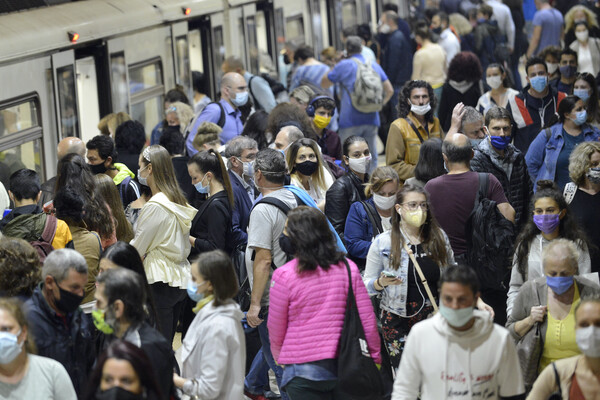
Subway train passengers with protective masks on a station platform in Sofia, Bulgaria in June 2020.
(Image: iStock/JordanSimenov)
Social conformity in pandemics: How our behaviors spread faster than the virus itself
Researchers led by former postdoc Bryce Morsky and Erol Akçay of the School of Arts & Sciences have produced a model for disease transmission that factors in the effects of social dynamics, specifically, how masking and social distancing are affected by social norms.
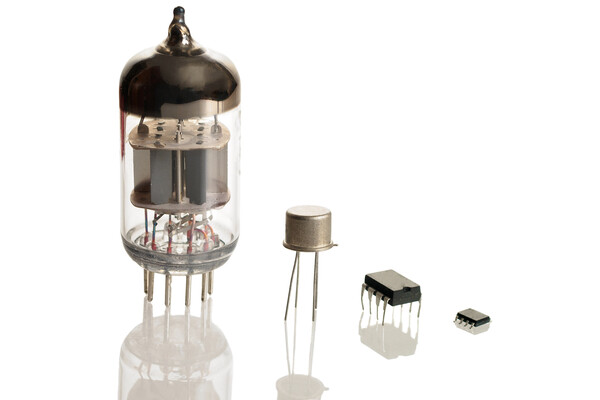
Transistors replaced vacuum tubes in the mid-20th century. They were initially made of germanium and later silicon, leading to the development of integrated circuits containing millions to billions of transistors on a single chip. The Metal-Oxide-Semiconductor Field-Effect Transistor (MOSFET) became the dominant type due to its smaller size, faster speed, and greater energy efficiency. Today, MOSFETs are essential components in modern electronic devices such as computers, smartphones, and power electronics.
(Image: iStockphoto/vlabo)
Moore than meets the eye
Following the death of Gordon Moore, co-founder of Intel and a pioneer in computer processor chips, Penn Today spoke with the School of Engineering and Applied Science’s Benjamin C. Lee about Moore’s contributions to technology and the history and rapid evolution of chips.
Newly elected members of the U.S. National Academy of Sciences, (clockwise from top left) David Brainard from the School of Arts & Sciences; Duncan Watts from the Annenberg School for Communication, the School of Engineering and Applied Science, and the Wharton School; Kenneth S. Zaret; and Susan R. Weiss, both from the Perelman School of Medicine.
nocred
Four from Penn elected to the National Academy of Sciences
The newly elected members, distinguished scholars recognized for their innovative contributions to original research, include faculty from the School of Arts & Sciences, Perelman School of Medicine, Annenberg School for Communication, and Wharton School.