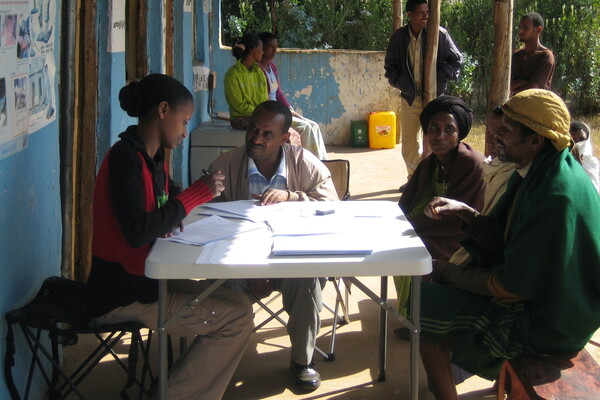
Members of Tishkoff's research team collecting ethnograpgic information from participants in Ethiopia.
(Image: Courtesy of Sarah Tishkoff)
Neanderthals carried genes acquired from ancient interactions with ‘cousins’ of modern humans
A new collaborative study led by Sarah Tishkoff shows that Neanderthals inherited at least 6% of their genome from a now-extinct lineage of early modern humans.
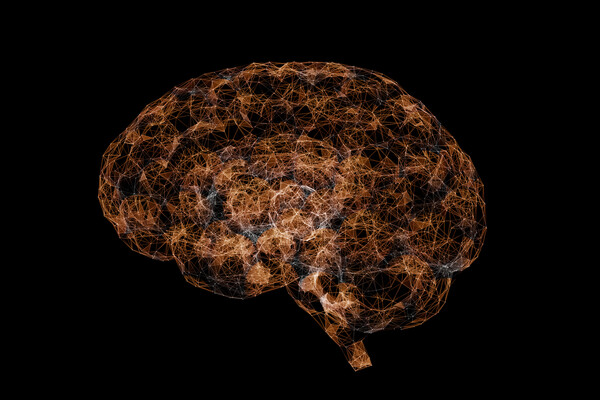
PIK Professor Michael Platt and collaborators have generated the first single-cell “atlas” of the primate brain to help explore links between molecules, cells, brain function, and disease.
(Image: iStock / Jezperklauzen)
Understanding the brain via a molecular map
PIK Professor Michael Platt and collaborators have generated the first single-cell “atlas” of the primate brain to help explore links between molecules, cells, brain function, and disease.
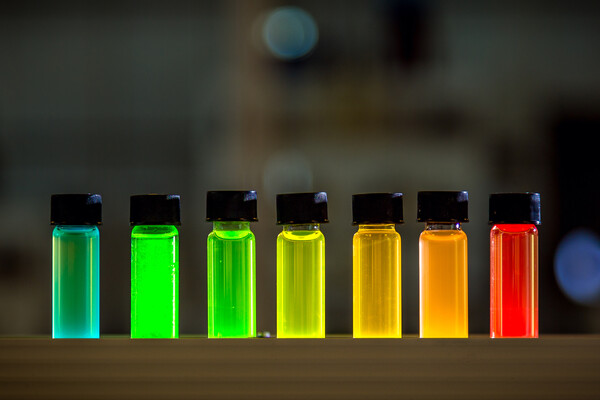
Quantum dots are not just any nanoparticles. Often described as artificial atoms, these nanometer-sized semiconductor crystals possess unique attributes largely governed by their size, which chiefly dictates how they interact with light.
(Image: iStock / Tayfun Ruzgar)
Delving into quantum dots
Christopher B. Murray shares his excitement, thoughts, and knowledge on quantum dots, a nanoparticle that just earned his Ph.D. advisor the Nobel Prize in Chemistry.
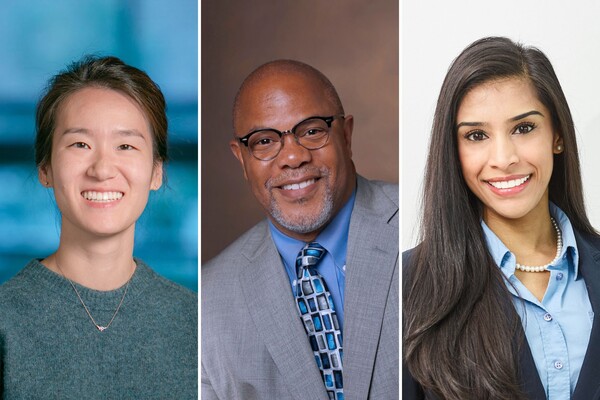
Jina Ko (left) and Kevin Johnson (middle), from both the School of Engineering and the Perelman School of Medicine, along with Sheila Shanmugan (right) from the latter, have received the National Institute of Health Director’s Award to support their “highly innovative and broadly impactful” research projects through the High-Risk, High-Reward program.
no cred
Three from Penn receive NIH Director Award
Kevin B. Johnson, Jina Ko, and Sheila Shanmugan awarded NIH Common Fund’s High-Risk, High-Reward Research program.
Susan Wachter, of the Wharton School and the Penn Institute for Urban Research, co-hosts the monthly webinar with William Glasgall, a Penn IUR Fellow, featuring panel discussions about the COVID-19 pandemic’s fiscal effects on cities and states. Penn Today spoke with Wachter and Glasgall about the latest episode, which explores effects of the Federal Reserve’s interest rate hikes.
(Image: iStock / Dilok Klaisataporn)
Recession or soft landing?
Susan Wachter and William Glasgall of the Penn Institute for Urban Research discuss key takeaways from their webinar on interest rate increases by the Federal Reserve.
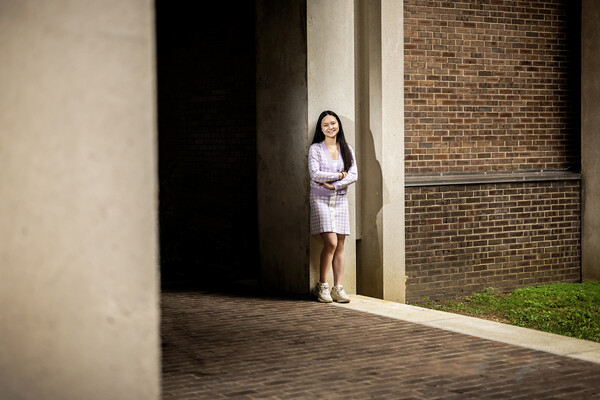
Mentored by Vijay Balasubramanian of the School of Arts & Sciences, third-year Lily Wei spent the summer deciphering how the brain recognizes auditory objects.
(Image: Eric Sucar)
Decoding acoustic objects
Third-year student Lily Wei spent the summer conducting research in the lab of Vijay Balasubramanian using algorithms to propose how the brain may recognize acoustic objects.
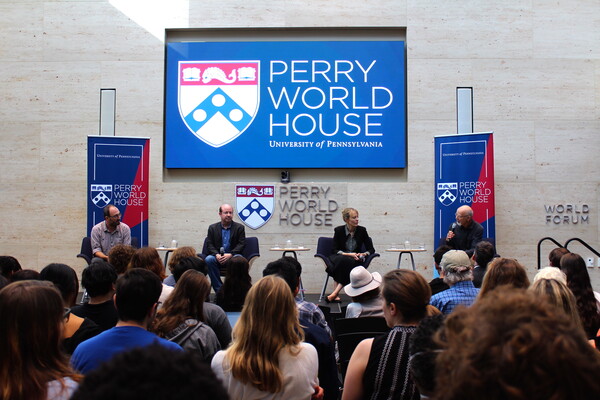
From left: Erol Akçay, associate professor of biology in the School of Arts & Sciences; Michael Mann, Presidential Distinguished Professor in the Department of Earth and Environmental Science in the School of Arts & Sciences, with a secondary appointment in the Annenberg School for Communication; Zinta Zommers, humanitarian affairs officer with the United Nations Office for the Coordination of Humanitarian Affairs and served as the Wolk Visiting Fellow (2021-22) and a Visiting Fellow (2022-23) at the Perry World House; and Simon Richter, professor of Germanic languages and literatures, a Perry World House faculty fellow, a faculty fellow of Penn Institute of Urban Research, and a faculty advisory board member of the Water Center at Penn.
(Image: Courtesy of Gabrielle Szcepanek)
The crisis of climate-driven extinction
In a session moderated by Simon Richter, panelists Erol Akçay, Michael Mann, and Zinta Zommers discussed the impact of climate change on efforts to conserve biological diversity.
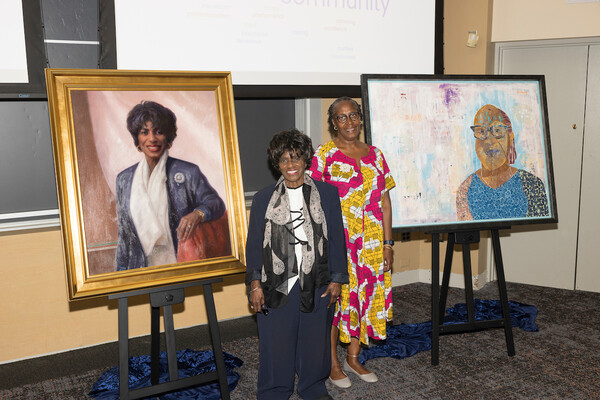
Engineering changemakers: Honoring Cora Ingrum and Donna Hampton
Sharing a legacy of leadership and decades of service in Penn Engineering’s Office of Diversity, Equity, and Inclusion, Cora Ingrum and Donna Hampton had a transformative impact on academic life at the school.
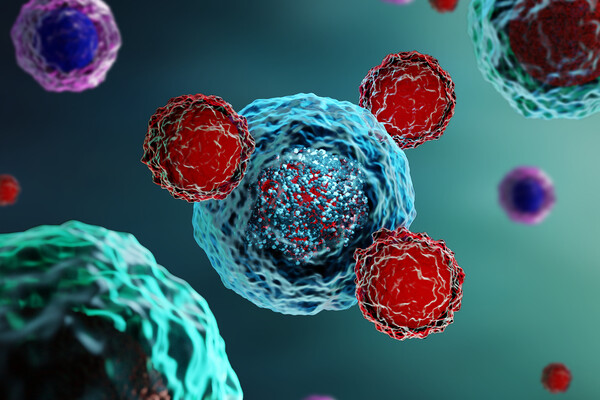
Chimeric antigen receptor T cell (CAR T) therapy has delivered promising results, transforming the fight against various forms of cancer, but for many, the therapy comes with severe and potentially lethal side effects. Now, a research team led by Michael Mitchell of the School of Engineering and Applied Science has found a solution that could help CAR T therapies reach their full potential while minimizing severe side effects.
(Image: iStock / Meletios Verras)
A suit of armor for cancer-fighting cells
New research from the University of Pennsylvania offers a safer path for CAR T cell immunotherapy.
This summer, Eleni Katifori and Arnold Mathijssen of the School of Arts & Sciences organized a weeklong summer program in Crete where students from Penn and other institutions could network about topics and ideas in active biophysics research.
(image: Courtesy of Eleni Katifori)
Biophysics summer school in Crete
Eleni Katifori and Arnold Mathijssen spent a week in Crete, introducing students from Penn and other institutes to various topics and ideas in active biophysics research.