Recession or soft landing? The impact of interest rate hikes on states and cities
Susan Wachter and William Glasgall of the Penn Institute for Urban Research discuss key takeaways from their webinar on interest rate increases by the Federal Reserve.
Susan Wachter, of the Wharton School and the Penn Institute for Urban Research, co-hosts the monthly webinar with William Glasgall, a Penn IUR Fellow, featuring panel discussions about the COVID-19 pandemic’s fiscal effects on cities and states. Penn Today spoke with Wachter and Glasgall about the latest episode, which explores effects of the Federal Reserve’s interest rate hikes.
(Image: iStock / Dilok Klaisataporn)
In response to effects of the COVID-19 pandemic, the Federal Reserve last year began raising interest rates to slow the economy and cool inflation. In an intricate dance of economic policies, the Fed’s strategies on inflation remain the pivot around which the U.S. economy turns.
This seemingly precarious position raises a pertinent question: Will the Fed’s maneuvers induce an impending recession or facilitate the much-anticipated soft landing? This question is not only vital at the national level but has profound implications for our states and localities, according to Penn experts.
The panel included Zac Jackson, Indiana budget director; Eric Kim, senior director, Fitch Ratings; Torsten Slok, chief economist, Apollo Global Management; Matthew Stitt, director and national lead for equitable recovery and strategic financial initiatives, PFM’s Management and Budget Consulting team; and Kate Watkins, president and chief economist, Bright Fox Analytics. Penn Today spoke with Wachter and Glasgall to explore key takeaways from the discussion.
The term ‘soft landing’ is tricky
“From the discussion it seems one thing is clear: we don’t really know what a soft landing is, because there isn’t a clear definition of a soft landing,” says Glasgall. “Whether it’s hard, softish, or what have you, a landing is a landing.”
If economic growth slows down sufficiently, he says, the expectation is that a recession can be avoided. However, if the gross domestic product (GDP) settles at slow growth, it would be better than no growth, he says, because if no growth occurs, then the situation becomes increasingly precarious, and could, at some point later on, result in a recession.
“With the notable exception of the COVID-19-linked recession—where much of the U.S. economy was shut down and state and local tax and fee revenue was affected immediately—changes in state and municipal revenue generally trail fluctuations in national GDP by about a year,” Glasgall says.
“Our panel pointed out something quite interesting about the mechanics of these lags following Fed policy,” says Wachter. “Torsten Slok predicts the maximum negative impact of rate hikes will be felt in four fiscal quarters. But given that the Fed has been continuously raising rates for the last 18 months, we’re going to continue to see the economy negatively impacted.”
Wachter notes that state budget directors pay close attention to leading indicators like tax revenues from sales tax, which is a concurrent indicator that signals a recession is looming.
“So, you might expect revenues to continue their modest weakening trend into 2024 before later recovering in 2025 to 2026,” Glasgall adds.
Glasgall also says that what sets this cycle apart from earlier ones is that most states and cities went into the current fiscal year with reserves—rainy day funds and general fund balances—at or near record highs. Those reserves put them in much better positions to weather disruptions in revenues than they were when the Great Recession hit in 2007.
Why state and local governments matter in the bigger picture
Glasgall notes that in 2022, about 20 million people (about the population of New York state) were employed by state and local governments in the U.S., with three-quarters representing local, and one-quarter state. To put that figure into perspective, he adds that this number represents about 13% of non-farm employees—paid U.S. workers excluding farm employees, private household employees, active military, and employees of nonprofit organizations that provide assistance to individuals.
“These are people that work in governments both state and local,” Glasgall says. “And one of the reasons why the Great Recession took a long time to recover from is that states and localities were in bad shape, so it took years for their revenues to come back from that big hit in 2007.”
He adds that state and local government spending is about $4 trillion per year in a $21 trillion economy, about 20% of the GDP, “so, it’s a very important sector of the economy to pay attention to.”
Some of the ways local and state governments plan ahead
Glasgall explains that state and local governments have their own economists and forecasters, and they may buy forecasts from companies like Moody;s Analytics. Following discussions at revenue-estimating conferences, he says, they project earnings that are subject to minor tweaks for a given period of time.
Wachter cites Jackson’s description of work he has done preparing Indiana’s budget, saying, “They budget for the year but hold back 2%, which can only to be given at the end of that year if all goes as planned. If they feel revenues are decreasing, they hold back expenditures.” She adds that although they adjust the budget and spending throughout the year, it’s impossible to perfectly predict what comes next, as there are delays.
“And saying, ‘adjust the budget down,’ sounds easy, but of course, it’s painful,” Wachter says. “So, in many instances, recession follows; and if it’s a significant one, this brings city and statewide cut-backs that could lead to job loss, and that’s quite painful.”
She does stress, however, that cities and states, like Indiana, have learned to be cautious since the Great Recession and have developed tools such as formal and informal reserves. As an example of the informal reserves, Glasgall cites how some cities and states may postpone massive projects, especially those with large capital investments, like a new road, bridge, or even large-scale infrastructure maintenance.
Both Wachter and Glasgall hark back to the idea that despite the confusion surrounding macroeconomic trends, cities and state economists are more prepared to weather the coming storms than they were for the Great Recession.
Susan Wachter is the Albert Sussman Professor of Real Estate and Professor of Finance in the Wharton School at the University of Pennsylvania and co-director of the Penn Institute for Urban Research.
William Glasgall is senior director of public finance at the Volcker Alliance and a Penn IUR Fellow.
On the move: Water quality and antimicrobial resistance testing goes mobile
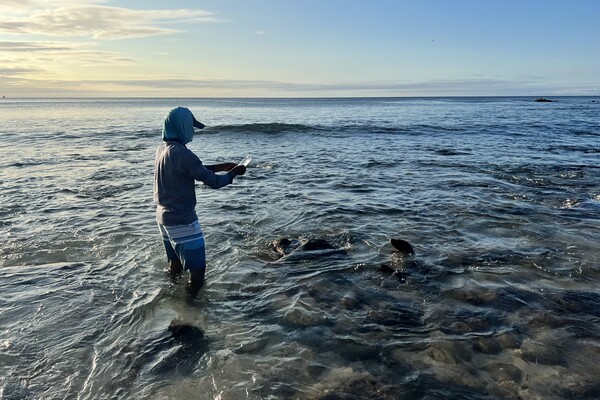
Penn researchers have developed a mobile field laboratory allowing them to test water quality and track antimicrobial resistance in and around San Cristóbal in the Galápagos.
Penn researchers Vanessa and Alexis North are studying one of the largest collections of Egyptian blue objects ever found in the ancient Near East, shedding new light on how the world’s first synthetic pigment may have traveled far beyond Egypt.
A new role for dental providers? Rethinking where vaccines are given
Vaccinations have traditionally been administered in primary care settings or pharmacies. However, for about a decade, some states have authorized dentists to administer vaccines, and many others did so during the COVID-19 pandemic. The effectiveness of this approach has led some countries and states to expand or consider expanding the role of dental providers in delivering routine vaccines, including those against COVID-19 and the human papillomavirus (HPV), and in providing vaccine education.
Penn student develops a way for computer chips to run more efficiently
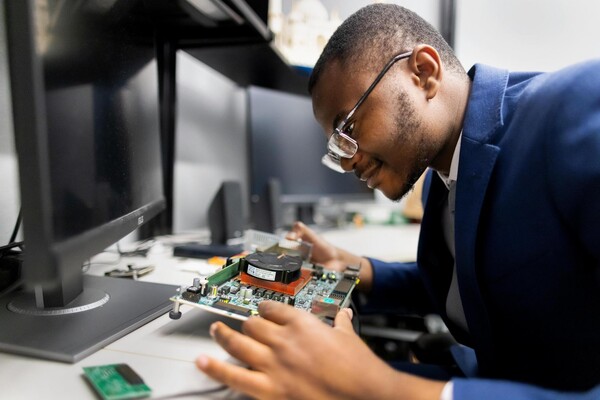
Fluid Silicon, a platform from President’s Sustainability Prize winner Nhlanhla Mavuso, allows computer chips to continuously monitor their health and self-tune as their characteristics change. The technology has the potential to reduce energy usage in data centers and improve reliability in mission-critical applications.