From wind ripples to tides the size of the planet, physicist Arnold Mathijssen explains what’s really rolling towards the shore.
3 min. read
Arnold Mathijssen is an assistant professor whose group explores the physics of life by combining experiments and theory across the disciplines of biological physics, soft matter, and fluid and statistical mechanics. He is also involved with Penn’s Center for Soft and Living Matter.
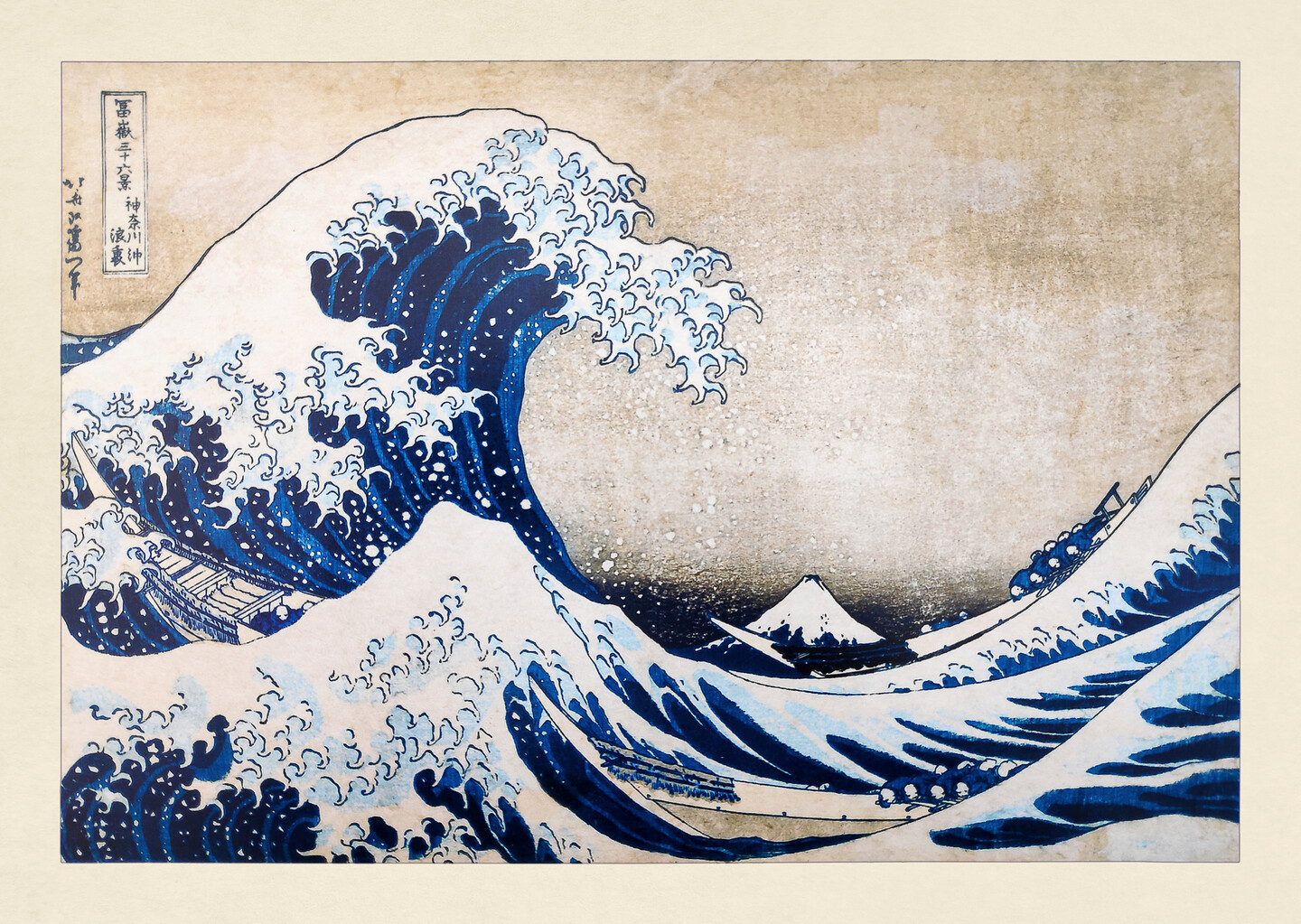
From Katsushika Hokusai’s print “The Great Wave off Kanagawa” to Otis Redding’s song “(Sittin’ On) The Dock of the Bay,” watching the tide roll away has long been a mainstay for beachgoers, inspiring timeless works of art.
But beyond the sea’s artistic allure, the motion of the ocean “has supplied science an equally generous source of inspiration,” says Arnold Mathijssen, an assistant professor in the Department of Physics and Astronomy in the School of Arts & Sciences whose lab studies fluid dynamics and how creatures move through liquids.
RELATED
“For example,” Mathijssen says, “when Isaac Newton published the Principia in 1687, he used the rise and fall of the ocean as evidence that a single force governed both falling objects on Earth and bodies in space. The tides, Newton showed, are the moon and the sun pulling on the water by gravity.”
“What’s great about the beach is that it is often viewed as a place for simple relaxation, but it’s also actually a massive, open-air laboratory of everyday physics,” he adds. “From planetary-scale energy to the microscopic mechanics of glowing cells, the shore reveals the hidden machinery of our world.”
Small, big, and planet-sized
There are four major kinds of waves at any beach, Mathijssen says, and they scale.
Wind waves come first, driven directly by air currents, ranging from ripples to storm chop. Above them sit swell waves, which can travel for thousands of miles. Swells are predictable, which is why buoys and phone apps can alert surfers that a good one is inbound. Swells arriving from different directions combine and produce a “rogue wave”—like the one in the famous Hokusai print—far taller than either is on its own.
Illustration of the “The Great Wave of Kangawa” by Katsushika Hokusai published on December 1st, 1884 in the monthly magazine “Paris illustré.”
(Image: Gwengoat/iStock)
Third are tsunamis, each of which packs enormous energy into a single wave whose wavelength can run for miles, which is why it goes almost unnoticed in deep water.
And then there are the tides, which are “basically waves that are the size of our planet,” Mathijssen says. The moon does most of the pulling, and the sun adds to it, raising two crests that sweep around the globe as Earth rotates underneath. The wavelength is roughly the diameter of the planet.
Waves can’t be stopped, only talked down
“You can deflect them, you can divert them, you can reduce impact,” Mathijssen says. “But you can’t really break a wave.”
Breakwaters work by making waves break early, transferring energy into friction and eddies before a wave reaches shore, he explains. But those eddies can still cause damage. Similarly, the deflected energy from seawalls often results in erosion further down the coast.
“The best wave-breakers are the ones nature made: reefs and coastal vegetation,” he notes. “They are actually incredibly effective at breaking this energy, which makes coral bleaching a coastal engineering problem as much as an ecological one.”
The wave is not the water
The actual water isn’t traveling, because water particles are going in circles, Mathijssen says. What travels is energy. And those circles don’t quite close either—each orbit ends a small distance from where it started, so anything floating creeps shoreward at about 1% of the wave’s speed. This is called Stokes drift.
“It’s also why plastic pollution sorts itself by size,” Mathijssen adds. “A big gallon jug of milk will come towards the beach, and you can clean it up, because the Stokes drift effect increases with the size of the floating object. Break it down a bunch, and the drift weakens. Microplastics stay out at sea, dispersed and far harder to collect.”
The surf that glows
Swim after sunset at the Jersey shore in August or September and, with some luck, the water sparkles wherever it is disturbed.
The source is a dinoflagellate, often Noctiluca scintillans—“scintillans, as in scintillating,” Mathijssen says. “It’s a very nice name.”
Inside are luciferin and luciferase, the same compound and enzyme that light fireflies. The trigger is mechanical: stretch the cell membrane with a breaking wave, a passing fish, or a hand, and mechanosensitive ion channels pull open, calcium floods in, and a biochemical cascade fires off a flash.
On the move: Water quality and antimicrobial resistance testing goes mobile
Penn researchers have developed a mobile field laboratory allowing them to test water quality and track antimicrobial resistance in and around San Cristóbal in the Galápagos.
Penn researchers Vanessa and Alexis North are studying one of the largest collections of Egyptian blue objects ever found in the ancient Near East, shedding new light on how the world’s first synthetic pigment may have traveled far beyond Egypt.
A new role for dental providers? Rethinking where vaccines are given
Vaccinations have traditionally been administered in primary care settings or pharmacies. However, for about a decade, some states have authorized dentists to administer vaccines, and many others did so during the COVID-19 pandemic. The effectiveness of this approach has led some countries and states to expand or consider expanding the role of dental providers in delivering routine vaccines, including those against COVID-19 and the human papillomavirus (HPV), and in providing vaccine education.
Penn student develops a way for computer chips to run more efficiently
Fluid Silicon, a platform from President’s Sustainability Prize winner Nhlanhla Mavuso, allows computer chips to continuously monitor their health and self-tune as their characteristics change. The technology has the potential to reduce energy usage in data centers and improve reliability in mission-critical applications.