Nader Engheta is the H. Nedwill Ramsey Professor in the Department of Electrical and Systems Engineering in the School of Engineering and Applied Science, with secondary appointments in Penn Engineering’s Departments of Bioengineering and Materials Science and Engineering and in the Department of Physics and Astronomy in the School of Arts & Sciences.
“Sunlight is a wave as well: an electromagnetic one, streaming 93 million miles to reach us. Unlike other waves, light doesn’t need a medium,” he says.
What sets electromagnetic waves apart is frequency: how many times per second the wave cycles. Human eyes register just one narrow band of those frequencies, the visible spectrum, while the rest streams past unnoticed—which is also why the same wave can breeze through one material and bounce off another.
Engheta demonstrates this in lectures by having students picture their phone’s flashlight aimed at a wall. The light doesn’t go through the wall, whereas an incoming call will. “Same kind of wave, different frequency,” he says. “The wall blocks visible light but lets longer, lower-frequency signals slip through.”
When a light wave strikes skin, the sand, or a beach umbrella, it jostles the charged particles inside, setting them into motion. That motion quickly randomizes, Engheta says, “and that randomized motion of charged particles is what we call heat.”
The same principle powers a microwave oven. “The microwave never delivers heat; it just delivers energy that becomes heat once matter gets in the way,” he says. “Your skin at the beach works the exact same way!”
Red sky at night, a scattered light
“There is a question every child asks but few adults can fully answer: ‘Why is the sky blue?’” Engheta chuckles. The answer lies in the composition of the atmosphere: molecules far tinier than the wavelength of light.
White sunlight is a mixture of all colors, but they don’t behave the same. When sunlight hits those atmospheric molecules around midday, the white light from the sun experiences Rayleigh scattering, wherein shorter wavelengths (blues) scatter far more than longer ones (reds).
The same science paints the colors of a sunset, Engheta explains. Near dusk, the sun sits low at the horizon, and so its light must plow through far more atmosphere to reach the human eye. Along that long path, the blue scatters away entirely, leaving the reds, pinks, and oranges.
By dusk, sunlight is cutting through so much more atmosphere that its shorter blue wavelengths have scattered away entirely, leaving only the reds and oranges. This phenomenon is called Rayleigh scattering, the scattering of light by particles much smaller than its wavelength, which favors blue over red.
(Image: somnuk krobkum via Getty Images)
Why a polarized worldview can let humans ‘see’ more
An electromagnetic wave, Engheta explains, is really a synchronized oscillation of electric and magnetic fields. The electric field is a vector, “meaning it points in a direction as it vibrates, whether up and down, side to side, or at an angle,” he says. That orientation is called polarization.
Sunlight arrives unpolarized—a jumble of every direction all at once because it’s generated by countless electrons jittering randomly in the roughly 10,000° Fahrenheit surface of the sun. Something changes, though, when that light reflects off a flat surface like water. Waves polarized parallel to the surface reflect more strongly than those polarized perpendicular to it, giving the shimmering glare bouncing off a calm sea a horizontal orientation. Polarized sunglasses stop glare by absorbing horizontally polarized light and passing the rest.
“By blocking that horizontal glare, you get an incredible payoff,” Engheta says. “You don’t just stop the squinting; you can actually see straight through the surface of the water. If you’re out fishing, the fish swimming underneath suddenly pop into view, because the light scattered back from them is no longer drowned out by the blinding reflection of the sky.”
Fishy findings about light hidden geometry
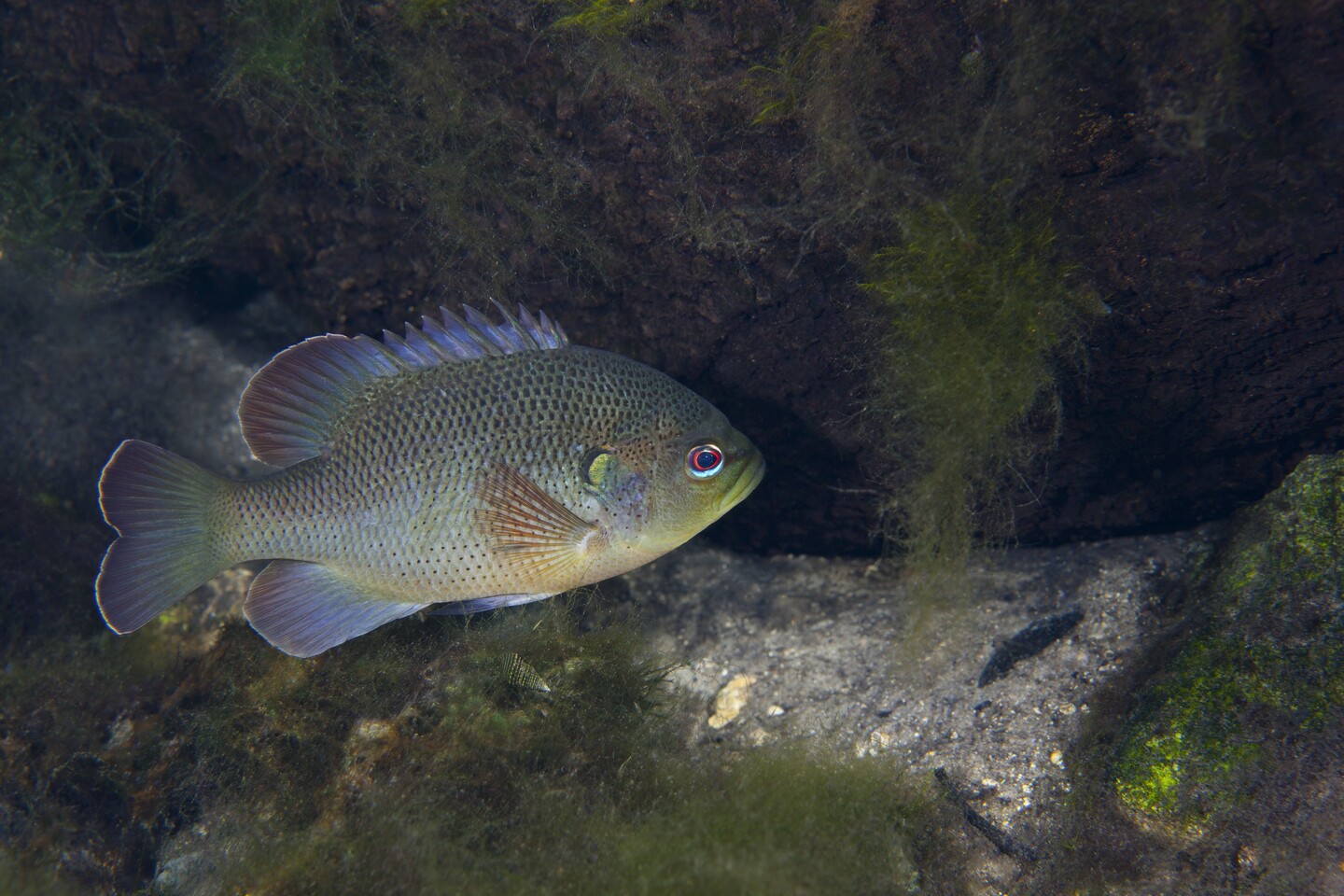
Unlike humans, many marine species can detect polarized light. For example, he says, octopuses can flash high-definition, polarized communication signals that are invisible to predators. Engheta knows a surprising amount about how fish see due to a collaborative, decade-long partnership with the Department of Psychology.
It began when Edward Pugh, a former Penn neuroscientist, presented Engheta with a microscope picture of a green sunfish retina and a hunch about how the fish hunted. Looking at the fish’s specialized double photoreceptor cones, Pugh and Engheta realized they behaved exactly like tiny graded-index waveguides — the same physical mechanism used in designing optical fibers. Together, they published models showing it was plausible that their eyes were mathematically optimized to detect different polarizations of light.
The green sunfish’s double photoreceptor cones behave like tiny graded-index waveguides, mathematically tuned to detect different polarizations of light. This structure sent former Penn neuroscientist Edward Pugh to Nader Engheta’s lab, launching a decade-long collaboration on polarization vision.
(Image: Michael Wood/Stocktrek Images)
“Once we understood the biology, we asked: ‘Can we build a camera that mimics this unusual ability?’” Engheta says. They did, and in a test, their camera could see three to four times deeper in murky water than a standard camera.
Beyond the ocean, creatures such as honeybees and the North African desert ant use the sky’s polarization to navigate.
The next clear day at the shore, Engheta suggests looking at the sky 90 degrees away from the sun, where the polarization is strongest: toward the horizon if the sun is overhead, or straight up near sunrise or sunset. Hold up your polarized sunglasses, rotate them, and watch the brightness shift. That flicker is the sky’s polarization map.
One rule, Engheta adds: “Never look directly at the sun.”
On the move: Water quality and antimicrobial resistance testing goes mobile
Penn researchers have developed a mobile field laboratory allowing them to test water quality and track antimicrobial resistance in and around San Cristóbal in the Galápagos.
Penn researchers Vanessa and Alexis North are studying one of the largest collections of Egyptian blue objects ever found in the ancient Near East, shedding new light on how the world’s first synthetic pigment may have traveled far beyond Egypt.
A new role for dental providers? Rethinking where vaccines are given
Vaccinations have traditionally been administered in primary care settings or pharmacies. However, for about a decade, some states have authorized dentists to administer vaccines, and many others did so during the COVID-19 pandemic. The effectiveness of this approach has led some countries and states to expand or consider expanding the role of dental providers in delivering routine vaccines, including those against COVID-19 and the human papillomavirus (HPV), and in providing vaccine education.
Penn student develops a way for computer chips to run more efficiently
Fluid Silicon, a platform from President’s Sustainability Prize winner Nhlanhla Mavuso, allows computer chips to continuously monitor their health and self-tune as their characteristics change. The technology has the potential to reduce energy usage in data centers and improve reliability in mission-critical applications.