The impact of microplastics—and how to limit exposure
Microplastics researchers Samantha McBride and Derek Ho of Penn Engineering and Vijay Bhatia of the Philadelphia Water Department discuss how microplastics get into ecosystems and human bodies, offering practical ways to minimize exposure.
3 min. read
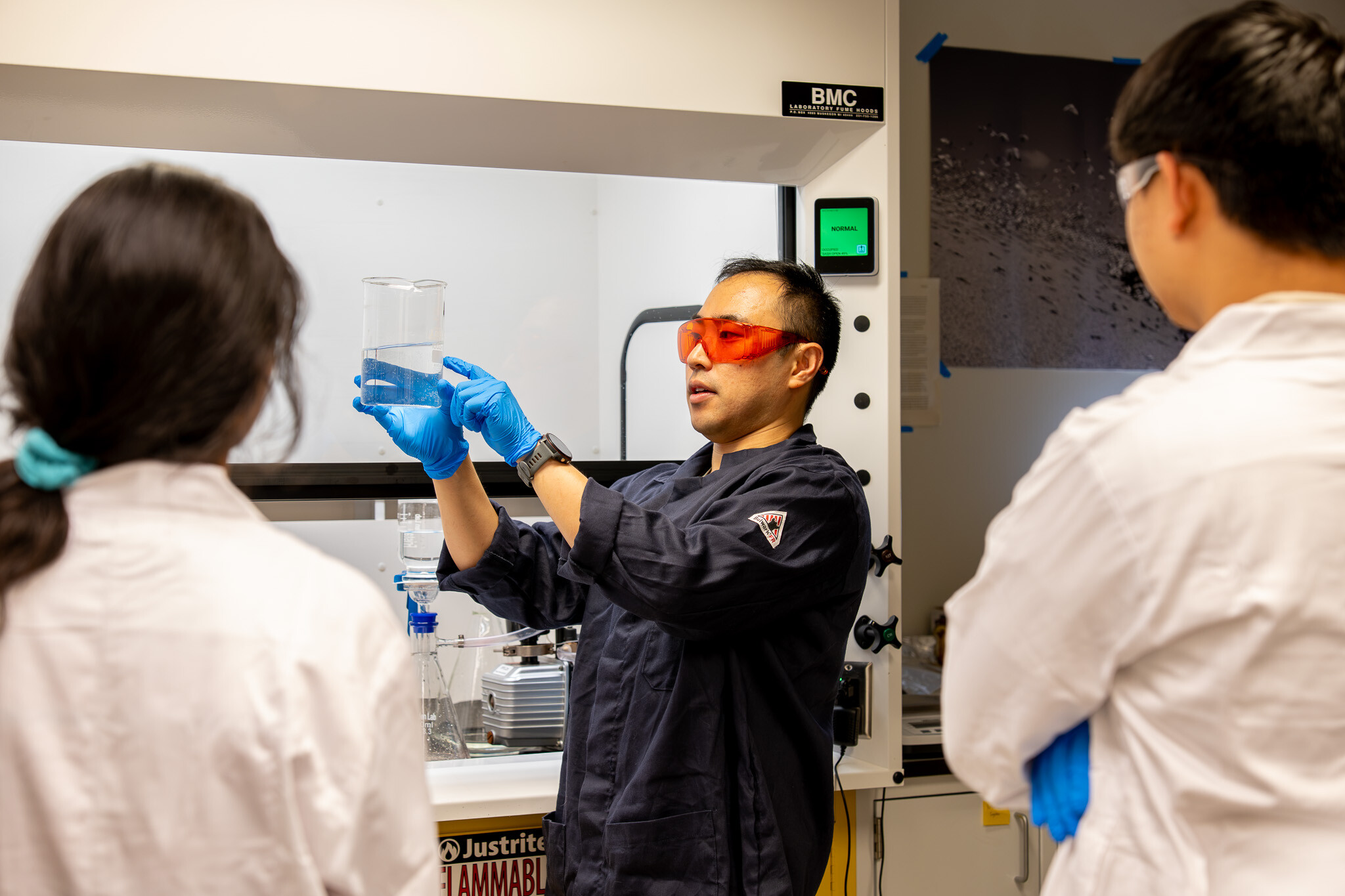
To better visualize microplastics, researchers in the McBride Lab at Penn Engineering use fluorescent dyes like Nile Red, which attach to plastics and make them glow under specific light. Environmental researcher Derek Ho developed a system used in their lab called the Fluorescent Imaging Microplastic Analysis Platform, or FIMAP. It uses machine learning to detect and identify plastic particles larger than about 20 microns in complex water samples.
(Image: Sylvia Zhang)
Sun, sand, and surf are the mainstays of a beach day. But something else now lingers along the coast and other outdoor spaces: bits of plastic broken down so small that scientists need special tools to see them.
These microplastics have been building up for decades. In some coastal sediments, plastic deposition has doubled roughly every 15 years since 1945. Microplastics end up in human blood, lungs, and placentas, and researchers are starting to tie them to real harm. One study linked plastics in artery plaque to a more than fourfold higher risk of heart attack, stroke, or death.
To better understand how these particles get into the environment and the human body and what can be done to reduce their impact, Penn Today spoke with Samantha McBride, the William K. Gemmill Term Assistant Professor of Mechanical Engineering in the School of Engineering and Applied Science; postdoctoral fellow Derek Ho, who studies microplastics in the McBride lab; and Vijay Bhatia, a microplastics researcher in the Philadelphia Water Department who has partnered with McBride’s lab to bring microplastics education to local high schools.
What are the most common sources of the microplastics found in marine environments?
McBride: It varies significantly from region to region. Our colleague, Rachael Miller, at the Rozalia Project has examined microplastics at a huge range of locations to trace fragments back to their source, and she finds a lot of particles that can be attributed directly to local pollution: fragments from beach toys or swimsuits where people swim, from consumer products in heavily polluted areas, and from fishing gear where fishing is big.
There’s some global redistribution, too, but for the most part they’re attributable to the plastics in the immediate environment.
How do marine life and microorganisms end up ingesting plastics, and how do they then travel up the food chain?
McBride: There are certainly accounts of fish and birds eating larger plastic fragments because they look like colorful, shiny little fish. I imagine it’s similar for smaller organisms encountering microplastics, and of course filter feeders will accumulate any particle of a certain size.
Larger plastics are likely to pass through the digestive tract without bioaccumulating, whereas smaller pieces can cross intestinal barriers and end up in fat stores. Once there, they stay.
When a larger organism eats a smaller organism, those microplastics transfer to its fat stores, and so on up to humans. The higher up the food chain you go, the more microplastics we’d expect to find
Microplastics don’t travel alone. What kinds of things are hitchhiking on these particles, and does that change how worried we should be about exposure?
Bhatia: Researchers have found that microplastics attract and transport bacteria, viruses, heavy metals, PFAS (per- and polyfluoroalkyl substances also known as ‘forever chemicals’), pesticides, pharmaceuticals, and industrial chemicals.
These hitchhikers can make microplastics more persistent and sometimes more harmful than the particles alone. Understanding them helps us ask better questions. It shifts the focus from counting particles to understanding their chemistry, their ecology, and their interactions with human biology.
What are the most promising methods for detecting microplastics?
Ho: The most accurate methods for detecting microplastics work well in the lab, but they are slow, expensive, and require a lot of sample preparation. This is because microplastics are spread out in very low concentrations in the environment, so scientists first need to filter and process large volumes of water before analysis can even begin.
There is a strong need for faster and simpler tools that can be used outside the lab and at much larger scales. One promising approach uses fluorescent dyes like Nile Red, which attach to plastics and make them glow under specific light.
I developed a system we use in our lab called the Fluorescent Imaging Microplastic Analysis Platform, or FIMAP. It uses this idea along with machine learning to detect and identify plastic particles larger than about 20 microns in complex water samples. We hope to make this type of technology more accessible by adapting it for use with standard microscopes and even smartphones.
What can individuals do to reduce the amount of microplastic in the water they’re drinking?
Bhatia: Home filtering can reduce microplastics, but research has shown that only filters that physically remove particles especially those below ~5 microns—make a real difference. Activated carbon pitchers help a little; under-sink filters and reverse osmosis systems help a lot.
And the most overlooked step is reducing the microplastics already present in your home’s air and dust, which often contribute more to your total exposure than tap water.
A few don’ts:
Avoid single-use coffee cups, especially for hot drinks; those paper cups have a plastic liner.
Avoid single-use plastic bottles and aluminum cans whenever possible. If you do have to use them, try to minimize sloshing and keep them out of the heat.
Avoid plastic takeout containers.
Don’t heat food in plastic containers in the microwave, even if the label says microwave safe.
And most of all, don’t litter.
And a few dos:
Wear natural fibers when you can.
Eat plenty of high-fiber vegetables, which can help move particles through the digestive tract, reducing their absorption.
Use a metal tea strainer with loose, bulk tea rather than nylon tea bags.
Wash synthetic clothing in cold water, use a microfiber-catching laundry bag, and vacuum and dust regularly.
Derek Ho is a postdoctoral researcher in the McBride Lab at Penn Engineering.
Vijay Bhatia is a microplastics researcher with the Microplastics Analytical Services Laboratory at the Bureau of Laboratory Services in the Philadelphia Water Department.
On the move: Water quality and antimicrobial resistance testing goes mobile
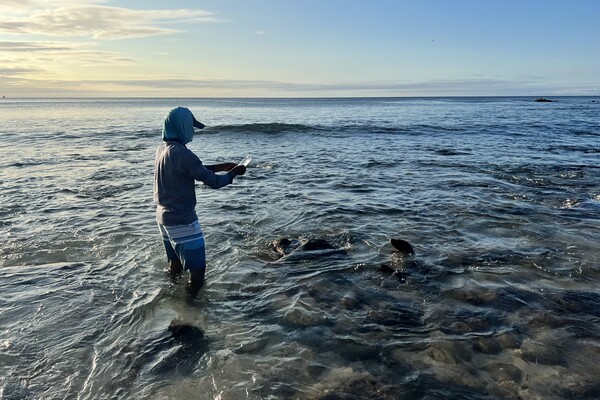
Penn researchers have developed a mobile field laboratory allowing them to test water quality and track antimicrobial resistance in and around San Cristóbal in the Galápagos.
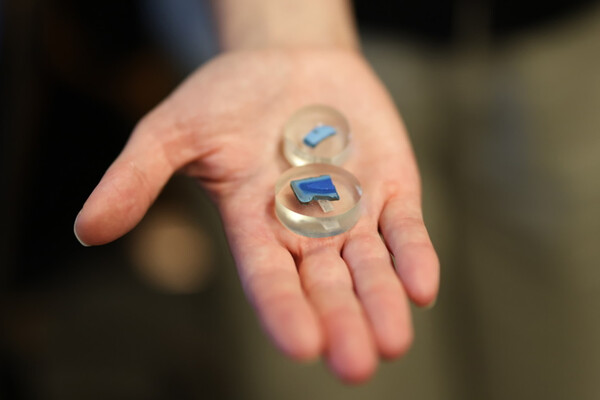
Penn researchers Vanessa and Alexis North are studying one of the largest collections of Egyptian blue objects ever found in the ancient Near East, shedding new light on how the world’s first synthetic pigment may have traveled far beyond Egypt.
A new role for dental providers? Rethinking where vaccines are given
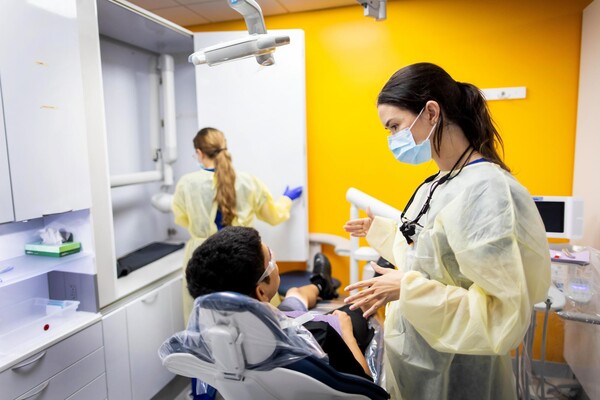
Vaccinations have traditionally been administered in primary care settings or pharmacies. However, for about a decade, some states have authorized dentists to administer vaccines, and many others did so during the COVID-19 pandemic. The effectiveness of this approach has led some countries and states to expand or consider expanding the role of dental providers in delivering routine vaccines, including those against COVID-19 and the human papillomavirus (HPV), and in providing vaccine education.
Penn student develops a way for computer chips to run more efficiently
Fluid Silicon, a platform from President’s Sustainability Prize winner Nhlanhla Mavuso, allows computer chips to continuously monitor their health and self-tune as their characteristics change. The technology has the potential to reduce energy usage in data centers and improve reliability in mission-critical applications.