Leveraging principles of quantum mechanics to securely transmit messages has promised a revolution in encryption, keeping sensitive information secure. Now, a collaborative team of researchers including the School of Engineering and Applied Science’s Liang Feng and Ph.D. candidate Yichi Zhang have developed a system that enables more stable, robust, high-efficiency, and long-range quantum communication—paving the way for practical, high-dimensional quantum networks.
(Image: Courtesy of Jian Fan)
Quantum communications
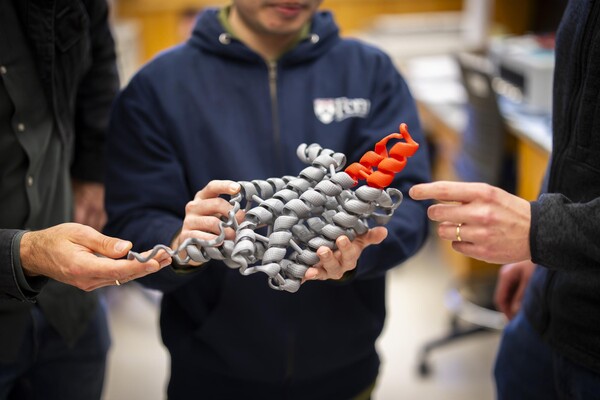
Penn and CUNY researchers collaborated to develop a device that uses quantum principles to relay information securely—an advance that could improve encryption in critical service areas like banking and health care.
In Senegal, the ambitious Dakar Greenbelt project seeks to create an extensive network of ecological infrastructure in and around the city to sustainably address environmental concerns and enhance urban life. With support from David Gouverneur and Ellen Neises, Ph.D. candidate Rob Levinthal in the Weitzman School of Design led two courses that included a field trip to Dakar, that culminated in students presenting their visions for parts of the Greenbelt.
(Image: Courtesy of Chaowu Li)
Turning the desert into an oasis
Students from the Weitzman School of Design journeyed to Senegal to help with a massive ecological and infrastructural greening effort as part of their coursework. The Dakar Greenbelt aims to combat desertification and promote sustainable urban growth.
Cells are dynamic, fast-changing, complex, tiny, and often hard-to-see in environments that don’t always behave in predictable ways when exposed to external stimuli. Now, researchers led by Lukasz Bugaj of the School of Engineering and Applied Science have found new ways to modulate cell activity remotely.
(Image: iStock/Maksim Tkachenko)
New ways to modulate cell activity remotely
Penn researchers use temperature to guide cellular behavior, promising better diagnostics and targeted therapies.
Researchers combined cosmological data from two major surveys of the universe’s evolutionary history and found that it may have become “messier and complicated” than expected in recent years.
The University’s nexus for technology transfer supports researchers in their innovative efforts, from CAR T to mRNA advancements that have dramatically reshaped the world.
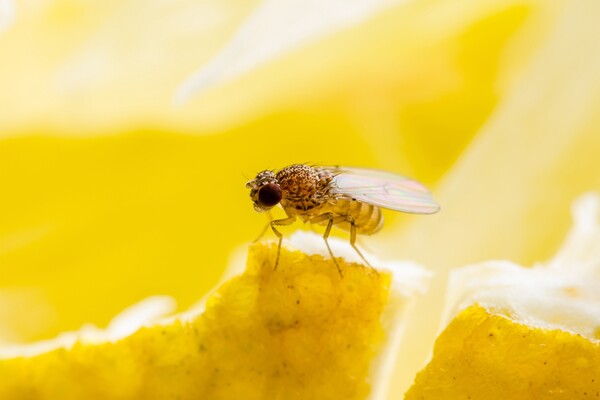
Drosophila melanogaster, the fruit fly, has long been a model species for biologists seeking to understand the molecular mechanisms of animal function and how novelty may arise in organisms. Theoretical physicist Andrea Liu of the School of Arts & Sciences is conducting research on the insect, along with biology and experimental biophysics collaborators at Duke University. Their research has opened the door to an approach that could offer not only a new understanding of how biological function emerges but also suggest a new class of systems in condensed matter physics.
(Image: iStock / nechaev-kon)
Fruit fly development offers insights into condensed matter physics
Penn Physicist Andrea Liu and collaborators modeled the behavior of tissue during a stage of fly development and found, surprisingly, it doesn’t fluidize as it shrinks but stays solid. Their approach could offer insights physical systems with complex functionality.
For more than a month, residents in New Jersey, parts of Pennsylvania, and New York have spotted unidentified flying objects, which local residents refer to as “drones,” hovering over neighborhoods, critical infrastructure and even restricted sites. To learn more about the mysterious flying objects, Penn Today spoke with local expert Dean Vijay Kumar of the School of Engineering and Applied Science.
(Image: Courtesy of iStock/Naypong)
Q&A: Dean Kumar and the ‘drone’ sightings
Penn Engineering Dean Vijay Kumar discusses the mysterious flying objects, or “drones,” hovering around parts of the East Coast.
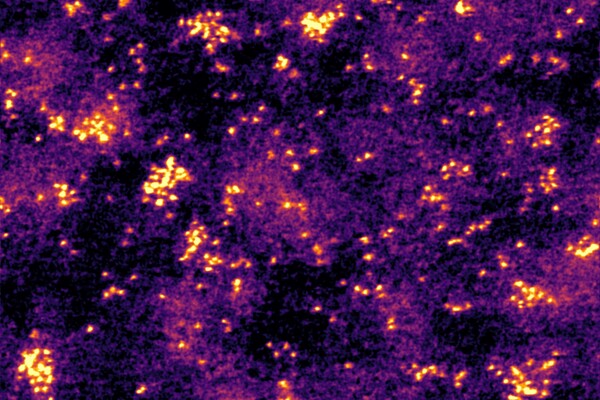
Eric Stach of the School of Engineering and Applied Science and colleagues used neural networks to better identify the characteristics of catalysts that drive the creation of liquid fuels from sunlight. Shown here: The arrangement of a catalyst molecule, as observed under cryogenic conditions. The bright spots represent individual or small groups of molecules immobilized on a surface and the cryogenic temperature helps minimize clustering caused by the electron beam during imaging, allowing scientists to study the molecule’s distribution more accurately.
(Image: Sungho Jeon)
Mapping molecular arrangements to pave the way for better catalytic systems
The Stach Group in Penn Engineering led a collaborative team identifying how chemical catalysts drive the creation of liquid fuels from sunlight, paving the way for more efficient removal of greenhouse gases from the atmosphere.
Penn researchers led a collaborative effort pioneering safer, more sustainable technique to extract elements critical to battery-powered technologies. Findings pave the way for getting value from materials that would otherwise be considered waste.