Mapping molecular arrangements to pave the way for better catalytic systems
The Stach Group in Penn Engineering led a collaborative team identifying how chemical catalysts drive the creation of liquid fuels from sunlight, paving the way for more efficient removal of greenhouse gases from the atmosphere.
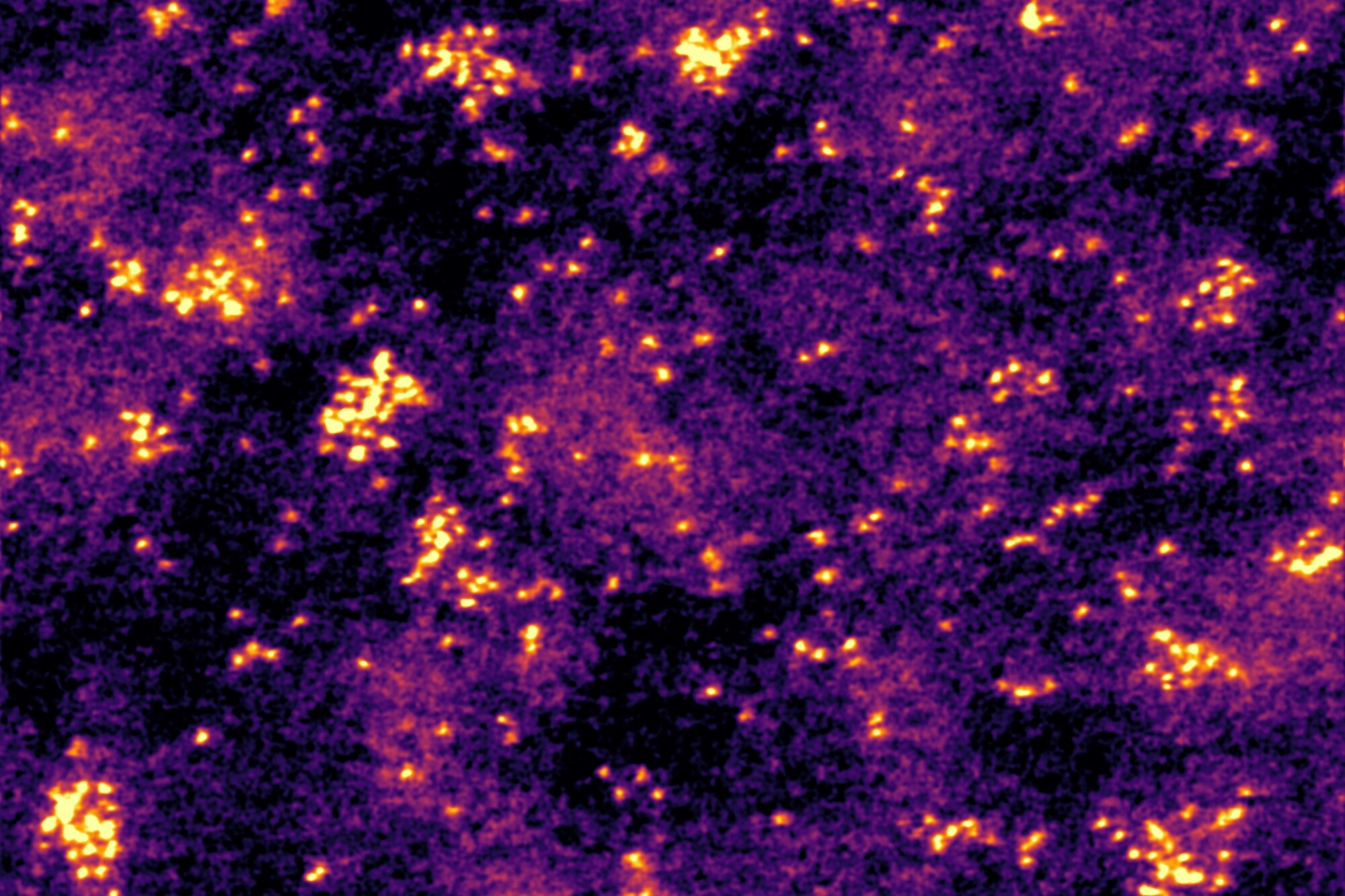
Eric Stach of the School of Engineering and Applied Science and colleagues used neural networks to better identify the characteristics of catalysts that drive the creation of liquid fuels from sunlight. Shown here: The arrangement of a catalyst molecule, as observed under cryogenic conditions. The bright spots represent individual or small groups of molecules immobilized on a surface and the cryogenic temperature helps minimize clustering caused by the electron beam during imaging, allowing scientists to study the molecule’s distribution more accurately.
(Image: Sungho Jeon)
“Imagine standing in a desert under a clear, starlit sky,” says Eric Stach, Robert D. Bent Professor of Engineering at the University of Pennsylvania. “With just your naked eye, you might spot the shimmering band of the Milky Way or the fuzzy glow of Andromeda. But without a telescope and other sophisticated tools, it’s nearly impossible to distinguish individual stars or truly understand their arrangement in the cosmos.”
Stach likens this experience to the challenge the team faced in trying to visualize molecular catalysts, the microscopic structures key to chemical reactions like converting carbon dioxide (CO₂) into usable fuels, on surfaces of semiconductor materials.
These catalysts, which contain heavy metal atoms, are scattered across surfaces in ways that are crucial to their performance, yet, like stars in the night sky, “their precise placement and clustering are difficult to discern with conventional techniques,” Stach says.
“The project brought together researchers with complementary expertise in imaging, molecular synthesis, catalysis, and surface chemistry,” says Jillian L. Dempsey of UNC. “The collaboration was essential for visualizing how individual catalysts are distributed across semiconductor photoelectrodes.”
By providing a new understanding of how molecular catalysts behave on semiconductor surfaces, the team’s findings pave the way for more efficient catalytic systems. Advances could accelerate developments in renewable energy technologies, such as CO₂ conversion and hydrogen production, and offer insights applicable to a wide range of industrial processes.
“The elegance of our approach really lies in a simple yet powerful idea,” says Sungho Jeon, a postdoctoral researcher in the Stach Group and co-first author of the paper. “If you want to correlate variables, like how molecular coverage and distribution influence catalyst performance, you first have to measure them accurately. Our work shows how to precisely and robustly measure surface coverage, quantify distributions, and see how changing conditions, like the type of molecule or functionalization process, alters those properties.”
Making an atomic map
The team used High-Angle Annular Dark-Field Scanning Transmission Electron Microscopy (HAADF-STEM) carried out at the Singh Center for Nanotechnology at Penn. This generates images with atomic-level resolution by highlighting the contrast between heavy atoms, such as rhenium or platinum, and their lighter surroundings. While techniques like HAADF-STEM provide extraordinary detail, they only capture small regions at a time and give researchers massive datasets that can be tricky to analyze manually.
“Enter Sungho’s convolutional neural networks (CNNs),” Stach says. “It’s a type of machine learning that excels at pattern recognition. Sungho trained CNNs to detect individual atoms in HAADF-STEM images, which let us see them to systematically map the surface coverage and distribution of catalysts across their supports.”
This allowed the researchers to not only quantify the number of immobilized molecules but also understand whether they were clustered, evenly spaced, or randomly scattered—insights critical for optimizing catalytic performance.
Why does this matter? The spatial arrangement of catalysts can dramatically influence their efficiency and selectivity. Molecules that are too densely packed might interfere with each other, reducing their effectiveness. Conversely, evenly dispersed catalysts can increase reaction rates and improve outcomes.
“Understanding these details is a game-changer,” says Stach. “It’s the first step toward designing catalytic systems with precision, tailoring their structure to enhance their function.”
Do not destroy
The team also overcame major practical hurdles, like the fragility of molecular catalysts under the intense electron beams used for imaging. They developed sample preparation methods and stabilization techniques to protect the molecules, ensuring the images accurately reflected real-world conditions.
Stach explains that there was an initial concern that the high-energy electrons would “destroy everything” upon impact, potentially “knocking atoms around like pinballs,” rendering the images unreliable and making it impossible to accurately determine their true arrangement. So, the researchers employed new sample preparation techniques, including backfilling the surface with stabilizing molecules to minimize electron beam damage.
“We had to convince ourselves—and reviewers—that what we were imaging was real and not an artifact of the imaging process,” says Stach. He notes that this ensured that the molecular catalysts’ true distribution was captured without distortion. Through this approach, the researchers uncovered distinct patterns in how catalysts interacted with their surfaces.
The researchers observed that some molecules, like the CO₂-reducing Re-Phen, tended to cluster, while others, such as the hydrogen-evolving Pt-Porph, exhibited more dispersed arrangements. These differences, they found, were influenced by variables such as the choice of attachment group and the functionalization process used to bond the molecules to the surface.
“This work would not have been possible without the combined expertise of researchers across institutions,” says Nilay Hazari of Yale. “Each team brought unique skills that enabled us to perform these imaging experiments. The superb instrumentation at Penn, in particular, was crucial to our success.”
The clustering of catalysts like Re-Phen was found to potentially hinder catalytic efficiency due to interactions between neighboring molecules, while dispersed arrangements optimized performance.
Looking ahead, the team is already exploring how this methodology can be adapted to study catalysts on more complex surfaces, such as “porous materials that offer greater surface area but pose additional imaging challenges,” Stach says. “We would’ve never bothered with something this tricky a couple of years ago, but the information we got from this paper’s already paying tremendous dividends in the preliminary data.”
Eric Stach is the Robert D. Bent Professor of Engineering in the Department of Materials Science and Engineering in the School of Engineering and Applied Science, director of the Laboratory for Research on the Structure of Matter, and scientific director of the Singh Center for Nanotechnology at the University of Pennsylvania.
Jillian Dempsey is the Bowman and Gordon Gray Distinguished Term Professor of Chemistry at the University of North Carolina at Chapel Hill.
Nilay Hazari is chair and the John Randolph Huffman Professor of Chemistry at Yale University.
Sungho Jeon is a postdoctoral researcher in the Stach Group at Penn Engineering.
Other authors include Jihoon Choi of Penn Engineering; Xiaofan Jia, James M. Mayer, Hannah S. Nedzbala and Adam J. Pearce of Yale University; Gabriella P. Bein, Carrie L. Donley, and Brittany L. Huffman of the University of North Carolina at Chapel Hill; and Hala Atallah and Felix N. Castellano of North Carolina State University.
This work was supported by the Department of Energy (award DESC0021173), the National Science Foundation (grant NNCI-2025608), the Laboratory for Research on the Structure of Matter (DMR-201720530 and 2309043), and the North Carolina Research Triangle Nanotechnology Network (RTNN) (ECCS-2025064), a member of the National Nanotechnology Coordinated Infrastructure (NNCI).
On the move: Water quality and antimicrobial resistance testing goes mobile
Penn researchers have developed a mobile field laboratory allowing them to test water quality and track antimicrobial resistance in and around San Cristóbal in the Galápagos.
Penn researchers Vanessa and Alexis North are studying one of the largest collections of Egyptian blue objects ever found in the ancient Near East, shedding new light on how the world’s first synthetic pigment may have traveled far beyond Egypt.
A new role for dental providers? Rethinking where vaccines are given
Vaccinations have traditionally been administered in primary care settings or pharmacies. However, for about a decade, some states have authorized dentists to administer vaccines, and many others did so during the COVID-19 pandemic. The effectiveness of this approach has led some countries and states to expand or consider expanding the role of dental providers in delivering routine vaccines, including those against COVID-19 and the human papillomavirus (HPV), and in providing vaccine education.
Penn student develops a way for computer chips to run more efficiently
Fluid Silicon, a platform from President’s Sustainability Prize winner Nhlanhla Mavuso, allows computer chips to continuously monitor their health and self-tune as their characteristics change. The technology has the potential to reduce energy usage in data centers and improve reliability in mission-critical applications.