In an ambitious new project, historian Simcha Gross and Harvard’s Rivka Elitzur-Leiman are studying hundreds of ancient incantation bowls housed at the Penn Museum. They hope to better understand the objects and eventually, build a database of all these bowls worldwide.
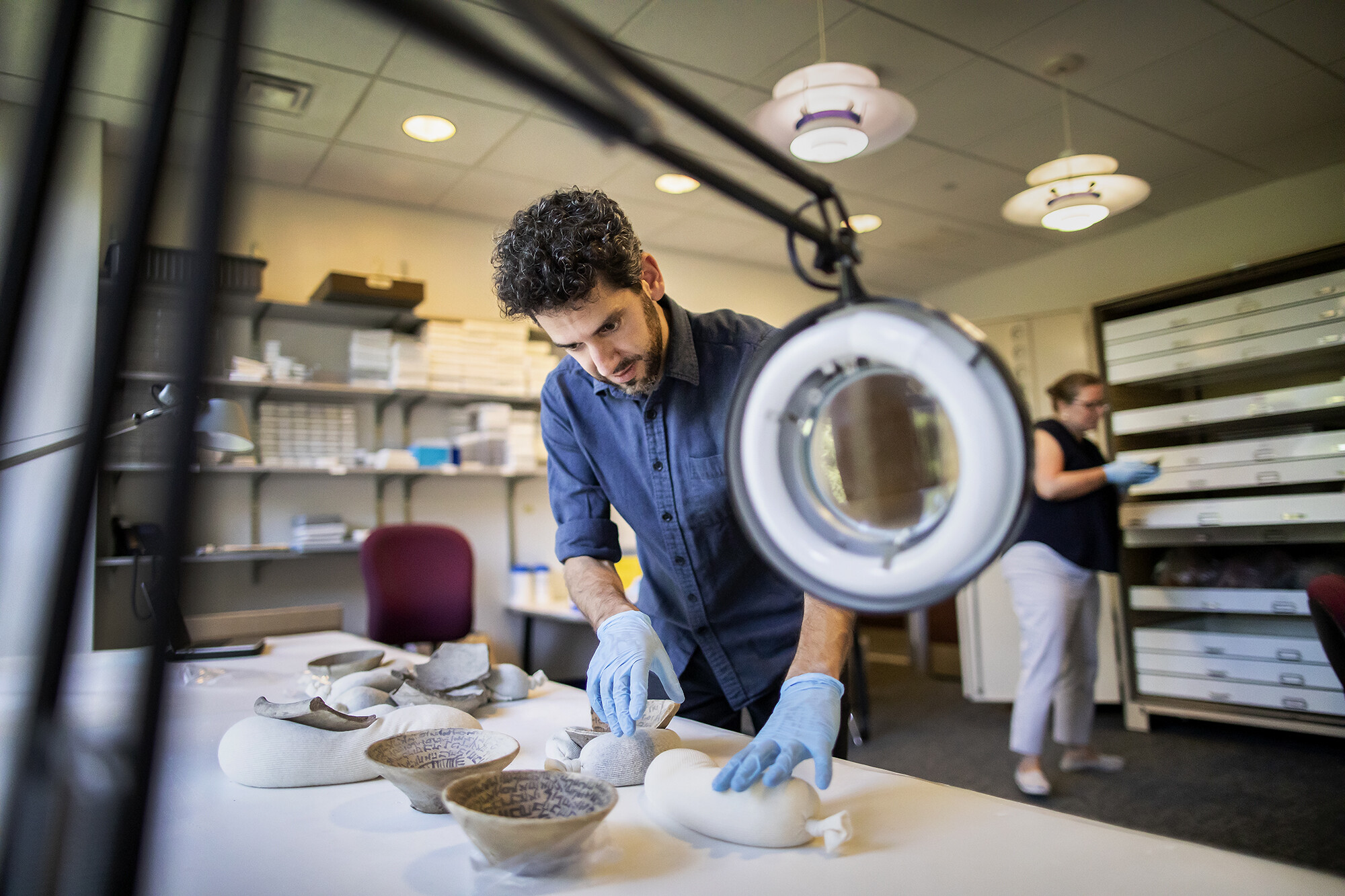
Researcher Simcha Gross lays out incantation bowls in the research room at the Penn Museum, nestling the objects atop long bags filled with silica gel for support. In the background, museum object keeper Katherine Blanchard pulls an item from the storage cabinet.
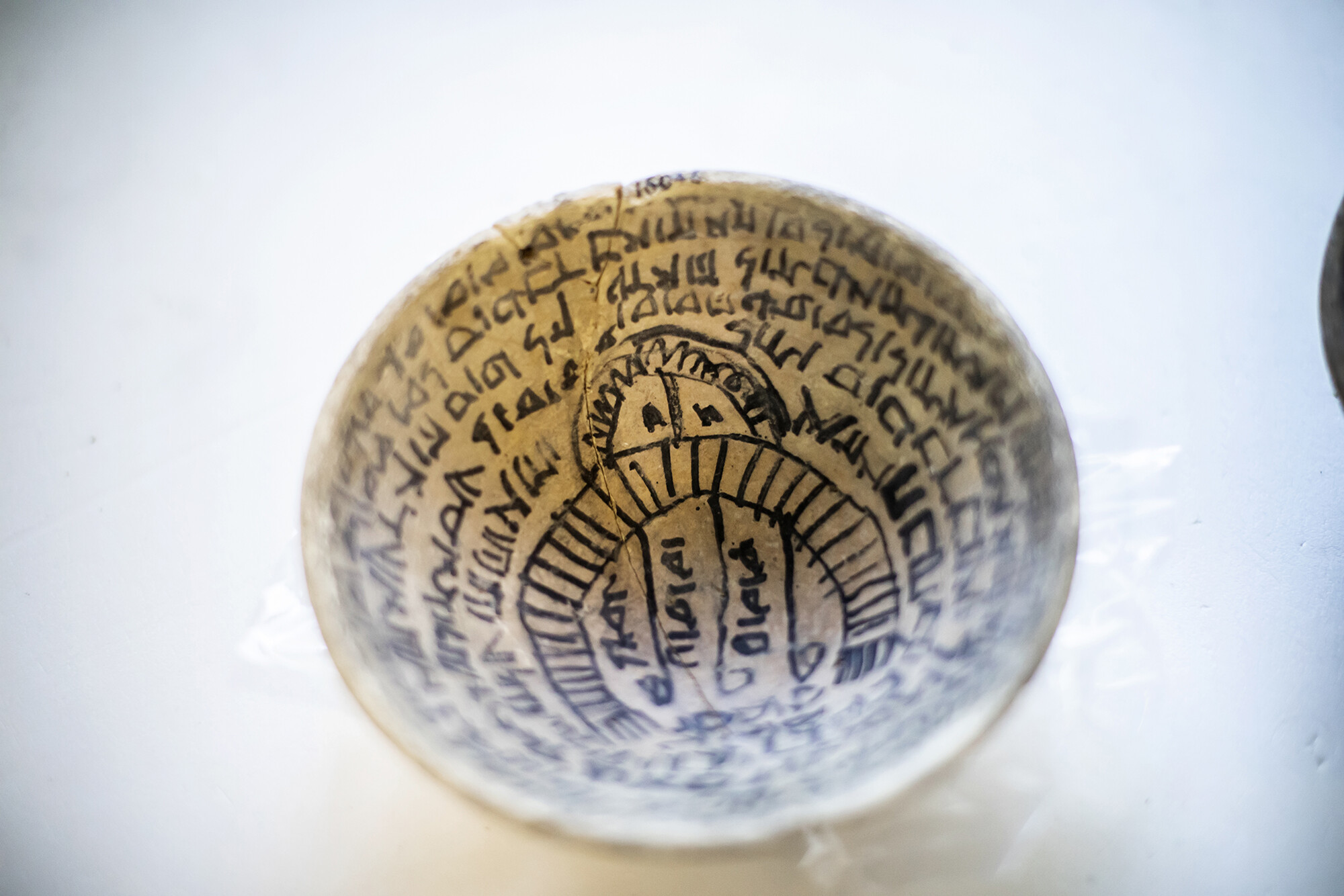
In a nondescript room on the fourth floor of the Penn Museum, researcher Simcha Gross cradles a small, earthenware bowl in his gloved hands. Markings cover its inside entirely, swirling inward until they stop at a cartoonish figure with black, beady eyes and squiggly arms in the shape of a semi-circle.
Simplistic or “cute” as the drawing may seem, it’s actually quite complex, extraordinary even, Gross explains: The character represents a demon, and the text surrounding it details a specific and personal request for protection or love, maybe a counter curse—or something else altogether. Both the drawing and text were inscribed hundreds of years ago.
“In the mid-19th century, we begin to unearth incantation bowls that name the clients who purchase the bowl, their problems, their families. These people invoke various powerful forces and deities to resolve a variety of issues, offering a literary corpus that provides a new perspective,” says Gross, an assistant professor of ancient rabbinics in the Near Eastern Languages & Civilizations Department at Penn.
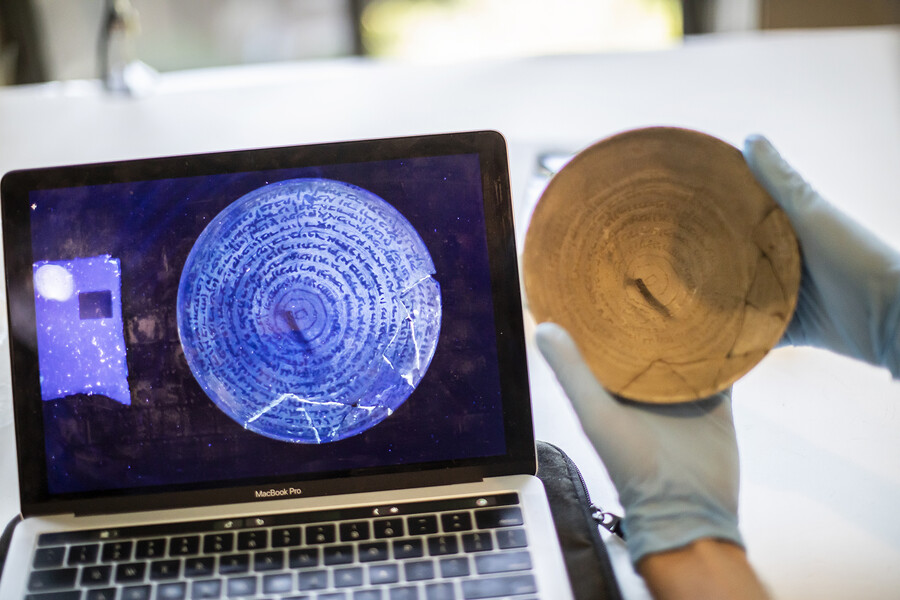
Many of the bowls have illegible words. Working with Museum staff, the researchers tried a technique called multispectral imaging to enhance the text. It worked, but on just one of four faded bowls.
By that day in early August, Gross has seen this special object—and many other “magic” bowls—at least half a dozen times, but he’s as excited now as he was initially. An estimated 2,500 incantation bowls exist worldwide, with 290 at Penn, most of which are not displayed publicly. This summer, Gross and colleague Rivka Elitzur-Leiman of Harvard began a massive undertaking to catalogue and study the antiquities.
They have many goals for the research. They want to improve the technological toolkit available to read illegible text on these objects and test the materials from which they’re made. They hope to contextualize and understand not just the literal words, but the reasons behind word placement, vessel type and size, and language choice. Longer term, Gross also says he’d like to correlate dig archives to actual bowls, which hasn’t previously been done, and ultimately, create an online database that includes every one of these items around the world.
“We’re finally beginning to move past this idea that magic is strange, this separate domain of life,” he says. “We’re also beginning to better understand that previous ideas that assumed that the bowls represent the interest of a lower, popular, or non-elite class of Jews, Christians, and others simply do not hold; the bowls were a surface on which scribes from a range of social, educational, and religious background wrote incantations.”
Nippur excavations
Five of the bowls—variously called amulets, incantation bowls, or magic bowls—are currently on display at the University of Pennsylvania Museum of Archaeology and Anthropology. These and the 285 more in storage have a long history with Penn.
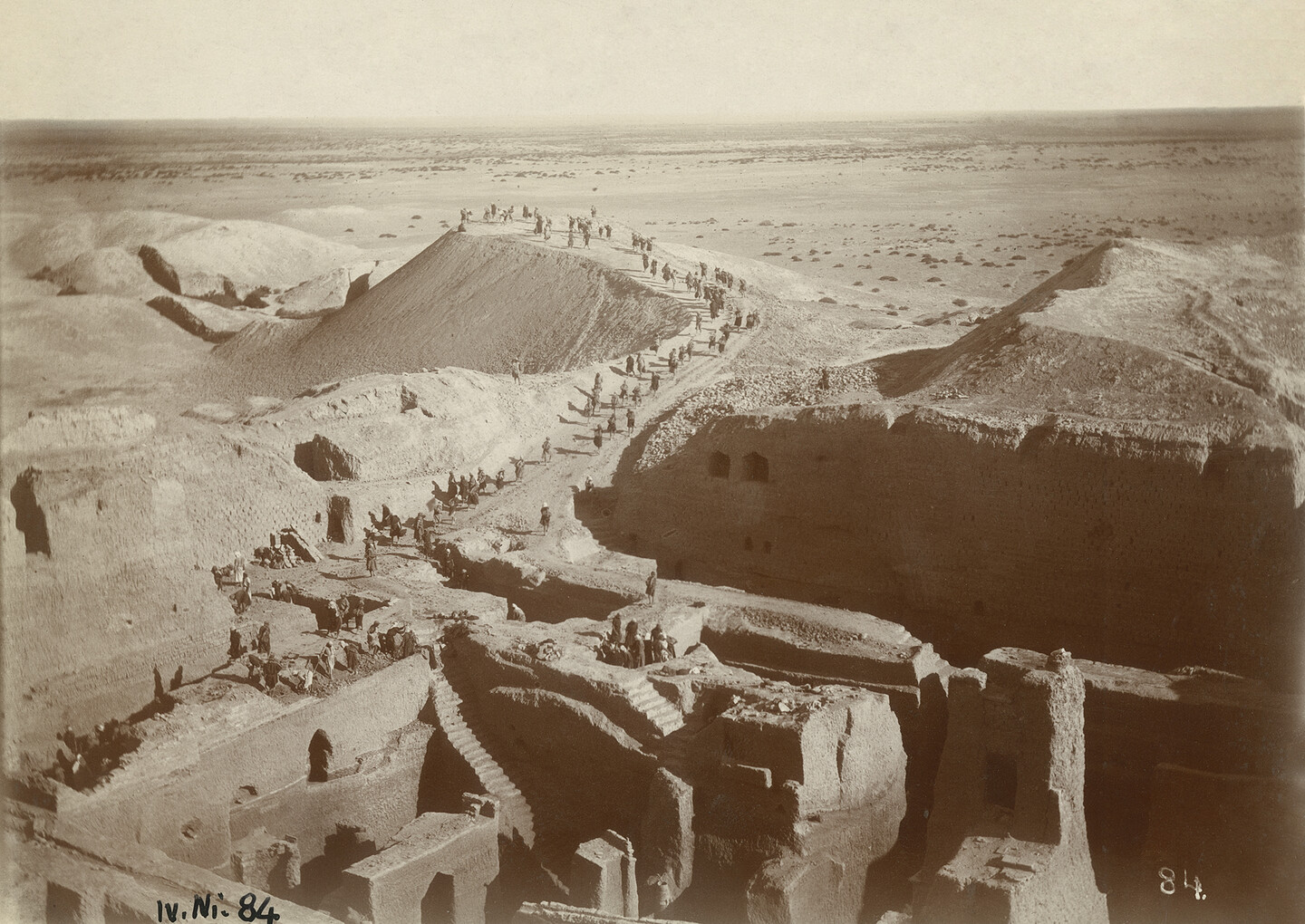
In 1888, John P. Peters, a Penn professor of Hebrew, organized and carried out an archaeological excavation in Nippur, part of the Ottoman Empire and located in modern-day Iraq. Penn received permitting from the Ottoman Sultan to conduct the excavation, the first of its kind there by an American institution, and a private group of prominent Philadelphians raised the money for it. That excavation, and several that followed, unearthed a slew of important items, including cuneiform tablets and many incantation bowls.
Starting in the late 1880s, excavations at Nippur (above) in what is modern-day Iraq unearthed a slew of important archaeological items, including cuneiform tablets and many incantation bowls. (Image: John Henry Haynes, Penn Museum)
It wasn’t just the bowls themselves that left an impression; it was also how they were situated when discovered. “The bowls were buried upside down under the floors of houses in strategic locations—under the door sills, in the corners of rooms—likely to protect against evil demons,” says Penn archaeologist Richard Zettler, associate curator-in-charge of the Penn Museum’s Near East Section. “Sometimes they put bowls together, rim to rim, and sealed them.”
Penn’s collection of these antiquities is well-known, with more than three dozen appearing in the first critical academic text on incantation bowls published in 1913 by James Montgomery, then an assistant professor at Penn and a professor at the Philadelphia Divinity School. That book, “Aramaic Incantation Texts from Nippur,” is still cited today.
We’re finally beginning to move past this idea that magic is strange, this separate domain of life.
Simcha Gross, an assistant professor of ancient rabbinics in the Near Eastern Languages & Civilizations Department
Elitzur-Leiman suspects that the volume’s longevity likely stems in part from the fact that the bowls it describes come from a collection with a known and well-recorded history—a rarity for the field before the turn of the 20th century. “The Penn incantation bowls were a watershed in the study of ancient Jewish magic and amulets,” she says. “They were the first and the only major group of such items that emerged from a documented archaeological excavation.”
Montgomery focused only on the most beautiful and easily decipherable bowls, Gross explains, a monumental task given the lack of comparable materials at the time. Yet “there are so many more. When I arrived at Penn, Richard walked me down to the storeroom and showed me the shelves where the bowls are kept. There are hundreds,” he says. “Some of them are too faded to read; some of them have writing that doesn’t make out a language.”
Gross and Elitzur-Leiman want to study them all, from the easy-to-read and unscathed to the tiniest fragments with indecipherable writing. “We’re interested in thinking about this collection holistically,” he says.
A project takes shape
After Gross visited the Museum collection with Zettler back in 2019, he started envisioning what a project with the bowls might entail. He reached out to Elitzur-Leiman, a friend and colleague who specializes in ancient inscriptions and Jewish magic. He also enlisted Katherine Blanchard, the Museum’s Fowler/Van Santvoord Keeper of the Near East Collections.
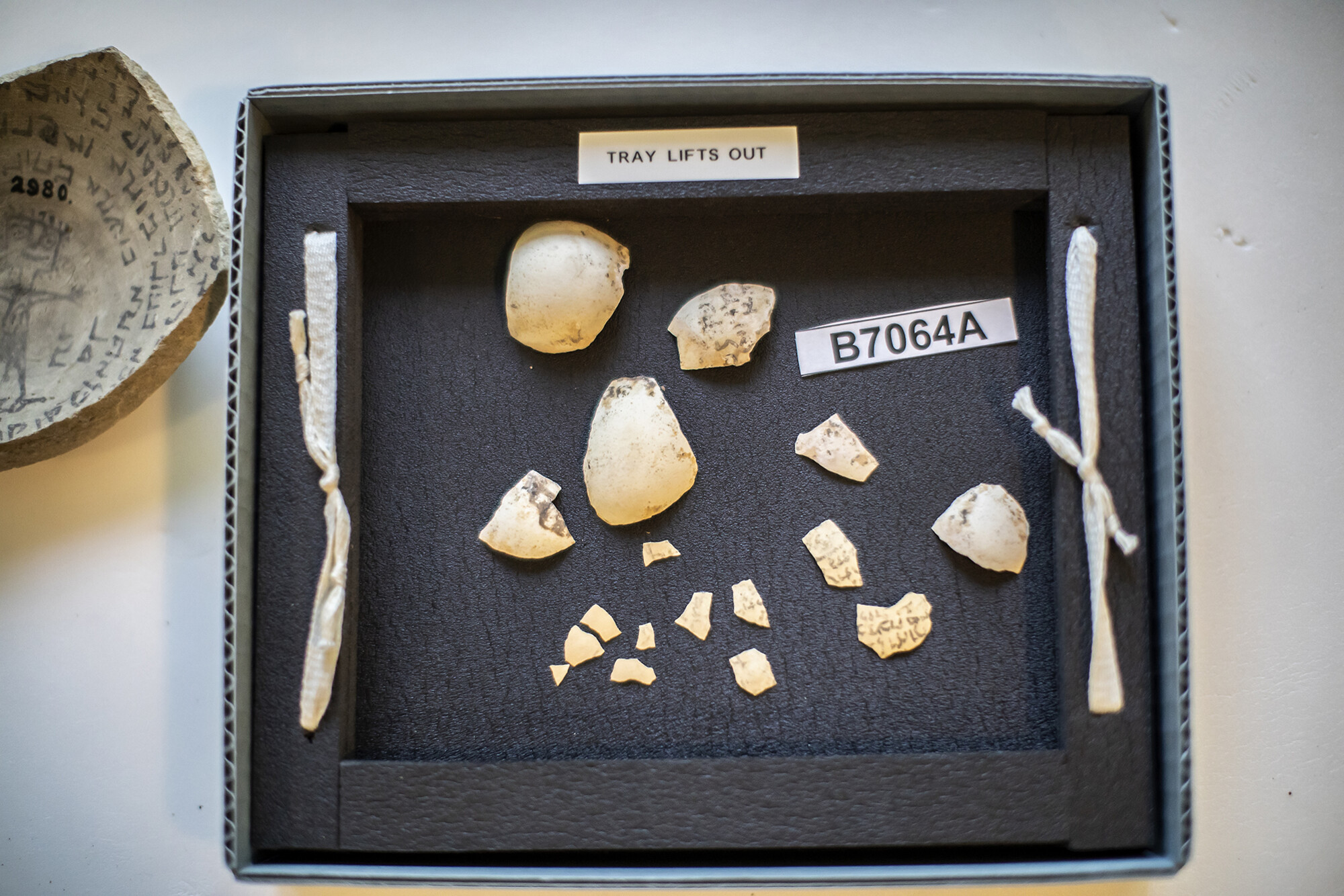
This summer, Gross and Elitzur-Leiman familiarized themselves with more than five dozen bowls and fragments in the Museum’s collection—including the eggshell (above left), which itself has a faded inscription. The bowl on the right is one of four the research team discovered had been made by the same scribe. They’re able to tell by the similarity in the writing and the “demon” pictured at center.
As an object keeper, Blanchard is in charge of hundreds of thousands of items. For this project, she started by taking 275 new high-resolution photos of 17 bowls. Then this summer, Elitzur-Leiman and Gross studied 67 bowls and fragments—plus one inscribed eggshell—that Blanchard retrieved from the Museum’s basement. Between visits, the items lived in the fourth-floor research room, in a large metal cabinet on a pull-out drawer, sandwiched between objects slated for an upcoming Museum exhibit and large antique vessels.
“We had a few goals this summer, key among them to familiarize ourselves with the many bowls in the collection that remain unpublished,” Gross says. The work proved fruitful. The researchers figured out that the text on one bowl was backwards, readable only with a mirror. They found four bowls inscribed by the same person, the details nearly identical but for the client’s name. With a team from the Museum, they tried a technology called multispectral imaging to make illegible words visible, which worked, but on just one of four faded bowls.
“There is always something exciting about holding ancient objects, primarily materials from your personal fields of interest,” Elitzur-Leiman says. “The experience of working at the Museum this summer was fascinating and enjoyable.” And it barely scratched the surface of what’s possible.
Questions yet to answer
So many questions remain about these incantation bowls: What’s special about each item? How do they differ from those found elsewhere? Why did the scribes choose bowls over other surfaces? Why are most cereal-bowl sized, except for a few larger, thicker bowls, which are the size of large salad bowls?
Inscription language also varies widely. “All of the bowls are written in Eastern Aramaic, but they are in different dialects,” Gross says, namely Jewish Babylonian Aramaic, which is a Hebrew script; Syriac, the language used in many early Christian texts; and Mandaic, used by a religious group in southern Iraq called the Mandaeans.
The Penn incantation bowls were a watershed in the study of ancient Jewish magic and amulets.
Rivka Elitzur-Leiman, Harvard University fellow
Though the bowls are in different dialects, Gross notes that the incantations reflect the fact that “neat religious lines don’t hold in the way we might imagine. There’s more porousness,” he adds. For instance, the names of rabbis appear in bowls with otherwise Christian-themed texts and the name Jesus Christ appears on an incantation bowl in Hebrew script.
There’s a question of why common themes like curses and counter curses, generic protection, and love prevailed over others. Gross and Elitzur-Leiman also challenge the much-debated notion of whether charlatans took advantage of illiterate clients by writing in what is akin to ancient gibberish, known as pseudo-script.
A complete digital catalogue
Ideally, the work the Penn-Harvard team hopes to do with technology and by correlating dig archives to specific bowls will bring into sharper relief the neighborhoods and people of southern Mesopotamia some 1,400 years ago. But the most ambitious part of the project, digitizing Penn’s collection of incantation bowls, could potentially have the biggest impact.
RELATED
“It would be an open-source database with all the bowls that we can collect, together with transliterations and translations, new photography, and possibly some technological, analytical work on the bowls’ material to see whether they stand out from the large corpus of ceramics that we have,” says Zettler.
He shares the excitement Gross and Elitzur-Leiman have for this particular aspect of the work. “I’m just thrilled that Simcha wants to work with this corpus of material, to use it as a springboard for something much bigger,” Zettler says.
To that end, Gross envisions places like the British Museum and Louvre, which also house collections of incantation bowls, adding theirs to this first-of-its-kind database. Eventually, he says, he’d love to build a single, accessible, comprehensive digital collection of all the magic bowls that are known around the world. The point would be to make them available to anyone who wishes to experience them. He’s been consulting with the Judaica Digital Humanities team at the Penn Libraries, which has experience with this kind of project.
“Beyond what these bowls tell us about Jewish magic, about what these communities were doing at the time, they answer bigger cultural and historical questions around inter-religious context,” Gross says. “This environment is far richer than anyone could imagine.”
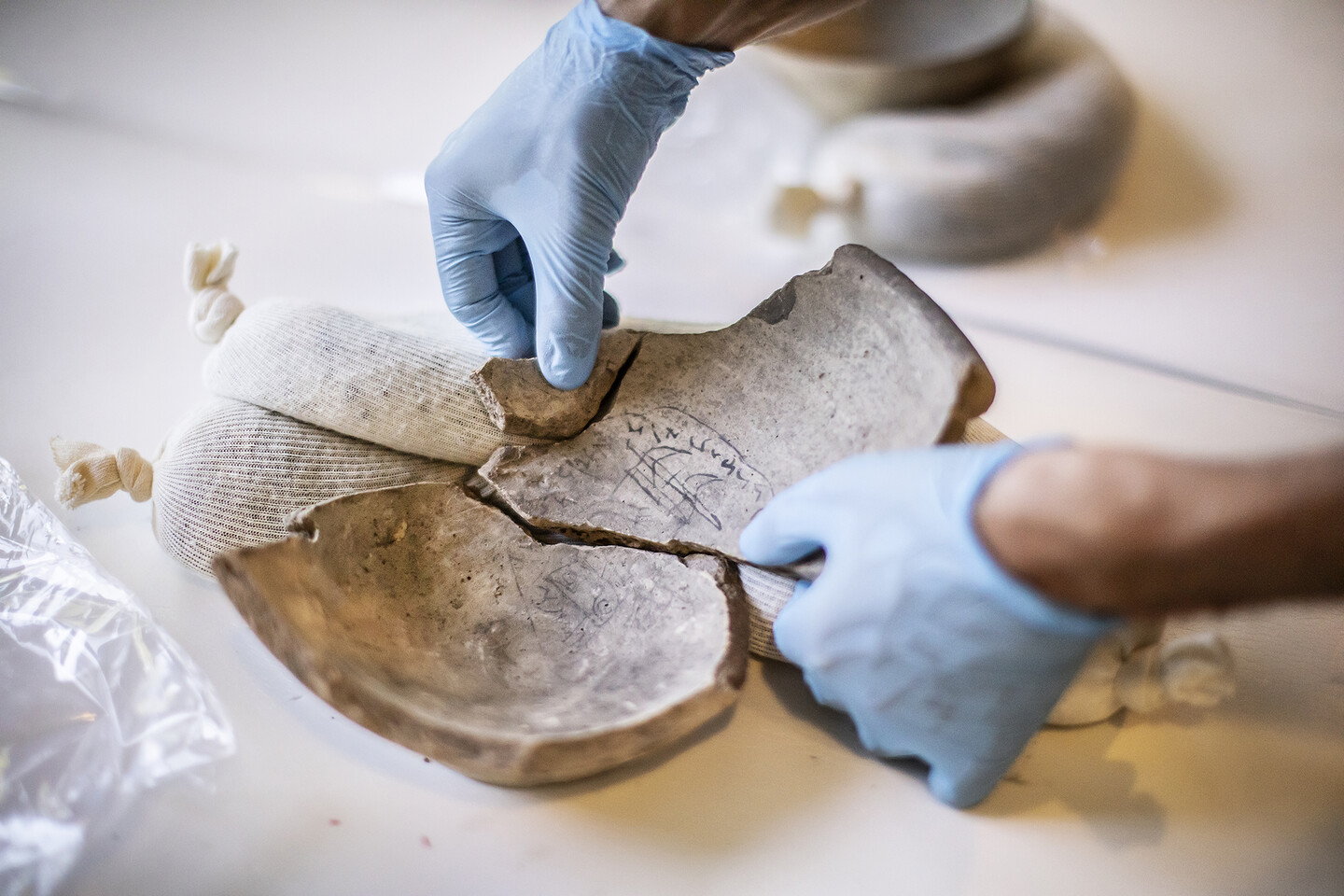
Gross and Elitzur-Leiman are studying some intact, pristine bowls and others, like the one above, that are in pieces. “The sherds tell a story, too,” says Blanchard.
On the move: Water quality and antimicrobial resistance testing goes mobile
Penn researchers have developed a mobile field laboratory allowing them to test water quality and track antimicrobial resistance in and around San Cristóbal in the Galápagos.
Penn researchers Vanessa and Alexis North are studying one of the largest collections of Egyptian blue objects ever found in the ancient Near East, shedding new light on how the world’s first synthetic pigment may have traveled far beyond Egypt.
A new role for dental providers? Rethinking where vaccines are given
Vaccinations have traditionally been administered in primary care settings or pharmacies. However, for about a decade, some states have authorized dentists to administer vaccines, and many others did so during the COVID-19 pandemic. The effectiveness of this approach has led some countries and states to expand or consider expanding the role of dental providers in delivering routine vaccines, including those against COVID-19 and the human papillomavirus (HPV), and in providing vaccine education.
Penn student develops a way for computer chips to run more efficiently
Fluid Silicon, a platform from President’s Sustainability Prize winner Nhlanhla Mavuso, allows computer chips to continuously monitor their health and self-tune as their characteristics change. The technology has the potential to reduce energy usage in data centers and improve reliability in mission-critical applications.