A quest to restore cultural heritage in Iraq, one site at a time
Penn archaeologists, in collaboration with colleagues from the University of Mosul and Iraq’s State Board of Antiquities and Heritage, seek to undo the terrible destruction ISIS wrought, particularly on targeted minority groups.
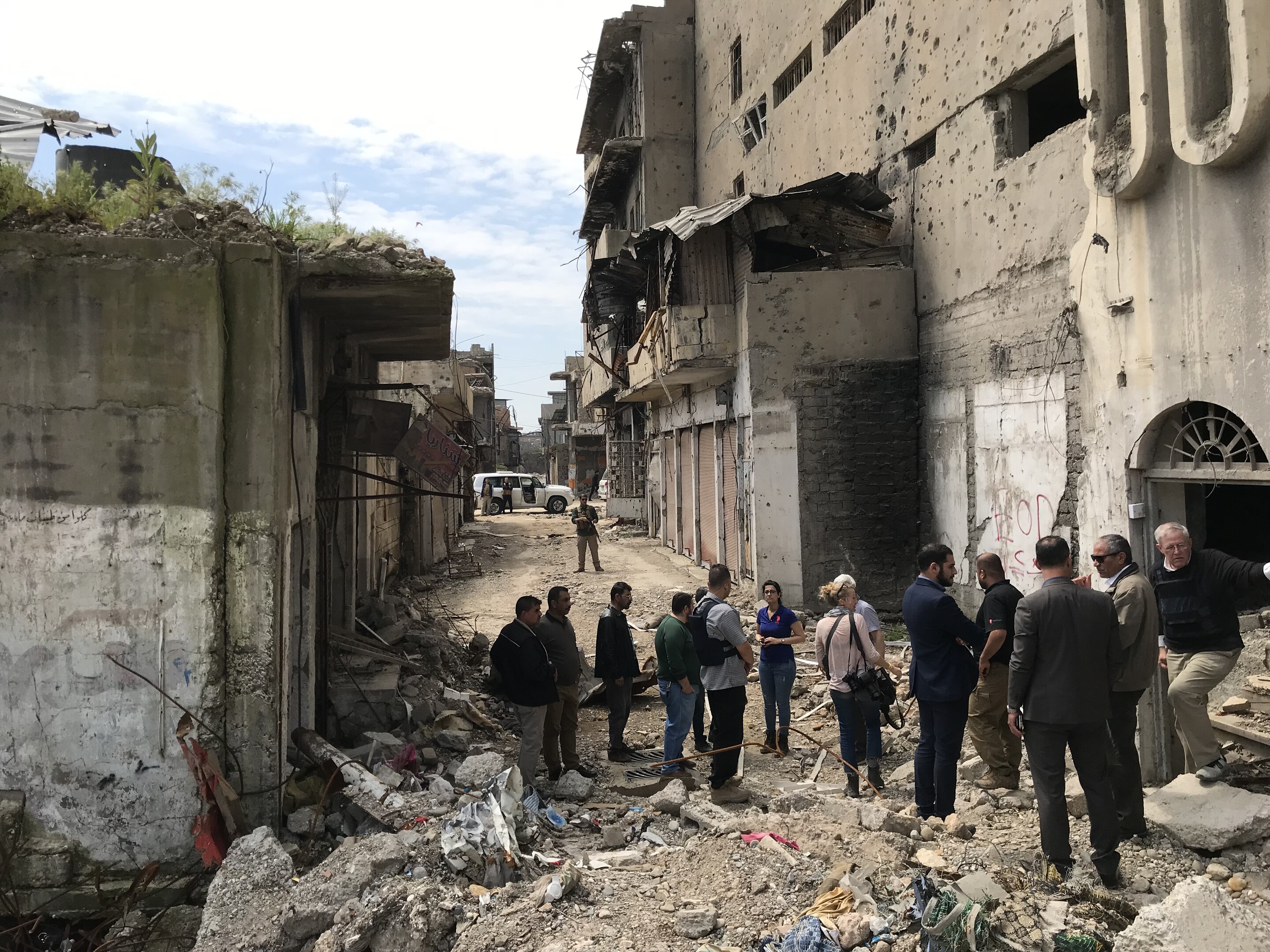
When restoration on Beit al-Tutunji (above) is complete, it will become a cultural center, housing a local museum with exhibits on what life was like in the early city before total modernization. In 2014, the Islamic State arrived in Mosul and took over the house for its own use. The project is one of three larger efforts underway from Penn’s Mosul Heritage Stabilization Program. (Image: Michael Danti)
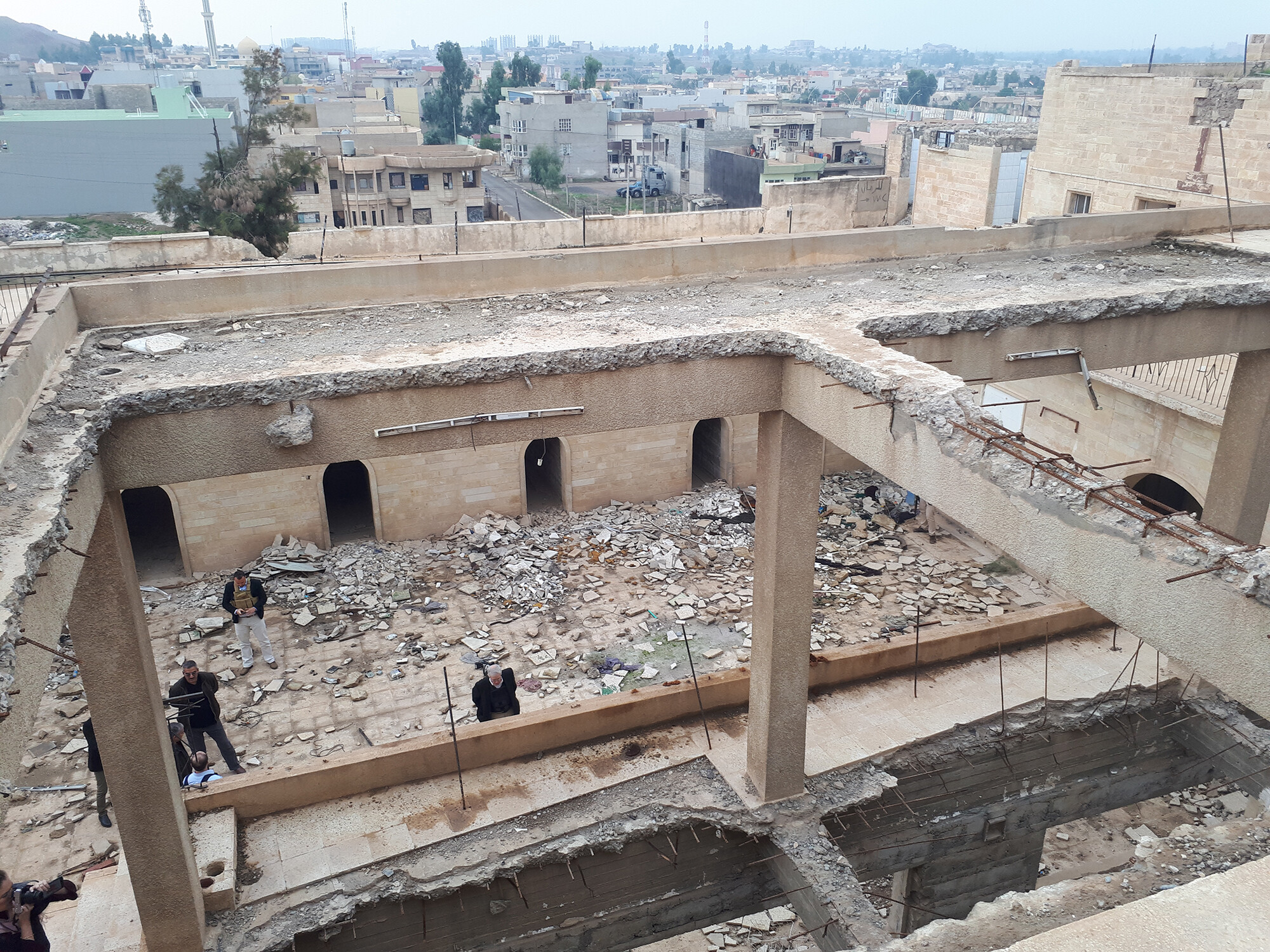
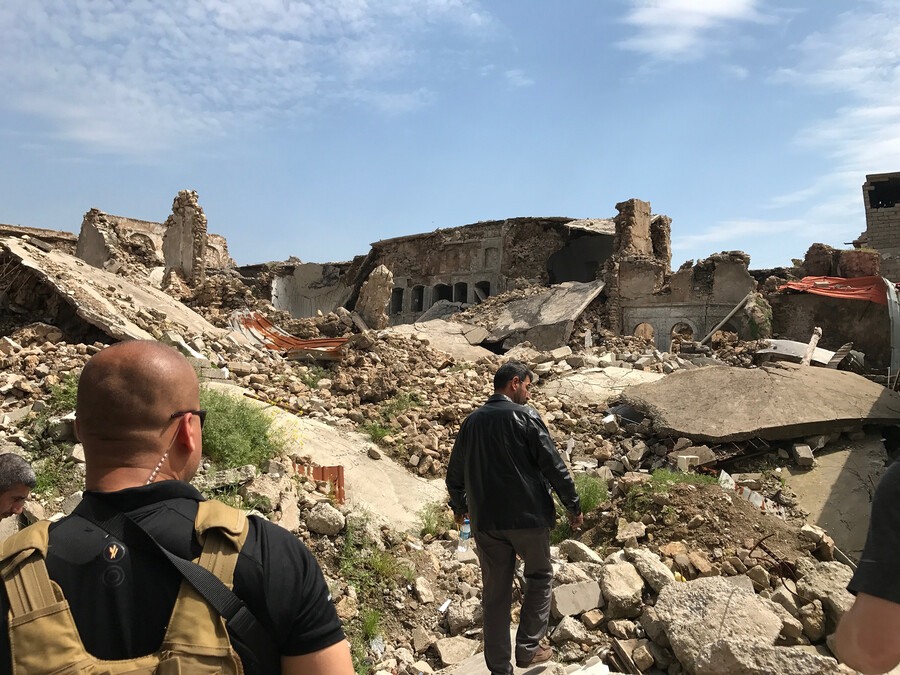
Beit al-Tutunji had nearly been restored to its original 19th-century splendor when the Islamic State took Mosul in 2014. The Ottoman-period house, designed like many others of the time, had a central open-air courtyard surrounded by rooms on all sides. For ISIS, this set up provided an easy base from which to lob shells across the Tigris River into east Mosul. But it also made the house a focus for airstrikes aimed at ending the ISIS occupation there.
Today, where the structure previously stood lie piles of rubble, mountains of cracked limestone and plaster. It’s hard to imagine a once ornate and beautiful building there. But with help from Penn’s Mosul Heritage Stabilization Program (MHSP), this site and others important to minority groups targeted by ISIS will soon emerge anew.
Backed by more than $4 million in funding from various sources, including the U.S. State Department, a team led by Penn archaeologists Richard L. Zettler and Michael Danti will support the efforts of Iraq’s State Board of Antiquities and Heritage to rebuild the Tutunji House, plus two other large sites—St. George’s Monastery and the Yazidi central temple at Lalish—as well as start restoring three smaller Christian churches outside of Mosul. They began the years-long work this September.
What you’re looking at is hatred and intolerance. The sooner that we can get rid of that, the better.
Michael Danti, MHSP project manager and a consulting scholar in Penn Museum’s Near East Section
“When I see [the damage], especially the graffiti and iconoclasm, it’s just really hurtful,” says Danti, MHSP project manager and a consulting scholar in Penn Museum’s Near East Section. “We’ve seen it in Yazidi shrines, Sufi shrines, even in Sunni mosques that had architectural components that ISIS believed were inappropriate to Islam. A lot of tombs and the like were defaced. They went after just about everything.”
“What you’re looking at is hatred and intolerance,” he adds. “The sooner that we can get rid of that, the better.”
An ancient monastery
One of the highest priorities is the Monastery of St. George in east Mosul. Supported by $1 million in funding from the U.S. Department of State and in partnership with nearby University of Mosul and the order of monks that maintains the monastery, called the Antonian Order of St. Hormizd, the Penn team will restore the main church, a smaller chapel, and other parts of this Chaldean Catholic site.
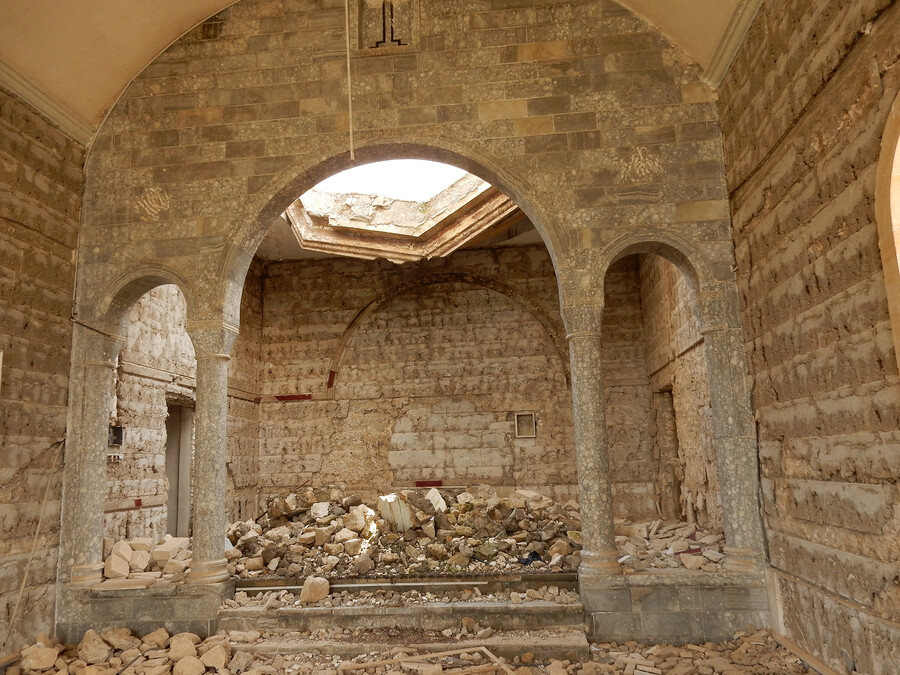
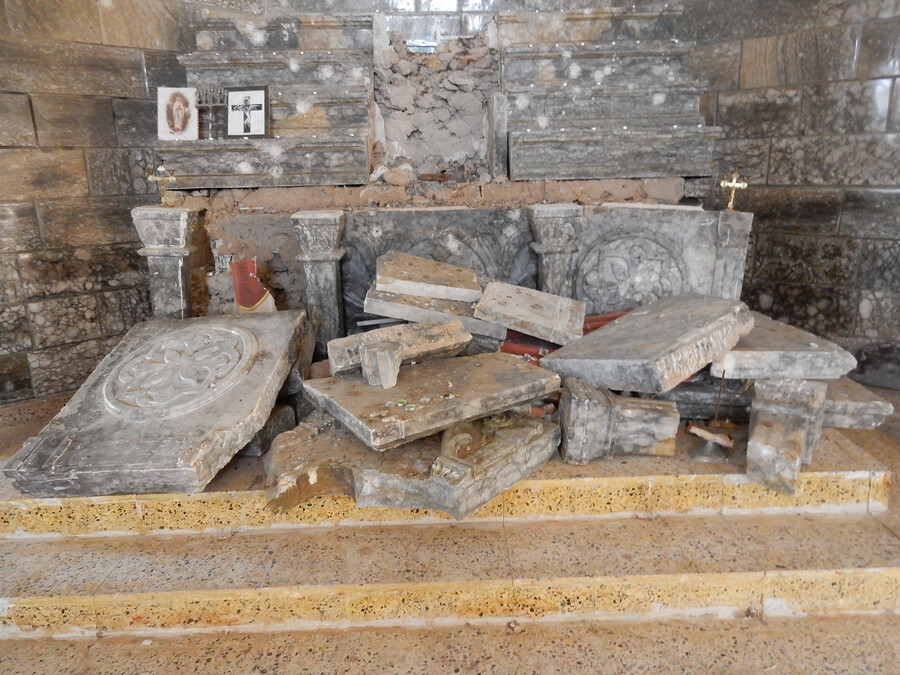
The sanctuary of the main church at the Monastery of St. George, after the Islamic State destroyed the altar, removed the marble cladding, and tipped the dome on its side. (Image: Richard Zettler)
Chaldean Catholics are a subgroup of the Church of the East that joined the Holy See of Rome in the 16th century, but the monastery has a much longer history. It began as the church of a village called Ba’wira, then about 6 miles north of Mosul, that existed as early as the 10th century. When the villagers moved closer to the Tigris, the church, isolated atop an archaeological site of great antiquity, became the ideal location for a monastic order. Though no one knows when a monastery was first established on the site, there is historical documentation that the Monastery of St. George existed by the 17th century.
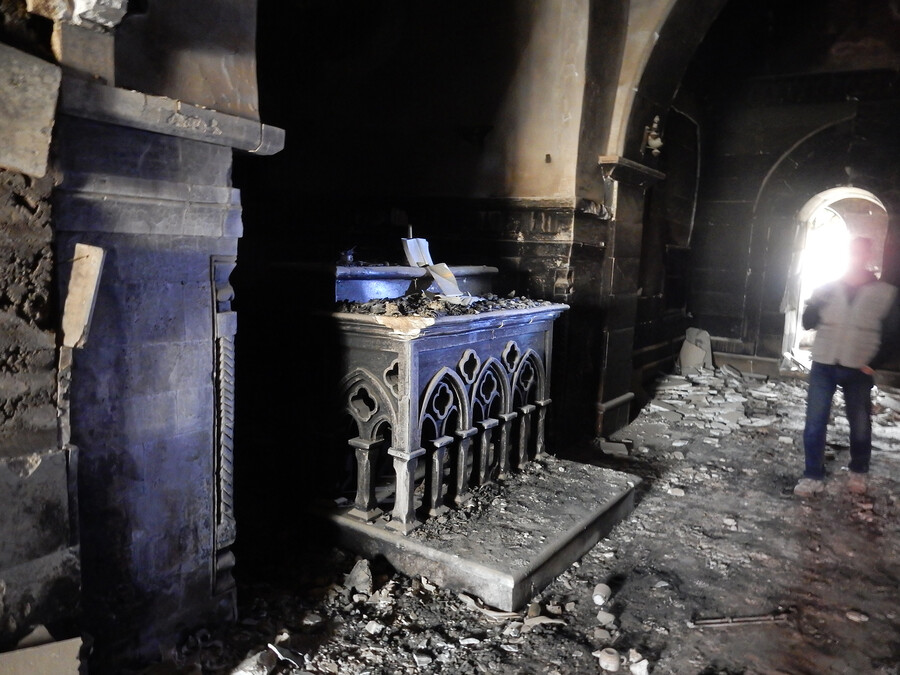
“The Islamic State largely destroyed the larger church. They lifted the dome and turned it on its side. The front of the church had a large cross; they blew that out of there entirely,” he explains. “They stripped all the marble cladding from the face of the structure, all the electrical wiring. They took everything. They did that in the chapel as well. They took everything that wasn’t nailed down.”
A look at the destruction to St. George’s Monastery. “The Islamic State largely destroyed the larger church. They lifted the dome and turned it on its side. The front of the church had a large cross; they blew that out of there entirely,” explains Penn’s Richard Zettler. “They stripped all the marble cladding from the face of the structure, all the electrical wiring. They took everything. They did that in the chapel as well. They took everything that wasn’t nailed down.” (Image: Omar Adil Sabah)
A Yazidi shrine
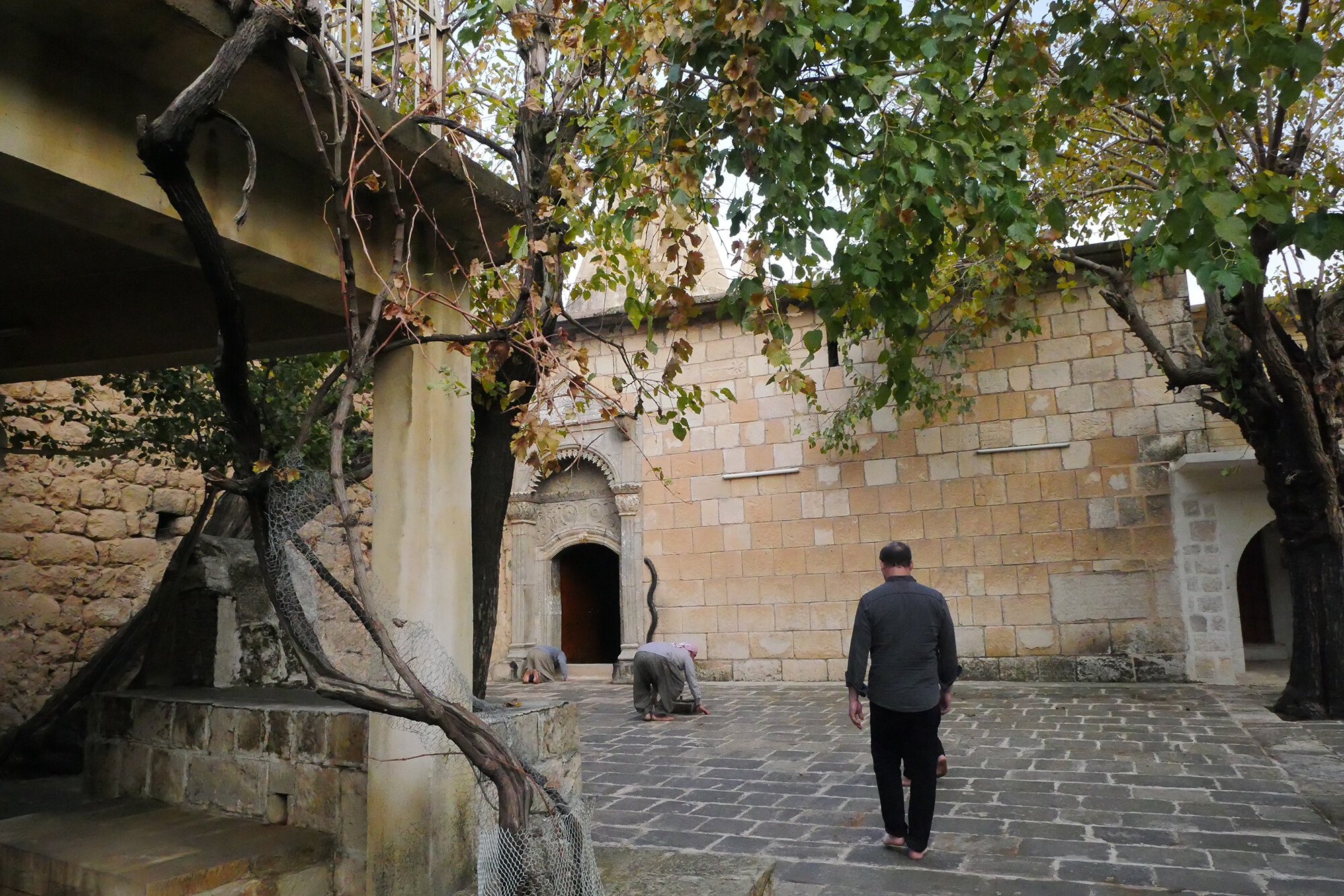
A hundred-plus miles away, in a mountain village in the district of Sheikhan, close to the modern Iraqi city of Duhok, is Lalish Temple, a key religious site for a religious minority called the Yazidis. “This is like Vatican City for the Yazidis,” Zettler says. “This wasn’t impacted by the Islamic State, but the Yazidis [asked] that if we were going to do anything, we help them restore Lalish.”
For this project, the Penn team secured a $500,000 grant from the U.S. State Department to restore the temple’s interior, including the tomb of an important sheikh and several halls used for rituals.
Interior shot of a ritual hall at Lalish Temple, a key religious site for a religious minority called the Yazidis. Though this site in particular wasn’t harmed by ISIS, the Yazidis asked that it be a priority, the first in what the Penn team hopes will be many similar projects. (Image: Allison E. Cuneo)
Part of the reason for this work is practical: According to religious doctrine, each Yazidi is expected to visit Lalish at least once during his or her lifetime, so the site experiences significant foot traffic. “A lot of people go through the shrine on a daily basis,” Danti says. “There’s a need to facilitate access.” Beyond that, starting with Lalish—and employing Yazidi architects and engineers to do the actual work—aims to fosters goodwill with this group, ideally leading to and facilitating future collaborations.
“So many of the Yazidi shrines were destroyed by ISIS. Those projects, they’re going to be time-consuming and costly,” Danti says. “But the Yazidis felt it was appropriate for the international community to begin its work on this site before others. It’s much-needed work, but it’s also taking a top-down approach to Yazidi heritage. I’m really looking forward to it. It’s a rare opportunity to go inside the shrine, to such an ancient, holy place.”
An Ottoman-era house
The Tutunji House is the final large-scale project MHSP recently began, with close to $800,000 in funding over three years coming from a Swiss foundation called the International Alliance for the Protection of Heritage in Conflict Areas, known as ALIPH. It is one of five ALIPH-funded projects in what the foundation calls the “Mosul mosaic” and the only one for a U.S.-based group.
In its heyday, Beit al-Tutunji was ornate, built for an Ottoman governor of Mosul in the early 19th century. Subsequently, it was occupied by a prominent Mosul family with the surname Tutunji—which means “tobacco merchant” in Arabic—hence how it’s known today.
Designed like many others of the time, the Tutunji house that once stood here had a central open-air courtyard surrounded by rooms on all sides. For ISIS, this set up provided an easy base from which to lob shells across the Tigris River into east Mosul. But it also made the house a focus for airstrikes aimed at ending the ISIS occupation there. The rubble pile is what’s left today. (Image: Richard Zettler)
“It’s traditional construction with stone rubble set in a lime plaster,” Zettler says. “It had a lot of carved marble decoration and plaster work, with inscriptions from the Koran painted in blue against a white background. Most recently, it was being used as a cultural center.” The State Board of Antiquities and Heritage had nearly completed restoration of the house when the Islamic State arrived five years ago.
When the conflict ended in 2016, there was little left of the Tutunji House. Once it’s rebuilt—again—it will become the cultural center it was intended to be, housing a local museum with exhibits on what life was like in the early city before total modernization. “It’s always a struggle between modern development and preserving the past,” Danti says. “It’s a constant give and take.”
Three small churches—and beyond
Beyond the three big conservation projects getting underway, many smaller buildings outside of Mosul require attention. During phase one of the MHSP, which took place in late 2018 and early 2019, Zettler and Danti had conducted condition assessments of more than 50 sites in and around Mosul, then supplied a priority list to the State Department.
The Church of Saints Sergius and Bacchus in the town of Qaraqosh south of Mosul, one of three State Department-approved restoration projects the Penn team will undertake. (Image: Richard Zettler)
They recently learned they received approval to start restoration on three churches: One is a Syriac Orthodox church called the Church of Saints Sergius and Bacchus in the town of Qaraqosh south of Mosul. The second and third are both Chaldean Catholic churches, one called the Church of Saints Peter and Paul in Tell Keyf, between Mosul and Batnaya, and the other, the Church of Saint Cyricus in the town of Batnaya.
“When we visited Batnaya in April, it was a ghost town,” Zettler says. “Now the United Nations Development Programme and USAID are beginning to restore houses and the town’s water and electricity. Former inhabitants are beginning to return. Restoring the town’s main church, we hope, will also help to draw the population back.”
That’s ultimately the goal of all three smaller projects, and many more the Penn teams hopes will follow. “Christian populations are reluctant to return. Just like after World War II in Europe, there was a lot of population flux,” Danti says. “Yes, we [are] preserving very old churches, but we’re really hoping they’ll become functioning parts of the community again.”
The Church of Saint Cyricus in the town of Batnaya. The goal of restoring this small church and others like it is to help them become a functioning part of each community again. (Image: Richard Zettler)
In some cases, that will work; in others, it won’t, partially because it’s not what the community desires. Over the next months and years, all of that will unfold as Zettler, Danti, and colleagues meet with key stakeholders to understand what’s important to each community and these cultural heritage sites.
Ultimately, it’s a cooperative effort between parties who all have a stake in returning these treasures to their original states. “ISIS sought to divide these communities,” Danti says. “But we’re seeing them all work together to try to reestablish themselves. Not everything is rosy, but the people we’re working with, most of them just want to get back to their lives. It’s been a long time.”
Funding for the Mosul Heritage Stabilization Program comes from a Department of State Cooperative Agreement, S-NEAAC-18-CA-0043, under the U.S. Ambassadors Fund for Cultural Preservation, as well as from the International Alliance for the Protection of Heritage in Conflict Areas
Michael Danti is project manager for the Mosul Heritage Stabilization Program and a consulting scholar in Penn Museum’s Near East Section. He is also academic director of the American Schools of Oriental Research Cultural Heritage Initiatives.
Homepage Photo: A group of people observe the ruins of Beit al-Tutunji, an Ottoman-era house built for an Ottoman governor of Mosul in the early 19th century, then subsequently occupied by a prominent Mosul family with the surname Tutunji—which means “tobacco merchant” in Arabic—hence how it’s known today. (Image: Allison E. Cuneo)
On the move: Water quality and antimicrobial resistance testing goes mobile
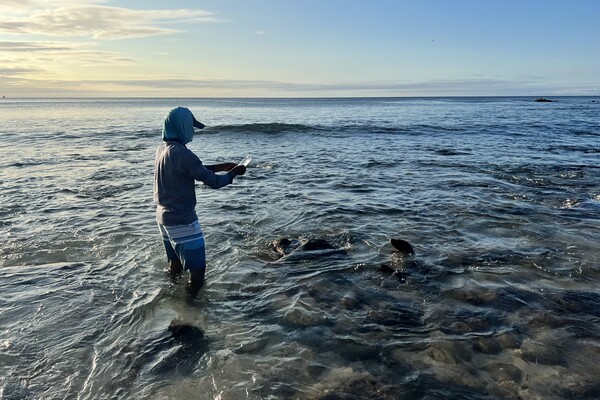
Penn researchers have developed a mobile field laboratory allowing them to test water quality and track antimicrobial resistance in and around San Cristóbal in the Galápagos.
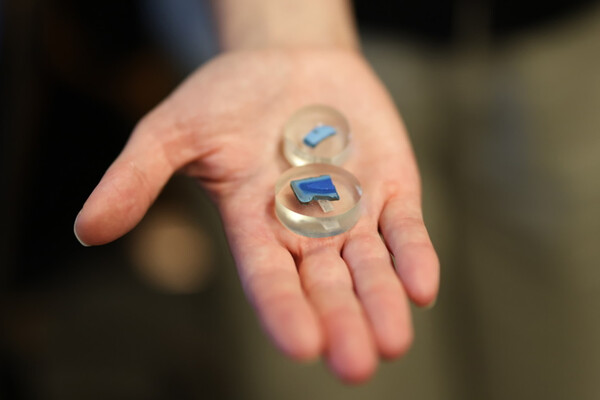
Penn researchers Vanessa and Alexis North are studying one of the largest collections of Egyptian blue objects ever found in the ancient Near East, shedding new light on how the world’s first synthetic pigment may have traveled far beyond Egypt.
A new role for dental providers? Rethinking where vaccines are given
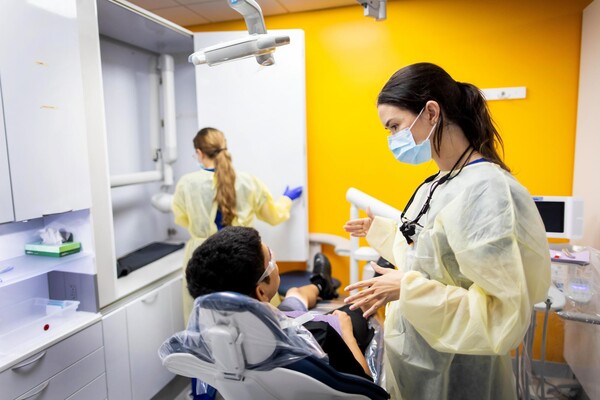
Vaccinations have traditionally been administered in primary care settings or pharmacies. However, for about a decade, some states have authorized dentists to administer vaccines, and many others did so during the COVID-19 pandemic. The effectiveness of this approach has led some countries and states to expand or consider expanding the role of dental providers in delivering routine vaccines, including those against COVID-19 and the human papillomavirus (HPV), and in providing vaccine education.
Penn student develops a way for computer chips to run more efficiently
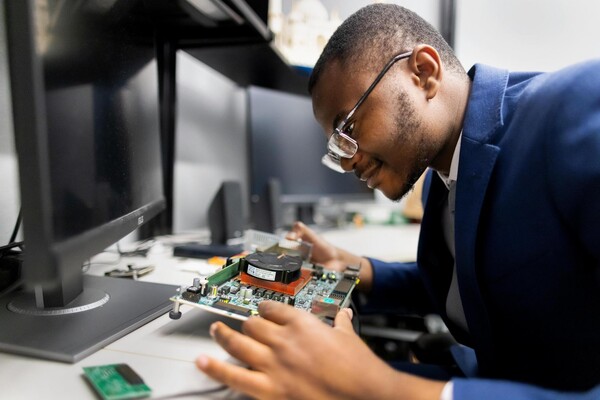
Fluid Silicon, a platform from President’s Sustainability Prize winner Nhlanhla Mavuso, allows computer chips to continuously monitor their health and self-tune as their characteristics change. The technology has the potential to reduce energy usage in data centers and improve reliability in mission-critical applications.