NASA’s Roman Space Telescope will investigate the history of galaxies
Robyn Sanderson and collaborators are unearthing the history of the universe’s formation by looking for clues that reveal its ‘galactic fossil record.’
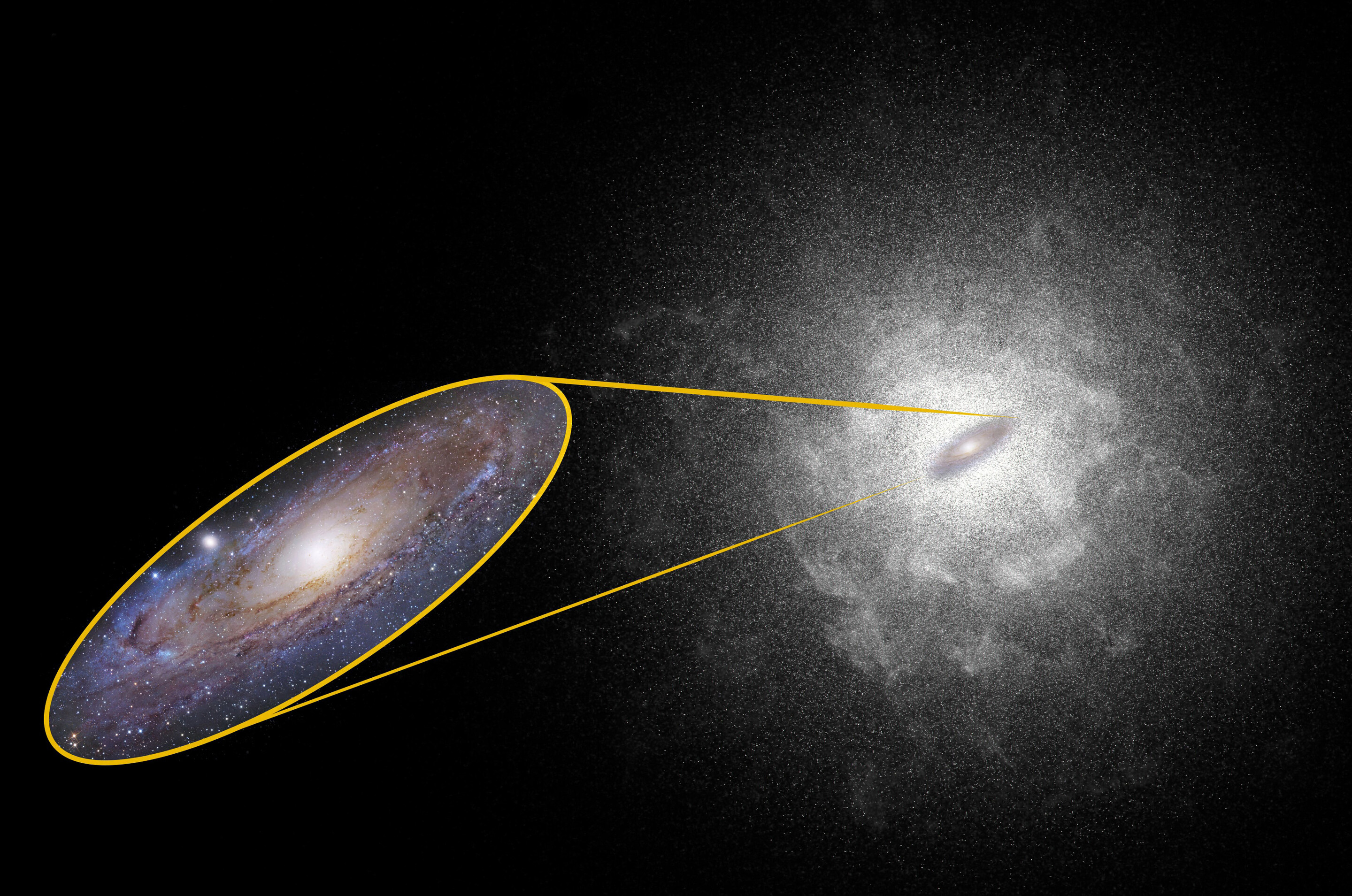
Robyn Sanderson and Adrien Thob of the School of Arts & Sciences are part of a team of astronomers using NASA’s upcoming Nancy Grace Roman Space Telescope to uncover the “fossil record” of the universe as they look to clues to unearth key insights into its formation.
(Image: Courtesy of NASA, Ralf Crawford (STScI))
The universe is a dynamic, ever-changing place where galaxies are dancing, merging, and changing appearance. Looking ever deeper into the universe, astronomers see galaxies at earlier stages in their lives. Unfortunately, because these changes take millions or billions of years, telescopes only provide snapshots, squeezed into a human lifetime.
However, galaxies leave behind clues to their history, and they can be examined to uncover how these collections of stars and gas came to be. NASA's Nancy Grace Roman Space Telescope will have the capacity to look for these fossils of galaxy formation with high-resolution imaging of galaxies in the nearby universe.
Through a grant from NASA, astronomers and cosmologists like Robyn Sanderson and Adrien Thob of the University of Pennsylvania’sSchool of Arts & Sciences are designing a set of possible observations called the Roman Infrared Nearby Galaxies Survey (RINGS) that would collect these images, and the team is producing publicly available tools that the astronomy community can use once Roman launches and starts recording data. The RINGS survey is a preliminary concept that may or may not be implemented during Roman’s science mission.
Sanderson, who will be the deputy science principal investigator for RINGS, notes that Roman is uniquely up to task due to its resolution which is similar to NASA’s Hubble Space Telescope and its wide field of view—at least 100 times greater than that of Hubble—making it a sky-survey telescope that complements Hubble’s narrow-field capabilities.
Galactic archaeologists
Scientists can only look at brief instances in the lives of evolving galaxies that eventually lead to the fully formed galaxies around us today. As a result, galaxy formation can be difficult to track.
RELATED
Fortunately, galaxies leave behind hints of their evolution in their stellar structures, almost like the way species ancestral to humans left behind imprints in rock, Sanderson says. These galactic “fossils” are ancient stars that hold the history of the galaxy’s formation and evolution, including the chemistry of the galaxy when those stars formed.
These cosmic fossils are of particular interest to Sanderson, and she describes the process of analyzing stellar structures in galaxies as “like going through an excavation and trying to sort out bones and put them back together.”
Roman’s high resolution will allow scientists to pick out these galactic fossils, using structures like long tidal tails of stars to give clues to a galaxy’s merger history. The goal, Sanderson says, is to “reassemble these fossils in order to look back in time and understand how these galaxies came to be.”
To help with this “reassembly,” Sanderson and Thob are using a novel technique she pioneered and has made publicly available which allows researchers to forecast what simulated galaxies would look like to Roman.
Shedding light on dark matter
RINGS will also enable further investigations of one of the most mysterious substances in the universe: dark matter, an invisible form a matter that makes up most of a galaxy’s mass. A particularly useful class of objects for testing dark matter theories is ultra-faint dwarf galaxies. According to Raja Guha Thakurta of the University of California, Santa Cruz, “ultra-faint dwarf galaxies are so dark matter dominated that they have very little mass for star formation. Even when they do form stars, the process will blow away more of the gas needed to create the next generation of stars, so they are deeply inefficient at producing stars.” With so few stars being created, ultra-faint galaxies can essentially be seen as pure blobs of dark matter to study.
Roman’s having the field of view and resolution to observe these ultra-faint galaxies will help test multiple prominent theories of dark matter. With this new data, the astronomical community will hopefully come closer to finding the truth about the unobservable matter that seems to outweigh visible matter by roughly a six to one ratio, making up about 27% of the universe, as opposed to 5% for normal matter.
Ultra-faint galaxies are far from the only test of dark matter, though. Often, just looking in an average-sized galaxy’s backyard is enough. The structures in the halo of a galaxy often give hints to the amount of dark matter present. However, due to the sheer size of galactic halos (they are often 15-20 times as big as the galaxy itself), current telescopes are deeply inefficient at observing them.
At the moment, the only fully resolved galactic halos scientists have to go on are the Milky Way and Andromeda. Ben Williams, the principal investigator at the University of Washington, describes how Roman’s power will amend this problem: “We only have reliable measurements of the Milky Way and Andromeda because those are the only galaxies close enough that we can get measurements of large numbers of stars distributed across their stellar halos. So, with Roman, all of a sudden we’ll have 100 or more of these fully resolved galaxies.”
When Roman launches in 2027, it is expected to fundamentally alter how scientists understand galaxies. In the process, it will shed some light on our own home galaxy. The Milky Way is easy to study up close, but we do not have a large enough selfie stick to take a photo of our entire galaxy and its surrounding halo. By studying the nearby universe, RINGS will examine galaxies similar in size and age to the Milky Way and shed light on how humans and other life came to be here.
Patt Molinari and Ann Jenkins of the Space Telescope Science Institute contributed to this story.
On the move: Water quality and antimicrobial resistance testing goes mobile
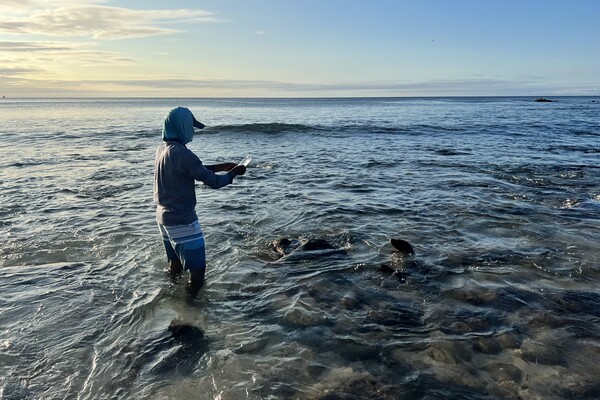
Penn researchers have developed a mobile field laboratory allowing them to test water quality and track antimicrobial resistance in and around San Cristóbal in the Galápagos.
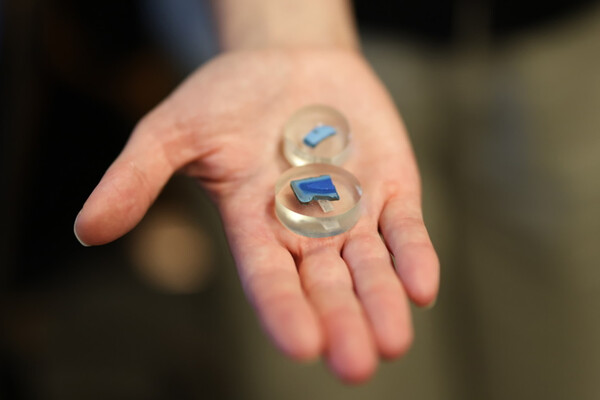
Penn researchers Vanessa and Alexis North are studying one of the largest collections of Egyptian blue objects ever found in the ancient Near East, shedding new light on how the world’s first synthetic pigment may have traveled far beyond Egypt.
A new role for dental providers? Rethinking where vaccines are given
Vaccinations have traditionally been administered in primary care settings or pharmacies. However, for about a decade, some states have authorized dentists to administer vaccines, and many others did so during the COVID-19 pandemic. The effectiveness of this approach has led some countries and states to expand or consider expanding the role of dental providers in delivering routine vaccines, including those against COVID-19 and the human papillomavirus (HPV), and in providing vaccine education.
Penn student develops a way for computer chips to run more efficiently
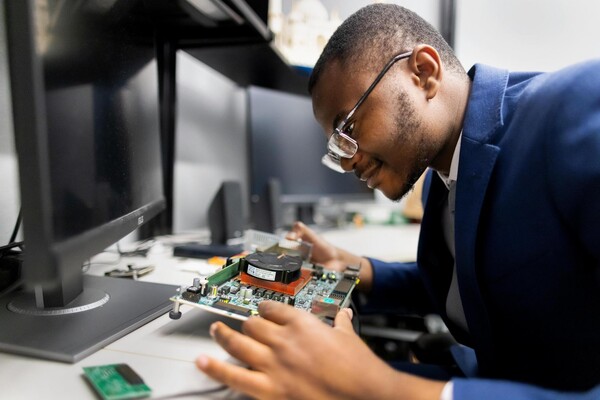
Fluid Silicon, a platform from President’s Sustainability Prize winner Nhlanhla Mavuso, allows computer chips to continuously monitor their health and self-tune as their characteristics change. The technology has the potential to reduce energy usage in data centers and improve reliability in mission-critical applications.