What can tiny molecules in ants and naked mole-rats tell us about societal roles?
PIK Professor Shelley Berger and colleagues explored the genetic basis of labor distribution in communal-dwelling species and discovered that pathways dating back hundreds of millions of years are conserved across animal kingdoms. Their findings offer fundamental insights into complex social behaviors.
5 min. read
In eusocial superorganisms like leafcutter ant colonies, labor is divvied up according to body shape and size, but PIK Professor Shelley Berger and her team discovered that molecular signals can override that blueprint. Their findings reveal how simple neuropeptides can reprogram ant behavior, reshuffling roles in nature’s most disciplined workforce.
Key Takeaways
Researchers led by PIK Professor in the School of Arts & Sciences and the Perelman School of Medicine Shelley Berger explore the genetic basis of how communal-dwelling organisms like leafcutter ants and naked mole-rats divide labor among their societies
They discovered that pathways dating back hundreds of millions of years are conserved across animal kingdoms
Their findings offer fundamental insights into the origins of complex social behaviors and the neuroplasticity of assigned roles
From the bright lights of cities that don’t sleep—where people hustle and bustle through the night to keep subways, servers, and supply chains alive—to the whisper-dark understory of tropical forests where ants hum in syncopated lines, the planet’s most intricate societies hinge on round-the-clock cooperation and finely tuned roles.
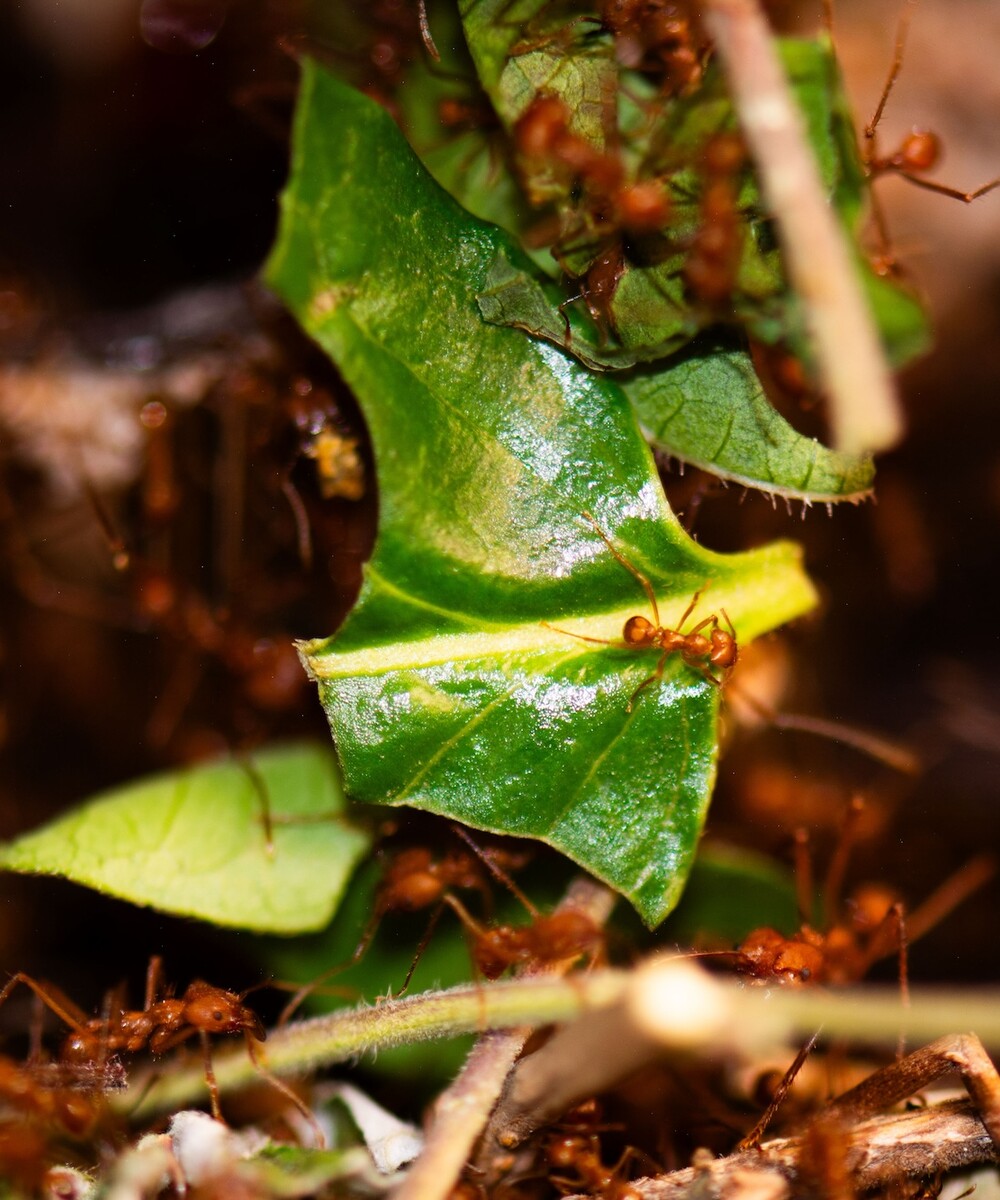
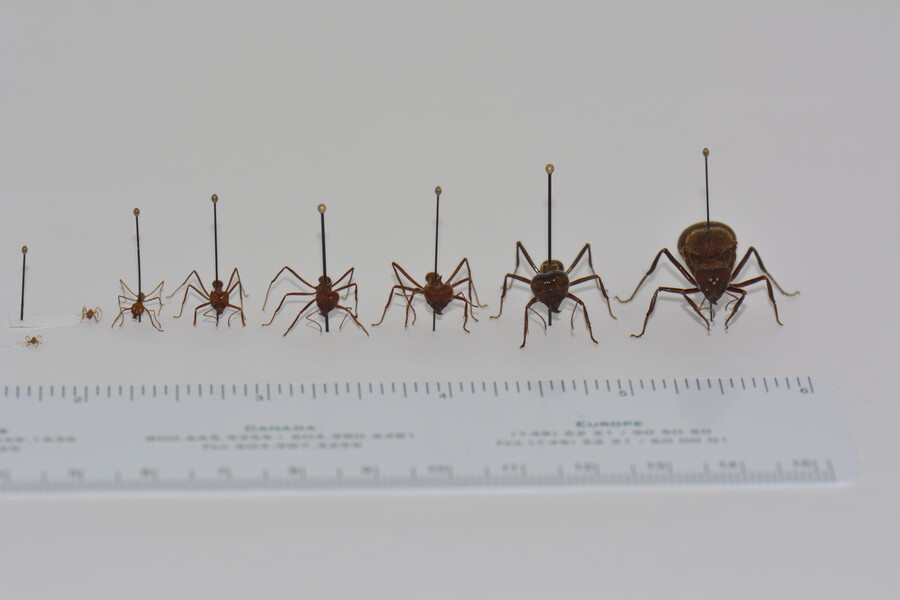
Within Atta cephalotes, or leafcutter ants, every role is pre-written in morphology, from curves of the mandible (jaws) to body size, scripting a precise division of labor. The hulking Major ants serve as sentinels, patrolling doorways and repelling intruders; the slightly more diminutive Media ants harvest leaf confetti for nimble Minors, the colony custodians and caretakers; and, at the tiniest tier, pin-sized Minima ants groom fungal gardens and cradle the brood.
Now, researchers led by Shelley Berger of the University of Pennsylvania, have revealed key elements of the leafcutters’ genetic code, pinpointing two signaling molecules that can be dialed up or down to reprogram ant duties. Crustacean cardioactive peptide (CCAP), elevated in Media ants, promotes leaf-harvesting tasks and can induce similar behavior in other subcastes. Neuroparsin-A (NPA), abundant in Majors, however, suppresses brood care and is linked to defensive patrols, alternately lowering its levels of NPA prompts caregiving behavior.
Reporting their findings in Cell, the researchers also uncovered a striking parallel: gene-expression patterns that govern division of labor in leafcutter ants mirror those in eusocial naked mole-rats—mammals that similarly abide by cooperative brood care—hinting at a convergent molecular mechanism dating back over 600 million years.
“We were amazed to see the apparent similarity of gene regulation between nurses and foragers of ants compared to naked mole-rat mammals—this was unexpected,” says Berger the Daniel S. Och Penn Integrates Knowledge University Professor with appointments in the School of Arts & Sciences and the Perelman School of Medicine. “Our results in ants reinforce how single neuropeptides can dramatically alter behavior, which may be applicable to human social behavior—although humans of course are much more complex.”
From carpenters to leafcutters
Building on previous research on the carpenter ants, which have a similar but simpler social organization consisting of two roles—forager and soldier—the team investigated several different neuropeptides in leafcutters to explore how these principles scaled up to the more nuanced four-subcaste structure of Major, Media, Minor, and Minim.
The researchers created 3D-printed behavioral chambers that allowed them to monitor how ants interacted with leaves, the brood, or fungus. These chambers enabled tracking and quantification of behavior through video analysis, demonstrating how altering CCAP and NPA levels in ants induced dramatic and reproducible shifts in their assigned tasks.
Meet the cast(e): from crumb-sized Minima to massive Majors, and winged queens poised for flight, Atta ants span a dramatic morphological range.
(Image: Courtesy of Tierney Scarpa)
“Generally speaking, specific neuropeptides are more abundant in certain castes, so we looked at the levels of neuropeptides in the brains of each caste,” explains Karl Glastad, assistant professor at the University of Rochester and former postdoctoral researcher in the Berger lab. “In Majors, the neuropeptide that dictates leafcutter behavior is low and the neuropeptide that stops nursing is high, so if we increase the former, it leads to leafcutter behavior, and if we decrease the latter, it leads to nursing and caretaking of brood.”
Glastad adds that these neuropeptides, once bound to their matching receptors, spark an intricate signaling cascade that ripples through gene networks, like a molecular Rube Goldberg machine, that leads to ants shifting from one specialized task to another.
Molecular mechanisms across kingdoms
To further explore the evolutionary depth and implications of this behavioral script, the team investigated naked mole-rats a distant evolutionary cousin whose subterranean colonies echo the caste-like harmony of leaf-cutter nests.
“At first, I thought incorporating naked mole-rats felt like a bit of a boondoggle,” laughs Glastad. “But we were amazed to discover that there’s actually a lot of similarities in the molecular regulation of these kinds of foraging and caretaking castes between the brains of these two species.”
Despite naked mole-rats lacking the exact neuropeptides like NPA found in ants, the researchers hypothesized that these peptides might still activate ancient, conserved pathways common to both species due to promiscuity of certain, more conserved receptors.
“When we saw these intriguing neuropeptide results, we pursued the idea that maybe this neuropeptide is plugging into some conserved gene pathways that convergently evolved in these very different animals to manage distinct behaviors,” Glastad explains. “And remarkably, we found substantial overlap—enough that the ant neuropeptide could even activate endogenous receptors in the naked mole-rat brain. Discovering that unexpected convergence was incredibly cool and, frankly, fortuitous.”
A novel role for insulin regulatory pathways?
The findings also reveal intriguing connections to insulin regulation pathways, known for their important role in sugar metabolism.
Particularly, insulin-like peptides such as Ilp1 were prominently expressed alongside NPA, suggesting a previously unappreciated interplay between neuropeptide signaling and insulin pathways in behavioral regulation.
From small to big, the size spectrum of Atta cephalotes workers reflects their caste, and their calling. But recent findings show that size isn’t destiny: With certain molecular nudges, even a hulking guard can be coaxed into nursery duty.
(Image: Courtesy of Tierney Scarpa)
“By discovering, essentially, that there’s this link between insulin and maternal caretaking behavior, both with naked mole-rats and then also with leafcutter ants, we speculate that this might open the door for potentially looking at how disorders in insulin regulation may affect these behaviors,” says first author Maxxum Fioriti, a graduate researcher in the Berger Lab.
“This connection launches new avenues for research into how insulin might regulate caregiving behaviors in mammals, potentially even humans,” Fioriti says, venturing that insulin resistance disorders like diabetes may affect maternal mental health and post-partum depression.
Extending to lifespan plasticity
Looking ahead, Berger’s team is keen to explore the persistence of biological plasticity as it relates to behaviors. They are also interested in extending their work to late life rejuvenation and lifespan plasticity because reproductive ant queens live much longer than workers that don’t reproduce.
Berger believes that epigenetics, the study of how gene activity can be turned on or off without changing the underlying DNA, offers powerful ways to understand not only behavioral plasticity but lifespan plasticity too.
“We’re really interested in how long the reprogrammed behavior persists, and what are the pathways for long-lived queens,” she says. “I think both phenomena are of enormous interest in mammalian and human biology—the long-term effects of the plasticity of behavior and lifespan we’re investigating.”
Speaking about future research on lifespan plasticity, Fioriti notes that one of the other ant species in the lab has amazing lifespan plasticity, “where instead of having just different behaviors, they can also switch between a long-lived queen versus a short-lived worker.”
“We have these comparisons of the ant behavior model with the naked mole-rat, and we’re also interested in seeing if we can couple understanding lifespan plasticity between ant and naked mole-rat as well,” Fioriti says.
Shelley Berger is the Daniel S. Och University Professor in the Departments of Cell and Developmental Biology at the Perelman School of Medicine and Biology at Penn Arts & Sciences and director of the Penn Epigenetics Institute.
Karl Glastad is an assistant professor of biology at the University of Rochester and a former postdoctoral researcher in the Berger Lab.
Maxxum Fioriti is a Ph.D. candidate at Penn Medicine and a researcher in the Berger Lab.
Other authors include Michael B. Gilbert, Matan Sorek, Tierney Scarpa, Freddy S. Purnell, Daniel Xu, Josue Baeza, Richard Lauman, Balint Z. Kacsoh, and Roberto Bonasio of the Perelman School of Medicine at Penn; Lindsay K. Pino of Talus Bioscience; Anatoly Korotkov, Ali Biashad, Andrei Seluanov, and Vera Gorbunova of the University of Rochester; Anastasiia Filippova and Mackenzie W. Mathis of the École Polytechnique Fédérale de Lausanne; and Benjamin A. Garcia of Washington University School of Medicine.
This work was supported by National Institutes of Health (Fellowships F32GM120933 and F31AG072777-03; grants NIA R01 AG055570, AG047200, and NIMH R01 MH131861); The Zuckerman STEM Leadership Post-Doctoral Program, and The Human Frontier Science Program.
On the move: Water quality and antimicrobial resistance testing goes mobile
Penn researchers have developed a mobile field laboratory allowing them to test water quality and track antimicrobial resistance in and around San Cristóbal in the Galápagos.
Penn researchers Vanessa and Alexis North are studying one of the largest collections of Egyptian blue objects ever found in the ancient Near East, shedding new light on how the world’s first synthetic pigment may have traveled far beyond Egypt.
A new role for dental providers? Rethinking where vaccines are given
Vaccinations have traditionally been administered in primary care settings or pharmacies. However, for about a decade, some states have authorized dentists to administer vaccines, and many others did so during the COVID-19 pandemic. The effectiveness of this approach has led some countries and states to expand or consider expanding the role of dental providers in delivering routine vaccines, including those against COVID-19 and the human papillomavirus (HPV), and in providing vaccine education.
Penn student develops a way for computer chips to run more efficiently
Fluid Silicon, a platform from President’s Sustainability Prize winner Nhlanhla Mavuso, allows computer chips to continuously monitor their health and self-tune as their characteristics change. The technology has the potential to reduce energy usage in data centers and improve reliability in mission-critical applications.