Beneath the surface: Diving into water’s hidden carbon-cleaning capabilities
Penn materials scientist Shoji Hall and colleagues have found that manipulating the surface of water can allow scientists to sustainably convert carbon monoxide to higher energy fuel sources like ethylene.
5 min. read
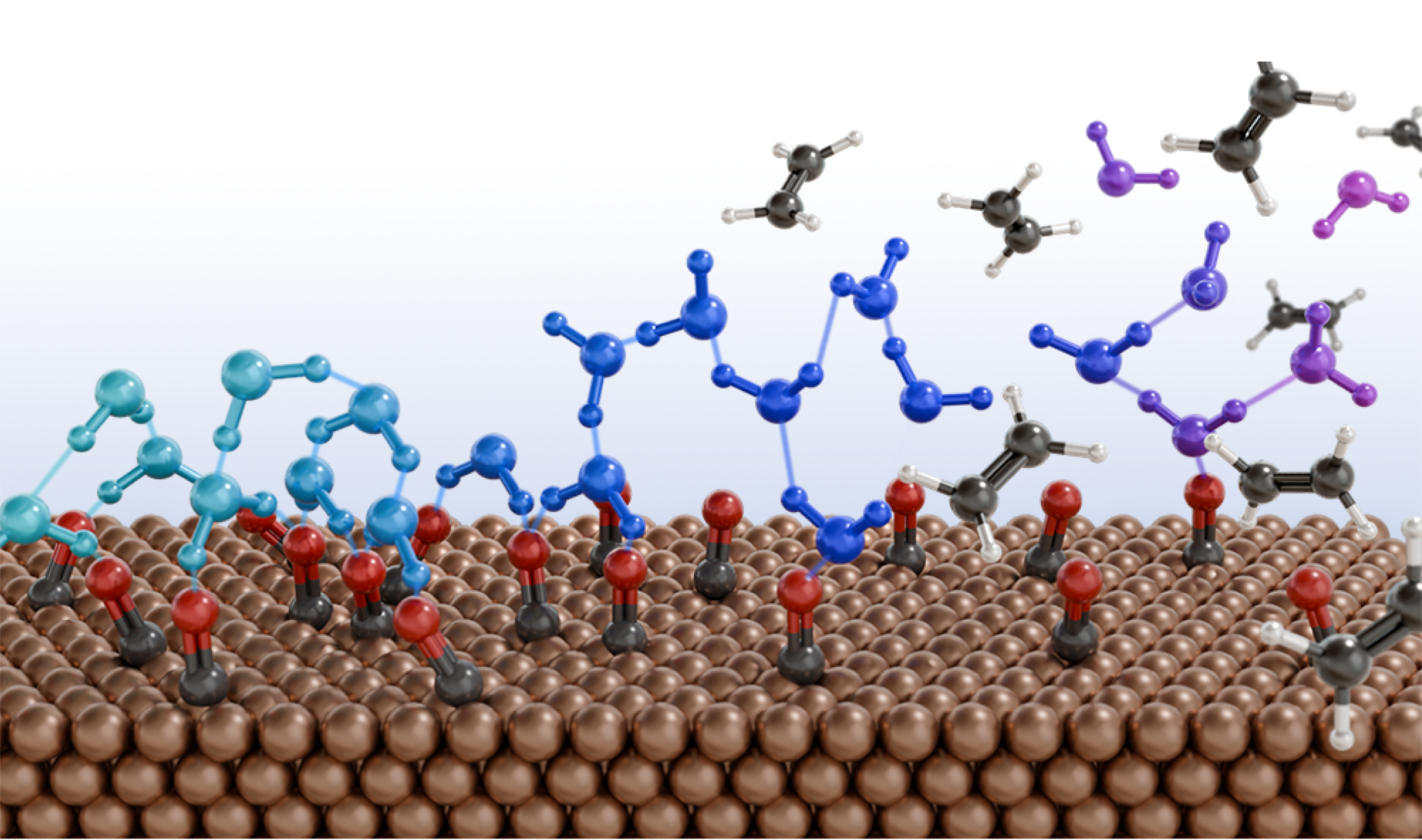
Water molecules become increasingly disordered at the surface of a catalyst. Researchers found that this disordered interfacial water, shown transitioning from structured (left) to disorganized (right), plays a key role in speeding up the conversion of carbon monoxide into ethylene, a valuable fuel and chemical building block.
(Image: Courtesy of Shoji Hall)
Key Takeaways
Penn Engineering's Shoji Hall and collaborators found that disrupting the structure of water at the metal surface dramatically boosts the conversion of carbon monoxide into ethylene.
The reaction is driven not by lowering energy barriers, but by increasing entropy, an unusual and powerful new lever in surface chemistry.
The findings position water not just as a solvent, but as a tunable co-designer in electrochemical systems for cleaner fuel production.
As human-made pollutants carbon monoxide (CO) and carbon dioxide (CO₂) continue to accumulate in Earth’s atmosphere, fueling climate change and threatening ecological balance, researchers are searching for new ways to recycle these chemicals into cleaner power sources and products.
Multi-carbon products like ethylene (C₂H₄) hold the promise to turn carbon’s doom into a boon. It’s a molecule held together by strong bonds formed by its carbon atoms sharing electrons. When these bonds are broken, like in combustion, they can release that stored energy as heat, making these compounds a useful fuel source. If they stay intact, they can serve as building blocks for countless manufactured goods, from packaging to textiles and pharmaceuticals.
But the chemistry behind turning CO and CO₂ into multi-carbon products like C₂H₄ is notoriously tricky. So much so, even popular metals like copper catalysts can often produce unwanted byproducts or waste energy in side reactions.
Now, researchers led by University of Pennsylvania materials scientist and engineer Anthony Shoji Hall have uncovered an unlikely ally in the fight to make good carbon-based products from carbon waste: the surface of water.
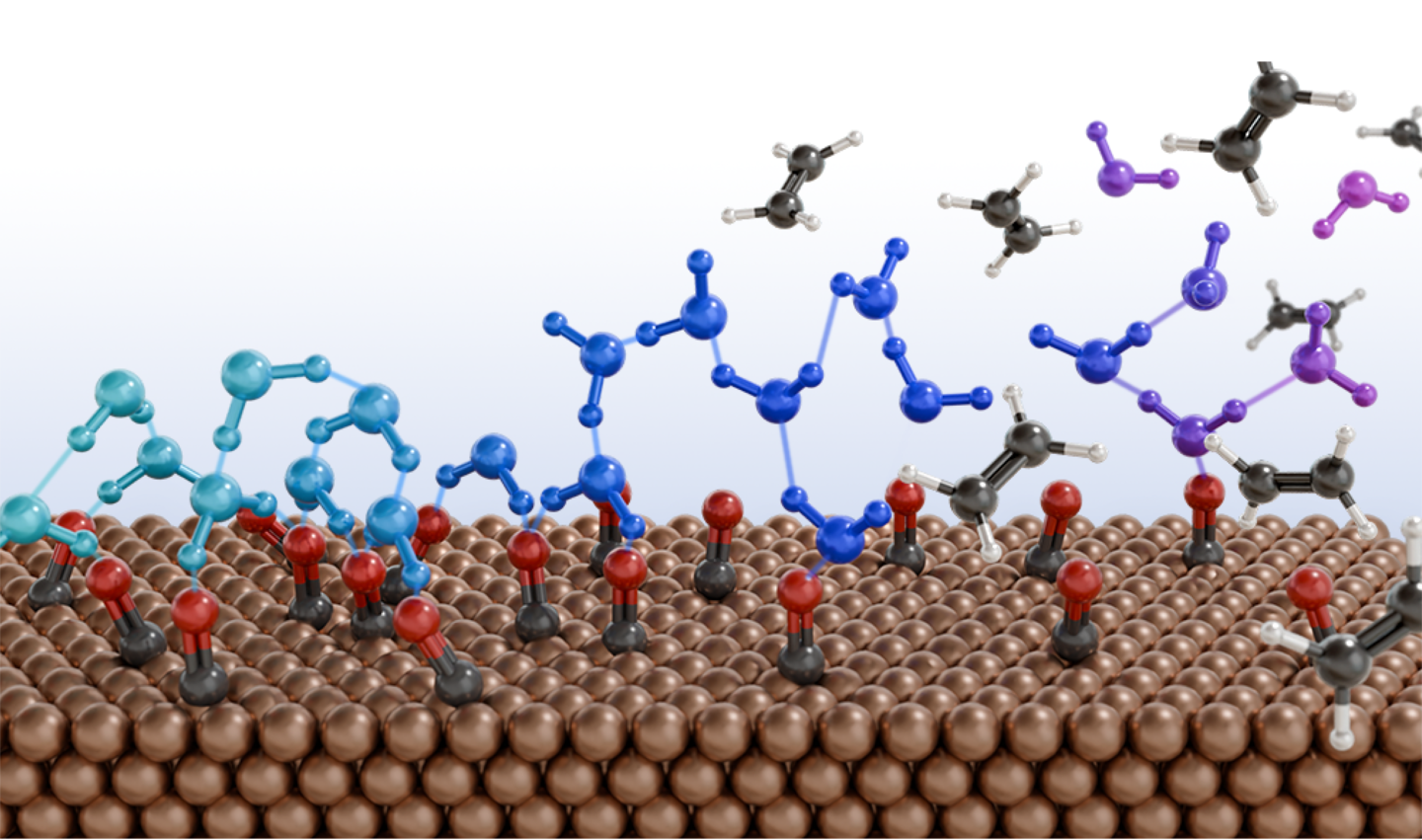
Water molecules become increasingly disordered at the surface of a catalyst. Researchers found that this disordered interfacial water, shown transitioning from structured (left) to disorganized (right), plays a key role in speeding up the conversion of carbon monoxide into ethylene, a valuable fuel and chemical building block.
(Image: Courtesy of Shoji Hall)
Their findings, published in Nature Chemistry, reveal that by precisely tuning the concentration of a salt called sodium perchlorate (NaClO₄) dissolved in water, the researchers could disrupt the neat, normally ordered hydrogen bonding network of water molecules right where the liquid meets metals like copper. This is a process known as electrochemical catalyzation—using electricity, water, and metal surfaces to drive faster the conversion of CO to multi-carbons like C₂H₄.
“This ‘jumble’ of water molecules at the interface—where liquid meets solid metal—turned out to be the missing spark for stitching carbon atoms together, a step that has long throttled our ability to convert CO into ethylene and other multi‑carbons,” says Hall, an associate professor in the Department of Materials Science and Engineering in the School of Engineering and Applied Science.
This hydrogen-bonded structure can be likened to a microscopic spiderweb, that when disrupted, becomes disordered, and that, it turns out, makes it easier for carbon atoms to join up and form larger products like ethylene.
“What excites me most is the simplicity,” he says. “If something as familiar as liquid water can be subtly adjusted to promote these reactions, we can start recycling problem gases like CO and CO₂ into valuable fuels or industrial chemicals without relying on exotic or expensive solvents.”
To test their hypothesis, the Hall Lab ran electrochemical reactions on copper-coated electrodes, which are metal surfaces that carry electrical current into the experimental environment. They submerged these into the salty water solution containing CO.
Gradually, they increased the amount of NaClO₄ in the water, allowing them to measure how efficiently CO was converted into various products such as ethylene, as well as the rate at which the reactions occurred as the water-based salty solution—or electrolyte—became more concentrated in NaClO₄.
Meanwhile, co-corresponding author David Raciti of the National Institute of Standards and Technology (NIST) used a specialized form of light-based chemical sample analysis to zoom in on the water layer right at the metal surface, enabling real-time monitoring as the NaClO₄levels rose.
As the NaClO₄ concentration increased from 0.01 to 10 molal, the system’s Faradaic efficiency—a measure of how many negatively charged particles (electrons) go toward making the desired products—jumped from 19% to 91%. Hydrogen gas, an unwanted byproduct, nearly disappeared. And ethylene emerged as the clear front-runner, with its production increasing eighteenfold.
To see if positively charged hydrogen atoms, or protons, were playing a role in driving the reaction speed instead of the entropy results they expected, the researchers swapped regular water for heavy water (deuterium oxide, or D₂O), which slows down proton transfer during.
Typically, in such electrochemical reactions, protons “shuttle” from water to surface-bound molecules, helping complete bonds and form products. But the researchers found the reaction was barely changed by proton movement but rather by entropy, or the growing disorder among water molecules at the interface that, somehow, made it easier for carbon atoms to link up.
“In most electrocatalysis studies, we focus on activation energy—the idea that lowering the energy barrier makes a reaction go faster,” says Hall. “But here, it’s entropy driving the reaction. That’s unusual, and it opens a new way of thinking about how to control surface chemistry.”
Beyond being a technical accomplishment, the implications are wide-ranging, as water is a universal component in electrochemical systems ranging from CO₂ conversion to battery design. Their work suggests that engineers may be able to fine-tune water’s interfacial structure—where water meets a surface—to coax better performance from a wide range of reactions.
“Electrochemistry is full of hidden levers,” Hall says. “And we think interfacial water structure is one of the biggest ones. With the right tools, we can stop treating water as just a solvent and start using it as a co-designer of the reaction environment.”
Looking ahead, Hall’s lab hopes to apply this strategy to more complex reactions, such as coupling carbon sources with nitrogen to produce fertilizer precursors. More broadly, the Hall Lab is exploring how interfaces can be engineered to guide chemical transformations with surgical precision.
Anthony Shoji Hall is an associate professor in the Department of Materials Science and Engineering at Penn Engineering.
The other authors are Hao Zhang of Johns Hopkins University and David Raciti of the National Institute of Standards and Technology.
This research was supported by the National Science Foundation (Awards CBET-2326720, CHE-2102648; and grant no. 2139757) and the American Chemistry Society Petroleum Research Fund.
On the move: Water quality and antimicrobial resistance testing goes mobile
Penn researchers have developed a mobile field laboratory allowing them to test water quality and track antimicrobial resistance in and around San Cristóbal in the Galápagos.
Penn researchers Vanessa and Alexis North are studying one of the largest collections of Egyptian blue objects ever found in the ancient Near East, shedding new light on how the world’s first synthetic pigment may have traveled far beyond Egypt.
A new role for dental providers? Rethinking where vaccines are given
Vaccinations have traditionally been administered in primary care settings or pharmacies. However, for about a decade, some states have authorized dentists to administer vaccines, and many others did so during the COVID-19 pandemic. The effectiveness of this approach has led some countries and states to expand or consider expanding the role of dental providers in delivering routine vaccines, including those against COVID-19 and the human papillomavirus (HPV), and in providing vaccine education.
Penn student develops a way for computer chips to run more efficiently
Fluid Silicon, a platform from President’s Sustainability Prize winner Nhlanhla Mavuso, allows computer chips to continuously monitor their health and self-tune as their characteristics change. The technology has the potential to reduce energy usage in data centers and improve reliability in mission-critical applications.