Twisting two-dimensional atomic sheets: A key to new materials for advanced technologies
A collaborative team of physicists in the School of Arts & Sciences have found that putting a twist on tungsten disulfide stacks illuminates new approaches to manipulate light.
A collaborative team of researchers led by Bo Zhen of the School of Arts & Sciences have created new materials by artificially twisting and stacking two-dimensional atomic “sheets.” New materials control light-matter interaction differently from constituent 2D atomic sheets, paving the way for next-generation laser, imaging, and quantum technologies.
(Image: istock / Sensvector)
The way light interacts with naturally occurring materials is well-understood in physics and materials science. But in recent decades, researchers have fabricated metamaterials that interact with light in new ways that go beyond the physical limits imposed on naturally occurring materials.
A metamaterial is composed of arrays of “meta-atoms,” which have been fabricated into desirable structures on the scale of about a hundred nanometers. The structure of arrays of meta-atoms facilitate precise light-matter interactions. However, the large size of meta-atoms relative to regular atoms, which are smaller than a nanometer, has limited the performance of metamaterials for practical applications.
Now, a collaborative research team led by Bo Zhen of the University of Pennsylvania has unveiled a new approach that directly engineers atomic structures of material by stacking the two-dimensional arrays in spiral formations to tap into novel light-matter interaction. This approach enables metamaterials to overcome the current technical limitations and paves the way for next-generation lasers, imaging, and quantum technologies. Their findings were recently published in the journal Nature Photonics.
“It's similar to stacking a deck of cards but twisting each card slightly before adding it to the pile,” says Zhen, a senior author of the paper and an assistant professor in the School of Arts & Sciences at Penn. “This twist changes how the entire ‘deck’ responds to light, enabling it to exhibit new properties that individual layers, or traditional stacks, do not possess.”
Bumho Kim, postdoctoral researcher in the Zhen Lab and first author of the paper, explains that by stacking layers of a material called tungsten disulfide (WS2) and twisting them at certain angles, they introduced what’s known as screw symmetries.
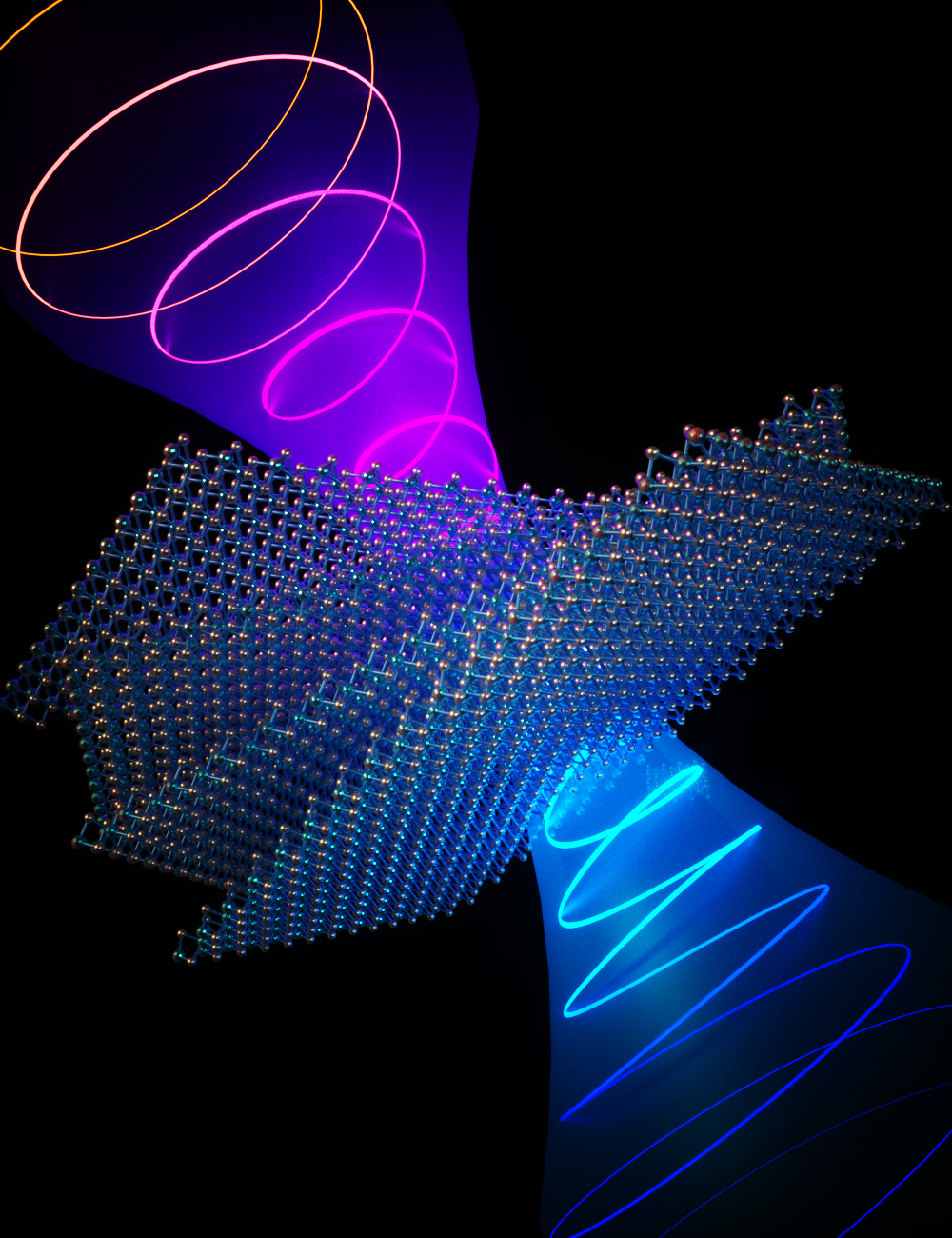
An artist’s impression of light traveling through twisted tungsten disulfide. It leads to a change in both color and orientation of the light field (helical light field), revealing novel properties not observed in natural tungsten disulfide.
(image: Courtesy of Ella Maru)
“The magic lies in controlling the twist,” Kim explains. “When you twist the layers at specific angles, you change the symmetry of the stack. Symmetry, in this context, refers to how certain properties of materials—like how they interact with light—are constrained by their spatial arrangement.”
By tweaking this arrangement at the atomic scale, the researchers have bent the rules of what these materials can do, and by controlling the twist across multiple layers of WS2, they created what’s known as 3D nonlinear optical materials.
Kim explains that a single layer of WS2 has particular symmetries, which allow certain types of interactions with light, where two photons at a given frequency can interact with the material to produce a new photon at double the frequency, a process known as second-harmonic generation (SHG).
“But, when two layers of WS2 are stacked with a twist angle different from the conventional 0° or 180°, all the mirror symmetries that were present in the single layer are broken,” says Kim. “This broken mirror symmetry is crucial because it leads to a chiral response—something entirely new and not seen in the individual layers.”
The researchers explain that the chiral response is significant because it is a cooperative effect resulting from the coupling between the electronic wavefunctions of the two layers, a phenomenon that can only arise in twisted interfaces.
An interesting property, Zhen adds, is that the sign of the chiral nonlinear response flips when the twist angle is reversed. This demonstrates direct control over the nonlinear properties by simply changing the twist angle between layers—a level of tunability that could be revolutionary for designing optical materials with custom responses.
Moving from bilayers to trilayers and beyond, the researchers observed how the interfacial SHG responses can constructively or destructively interfere depending on the twist angles between the layers.
In a stack with layers in multiples of four, “the chiral responses from all interfaces add up, while the in-plane responses cancel out,” says Kim. “This leads to a new material that exhibits only chiral nonlinear susceptibilities. This result could not be achieved without the precise stacking and twisting of the layers.”
The researchers found that screw symmetry enables new selectivity for the light’s electric field in the material, a part of light that determines its direction and intensity Kim notes how they found that screw symmetry enables a new kind of light generation in twisted four- and eight-layer stacks, counter-circularly polarized third harmonic generation, wherein light travels in the opposite spiral direction—a quality not seen in constituent WS2 monolayers.
“Adding an artificial screw symmetry allows us to control nonlinear optical circular selectivity at the nanoscale,” Kim says.
In testing this technique experimentally, the researchers verified the predicted nonlinearities inherent in various configurations of twisted WS2 stacks. The team observed new nonlinear responses and circular selectivity in twisted WS2 stacks that cannot be found in naturally occurring WS2, a revelation that could have profound implications in the field of nonlinear optics.
Bo Zhen is an assistant professor in the Department of Physics and Astronomy in the School of Arts & Sciences at the University of Pennsylvania.
Bumho Kim is a postdoctoral researcher in the Department of Physics and Astronomy in the School of Arts & Sciences at Penn.
Other authors are Jicheng Jin, Zhi Wang, Li He, and Eugene Mele of the University of Pennsylvania; and Thomas Christensen of the Massachusetts Institute of Technology and the Technical University of Denmark.
The research was supported by the Office of Naval Research (Grant N00014-20-1-2325 and N00014-21-1-2703) and Department of Energy (Grant DE-FG02-84ER45118).
On the move: Water quality and antimicrobial resistance testing goes mobile
Penn researchers have developed a mobile field laboratory allowing them to test water quality and track antimicrobial resistance in and around San Cristóbal in the Galápagos.
Penn researchers Vanessa and Alexis North are studying one of the largest collections of Egyptian blue objects ever found in the ancient Near East, shedding new light on how the world’s first synthetic pigment may have traveled far beyond Egypt.
A new role for dental providers? Rethinking where vaccines are given
Vaccinations have traditionally been administered in primary care settings or pharmacies. However, for about a decade, some states have authorized dentists to administer vaccines, and many others did so during the COVID-19 pandemic. The effectiveness of this approach has led some countries and states to expand or consider expanding the role of dental providers in delivering routine vaccines, including those against COVID-19 and the human papillomavirus (HPV), and in providing vaccine education.
Penn student develops a way for computer chips to run more efficiently
Fluid Silicon, a platform from President’s Sustainability Prize winner Nhlanhla Mavuso, allows computer chips to continuously monitor their health and self-tune as their characteristics change. The technology has the potential to reduce energy usage in data centers and improve reliability in mission-critical applications.