Things to know: Can data from the Large Hadron Collider snap string theory?
Penn theoretical physicists collaborate on work that tests the fallibility of a framework that seeks to unite physics across the universe.
10 min. read
Theoretical physicist Jonathan Heckman of the School of Arts & Sciences has put a spin on ideas related to testing string theory: Rather than looking to verify it, he and his collaborators sought a novel way to falsify it with data from the Large Hadron Collider at CERN.
(Image: Courtesy of Getty)
Key Takeaways
Researchers from Penn and Arizona State University pinpoint a lone five-particle package (a 5-plet) that could upend string theory if detected at the Large Hadron Collider.
“Ghost” tracks that vanish mid-flight may be the smoking gun these physicists are chasing.
Early data squeeze the search window, but the next collider runs could make—or break—the case for string theory.
In physics, there are two great pillars of thought that don’t quite fit together. The Standard Model of particle physics describes all known fundamental particles and three forces: electromagnetism, the strong nuclear force, and the weak nuclear force. Meanwhile, Einstein’s general relativity describes gravity and the fabric of spacetime.
However, these frameworks are fundamentally incompatible in many ways, says Jonathan Heckman, a theoretical physicist at the University of Pennsylvania. The Standard Model treats forces as dynamic fields of particles, while general relativity treats gravity as the smooth geometry of spacetime, so gravity “doesn’t fit into physics’ Standard Model,” he explains.
In a recent paper, Heckman; Rebecca Hicks, a Ph.D. student at Penn’s School of Arts & Sciences; and their collaborators turn that critique on its head. Instead of asking what string theory predicts, the authors ask what it definitively cannot create. Their answer points to a single exotic particle that could show up at the Large Hadron Collider (LHC). If that particle appears, the entire string-theory edifice would be, in Heckman’s words, “in enormous trouble.”
Penn Today caught up with Heckman and Hicks to learn more about string theory and why falsifying it is important.
String theory: the good, the bad, the energy-hungry
For decades, physicists have sought a unified theory that can reconcile quantum mechanics,and, by extension, the behavior of subatomic particles, with gravity—which is described as a dynamic force in general relativity but is not fully understood within quantum contexts, Heckman says.
A good contender for marrying gravity and quantum phenomena is string theory, which posits that all particles, including a hypothetical one representing gravity, are tiny vibrating strings and which promises a single framework encompassing all forces and matter.
“But one of the drawbacks of string theory is that it operates in high-dimensional math and a vast ‘landscape’ of possible universes, making it fiendishly difficult to test experimentally,” Heckman says, pointing to how string theory necessitates more than the familiar four dimensions— x, y, z, and time—to be mathematically consistent.
“Most versions of string theory require a total of 10 or 11 spacetime dimensions, with the extra dimensions being sort of ‘curled up’ or folding in on one another to extremely small scales,” Hicks says.
To make matters even trickier, string theory’s distinctive behaviors only clearly reveal themselves at enormous energies, “those far beyond what we typically encounter or even generate in current colliders,” Heckman says.
Hicks likens it to zooming in on a distant object: at everyday, lower energies, strings look like regular point-like particles, just as a faraway rope might appear to be a single line. “But when you crank the energy way up, you start seeing the interactions as they truly are—strings vibrating and colliding,” she explains. “At lower energies, the details get lost, and we just see the familiar particles again. It’s like how from far away, you can’t make out the individual fibers in the rope. You just see a single, smooth line.”
That’s why physicists hunting for signatures of string theory must push their colliders—like the LHC—to ever-higher energies, hoping to catch glimpses of fundamental strings rather than just their lower-energy disguises as ordinary particles.
Why serve string theory a particle it likely won’t be able to return?
Testing a theory often means searching for predictions that confirm its validity. But a more powerful test, Heckman says, is finding exactly where a theory fails. If scientists discover that something a theory forbids actually exists, the theory is fundamentally incomplete or flawed.
Because string theory’s predictions are vast and varied, the researchers instead asked if there’s a simple particle scenario that string theory just can’t accommodate.
They zeroed in on how string theory deals with particle “families,” groups of related particles bound together by the rules of the weak nuclear force, responsible for radioactive decay. Typically, particle families are small packages, like the electron and its neutrino sibling, that form a tidy two-member package called a doublet. String theory handles these modest particle families fairly well, without issue.
However, Heckman and Hicks identified a family that is conspicuously absent from any known string-based calculation: a five-member particle package, or a 5-plet. Heckman likens this to trying to order a Whopper meal from McDonald’s, “no matter how creatively you search the menu, it never materializes.”
“We scoured every toolbox we have, and this five-member package just never shows up,” Heckman says.
But what exactly is this elusive 5-plet?
Hicks explains it as an expanded version of the doublet, “the 5-plet is its supersized cousin, packing five related particles together.”
Physicists encapsulate this particle family in a concise mathematical formula known as the Lagrangian, essentially the particle-physics cookbook. The particle itself is called a Majorana fermion, meaning it acts as its own antiparticle, akin to a coin that has heads on both sides.
Identifying such a particle would directly contradict what current string theory models predict is possible, making the detection of this specific particle family at the LHC a high-stakes test, one that could potentially snap string theory.
Why a 5-plet hasn’t been spotted and the vanishing-Track clue
Hicks cites two major hurdles for spotting these 5-plet structures: “production and subtlety.”
In a collider, energy can literally turn into mass; Einstein’s E = mc² says that enough kinetic oomph (E) can be converted into the heft (m) of brand-new particles, so the heavier the quarry the rarer the creation event.
“The LHC has to slam protons together hard enough to conjure these hefty particles out of pure energy,” Hicks explains, citing Einstein’s E = mc², which directly links energy (E) to mass (m). “As the masses of these particles climb toward a trillion electron volts, the chance of creating them drops dramatically.”
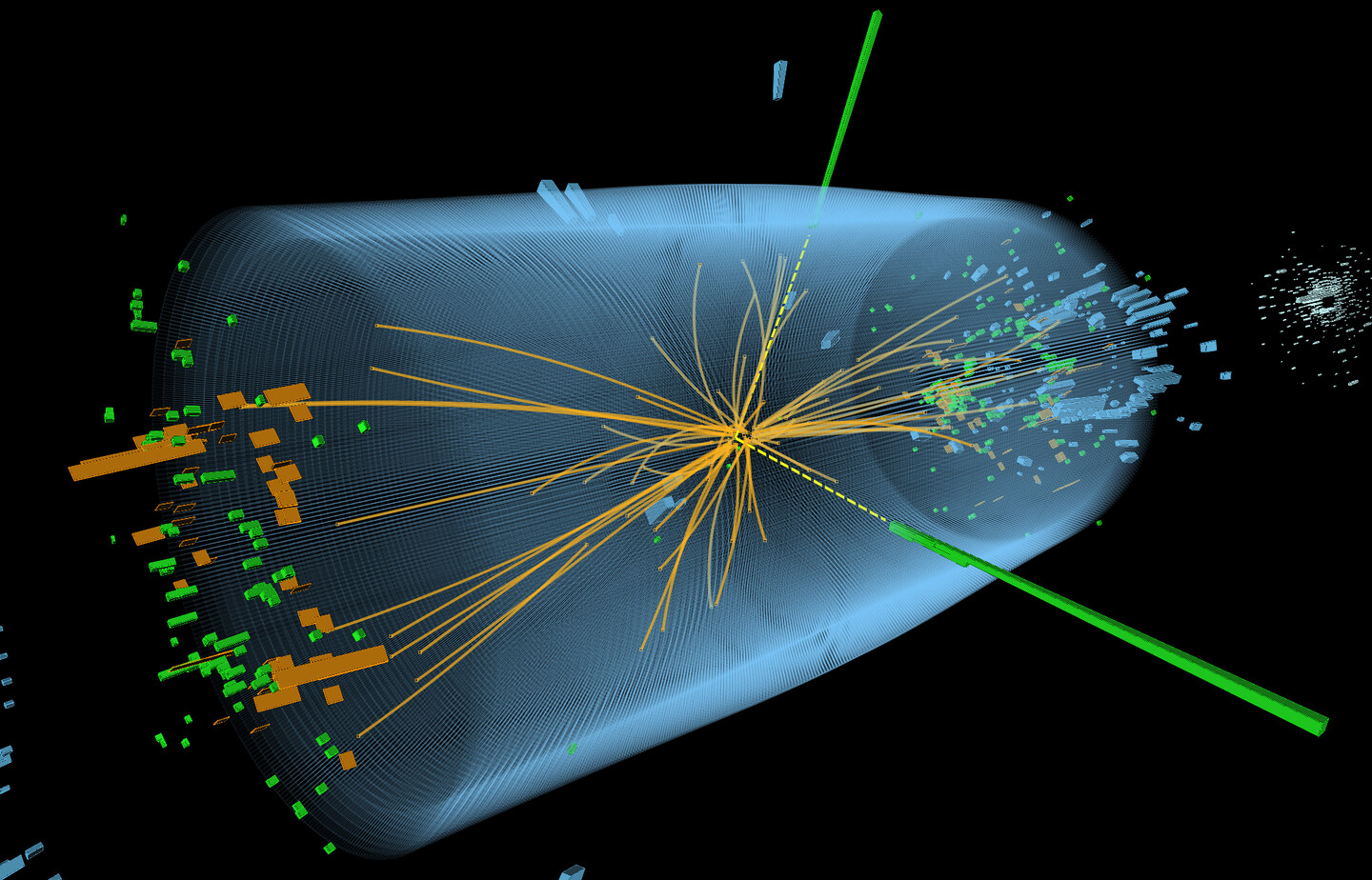
CMS (Compact Muon Solenoid) event display of a 2012 proton-proton collision, its golden sprays tracing the tell-tale Higgs-to-two-photon decay. The same precision tracking that captured this landmark Standard Model moment now fuels the hunt for disappearing “ghost” tracks, the subtle clues that could challenge string theory’s grip on the universe.
(Image: Courtesy of CERN)
Even if produced, detection is challenging. The charged particles in the 5-plet decay very quickly into nearly invisible products. “The heavier states decay into a soft pion and an invisible neutral particle, zero (X0),” Hicks says. “The pion is so low-energy it’s basically invisible, and X0 passes straight through. The result is a track that vanishes mid-detector, like footprints in snow suddenly stopping.”
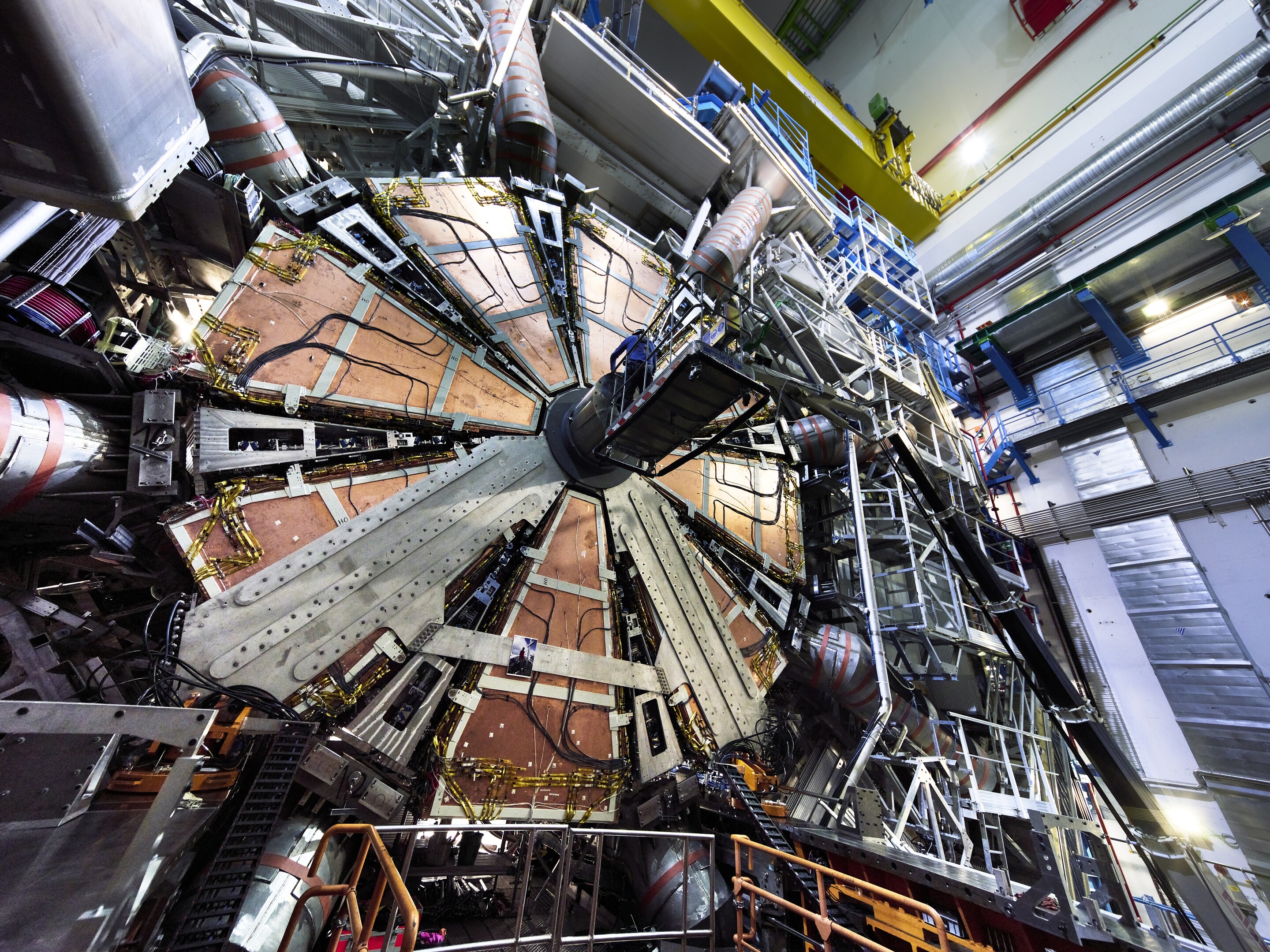
Those signature tracks get picked up by LHC’s ATLAS (short for A Toroidal LHC ApparatuS) and CMS (Compact Muon Solenoid), house-sized “digital cameras” wrapped around the collision center. They sit at opposite collision points and operate independently, giving the physics community two sets of eyes on every big discovery. Penn physicists like Hicks are part of the ATLAS Collaboration, helping perform the searches that look for quirky signals like disappearing tracks.
What the LHC has already ruled out
Using existing ATLAS data from collider runs, the team searched specifically for 5-plet signals.
“We reinterpreted searches originally designed for ‘charginos’—hypothetical charged particles predicted by supersymmetry—and looked for 5-plet signatures,” Hicks says of the team’s search through the repurposed ATLAS disappearing-track data. “We found no evidence yet, which means any 5-plet particle must weigh at least 650–700 GeV, five times heavier than the Higgs boson.”
For context, Heckman says, “this early result is already a strong statement; it means lighter 5-plets don’t exist. But heavier ones are still very much on the table."
Future searches with upgraded LHC experiments promise even sharper tests.
“We're not rooting for string theory to fail,” Hicks says. “We're stress-testing it, applying more pressure to see if it holds up."
“If string theory survives, fantastic," Heckman says. "If it snaps, we'll learn something profound about nature.”
ATLAS’s wheel-like end-cap reveals the maze of sensors primed to catch proton smash-ups at the LHC. Researchers comb through billions of events in search of fleeting “ghost” tracks that might expose cracks in string theory.
(Image: Courtesy of CERN)
Jonathan Heckman is a professor at the School of Arts & Sciences’ Department of Physics and Astronomy, with a secondary appointment in the Department of Mathematics.
Rebecca Hicks is a Ph.D. student in the Department of Physics and Astronomy at Penn Arts & Sciences.
Other authors include Matthew Baumgart and Panagiotis Christeas of Arizona State University.
This work received support from the Department of Energy (awards DE-SC0019470 and DE-SC0013528), the U.S.-Israel Binational Science Foundation (Grant No. 2022100), and the National Science Foundation.
On the move: Water quality and antimicrobial resistance testing goes mobile
Penn researchers have developed a mobile field laboratory allowing them to test water quality and track antimicrobial resistance in and around San Cristóbal in the Galápagos.
Penn researchers Vanessa and Alexis North are studying one of the largest collections of Egyptian blue objects ever found in the ancient Near East, shedding new light on how the world’s first synthetic pigment may have traveled far beyond Egypt.
A new role for dental providers? Rethinking where vaccines are given
Vaccinations have traditionally been administered in primary care settings or pharmacies. However, for about a decade, some states have authorized dentists to administer vaccines, and many others did so during the COVID-19 pandemic. The effectiveness of this approach has led some countries and states to expand or consider expanding the role of dental providers in delivering routine vaccines, including those against COVID-19 and the human papillomavirus (HPV), and in providing vaccine education.
Penn student develops a way for computer chips to run more efficiently
Fluid Silicon, a platform from President’s Sustainability Prize winner Nhlanhla Mavuso, allows computer chips to continuously monitor their health and self-tune as their characteristics change. The technology has the potential to reduce energy usage in data centers and improve reliability in mission-critical applications.