Penn pioneers a ‘one-pot platform’ to promptly produce mRNA delivery particles
New lipid platform enables rapid synthesis of molecules that can shuttle therapeutics for a range of diseases with a high degree of organ specificity.
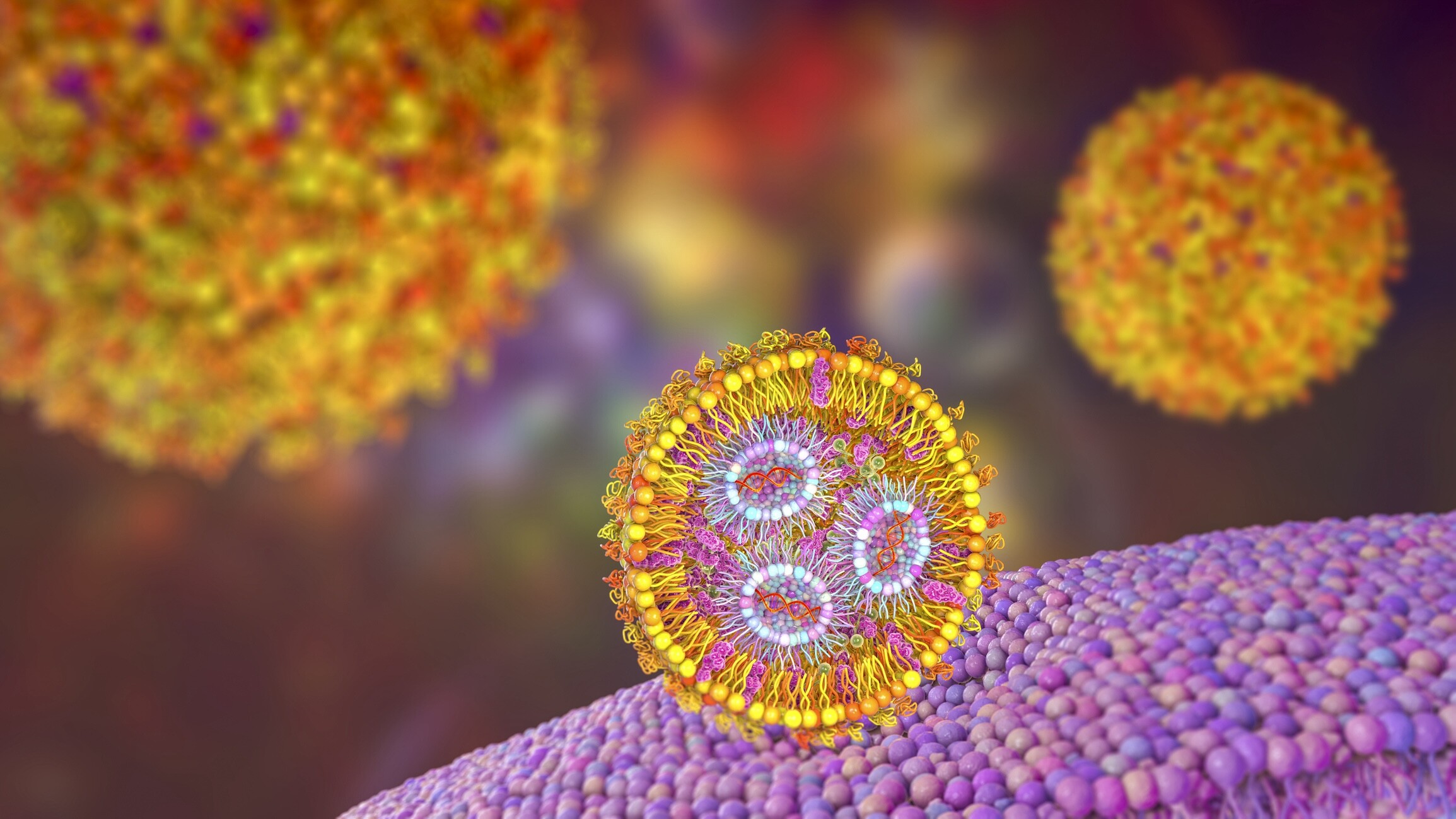
Lipid nanoparticles present one of the most advanced drug delivery platforms to shuttle promising therapeutics such as mRNA but are limited by the time it takes to synthesize cationic lipids, a key component. Now, Michael Mitchell and his team at the School of Engineering and Applied Science have developed a faster way to make cationic lipids that are also more versatile, able to carry different kinds of treatments to target specific organs.
(Image: iStock / Dr_Microbe)
Imagine a scenario where a skilled hacker must upload critical software to update a central server and thwart a potentially lethal virus from wreaking havoc across a vast computer network. The programmer, armed with the lifesaving code, must navigate through treacherous territory teeming with adversaries, and success hinges on promptly getting a safe, stealthy delivery vehicle that can place the hacker exactly where they need to be.
In the context of modern medicine, messenger RNA (mRNA) serves as the hacker, carrying genetic instructions to produce specific proteins within cells that can induce desired immune responses or sequester maladaptive cellular elements. Lipid nanoparticles (LNPs) are the stealthy delivery vehicles that transport these fragile mRNA molecules through the bloodstream to their target cells, overcoming the body’s defenses to deliver their payload safely and efficiently.
However, much like building an advanced stealth vehicle, the synthesis of cationic lipids—a type of lipid molecule that’s positively charged and a key component of LNPs—is often a time-consuming process, involving multiple steps of chemical synthesis and purification.
Now, Michael Mitchell and a team at the University of Pennsylvania have addressed this challenge with a novel approach that leverages a compound library fabrication technique known as “click-like chemistry” to create LNPs in a single, simple step. Their findings, published in the journalNature Chemistry, show that this method not only speeds up the synthesis process but also presents a way to equip these delivery vehicles with a “GPS” to better target specific organs such as the liver, lungs, and spleen, potentially opening new avenues for treating a range of diseases that arise in these organs.
“We’ve developed what we call an amidine-incorporated degradable (AID) lipid, a uniquely structured biodegradable molecule,” Mitchell says. “Think of it as an easy-to-build custom mRNA vehicle with a body kit that informs its navigation system. By adjusting its shape and degradability, we can enhance mRNA delivery into cells in a safe manner. By adjusting the amount of the AID lipid that we incorporate into the LNP, we can also guide it to different organs in the body, much like programming different destinations into a GPS.”
First author Xuexiang Han, a former postdoctoral researcher in the Mitchell Lab, explains that their new approach allows the rapid creation of diverse lipid structures in just an hour, compared to the weekslong process traditionally required.
“The result is a significant acceleration in the development and testing of AID-lipids,” he says. “This will enable us to explore a broader range of lipid compositions and their effects on mRNA delivery.”
To achieve these accelerated AID-lipid builds, the researchers made use of a tandem multicomponent reaction (T-MCR) to synthesize the AID-lipids, a process that involves combining chemical compounds—an amine, thiol, and acrylate—in a single step to produce diverse lipid structures rapidly. The one-pot synthesis approach significantly reduces the time needed to produce cationic lipids, making it a more efficient and scalable solution for mRNA-LNP delivery.
Mitchell’s team synthesized 100 different AID-lipids, which were then formulated into LNPs. The resulting LNPs were tested for their ability to deliver mRNA to various organs in animal models, which showed the team they could target specific organs with high precision.
A key feature of these AID-lipids is their ability to incorporate degradable components, ensuring that the LNPs break down safely within the body after delivering their mRNA payload. This biodegradability is essential for minimizing potential side effects and ensuring that the therapeutic agents do not accumulate in the body over time. The researchers demonstrated that the AID-lipid LNPs could effectively deliver mRNA encoding functional proteins, highlighting their potential for use in a wide range of therapeutic applications.
Another significant finding was the identification of a distinct head (or tail) ring-alkyl aniline structure that proved particularly effective in enhancing mRNA delivery. This structure, which the team dubbed the “wedge effect,” enables the LNPs to penetrate cellular membranes more efficiently, facilitating the release of mRNA into the target cells. The study showed that LNPs with this structure achieved higher transfection efficiencies and greater protein expression levels compared to LNPs without this structure.
The researchers also explored the potential of AID-lipid LNPs to deliver mRNA vaccines targeting specific immune cells and demonstrated that these LNPs could selectively transfect antigen-presenting cells in the spleen, a critical step for inducing robust immune responses. "This finding opens up new possibilities for developing mRNA-based vaccines that can precisely target and activate the immune system, potentially leading to more effective and long-lasting immunity against various diseases," Han says.
As Mitchell and the team continue to refine their platform, they are focusing on even more precise targeting, particularly in the lungs.
“We’re now working on guiding our vehicles past the initial barrier of blood vessels to reach deeper into lung tissue,” Mitchell says. “It’s a bit like programming our delivery system to navigate through increasingly complex security layers.”
Xuexiang Han is a former postdoctoral researcher in the Mitchell Lab at Penn Engineering and currently a professor in the Shanghai institute of biochemistry and cell biology, Chinese Academy of Sciences.
Other authors include Mohamad-Gabriel Alameh, Goutham Bojja, Garima Dwivedi, Majed Ghattas Claude C. Warzecha, Drew Weissman, and James M. Wilson of the Perelman School of Medicine; Rakan El-Mayta, Ningqiang Gong, Junchao Xu, and Lulu Xue of Penn Engineering; Andrew E. Vaughan and Gan Zhao of the School of Veterinary Medicine at Penn; and Ying Xu of Case Western Reserve University.
This research was supported by the National Institutes of Health (Award DP2 TR002776), a Burroughs Wellcome Fund Career Award at the Scientific Interface, the National Science Foundation (Award CBET-2145491), and the American Cancer Society Research Scholar (Grant RSG-22-122-01-ET). The researchers also received support from a sponsored research agreement with iECURE.
On the move: Water quality and antimicrobial resistance testing goes mobile
Penn researchers have developed a mobile field laboratory allowing them to test water quality and track antimicrobial resistance in and around San Cristóbal in the Galápagos.
Penn researchers Vanessa and Alexis North are studying one of the largest collections of Egyptian blue objects ever found in the ancient Near East, shedding new light on how the world’s first synthetic pigment may have traveled far beyond Egypt.
A new role for dental providers? Rethinking where vaccines are given
Vaccinations have traditionally been administered in primary care settings or pharmacies. However, for about a decade, some states have authorized dentists to administer vaccines, and many others did so during the COVID-19 pandemic. The effectiveness of this approach has led some countries and states to expand or consider expanding the role of dental providers in delivering routine vaccines, including those against COVID-19 and the human papillomavirus (HPV), and in providing vaccine education.
Penn student develops a way for computer chips to run more efficiently
Fluid Silicon, a platform from President’s Sustainability Prize winner Nhlanhla Mavuso, allows computer chips to continuously monitor their health and self-tune as their characteristics change. The technology has the potential to reduce energy usage in data centers and improve reliability in mission-critical applications.