Building bridges: A feat of engineering and artistry
At the Corning Museum of Glass, professor of architecture Masoud Akbarzadeh and his team have turned fragility into strength with a 30-foot-long span of shimmering glass, blending ancient wisdom with cutting-edge design to redefine the future of structural engineering and architecture.
9 min. read
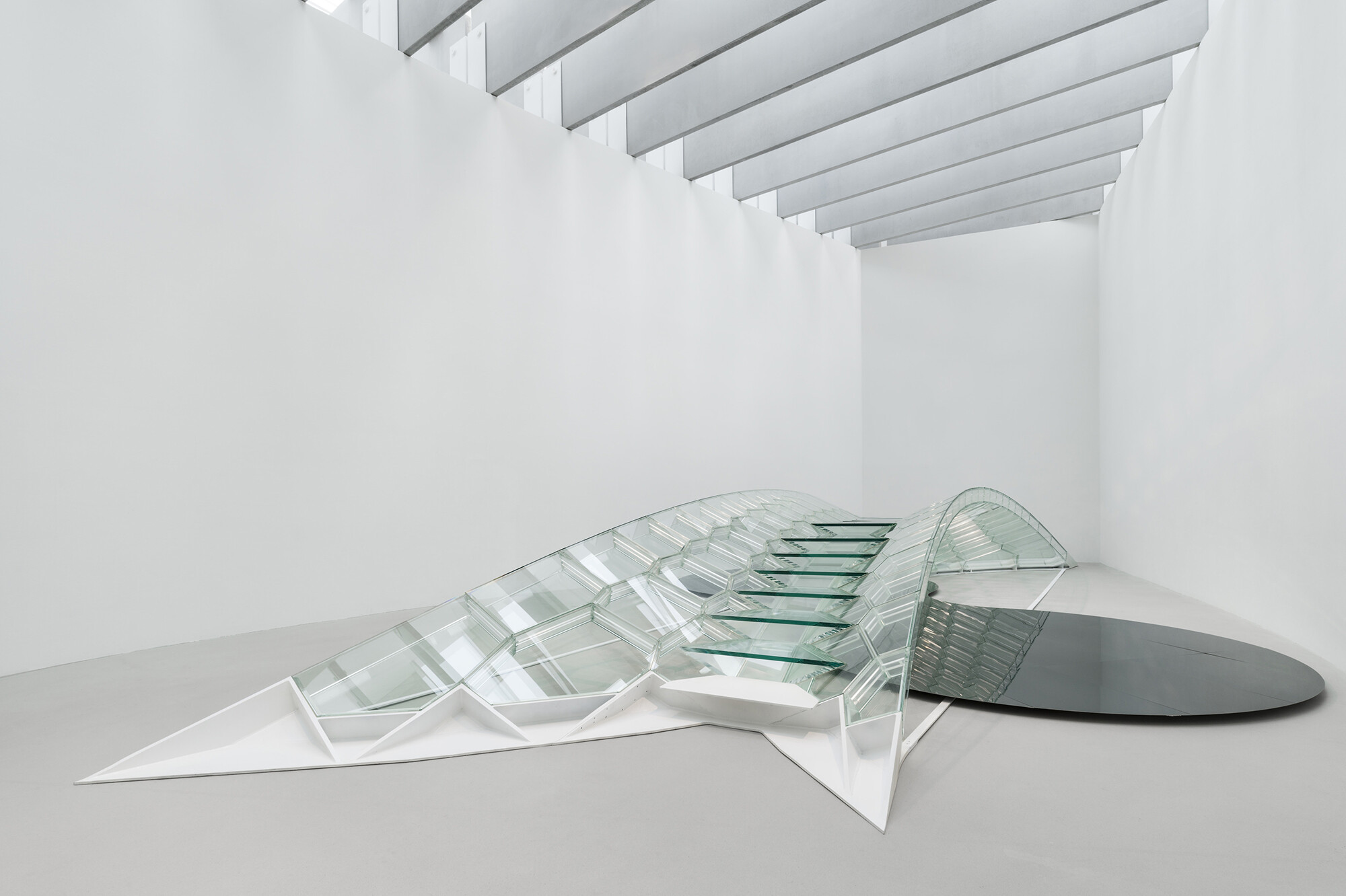
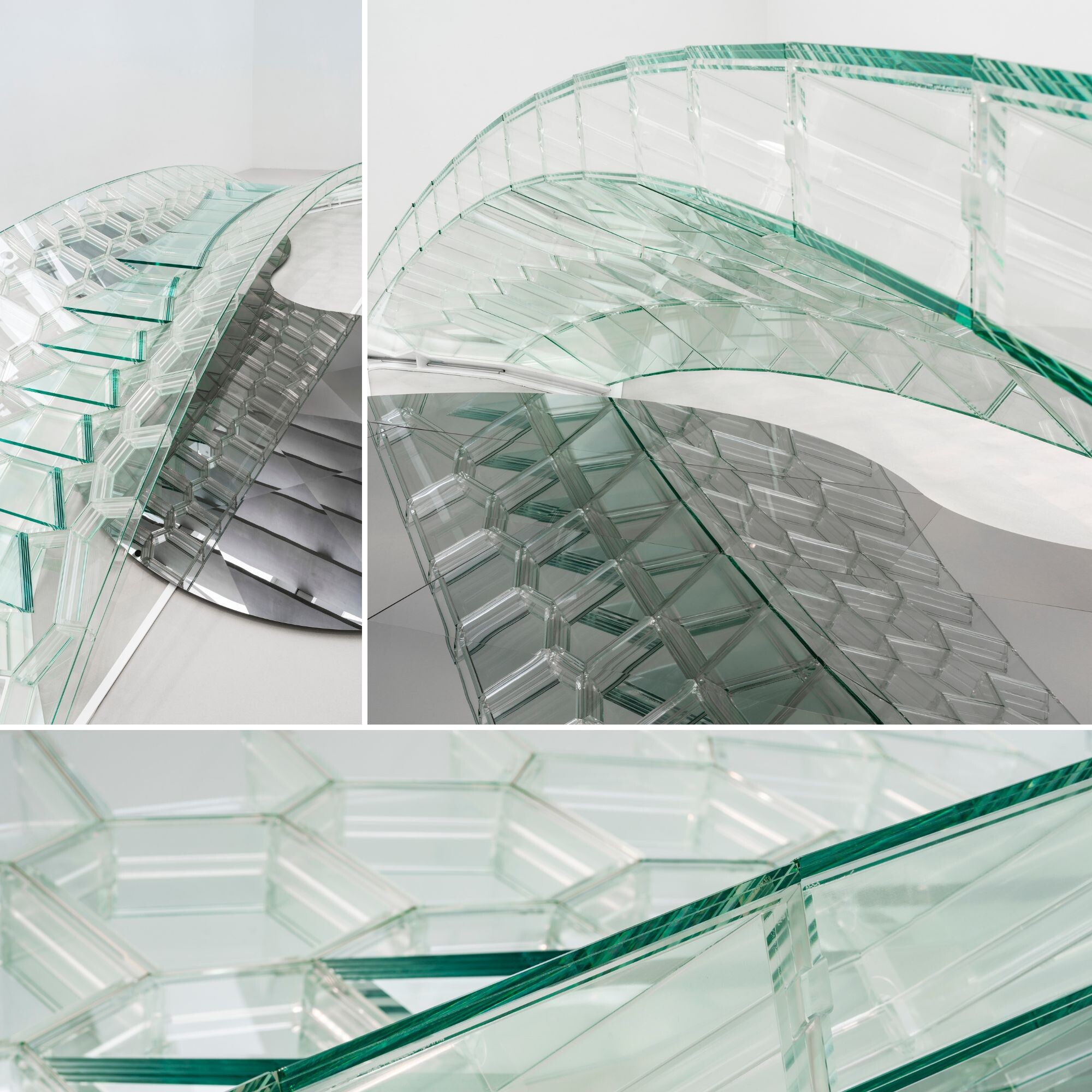
Architect Masoud Akbarzadeh and research assistant Boyu Xiao of the Weitzman School of Design, along with collaborators including Yao Lu of Jefferson University, defied conventional engineering by constructing a 30-foot-long bridge entirely from 16 millimeter hollow glass units. Their effort is now showcased at the Corning Museum of Glass.
(Image: Courtesy of the Corning Museum of Glass)
When was the last time you crossed a bridge?
If you live in Philadelphia, chances are it was today—maybe even several times. With more than 500 bridges crisscrossing the city, they are part an integral part of daily life. In a city defined by its rivers, bridges make possible the connections between people.
Where traditional bridges connect two sides of a chasm, architect and structural engineer Masoud Akbarzadeh has taken this challenge further, constructing one out of a material that conventional wisdom says should not be used for a bridge at all: glass.
The result is a breathtaking 30-foot-long structure composed entirely of interlocking hollow glass units. At first glance, the bridge appears impossibly delicate, an ethereal span of translucent polygons that shimmer under light.
“Bridges are more than mere structures spanning rivers and chasms; they symbolize physical and metaphorical connections,” says Akbarzadeh, an associate professor of architecture at the Weitzman School of Design. “As pathways between two points, they embody the human endeavor to overcome distances and unite disparate realms. Yet, beyond their practical utility, bridges serve as potent symbols of solidarity, understanding, and collaboration.”
The Glass Bridge eliminates the need for traditional reinforcements like steel, instead harnessing glass’s strength within a compression-dominant structural form.
“All these pieces alone, hollow glass units, might seem quite brittle—and they are,” Akbarzadeh says, “but depending on how you design to put these glass units together, they start relying on each other, and the units’ assembly establishes a path for the load to be transferred efficiently. Thus, the bridge gains strength as a whole.”
Akbarzadeh likens this notion of the pieces forming a greater, more powerful whole to human society, noting that “for a better-functioning society, we need to rely on each other. We need to trust each other, and together, only with transparency, we can work and unite to create an advancing world that serves the people in it.”
He and his team fabricated the bridge over the course of three weeks in 2024. According to Boyu Xiao, a 2024 Weitzman master of architecture graduate who currently works as a research assistant in Akbarzadeh’s Polyhedral Structures Laboratory, “the process was a test of both engineering ingenuity and sheer physical endurance.”
The bridge, formally known as“Glass Bridge: The Penn Monument for Hope,” stands tall, on display at the Corning Museum of Glass, where it will remain until Sept. 1. Leading up to its unveiling at the Museum, Greenhouse Media met with members of the team and documented the process of fabrication for an upcoming documentary.
But its journey to completion was anything but simple. It took six years of planning, drafting, revising, and negotiating with vendors around the world to get the blueprints ready. And in just 21 intense days last November, a rotating team of architects, engineers, researchers, and fabricators converged in Corning, New York, each playing a crucial role in bringing the structure to life.
Building on millennia of intuitive wisdom and scientific precision
In the summer of 2017, a year into his tenure at Penn, Akbarzadeh began the initial conceptualization and design of what would eventually become the Glass Bridge. “At the beginning, it was just an idea about using thin sheets of glass to build a super-efficient structure,” Akbarzadeh says. “But it very quickly grew into a larger study of structural resilience.”
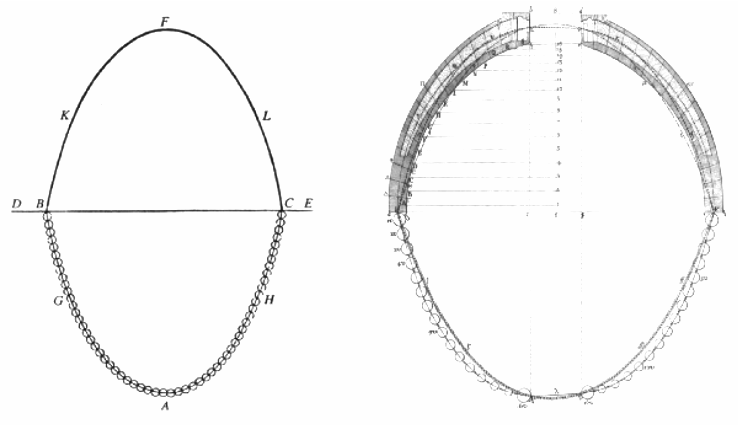
Physicist and mathematician Giovanni Poleni’s drawing (left) of Robert Hooke’s analogy between an arch and a hanging chain, and (right) his analysis of the Dome of St. Peter’s in Rome. Hooke famously discovered that a hanging chain forms a curve known as a catenary in tension under its own weight, formalizing ancient design and engineering principles seen in structures dating back to the Mesopotamians.
(Image: Courtesy of Giovanni Poleni)
The bridge and its prototype, he explains, draw on millennia-old engineering and architectural principles, particularly those associated with funicular design—structures that follow the natural flow of forces acting through them, primarily harnessing compression to achieve stability and strength. The use of these principles exists as early as 4000 BCE, when the Mesopotamians constructed arches and domes, and later with the Romans through aqueducts, bridges, and monumental structures like the Basilica of Maxentius that were designed to balance forces through arches and vaults.
However, while ancient builders relied on empirical intuition, the underlying mechanics remained largely unformalized until the 17th century. It was Robert Hooke, an English physicist and mathematician, who articulated a foundational principle of structural design in 1675: “As hangs the flexible line, so but inverted will stand the rigid arch.” Hooke’s observation, though elegantly simple, revealed a profound truth: an inverted version of a hanging chain naturally follows the perfect compression curve of an arch under uniform load.
“If you have the right form,” Akbarzadeh explains, “you can reduce the material and work with efficient and elegant forms.”
Hooke’s insights informed the work of Akbarzadeh’s major influences, James Clerk Maxwell and William John Macquorn Rankine. These 19th-century engineers, he says, “formalized the mathematical foundations of graphical statics, providing methods for visualizing and analyzing the internal forces within structures.”
RELATED
Akbarzadeh extended the methods of graphic statics from two dimensions to three, expanding Rankine’s 1864 proposition, since his Ph.D. thesis in 2012, at Penn since 2017, and outlined in his new book, “Polyhedral Graphic Statics.”
Akbarzadeh and his team designed the bridge’s geometry to channel forces along ideal compression paths. Every glass unit, joint, and angle was optimized so that the bridge’s arch would carry the load primarily through compression rather than bending forces—a method as ancient as the Sumerian U arches, now realized through cutting-edge computation and fabrication technologies.
Bridging the gap: Going from the prototype to production
The first step in realizing their concept, beyond sketches, calculations, and simulations, was a modest but crucial nearly 10-foot prototype. This model was a critical proving ground, a physical manifestation of the team’s digital machinations.
“Every flaw, every misalignment, and every unexpected failure was logged, studied, and resolved in preparation for a full-scale bridge to come,” says Yao Lu, a core member of the design team and a 2024 Ph.D. graduate of the Weitzman School’s architecture program who is currently an assistant professor of architecture at Thomas Jefferson University.
Lu had just started his Ph.D. at Penn when he designed the prototype. He notes that it was built from the same basic components envisioned for the final bridge—modular hollow glass units interlocked by precision-engineered acrylic connectors —and one of the earliest hurdles was determining how to join the glass modules without inducing stress points that could lead to fractures.
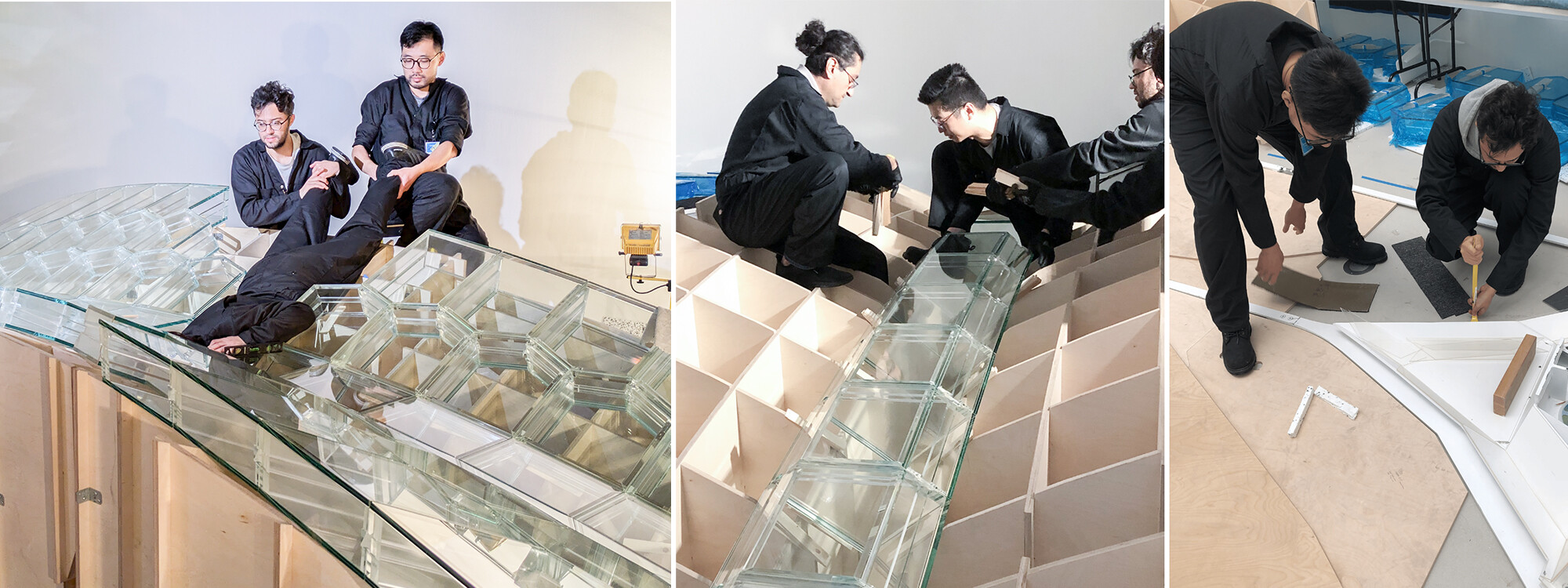
Members of the Polyhedral Structures Laboratory at the Weitzman School and collaborators from neighboring institutions fabricated the Glass Bridge over the course of 21 days. Their plans necessitated a wooden support designed by research assistant Boyu Xiao to hold the hollow glass units in place during assembly.
(Image: Courtesy of Polyhedral Structures Laboratory)
Lu explains that the team initially experimented with male-and-female key joints, which are interlocking geometries that would physically prevent the modules from slipping apart, however, “the male and the female shapes were really, really difficult to make out of glass.”
Glass materials are mostly planar, or two-dimensional. The team’s attempts to mold the glass into a three-dimensional structure using heat and formwork failed to produce the necessary precision, instead introducing new structural weaknesses.
Eventually, Akbarzadeh says, structural double-sided tape was used to assemble the small module, and the unit was sent 12 miles west to their collaborator Joseph Yost at Villanova University for stress testing, where it endured up to 41.6 kilopounds of compression.
“The test data was just super exciting because it showed us that this humble, cheap material could have a lot of load-bearing capacity,” says Lu.
For their prototype, the team settled on flat plates of glass bonded with precision-cut acrylic connectors secured using structural VHB tape, an industrial adhesive known for its strength and flexibility. “This approach permitted the necessary tolerance and ease of assembly without compromising the integrity of the glass,” Lu says. “The team over at Villanova worked to identify an interface material that could prevent catastrophic glass-on-glass contact between adjacent modules during assembly and under increased load.”
Their testing ultimately led them to polyvinyl butyral (PVB), a laminate material traditionally used in safety glass, which acted as a buffer between the glass modules. PVB offered just the right balance of flexibility and rigidity, allowing the forces within the bridge to distribute evenly without causing localized stress concentrations.
“But with these connectors, every cut, every angle, every dimension had to be accurate within 0.1 millimeters,” Akbarzadeh notes. “When you’re dealing with 124 separate glass units, even the tiniest misalignment can multiply across the entire span. If we didn’t maintain that level of precision, the whole structure could have collapsed under its own weight.”
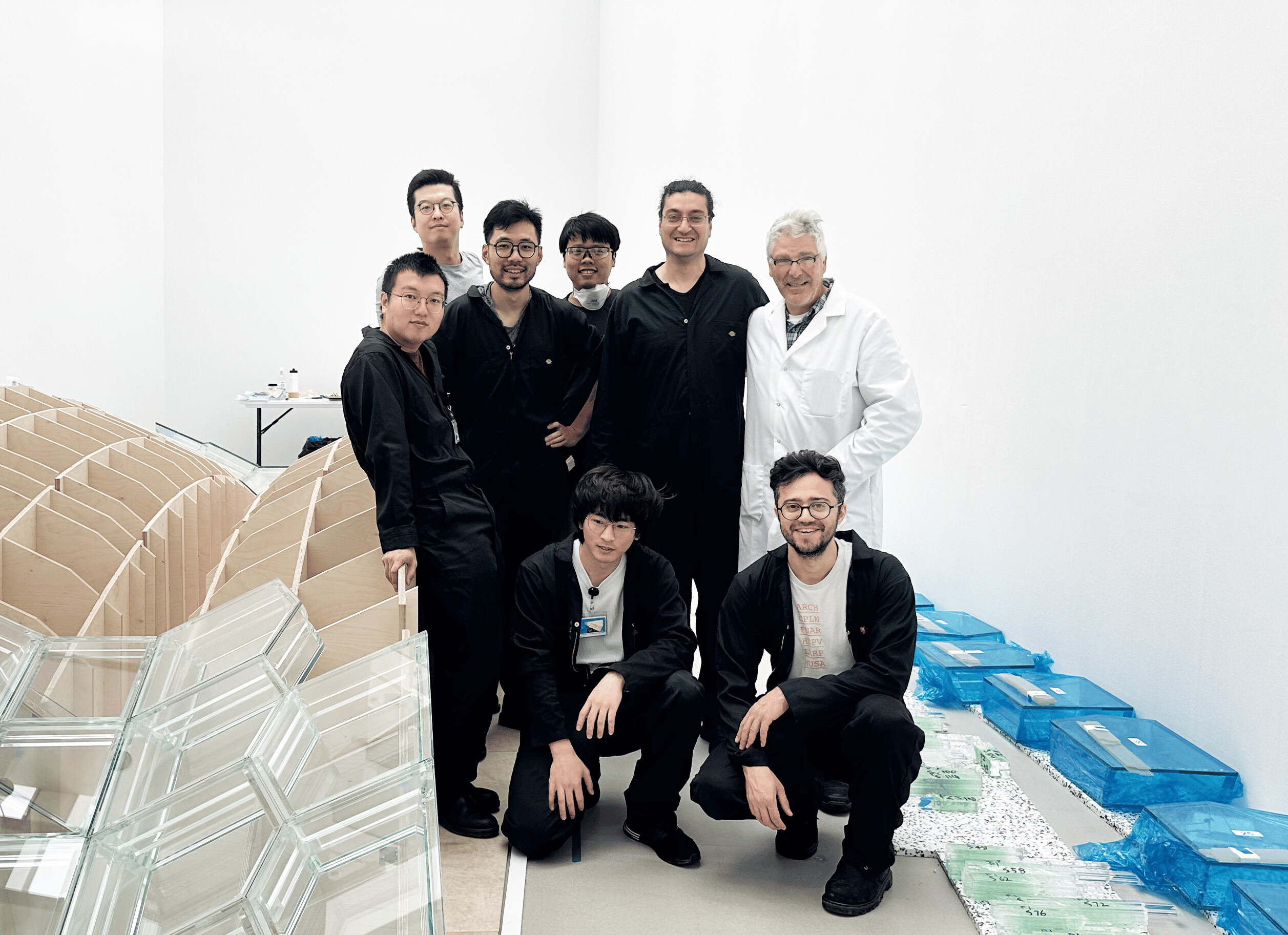
From left, back row: Teng Teng and Michael Ting. Middle row: Yefan Zhi, Yao Lu, Masoud Akbarzadeh, and Joseph Robert Yost. Front row: Boyu Xiao and Amir Motavaselian. “Glass Bridge: The Penn Monument for Hope” is on display at the Corning Museum of Glass, in Corning, New York, until Sept. 1.
(Image: Courtesy of Polyhedral Structures Laboratory)
To achieve this degree of accuracy, the team collaborated with several firms from Germany and China. The logistics of assembling the bridge in Corning presented yet another layer of complexity. Each hollow glass unit had to arrive on-site unblemished and intact—a challenge given the delicate nature of the materials and the thousands of miles each piece traveled to the United States.
“Shipping was one of our biggest nightmares,” Xiao admits. “We had to ensure that the glass wasn’t damaged in transit, that customs clearances went smoothly, and that every part arrived on time. Even a small delay could have jeopardized our construction schedule. Which is exactly what happened.”
A leap of faith
Xiao took the lead on the project’s day-to-day operations after Lu graduated, and became the logistical linchpin, coordinating everything from part shipments to team scheduling. As he describes it, “We didn’t just have to build a bridge. We had to figure out how to build a bridge that had never been built before.”
The bridge components arrived in Corning in early November, but the team immediately faced a logistical setback. The shipping company had deprioritized their freight, delaying the arrival of the glass units by two weeks. The exhibit’s opening schedule, however, was immovable. That meant the team had a matter of days—not weeks—to get everything in place.
“I was there from November 12th to the 15th for the first phase, where we installed the metal supports and wooden formwork that would support the bridge during construction,” says Xiao. “That was just laying the groundwork. The real push came when the full team arrived on November 21st.”
From that point forward, it was all hands on deck, Akbarzadeh says. He joined the effort, along with Amir Motevaselian, a newly-arrived research assistant who had been thrown into the deep end of the project, and the rest of the team from the Polyhedral Structures Laboratory.
Unlike a typical bridge construction, where materials like steel and concrete allow for some margin of error, Lu says the glass bridge demanded an almost unfathomable level of precision. Each hollow glass unit had to fit perfectly with its neighbors, and the tolerance for error was a mere 0.1 millimeters of accuracy, barely perceptible to the human eye.
“This bridge shows that we can rethink materials, that we can push the boundaries of engineering, and that we can build in ways that are both efficient and elegant,” Akbarzadeh says.
(Image: Courtesy of the Corning Museum of Glass)
“The museum staff were nervous about us taking up so much space, coming in with large tools,” Xiao notes. “It’s a museum of glass, so everything around us was insanely fragile. And there we were, sweating, lifting these massive crates, moving heavy machinery, sawing plastics—it looked like chaos.”
By the time the last shipment arrived in Corning, the team had carefully choreographed every step of the assembly process. The structural supports had already been installed to brace the arch during construction. A temporary wooden formwork was designed to hold the bridge steady until the final keystone glass modules could be locked into place, allowing the structure to support its own weight.
Still, the assembly would test both the physical stamina and emotional resilience of everyone involved.
“We had days where we worked from sunrise until the museum closed, lifting heavy glass units by hand, triple-checking measurements, and holding our breath during every installation,” Xiao notes. “We had to physically lift and position each unit by hand. The museum crew helped with the heavier pieces, but there were moments when it felt like we were building this thing with our bare hands.”
At one point, an improperly calibrated support caused a misalignment in the arch, forcing them to painstakingly disassemble and reposition several sections. At another, a miscalculation in the placement of the wooden formwork meant that the bridge couldn’t be properly supported as it was assembled.
“The worst part was that the whole structure had to be self-supporting by the end,” Xiao says. “It’s an arch—until you put in the last keystone piece, the whole thing is unstable.”
The final days of construction were particularly tense. The placement of the last few units was critical; any error would compromise the structural integrity of the entire span. But as the keystone unit clicked into place, there was a collective sigh of relief among the team.
On Nov. 30th, after a week of long days and late nights, the bridge stood tall.
The months of calculation, fabrication, and logistical coordination converged into something extraordinary: a shimmering arch of glass, delicate in appearance but solid in structure—a physical testament to the harmony of engineering precision, aesthetic beauty, and human collaboration.
“This bridge shows that we can rethink materials, that we can push the boundaries of engineering, and that we can build in ways that are both efficient and elegant,” Akbarzadeh says.
Xiao, who had spent months juggling logistics, material constraints, and sleepless nights, had a more succinct reaction.
“We did it,” he says. “Against all odds, we actually did it.”
This work was supported by a National Science Foundation CAREER Award (NSF CAREER-1944691 CMMI) and by Lori Kanter Tritsch, a Master of Architecture alum who serves on the Weitzman School’s Board of Advisors.
The project was led by Masoud Akbarzadeh of the University of Pennsylvania, with Joseph Robert Yost of Villanova University, Damon Bolhassani of the City University of New York, and Jens Schneider of TU Wien and the Glass Competence Center, TU Darmstadt as principal investigators. Richard Farley of Penn's Polyhedral Structures Laboratory served as an advising collaborator. Structural design was completed by Masoud Akbarzadeh, Yao Lu, Yiliang Shao, and Tian Ouyang, with Lu also leading computational design. Boyu Xiao, Michael Ting, and Pouria Vakhshouri handled steel support detailing and formwork design. Structural engineering was led by Damon Bolhassani, with contributions from Paria Yavartanoo, while Joseph Robert Yost, Jorge Huisa Chacon, and Mathew Cregan of Villanova conducted structural load testing and material verification. Jens Schneider led glass engineering with Philipp Amir Chhadeh. The early-stage research team included Andrei Nejur, Tian Ouyang, Mostafa Akbari, Zhenhao Zhou, Cory Byrnes, Ulrich Knaack, and Chris Borg Costanzi. The installation team consisted of Masoud Akbarzadeh, Boyu Xiao, Michael Ting, Yao Lu, Amir Motavaselian, Yefan Zhi, Teng Teng, Joseph Yost, Philipp Amir Chhadeh, Golnaz Moharrer, Esmaeel Negarestan, Hengameh Fazeli, and Alireza Fazeli.
On the move: Water quality and antimicrobial resistance testing goes mobile
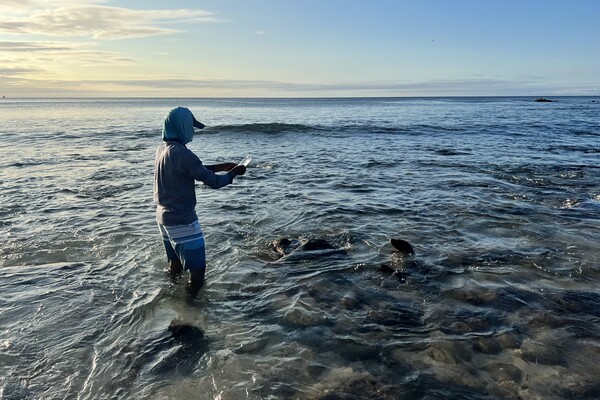
Penn researchers have developed a mobile field laboratory allowing them to test water quality and track antimicrobial resistance in and around San Cristóbal in the Galápagos.
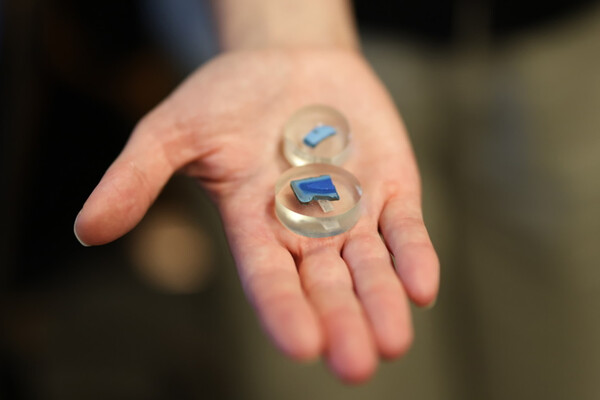
Penn researchers Vanessa and Alexis North are studying one of the largest collections of Egyptian blue objects ever found in the ancient Near East, shedding new light on how the world’s first synthetic pigment may have traveled far beyond Egypt.
A new role for dental providers? Rethinking where vaccines are given
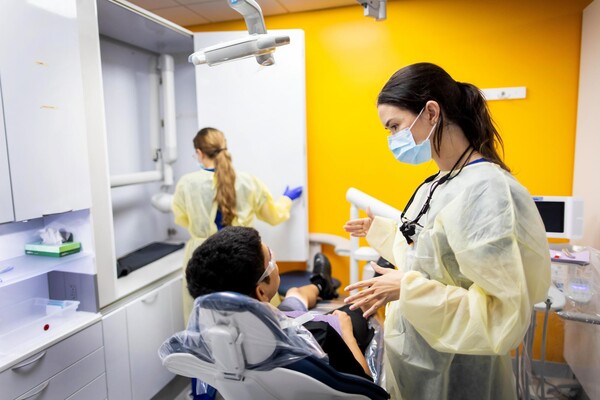
Vaccinations have traditionally been administered in primary care settings or pharmacies. However, for about a decade, some states have authorized dentists to administer vaccines, and many others did so during the COVID-19 pandemic. The effectiveness of this approach has led some countries and states to expand or consider expanding the role of dental providers in delivering routine vaccines, including those against COVID-19 and the human papillomavirus (HPV), and in providing vaccine education.
Penn student develops a way for computer chips to run more efficiently
Fluid Silicon, a platform from President’s Sustainability Prize winner Nhlanhla Mavuso, allows computer chips to continuously monitor their health and self-tune as their characteristics change. The technology has the potential to reduce energy usage in data centers and improve reliability in mission-critical applications.