A massive chunk of ice, a new laser, and new information on sea-level rise
For nearly a decade, Leigh Stearns and collaborators aimed a laser scanner system at Greenland’s Helheim Glacier. Their long-running survey reveals that Helheim’s massive calving events don’t behave the way scientists once thought, reframing how ice loss contributes to sea-level rise.
5 min. read
New research shows that Greenland’s Helheim Glacier’s calving events are shaped more by the landscape it flows over than by what’s happening in the air or water on a short-term basis. (Video: Courtesy of U.S Army’s Cold Regions Research and Engineering Laboratory [CRREL])
Key Takeaways
Penn researchers have developed an autonomous laser-scanning system able to continuously map detailed images of Greenland’s Helheim Glacier.
Continuous images show that Helheim Glacier doesn’t accelerate or move more even after kilometer-large sections of ice break away.
The study found that Helheim Glacier’s stability depends more on the shape of the bedrock beneath it and continuous melting at its base rather than on short-term weather or ocean conditions.
With continued mass loss of the Greenland Ice Sheet contributing to sea-level rise, this type of long-term monitoring will help scientists better understand the role climate change plays and to predict future impacts.
Ten years ago, glaciologist Leigh Stearns traveled to her favorite six-kilometer-wide chunk of ice, Greenland’s Helheim Glacier.
As in previous trips, she and her colleagues sought new data on how ocean processes influence glacier behavior. With the continued mass loss of the Greenland Ice Sheet contributing to sea level rise, they wanted to better understand the cause and effect of large iceberg calving events—spectacular and often violent phenomena wherein gargantuan, cliff-like slabs of ice shear off Helheim’s face and plunge into the ocean.
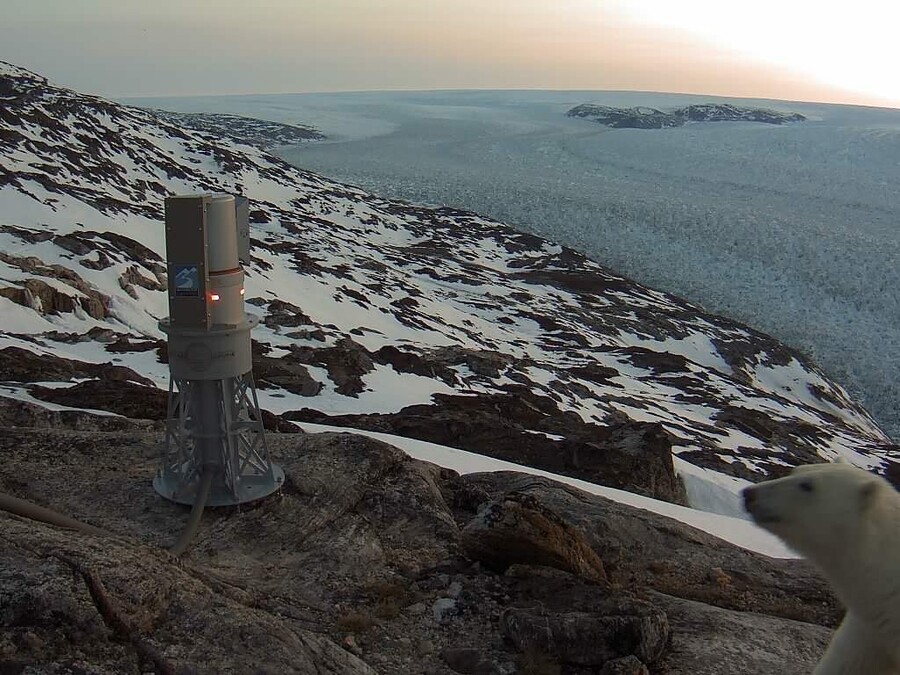
“Greenland’s a really tough place to put fragile machinery like this,” Stearns says, noting the lack of power and internet, the intensely cold and windy conditions, as well as occasional visits from polar bears.
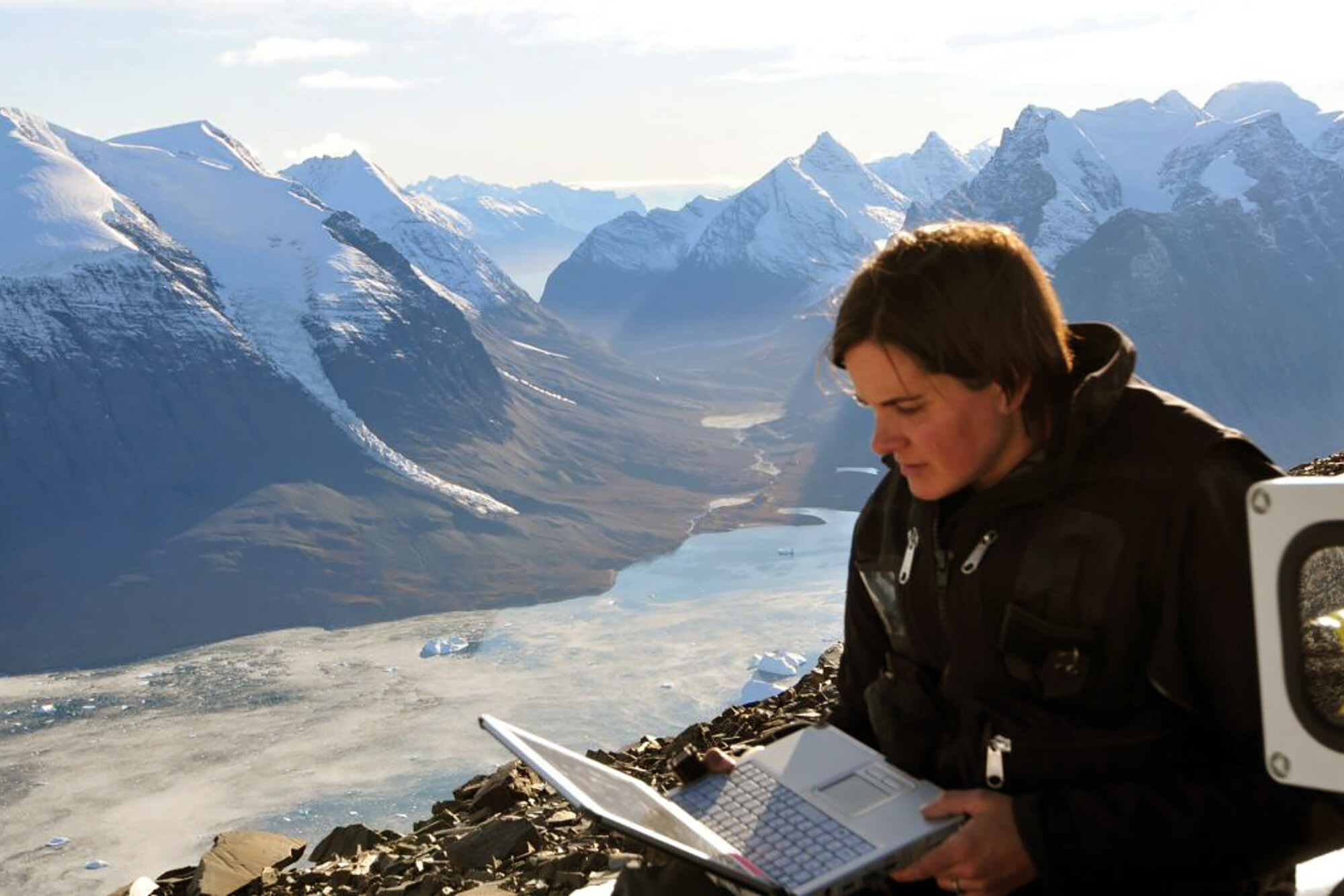
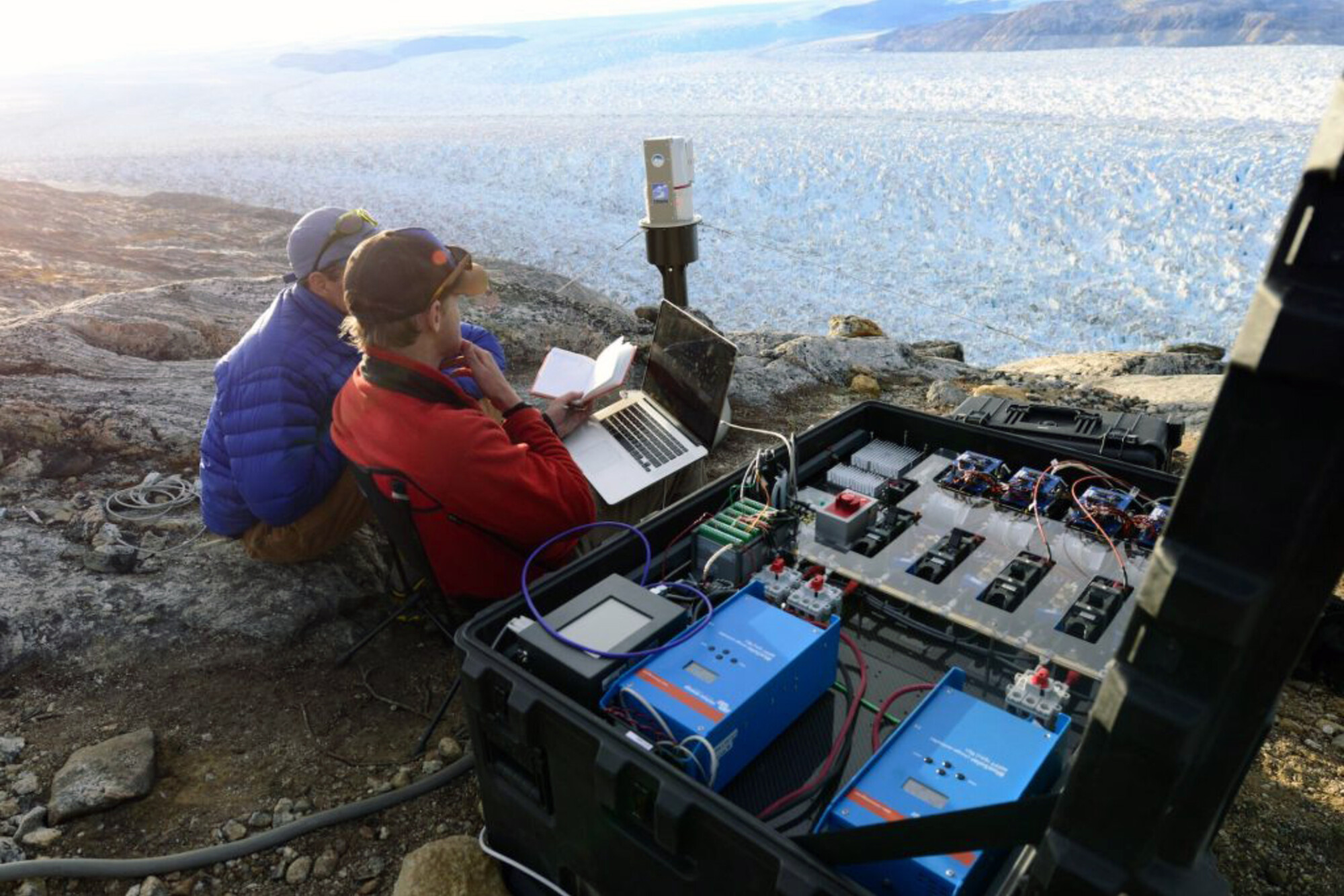
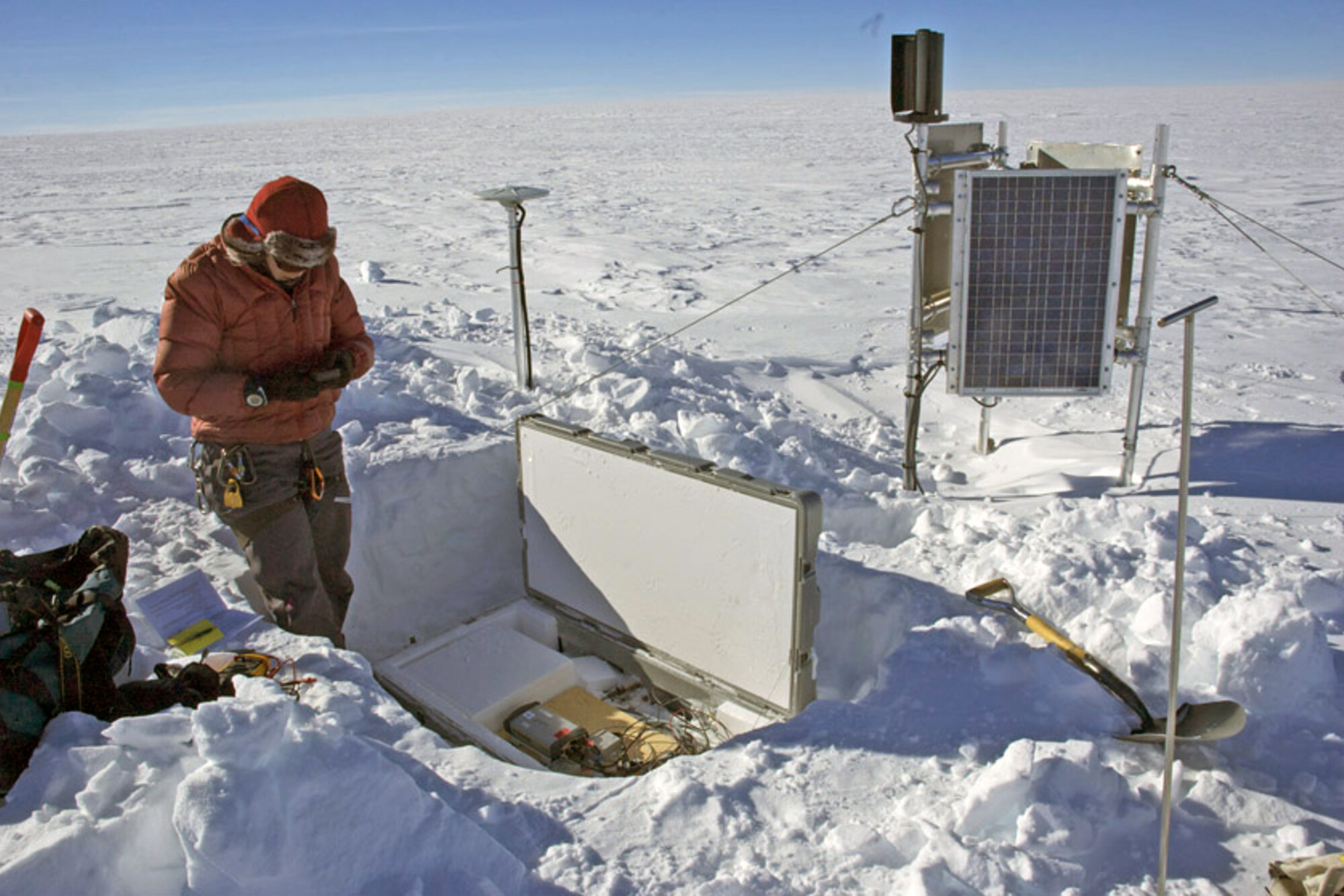
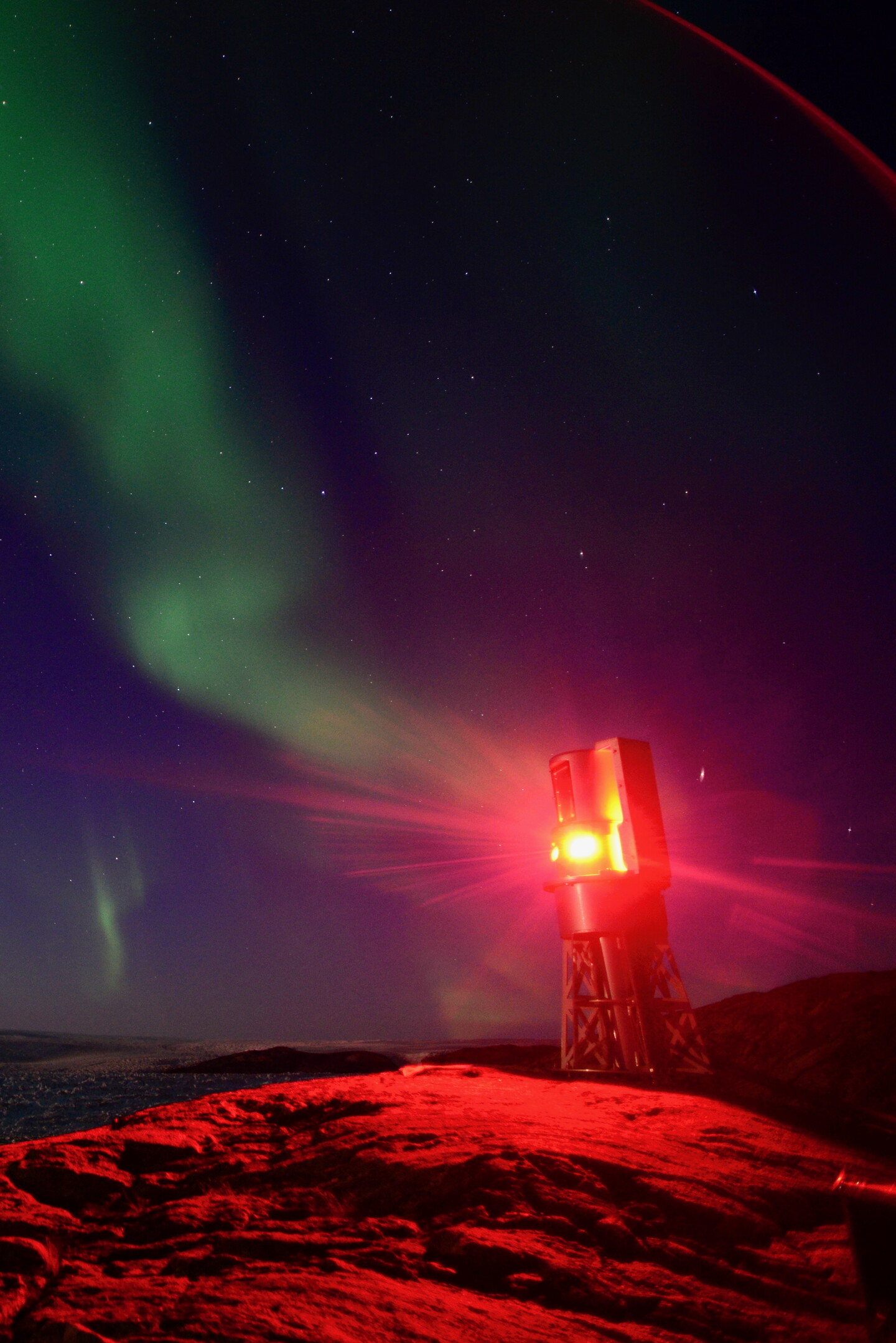
(Top) Leigh Stearns, professor in the Department of Earth and Environmental Sciences at the Penn, studies glacier dynamics to uncover how and why these massive rivers of ice evolve and what their changes reveal about the planet’s response to natural and human-driven climate forces. (Bottom left) To capture Helheim Glacier’s movements, Stearns and her collaborators worked with the U.S. Army’s Cold Regions Research and Engineering Laboratory to install the Autonomous Terrestrial Laser Scanning system (ATLAS).
(Images: Courtesy of Leigh Stearns and CRREL)
The system mapped Helheim’s three-dimensional surface features every few hours—similar to a mounted camera taking photos for a time lapse—even during months of darkness, delivering continuous, high-resolution data that “is already paying off by helping us see how glaciers actually respond to a changing climate, and what that means in the decades ahead,” Stearns says.
Now, after nearly a decade, Stearns and her team have published their findings in the Journal of Geophysical Research: Earth Surface. They find that, even after losing kilometer-scale slabs of ice in some calving events, Helheim’s flow speed—how quickly it advances or retreats—shows almost no sustained change.
“You’d expect the glacier to surge forward after something that massive breaks off,” says first author Michael Shahin, a postdoctoral researcher in the Stearns lab at Penn’s School of Arts & Sciences. “But it doesn’t. You see a kilometers-wide block fall into the fjord, and Helheim just keeps moving along at the same pace—as if nothing happened.”
During non-winter months, ATLAS’s scanners operate every six hours in a staggered sequence, so prevent sensor to sensor-to-sensor interference, measuring distances up to 10 kilometers.
(Image: Courtesy of Leigh Stearns and CRREL)
Stearns notes that, somewhat surprisingly, Helheim Glacier doesn’t seem to respond to short-lived events like massive calving the way researchers had hypothesized; it doesn’t accelerate its movement and it doesn’t accelerate ice loss—which, in turn, contributes to climate-driven sea level rise. Instead, its behavior appears to be shaped more by the landscape it flows over than by what’s happening in the air or water on a short-term basis.
That makes the glacier’s response to climate change more complex than previously understood. Rising temperatures affects how ice moves over its bedrock below, the glacier’s grip weakens and its path gradually shifts. These changes unfold over years or decades rather than days or weeks—meaning it’s not the storms or seasons that matter most for Helheim, but how a warming climate slowly transforms the ground it slides upon.
By stitching together thousands of laser scans, which was previously impossible to do with satellites that captured images days to weeks apart, Shahin notes they could effectively “rewind the glacier” and trace each calving event back to its point of origin.
They noticed that every major fracture began in almost the same spot—a patch perched on the smooth, downstream-facing (“lee”) side of a subglacial ridge buried under hundreds of meters of ice.
“It’s like there’s a built-in weak spot,” Stearns explains. “A crack opens there, over and over again, no matter the season or the weather, this consistent starting point for calving persists for over a decade.”
Analyses of the stress patterns around that region revealed a drop in basal drag, the friction between the ice and the bedrock below. This suggests that subtle shifts at the glacier’s base determine where these rifts form.
“The laser lets us see that tension building in slow motion,” Shahin says. “You can almost feel the ice stretching before it snaps.”
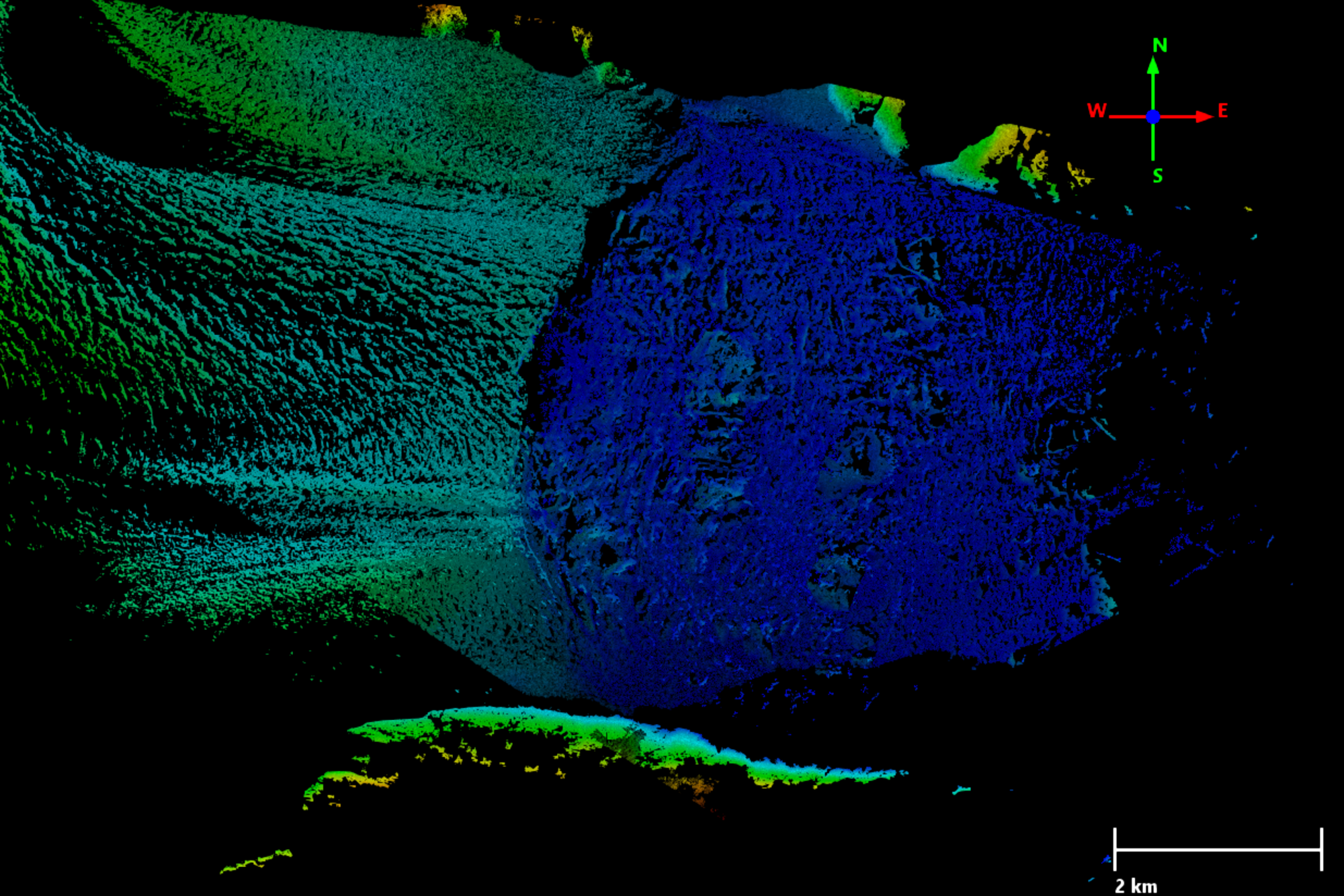
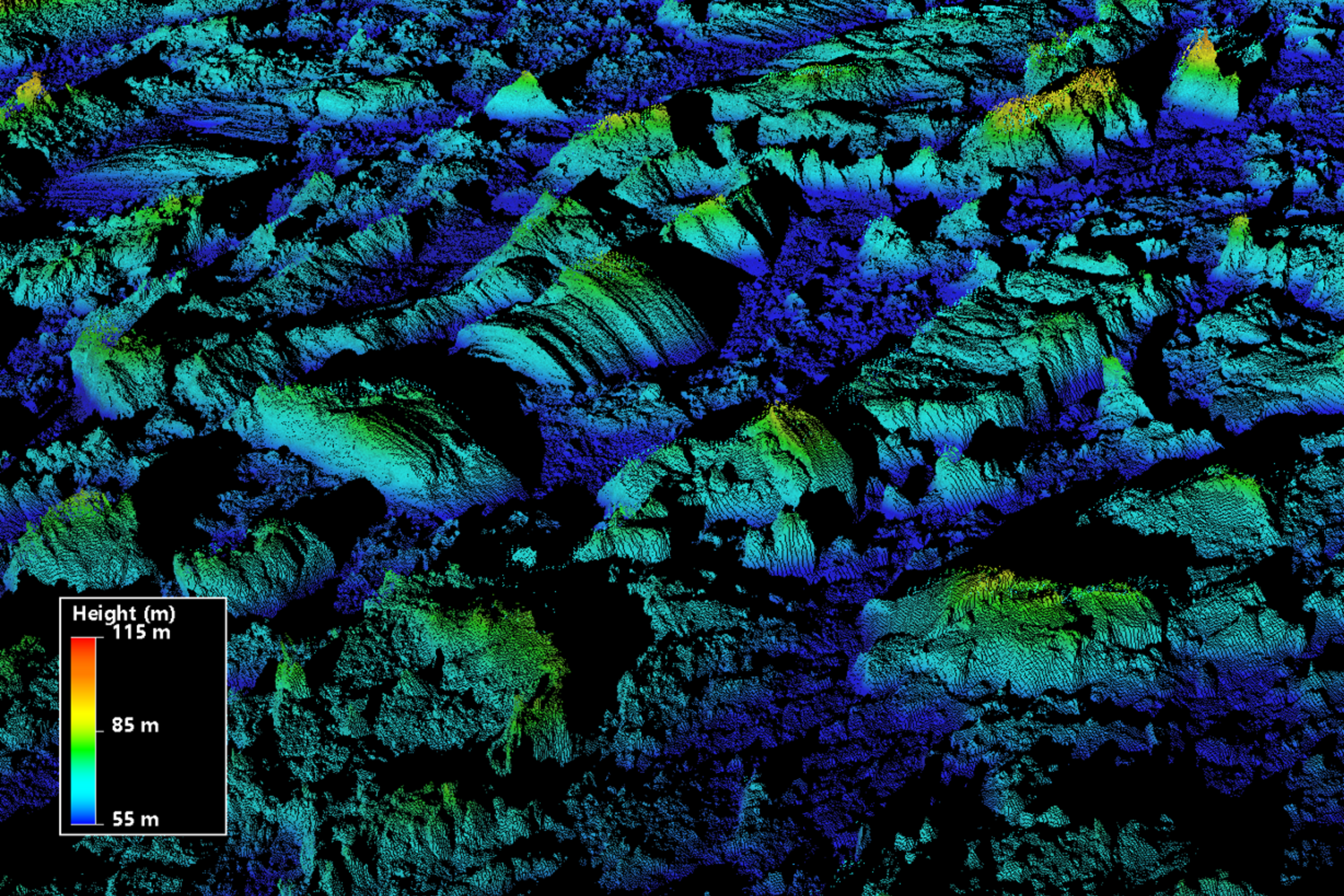
A 3D point cloud of Helheim Glacier’s calving front, captured by ATLAS. Each color represents changes in elevation across the glacier’s fractured surface, allowing researchers to pinpoint where massive icebergs break away and how the glacier’s shape shifts over time.
(Images: Courtesy of Michael Shahin and CRREL)
ATLAS also allowed the team to map the grounding zone, a never-before-seen transient border where Helheim transitions from being grounded in bedrock to just slightly floating on the ocean, which Shahin describes as Helheim “bobbing up and down every now and then,” as it moves in sync with the tides.
“It shows that the glacier’s underlying geometry, or shape of the land it flows over, has a much stronger and more predictable control over its behavior than short-term weather events,” Shahin says.
RELATED
Between 2018 and 2019, that line retreated nearly three kilometers, Shahin notes. That subtle unmooring bears potentially outsized consequences, as once a glacier’s base begins to float, ocean water can seep farther inland, speeding melt from below.
Though Greenland’s ice sheet is often treated as a single system, Helheim’s measured cool calm suggests that each of Greenland’s roughly 250 outlet glaciers “has a unique ‘personality,” Stearns says. “Some of them are incredibly sensitive to seasonal warmth; others, like Helheim, integrate those changes over years or decades. You can’t just paint Greenland’s glaciers with one brushstroke.”
Leigh Stearns is a professor in the Department of Earth and Environmental Science at the University of Pennsylvania’s School of Arts & Sciences.
Michael Shahin is a postdoctoral researcher in the Stearns Lab at Penn Arts & Sciences.
Other authors include Sarah F. Child of the Cooperative Institute for Research in Environmental Sciences at the University of Colorado Boulder; David C. Finnegan, Adam L. LeWinter, and Shad O’Neel of the U.S. Army Cold Regions Research and Engineering Laboratory; C. J. van der Veen of the University of Kansas; and Howard Butler of Hobu Inc.
This research was funded by the Heising-Simons Foundation with ancillary support from the U.S. Army Cold Regions Research and Engineering Laboratory, the National Science Foundation, and the University of Pennsylvania’s Department of Earth and Environmental Sciences.
On the move: Water quality and antimicrobial resistance testing goes mobile
Penn researchers have developed a mobile field laboratory allowing them to test water quality and track antimicrobial resistance in and around San Cristóbal in the Galápagos.
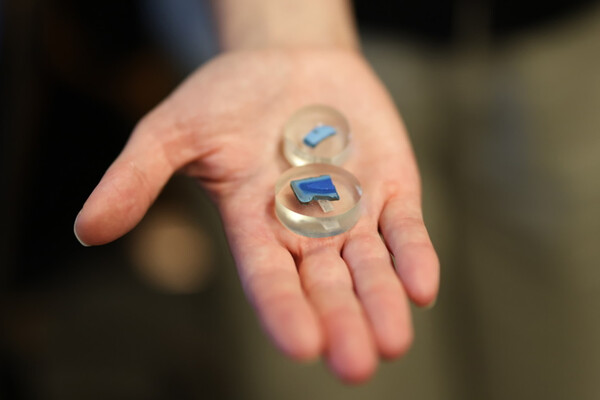
Penn researchers Vanessa and Alexis North are studying one of the largest collections of Egyptian blue objects ever found in the ancient Near East, shedding new light on how the world’s first synthetic pigment may have traveled far beyond Egypt.
A new role for dental providers? Rethinking where vaccines are given
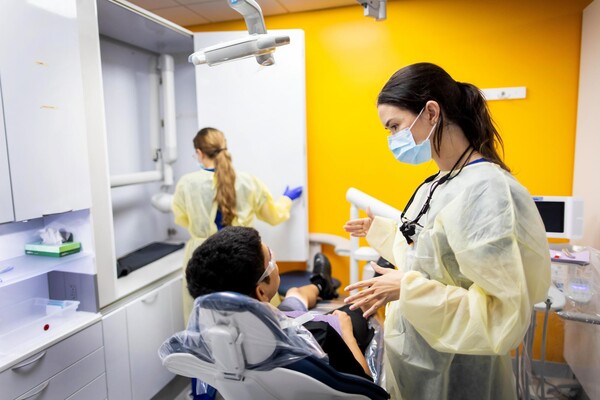
Vaccinations have traditionally been administered in primary care settings or pharmacies. However, for about a decade, some states have authorized dentists to administer vaccines, and many others did so during the COVID-19 pandemic. The effectiveness of this approach has led some countries and states to expand or consider expanding the role of dental providers in delivering routine vaccines, including those against COVID-19 and the human papillomavirus (HPV), and in providing vaccine education.
Penn student develops a way for computer chips to run more efficiently
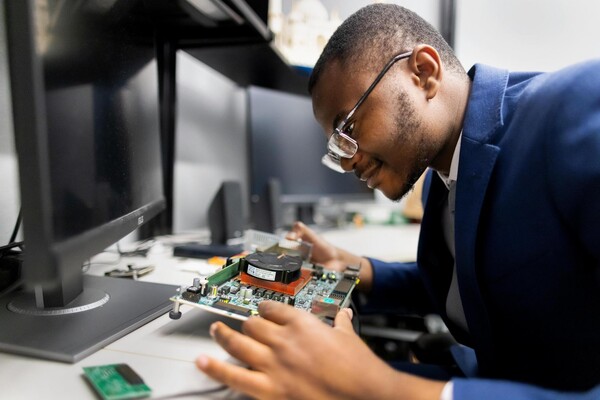
Fluid Silicon, a platform from President’s Sustainability Prize winner Nhlanhla Mavuso, allows computer chips to continuously monitor their health and self-tune as their characteristics change. The technology has the potential to reduce energy usage in data centers and improve reliability in mission-critical applications.