Mapping the expanding cosmos: Dark Energy Survey unveils clearest picture yet
The Dark Energy Survey collaborative, including Penn researchers, recently released an analysis that gives the clearest picture yet of how dark energy is driving the universe’s expansion and how matter—including galaxies and groups of galaxies—has been organized over cosmic time.
3 min. read
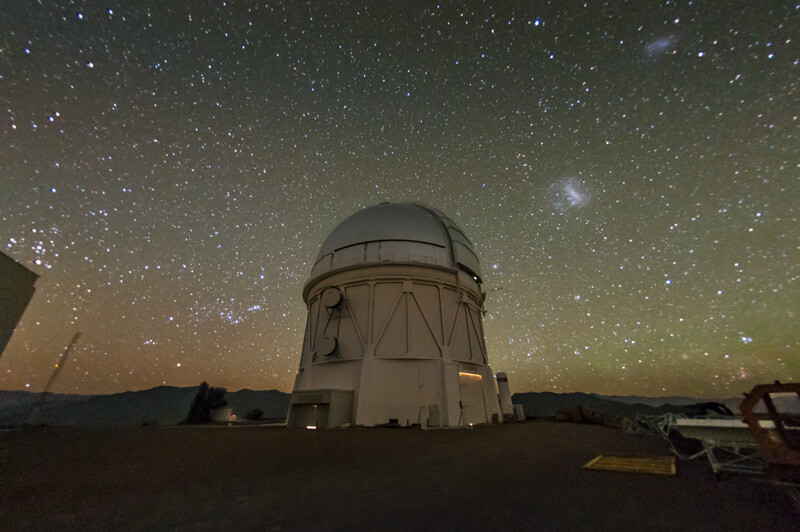
The Dark Energy Survey used a 570-megapixel camera mounted on the 4-metre Victor M. Blanco Telescope in Chile to image 5,000 square degrees of southern sky. The survey discovered more than 1,000 supernovae and mapped millions of galaxies to help astronomers better understand the accelerating expansion of our universe.
(Image: Courtesy of Dark Energy Survey Collaborative)
Key Takeaways
The Dark Energy Survey (DES) collaborative, involving a large international team of scientists working to understand how dark energy is driving the universe’s accelerating expansion, has produced a single, high-precision analysis, combining six years of data and four cosmic probes for the first time.
Their findings are consistent with the standard cosmological model, known as Lambda-CDM, in which dark energy remains constant over time but tightens the limits on how much variation is allowed.
The study also confirms a small but persistent tension: the universe appears slightly less “lumpy” today than previously predicted.
The universe is vast, and although scientists have known for nearly a century that it is getting larger over time, they expected that gravity would slow that expansion. In the late 1990s, however, astronomers realized that the expansion of the cosmos is actually accelerating—galaxies are moving away from one another and gaining speed—rather than slowing down.
Cosmologists theorize that dark energy is driving this accelerated expansion. Although it cannot be seen or directly detected, dark energy seems to make up roughly two thirds of the universe’s total energy content. Dark matter, another invisible substance that exerts gravity but does not emit light, accounts for much of the rest.
For more than a decade, the Dark Energy Survey (DES) collaborative has been one of the most ambitious efforts to understand how the universe is expanding and how its structures—galaxies, clusters, and vast filaments of matter—have formed over cosmic time. Now, a new comprehensive analysis from the DES collaboration, which includes major contributions from Penn astronomers Gary Bernstein, Bhuvnesh Jain and Masao Sako, offers the clearest picture yet of how dark energy influences the universe’s expansion and how cosmic structures have formed over billions of years.
A new high‑precision map of the universe
DES used a powerful 570‑megapixel camera mounted on the Blanco 4‑meter telescope in Chile to map nearly 669 million galaxies across one‑eighth of the sky between 2013 and 2019. Because looking farther into space reveals older light, this map allowed researchers to track how matter has evolved over cosmic time.
Light takes time to travel, so looking farther into space reveals the universe’s past. And by measuring the positions, shapes, and brightnesses of these galaxies, scientists can reconstruct how cosmic structures formed and how the universe’s expansion has changed over time.
This latest analysis brings together four key cosmological measurements—weak gravitational lensing, galaxy clustering, baryon acoustic oscillations, and type-Ia supernovae—into a single, unified framework. This approach significantly narrows the range of cosmological models that match the data.
Within DES, Penn researchers helped lead two of the survey’s central measurement techniques. Jain and Bernstein worked on weak gravitational lensing, which relies on the way the light from distant galaxies is subtly bent by the gravity of massive structures. Mapping these tiny distortions allows scientists to trace how dark matter is arranged across the cosmos. Sako led work on DES’s type‑Ia supernovae—bright stellar explosions that serve as precise distance indicators—providing one of the clearest ways to measure how the universe’s expansion rate has changed over time.
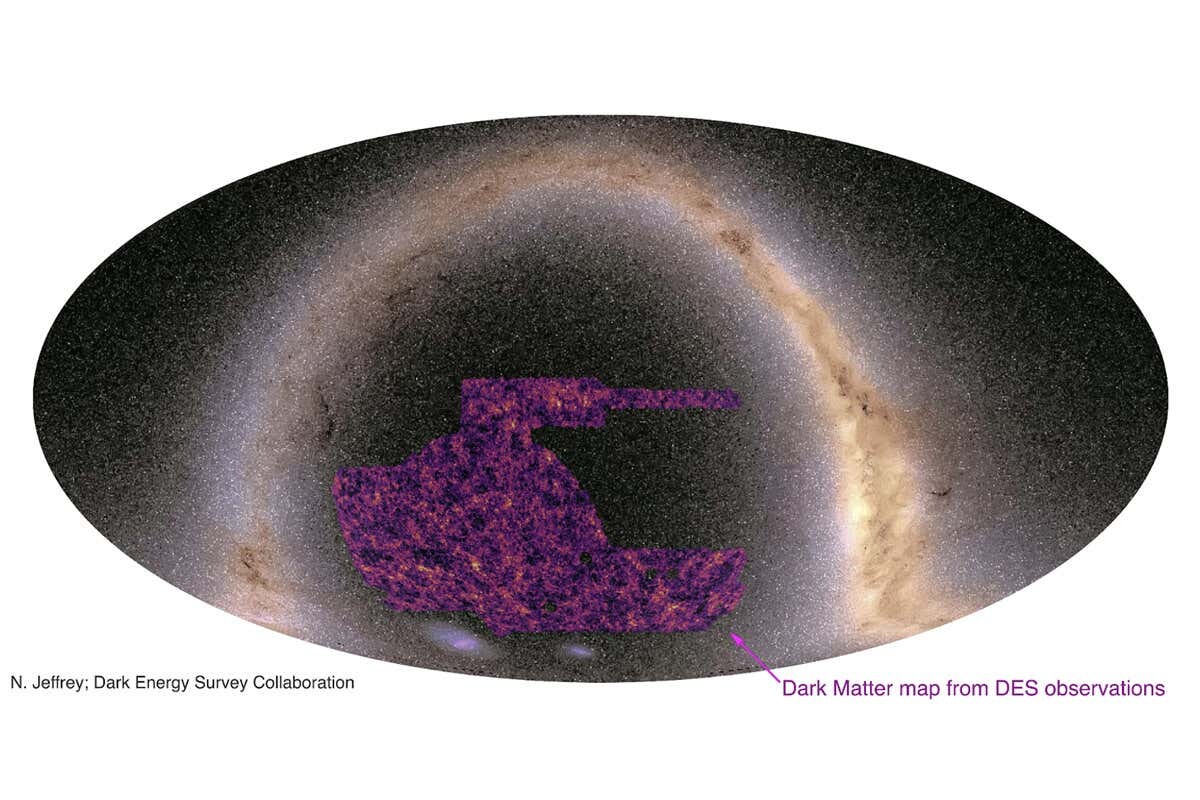
A map of dark matter across the observable universe from the Dark Energy Survey, shown as a purple heat map tracing the otherwise invisible scaffolding that shapes cosmic structure. The bright, curved band of stars cutting across the image is our home galaxy, the Milky Way Galaxy, whose light sits in the foreground of the survey’s deep view into the distant universe.
(Image: Courtesy of N. Jeffrey/Dark Energy Survey)
Bernstein explains that the strength of DES now comes from treating these tools collectively rather than separately. “We’re no longer asking what each probe says on its own,” he says—rather DES evaluates whether all lines of evidence tell the same story about the universe’s history and expansion.
Testing the standard model of cosmology
The DES team tested their results against two leading models:
· Lambda-CDM,the currently accepted standard model of cosmology in which dark energy is constant over time.
· wCDM, an extended model in which the dark energy density evolves over time.
The latest DES measurements overwhelmingly support the standard model and significantly tighten the limits on how much dark energy could vary. Constraining this variation is critical: Even small shifts could dramatically change predictions for the universe’s long-term future.
Jain notes that “the universe can be described with fewer than 10 parameters” in the Lambda‑CDM model—numbers that capture everything from its overall matter content to the strength of primordial fluctuations. Pinning down these values lets scientists reconstruct the cosmos’s entire 13.8‑billion‑year history from the first sparks of light—known as the Big Bang—to the current accelerated expansion.
A persistent, subtle tension
While the DES results agree with the standard model, they also reveal a small tension between the models’ predictions and the actual distribution of matter in the universe. The galaxies and dark matter appear to be a bit smoother, or less “lumpy,” than the standard model predicted.
When DES added the most recent data, that gap widened and persisted even when DES combined their measurements with those from other experiments. However, this gap is still too small to conclude that the standard model is incorrect.
“This isn’t a dramatic disagreement,” notes Bernstein, however, “it’s statistically robust enough that we need to pay close attention to it.” If new physics exists beyond the standard model, small deviations like this may provide the first clues, he explains.
Laying the groundwork for the new era
Rather than closing the case on dark energy, the DES results establish a lasting benchmark for future surveys. The Vera C. Rubin Observatory’s Legacy Survey of Space and Time, a new survey telescope now beginning a decade-long mission, is set to map billions more galaxies across the universe providing new data.
Looking at what’s next, Bernstein says, “Now the question is whether future surveys will simply sharpen this picture of a standard universe—or reveal cracks that force us to rethink what’s driving the universe’s expansion.”
Gary Bernstein is the Reese W. Flower Professor of Astronomy and Astrophysics Professor in the Department of Physics and Astronomy in the School of Arts & Sciences at the University of Pennsylvania.
Bhuvnesh Jain is the Walter H. and Leonore C. Annenberg Professor in the Natural Sciences and the co-director of the Center for Particle Cosmology in the Department of Physics and Astronomy in Penn Arts & Sciences.
Masao Sako is the Arifa Hasan Ahmad and Nada Al Shoaibi Presidential Professor of Physics and Astronomy in Penn Arts & Sciences.
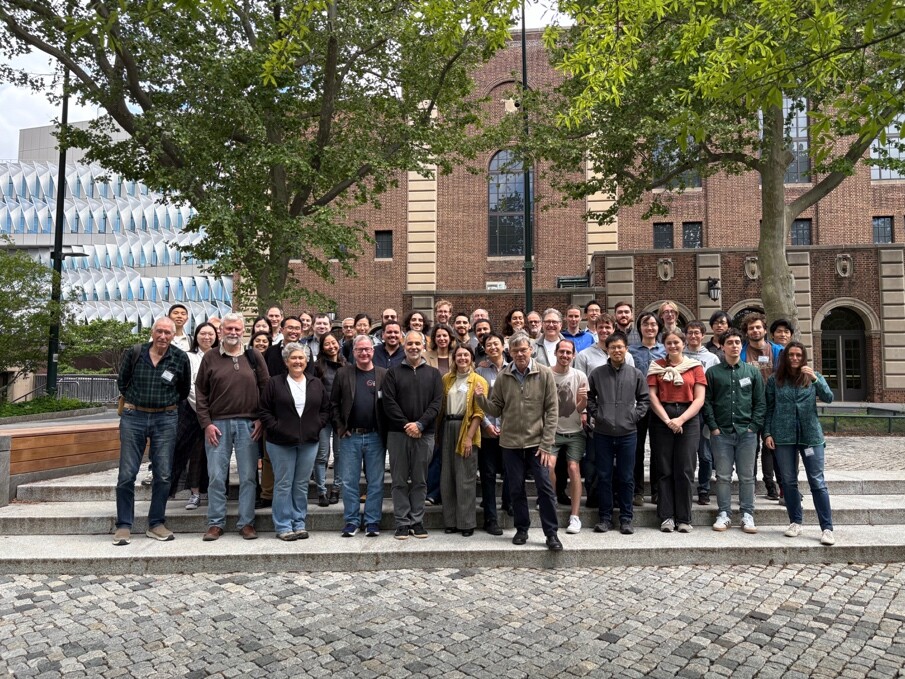
Members of the Dark Energy Survey Collaboration gather at the University of Pennsylvania during the project’s final collaboration meeting in 2025. The team’s recently released legacy results combine six years of observations—including measurements of weak gravitational lensing and galaxy clustering—to produce one of the most precise maps yet of how matter is distributed across the universe.
(Image: courtesy of Ari McManus / University of Pennsylvania)
The Dark Energy Survey is a collaboration of more than 400 scientists from 25 institutions in seven countries. Funding for the DES Projects has been provided by the U.S. Department of Energy, the U.S. National Science Foundation, the Ministry of Science and Education of Spain, the Science and Technology Facilities Council of the United Kingdom, the Higher Education Funding Council for England, the National Center for Supercomputing Applications at the University of Illinois at Urbana-Champaign, the Kavli Institute of Cosmological Physics at the University of Chicago, the Center for Cosmology and Astro-Particle Physics at the Ohio State University, the Mitchell Institute for Fundamental Physics and Astronomy at Texas A&M University, Financiadora de Estudos e Projetos, Fundação Carlos Chagas Filho de Amparo à Pesquisa do Estado do Rio de Janeiro, Conselho Nacional de Desenvolvimento Científico e Tecnológico and the Ministério da Ciência, Tecnologia e Inovação, the Deutsche Forschungsgemeinschaft and the Collaborating Institutions in the Dark Energy Survey.
On the move: Water quality and antimicrobial resistance testing goes mobile
Penn researchers have developed a mobile field laboratory allowing them to test water quality and track antimicrobial resistance in and around San Cristóbal in the Galápagos.
Penn researchers Vanessa and Alexis North are studying one of the largest collections of Egyptian blue objects ever found in the ancient Near East, shedding new light on how the world’s first synthetic pigment may have traveled far beyond Egypt.
A new role for dental providers? Rethinking where vaccines are given
Vaccinations have traditionally been administered in primary care settings or pharmacies. However, for about a decade, some states have authorized dentists to administer vaccines, and many others did so during the COVID-19 pandemic. The effectiveness of this approach has led some countries and states to expand or consider expanding the role of dental providers in delivering routine vaccines, including those against COVID-19 and the human papillomavirus (HPV), and in providing vaccine education.
Penn student develops a way for computer chips to run more efficiently
Fluid Silicon, a platform from President’s Sustainability Prize winner Nhlanhla Mavuso, allows computer chips to continuously monitor their health and self-tune as their characteristics change. The technology has the potential to reduce energy usage in data centers and improve reliability in mission-critical applications.