An echo of Einstein: An unexpected link between whale calls and special relativity
Researchers noticed a wave-interference effect that makes sound energy appear to outrun fundamental limits without breaking physics. Their findings could improve whale tracking.
3 min. read
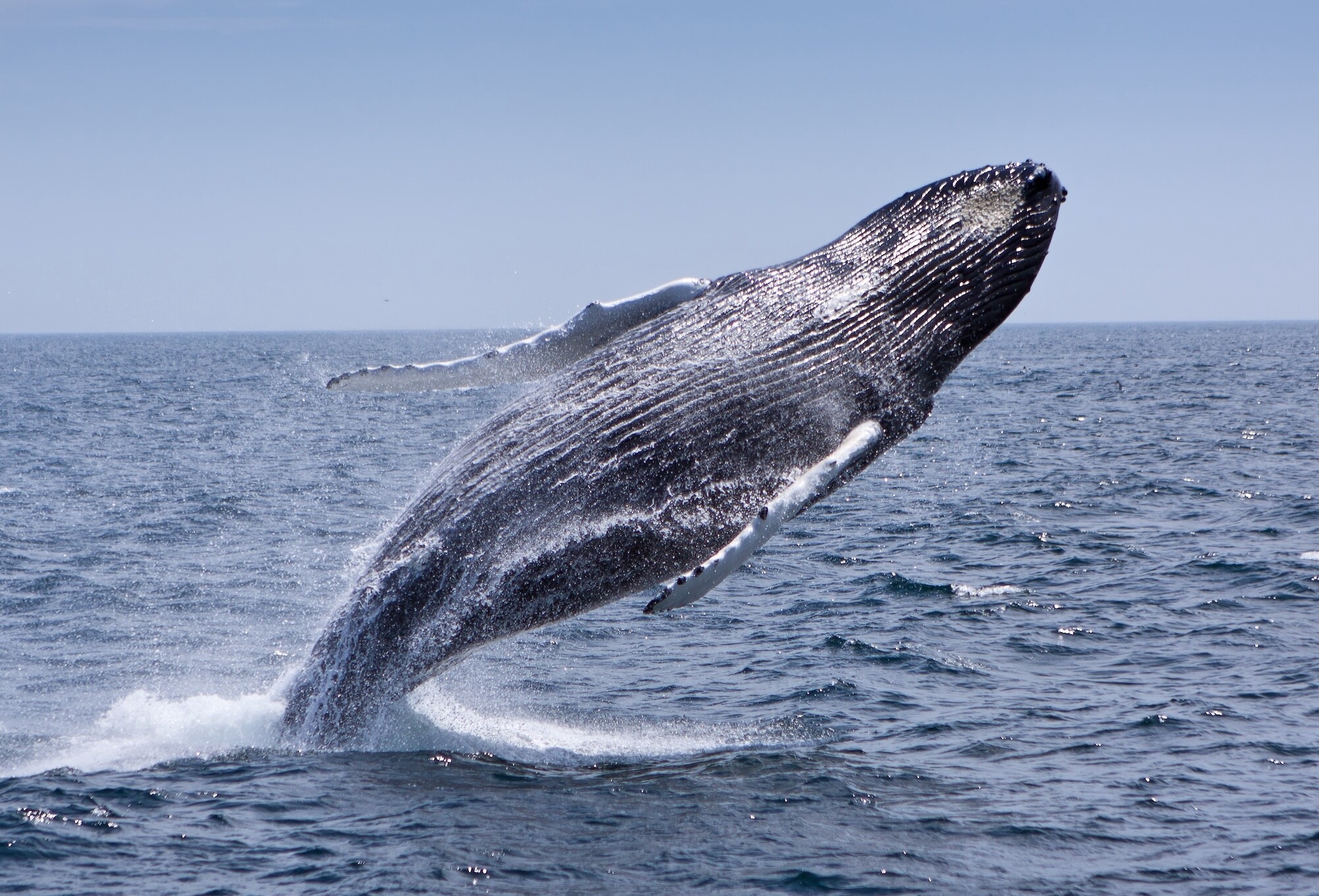
Humpback whales, like the one pictured here off the coast of Provincetown, Massachusetts, are routinely located by analyzing when their calls reach underwater microphones. In a recent paper, oceanographer John Spiesberger and a colleague identified a theoretical wave-interference effect that can make energy from sound waves outrun fundamental speed limits without violating the laws of physics. Their findings could improve whale tracking.
(Image: Courtesy of Bryce Flynn / Getty)
Standing on the sandy, windswept shores of Provincetown, Massachusetts, people may find themselves squinting at the horizon, waiting for a whale to make its grand entrance with a spectacular breach.
“Sound from a fin whale can be heard from 100 kilometers away underwater with a single hydrophone,” Spiesberger says. “Because those calls travel so far, we can use them to pinpoint where an animal is by comparing when its sound reaches receivers spread across the seafloor.”
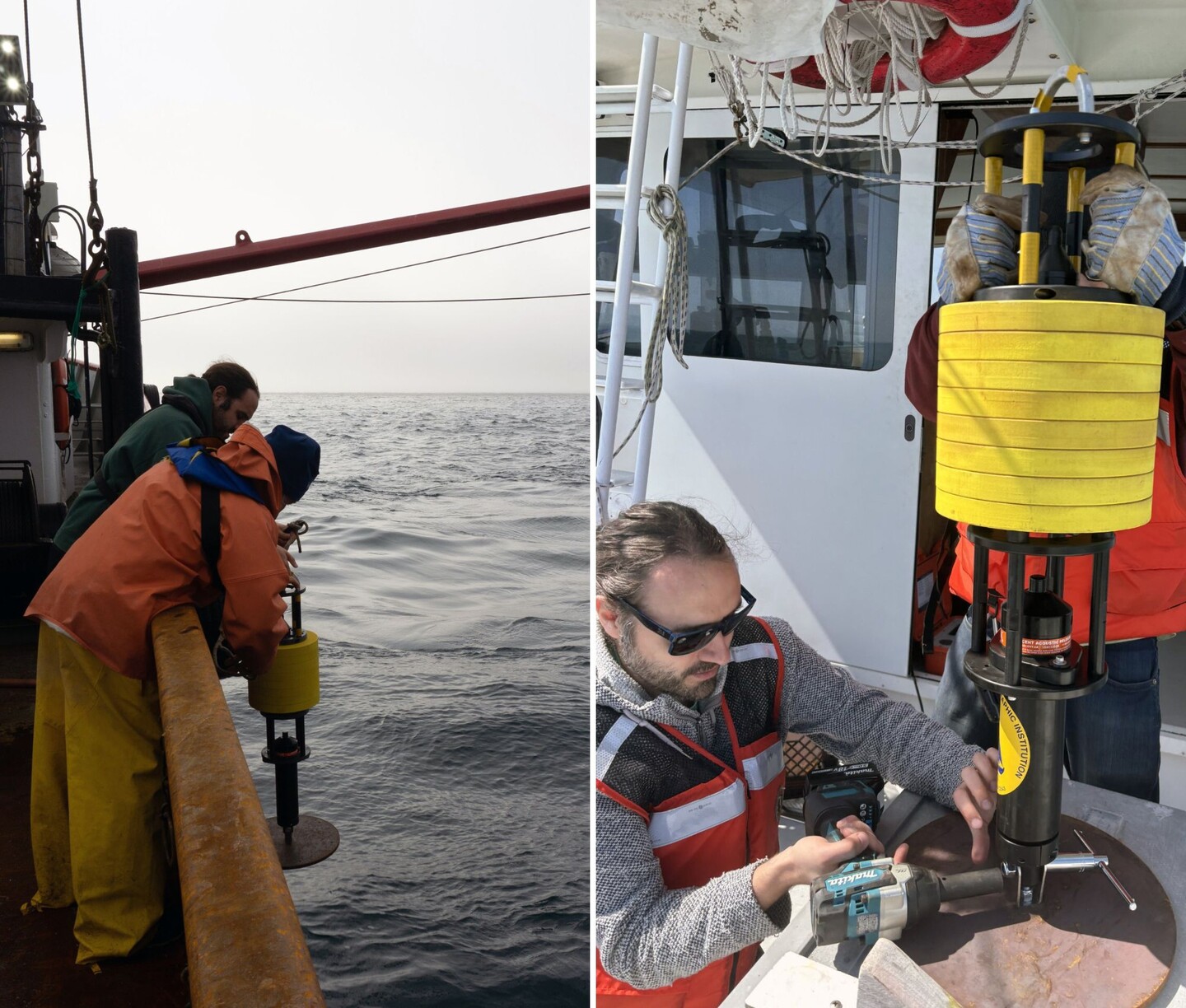
This type of ocean receiver, called a TOSSIT, sinks to the bottom, has its own clocks, and records sounds for up to months at a time. When done, they are recalled to the surface when they detect a certain acoustic signal from a ship above.
(Image: Courtesy of Julien Bonnel)
But there’s a catch: If they were trying to track a nearby whale using just standard physics, they’d probably place the animal in the wrong spot—off by hundreds of meters.
In a paper recently published in the journal Physical Review E, Spiesberger and colleague Eugene Terray of the Woods Hole Oceanographic Institute offer a potential explanation for why this occurs: The humble whale call is, improbably, tangled up with the same speed limits Einstein deduced from the universe. Their findings could improve whale tracking for conservationists.
“Most of us don’t hear a whale call and think, ‘Wow, look at the special theory of relativity in action,” says Spiesberger. “I would have never guessed any connection existed.”
Going over the limit
When a whale calls, Spiesberger explains, the sound doesn’t take a single path to each receiver. Some of the sound travels directly to a receiver, while some of it ricochets off the ocean surface first, arriving fashionably late.
That delay can put the two signals out of phase, causing them to interfere with one another and shifting when sound appears to arrive to a receiver.
Spiesberger stumbled onto this while refining a computer program meant to calculate the correct speed of sound for his whale-tracking equations. The results were surprising.
“The first time, we got a number that was around 1,000 meters per second,” he says, well below the roughly 1,500 meters per second that sound normally travels in seawater. “And then, further on, I got values that were sometimes 3,000 meters per second. I immediately thought there was a bug in my program.”
After examining his software for a few hours, he discovered that the behavior wasn’t a coding error, but a physical effect caused when a receiver picked up both the direct signal and its reflected echo when a whale was near the ocean’s surface.
Physicists call this “temporal interference,” the same phenomenon that causes TV broadcasts at your home antenna to fade out due to two paths arriving out of phase or sync. The interference can also shift the peak of the energy earlier and break the speed limit.
“The effect sounds like a violation of physics,” Spiesberger says, “but it isn't.”
What appears to speed up is not the signal carrying information but the position of the signal’s strongest peak. That crucial distinction is the reason their finding aligns with Einstein’s theory.
For more than a century, physicists have known that waves can sometimes appear to travel faster than light when their shape changes. But the information encoded in those waves still cannot travel faster than light—the central principle of Einstein’s theory of special relativity.
“You can’t use this trick to send a message to your past self to bet on the stock market,” Spiesberger jokes. “Causality isn’t overturned.”
Putting theory to practice
For now, this lives in theory and simulation, Spiesberger says. His next goal is to catch the effect in the real world, and he plans to start close to home.
He has set up audio microphones and intends to reflect sound off a hard floor, standing in for the ocean surface that bounces a whale’s call. If the acoustic version works, the same idea could be tested with light—a beam splitter sending one path toward a reflector and another straight to a detector, the two meeting to interfere.
Whether sound or light proves easier to pin down first is, Spiesberger says, an open question.
John Spiesberger is a visiting scholar in the Department of Earth & Environmental Sciences at the University of Pennsylvania’s School of Arts & Science.
Eugene Terray of the Woods Hole Oceanographic Institute co-authored this publication.
The research was supported by the Office of Naval Research (grant N00014-23-1-2336).
On the move: Water quality and antimicrobial resistance testing goes mobile
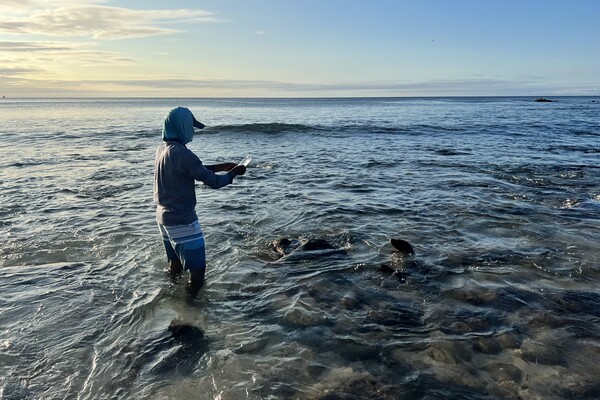
Penn researchers have developed a mobile field laboratory allowing them to test water quality and track antimicrobial resistance in and around San Cristóbal in the Galápagos.
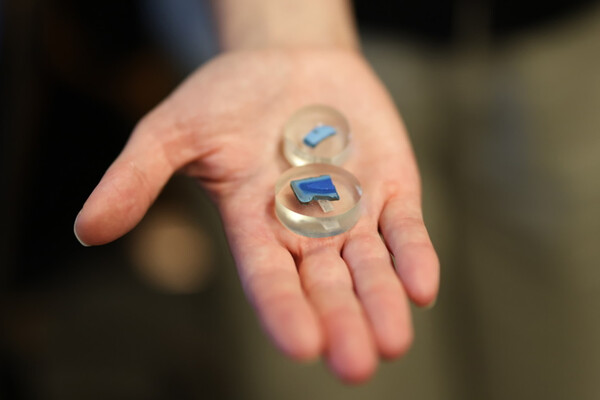
Penn researchers Vanessa and Alexis North are studying one of the largest collections of Egyptian blue objects ever found in the ancient Near East, shedding new light on how the world’s first synthetic pigment may have traveled far beyond Egypt.
A new role for dental providers? Rethinking where vaccines are given
Vaccinations have traditionally been administered in primary care settings or pharmacies. However, for about a decade, some states have authorized dentists to administer vaccines, and many others did so during the COVID-19 pandemic. The effectiveness of this approach has led some countries and states to expand or consider expanding the role of dental providers in delivering routine vaccines, including those against COVID-19 and the human papillomavirus (HPV), and in providing vaccine education.
Penn student develops a way for computer chips to run more efficiently
Fluid Silicon, a platform from President’s Sustainability Prize winner Nhlanhla Mavuso, allows computer chips to continuously monitor their health and self-tune as their characteristics change. The technology has the potential to reduce energy usage in data centers and improve reliability in mission-critical applications.