Does early-life cellular activity influence cancer and aging?
Penn biologists present new evidence on how telomere length is inherited in early embryos. Their findings open new avenues for research on aging and cancers.
3 min. read
Mia Levine and Michael Lampson’s research examines how telomere length is inherited, and how this can inform future genetic research in how cancer develops.
Key Takeaways
The length of telomeres, the protective caps for chromosomes, are inherited during early embryonic development.
Long paternal telomeres and short maternal telomeres promote long telomeres in early embryonic development, known as rapid telomere elongation.
Rapid telomere elongation is associated with alternative lengthening of telomeres (ALT), a pathway linked to tumor biology and cancer.
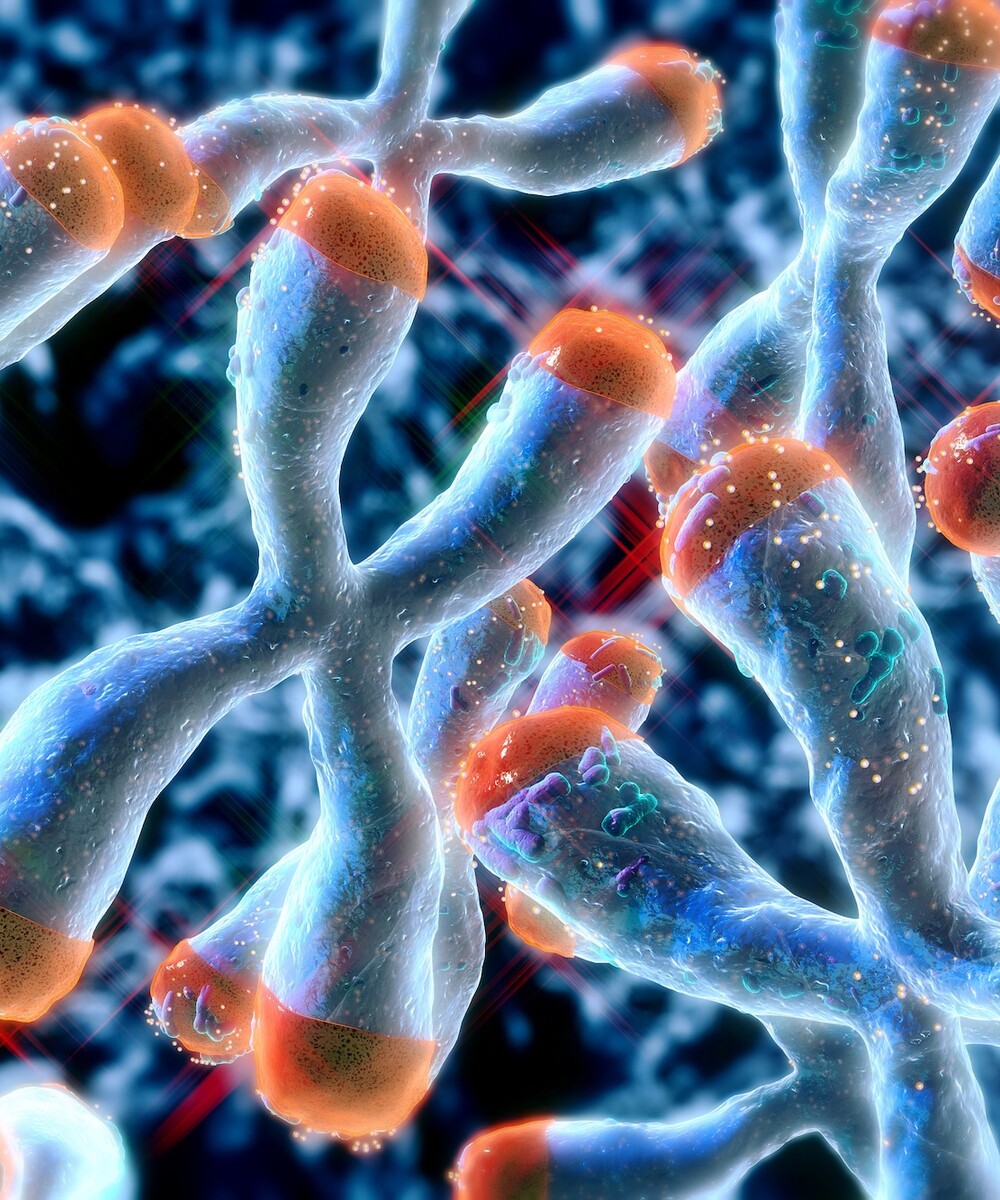
Small plastic or metal bits at the end of shoelaces, known as aglets, prevent laces from unraveling and protect them from wear and tear. Similarly, chromosomes are capped by telomeres—specialized complexes of repetitive DNA sequences and protective proteins that shield valuable genetic information at distal chromosomal tips from fraying or sticking to other chromosomes.
Like aglets, telomeres are subject to degradation. Every time a cell divides, telomeres get a little shorter. Once they reach a critically short length, the cell reads this as DNA damage and permanently stops dividing. This irreversible growth-arrest state, called cellular senescence, is linked to chronic inflammation and contributes to age-related disease.
For decades, scientists studying biomarkers of aging have investigated telomere length across species and individuals, as initial telomere length can vary even among members of the same species. The link between length and lifespan is complicated and confounded by many factors, but in mammals, starting life with shorter telomeres generally maps to higher risks of age-related disease and premature death.
“On the flipside, if telomeres are too long, it can also spell trouble because cancer cells require long telomeres to become longer lived, ‘immortal,’” says Mia Levine, associate professor of biology in the School of Arts & Sciences at the University of Pennsylvania, who co-led research on the heritability of telomere lengths.
Levine and Michael Lampson, a professor of biology at Penn’s School of Arts & Sciences, asked the extent to which telomere length inheritance follows the usual genetic rules. Specifically, is telomere length inherited as a polygenic trait, meaning it is influenced by many genes—similar to eye color or height—or are telomeres themselves inherited directly from egg and sperm cells?
“We wanted to ask how telomeres are really inherited,” says Lampson. “Is it just the telomere DNA sequence you inherit from your parents, or is it determined by the genes that regulate telomeres? What we found doesn’t fit neatly into either box.”
Published in Current Biology, the team’s experiments in an animal model support the existence of a parent-of-origin effect. When mothers contribute short telomeres and fathers contribute long ones, embryos elongate their telomeres. Reverse the pairing—long from mom, short from dad—and the embryos’ telomeres shortened.
“This parent-of-origin effect is consistent with patterns we’ve seen in human studies,” Levine explains. “For example, children of older fathers tend to have longer telomeres than children of younger fathers. But teasing apart why that happens is difficult, because human studies are confounded by so many factors—diet, smoking, stress, lifestyle. That’s why we turned to a controlled animal model to test these ideas directly.”
The researchers used mice with naturally long or short telomeres and performed reciprocal crosses—swapping which parent contributed which telomere type. Because the offspring were genetically identical in both cases, any differences in telomere outcomes pointed to parent-of-origin effects rather than underlying DNA sequence. “Reciprocal crossing is what lets us detangle the usual confounders,” Levine says.
Before the embryo switches on its own genome, it relies entirely on what’s already in the egg and sperm. In a short window, between the first and second cell divisions, the team observed telomeres either elongating or shortening, a pivot that determined their length later in development.
The mechanism, the researchers report, looks less like the well-known enzyme telomerase, which adds DNA-protein complexes to chromosomal tips in germ and stem cells, and more like a pathway known as alternative lengthening of telomeres (ALT). This pathway, used by roughly 10–15% of cancers, “copies and pastes” telomeric DNA from one chromosome to another rather than building it with telomerase.
The team’s data support the idea that embryos can flip on a similar template-driven process and that it is sensitive to the asymmetry between maternal and paternal telomeres. Experimentally, only the first pairing consistently triggered ALT-like elongation. The reverse pairing produced the opposite effect, measurable shortening.
Looking ahead, the team are interested in seeing how these trends may or may not be mapping to humans.
“On the human side, we’re now taking advantage of long-read genome sequencing,” Levine says. “That lets us look directly at telomeres in family trios—mom, dad, and child—to ask if the same parent-of-origin effects we saw in mice are detectable in humans.”
They are also interested in the implications for cancer research, as their embryonic model allows them to study the initiation of the ALT pathway.
“When people study ALT in cancer cells, it’s already been happening for many generations,” Levine explains. “But in embryos, we can catch ALT at its very initiation, at the very first cell divisions. That gives us a window into how this pathway naturally gets switched on.”
Mia T. Levine is an associate professor in the Department of Biology in the School of Arts & Sciences at the University of Pennsylvania.
Michael Lampson is a professor of biology at Penn Arts & Sciences.
Hyuk-Joon Jeon, a former postdoctoral researcher in the Levine and Lampson Labs, was first author of the study.
The study was supported by the National Institutes of Health (GM122475 and GM124684), the Penn Center for Genome Integrity and the University Research Fund at the University of Pennsylvania, and the National Research Foundation of Korea.
On the move: Water quality and antimicrobial resistance testing goes mobile
Penn researchers have developed a mobile field laboratory allowing them to test water quality and track antimicrobial resistance in and around San Cristóbal in the Galápagos.
Penn researchers Vanessa and Alexis North are studying one of the largest collections of Egyptian blue objects ever found in the ancient Near East, shedding new light on how the world’s first synthetic pigment may have traveled far beyond Egypt.
A new role for dental providers? Rethinking where vaccines are given
Vaccinations have traditionally been administered in primary care settings or pharmacies. However, for about a decade, some states have authorized dentists to administer vaccines, and many others did so during the COVID-19 pandemic. The effectiveness of this approach has led some countries and states to expand or consider expanding the role of dental providers in delivering routine vaccines, including those against COVID-19 and the human papillomavirus (HPV), and in providing vaccine education.
Penn student develops a way for computer chips to run more efficiently
Fluid Silicon, a platform from President’s Sustainability Prize winner Nhlanhla Mavuso, allows computer chips to continuously monitor their health and self-tune as their characteristics change. The technology has the potential to reduce energy usage in data centers and improve reliability in mission-critical applications.