Testing a novel, community-driven response to heat islands in Philadelphia
Researchers from three University of Pennsylvania schools collaborated with a Hunting Park nonprofit to design, build, and test a prototype of a cooling shelter to place at a bus stop.
Penn researchers worked with North10, a nonprofit in North Philadelphia, to bring a prototype cooling shelter to Hunting Park one day in August, an opportunity for community members to provide feedback and learn about the health impacts of heat.
(Image: Ji Yoon Bae)
July marked the 14th month in a row of record high global temperatures, and as the month ended, the National Weather Service said Philadelphia was on track for its third warmest summer since 1874. While 94° days are hardly pleasant for suburbanites, heat can be worse for residents in pockets of Center City, South Philadelphia, and North Philadelphia.
“In parts of Philadelphia called heat islands—on a hot day especially during heat waves—temperatures can exceed non-urban areas or Philadelphia suburbs by an average of 8 or 12°,” says associate professor of nursing Sara Jacoby, whose research lies at the intersection of health disparities and the sociostructural conditions of urban environments. She says heat islands can exist because of fewer trees and more concrete, and exposure to hotter temperatures and heat waves can pose health risks for people, especially those living with cardiovascular disease, asthma, and other chronic illnesses.
In Hunting Park, a North Philadelphia neighborhood, temperatures can be as much as 20° hotter than in other parts of the city. Operating out of the Lenfest Center, the nonprofit North10 serves the Hunting Park-East Tioga area by offering youth programs, workforce training, affordable housing, a community market, and more. Nikki Bagby, chief external affairs officer, says people of all ages who come for services wait in the heat to catch a bus, and the bus stop has no overhang.
This is thanks to a grant from the Penn Community Collaboratory for Co-Creation (Penn4C), a joint initiative from Penn Nursing and Penn Engineering “based on the recognition that technological solutions should be designed with active engagement of marginalized communities.”
Dorit Aviv, assistant professor of architecture and director of the Thermal Architecture Lab in Weitzman, led the research, design, and construction of the prototype with a team of students, while Jacoby provided messaging on the health impacts of heat and surveyed community members. The prototype is called Tenopy—a canopy created in collaboration with North10—and community members tested it out one day in August.
“We are aiming to provide an experience of being outside in the heat and then walking in here, sitting, and feeling relief while still being in an open-air structure,” Aviv says. “This can have important implications for how we think about urban cooling shelters for the future, especially given the need for open-air structures in light of what we’ve seen during the COVID pandemic. We also learned a lot from the community collaboration, and we hope that if the pilot is successful, we can work together toward long-lasting solutions.”
The prototype was designed as a temporary shelter, while installing a permanent structure involves material and structural enhancements and getting necessary permits for installation, Aviv says. She wants to see this experiment turned into a more permanent solution and replicated elsewhere.
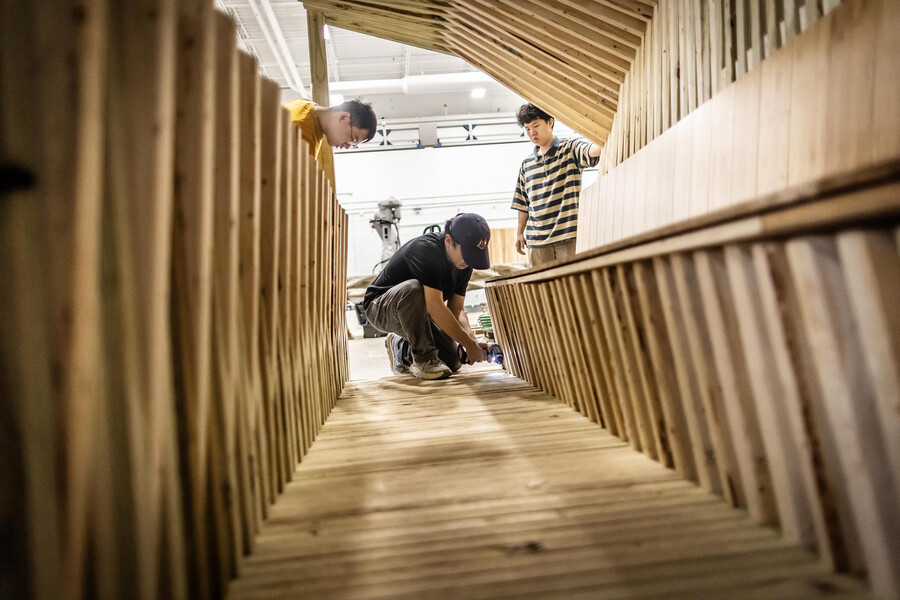
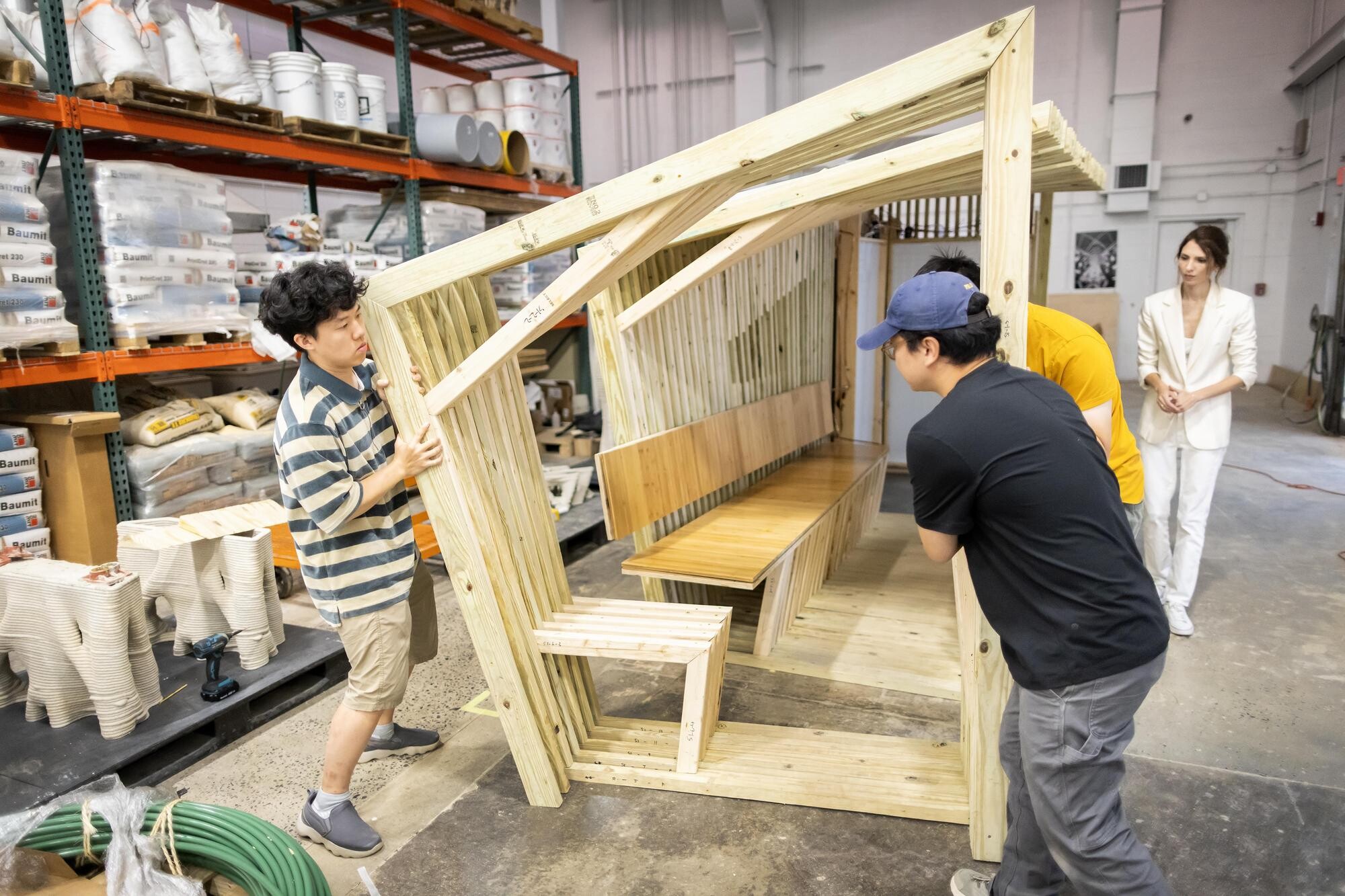
Graduate students Shuo-Hsuan (Wayne) Chang, Ji Yoon Bae, and Hanzhong Luo work on the Tenopy shelter in Dorit Aviv’s fabrication workshop at Pennovation.
Jacoby says Tenopy will also be the launching point for Designing to Care: Improving Health and Wellness, an SNF Paideia course she is teaching this fall with Weitzman lecturer Mikael Avery. Students will work with North10 on addressing heat, Jacoby says, whether creating imagery and messaging to incorporate in the cooling shelter or brainstorming completely different solutions.
“The deans of nursing and engineering wanted to get together and see if we can get more interaction to happen. We saw lots of opportunities for technology and engineering to be involved in health care,” Yim says. He envisions Penn4C growing larger and hopes that Weitzman can become a core partner.
Building a solution from the ground up
The cooling shelter came together this summer at Pennovation Works, Penn’s 23-acre site comprising labs, production spaces, and offices on the Schuylkill River. Beyond the garage doors into Aviv’s high-ceilinged fabrication workshop, she and students designed and built the 15-by-10-by-7-foot structure using basic two-by-four and two-by-two beams.
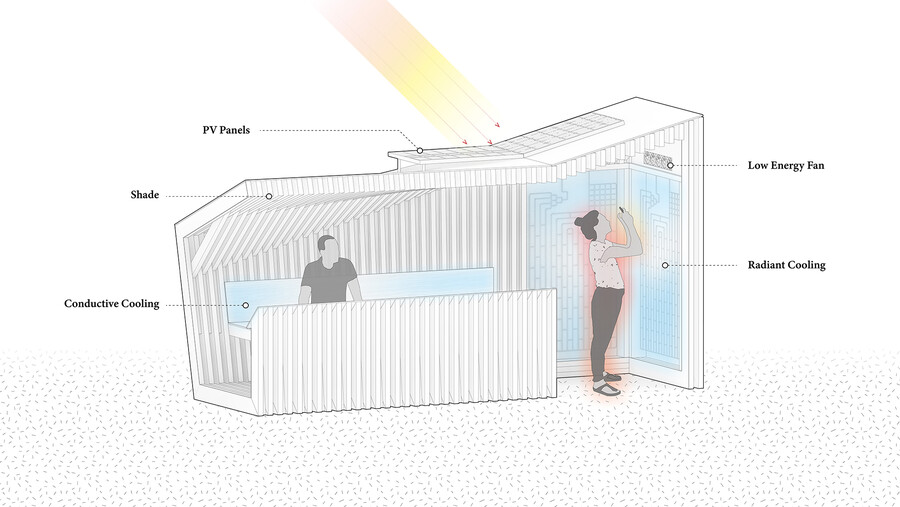
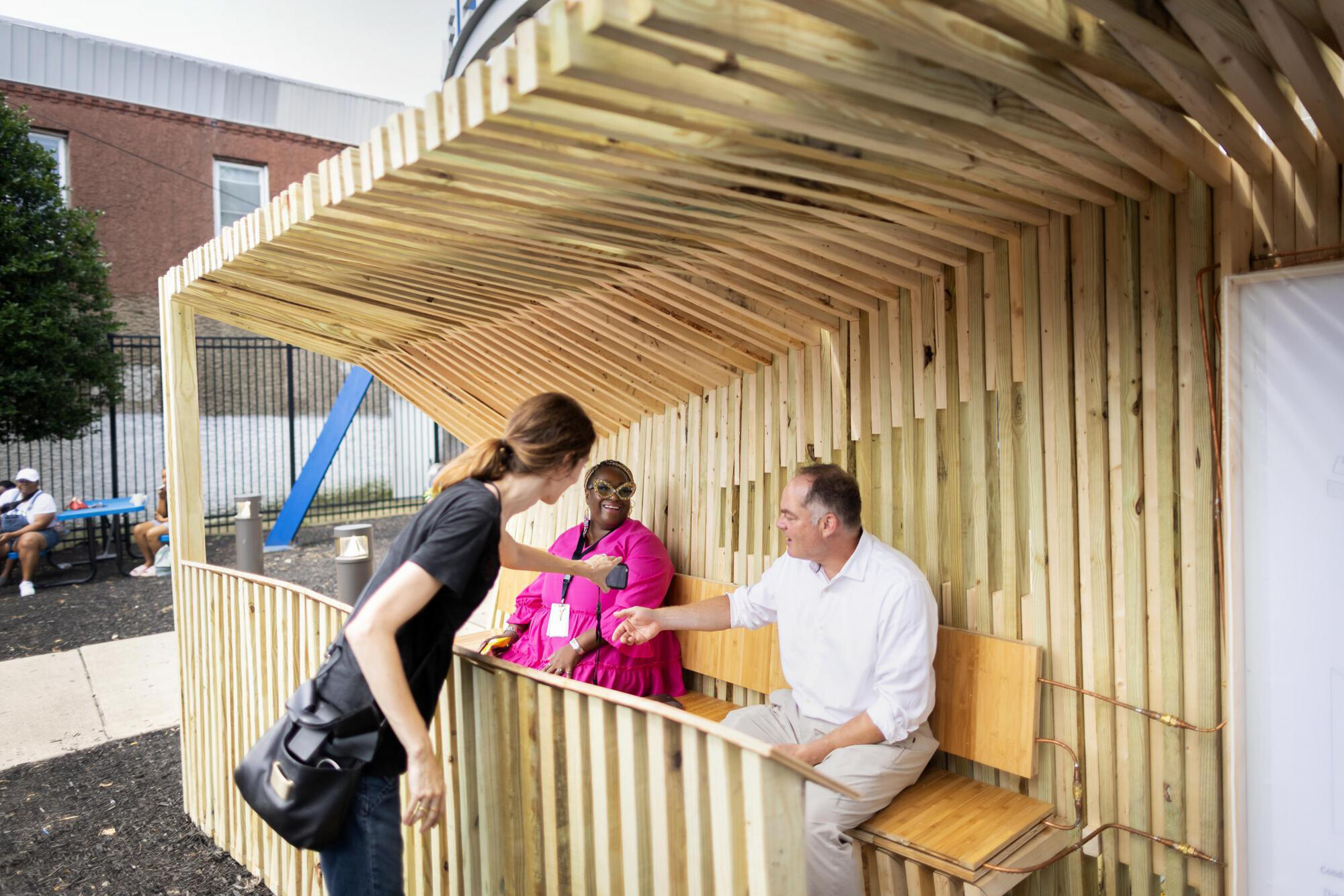
In addition to getting some shade, people using the shelter can sit on a bench with a conductive cooling surface or stand next to radiant cooling panels. Similarly to how radiant floors emit heat by circulating hot water through embedded pipes, Aviv explains, pipes containing a refrigerant within the wall panels in the shelter provide radiant cooling.
This is all powered by six small solar panels atop the structure that are connected to a heat pump and controls in the back, making the structure energy autonomous and renewable.
The solar-powered Tenopy shelter provides cooling through shade, a bench with a conductive cooling surface, and radiant cooling panels.
(Image: Thermal Architecture Lab)
“The neat thing about it is you really need this cooling when you have a lot of sun, like today,” Aviv said one 93° day in July, “so that means it will be powered as long as you need cooling.” Aviv began working with Penn4C and Bagby (from North10) last October, meeting with Bagby to get input on the design. Ji Yoon Bae, now a third-year Ph.D. student in architecture working in Aviv’s lab, joined the project in May and helped design the structure.
“I was super interested in the environmental aspect of design discourse,” Bae says. He envisioned an undulating angle for the backrest, so people can comfortably transition from sitting to standing, and designed the ceiling height on an angle to accommodate people of different ages.
Hanzhong Luo, a Master of Architecture student, and Shuo-Hsuan “Wayne” Chang, a Master of Science in Design in Environmental Building Design (MSD-EBD) student, later joined the project to help Bae with woodcutting and structure assembly, which began in early June. The students also used thermal cameras to document the effects of the shelter.
Thermal engineer Eric Teitelbaum of AIL Research in Hopewell, New Jersey, an architecture lecturer at Penn and longtime collaborator with Aviv, worked with the team throughout the process and designed the cooling equipment.
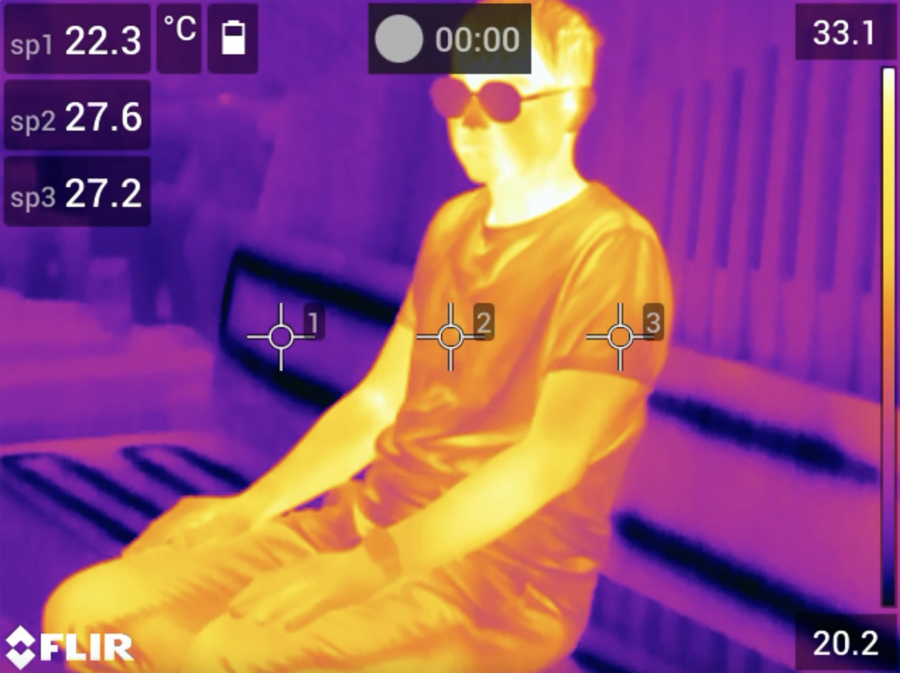
An infrared camera shows Shuo-Hsuan (Wayne) Chang on the Tenopy bench, and the cooling pipes embedded in the bench, which cannot be seen with a naked eye. It also shows that the person’s skin temperature (around 33° Celsius) is much higher than that achieved by the surface of the bench through the cooling effect (20-22°). The cooled surface of the bench removes heat from the skin through conduction.
(Image: Courtesy of Dorit Aviv)
Aviv says a major part of her research is finding alternatives to air conditioning, which consumes a lot of energy and requires an enclosed environment. In 2020, she and Teitelbaum co-authored a paper presenting results from an outdoor radiant-cooling pavilion they constructed in Singapore. “It successfully makes people feel comfortable in conditions exceeding 30°C and 65% relative humidity,” the authors reported.
Their work challenged two views that have kept radiant-cooling technologies from widespread commercial adoption: that the low temperature required will form condensation in humid environments, and that cold surfaces will still cool adjacent air via convection, limiting the effectiveness of radiant cooling.
The researchers used an infrared-transparent polyethylene membrane to separate the cooling surface from the humid air and thus prevent condensation, an approach also taken with Tenopy. But Tenopy is testing the cooling bench for the first time.
The Ramboll Foundation recently selected Aviv, Teitelbaum, and William Braham, the Andrew Gordon Professor of Architecture and director of the MSD-EBD Program, as recipients of a $149,000 grant to develop an architectural application of their membrane-assisted radiant cooling technology. This takes the form of a mobile structure that could be disassembled and then reassembled to be tested at various partner sites.
The grant and collaboration with architectural firm Henning Larsen “has the potential to make this technology accessible and deployable in the places that need it the most,” Aviv says.
From the workshop to the neighborhood
Tenopy originated with a call to the community, Yim says, since Penn 4C wants to support projects not already in process. Bagby says she heard about the grant and thought it was an awesome opportunity.
“What was most important for me was the fact we were able to partner with both the School of Nursing as well as the engineers. You can’t put a price on that,” says Bagby, who has a background in public health. She met with Yim to strategize and talk about issues in the community, and one that came up was heat islands.
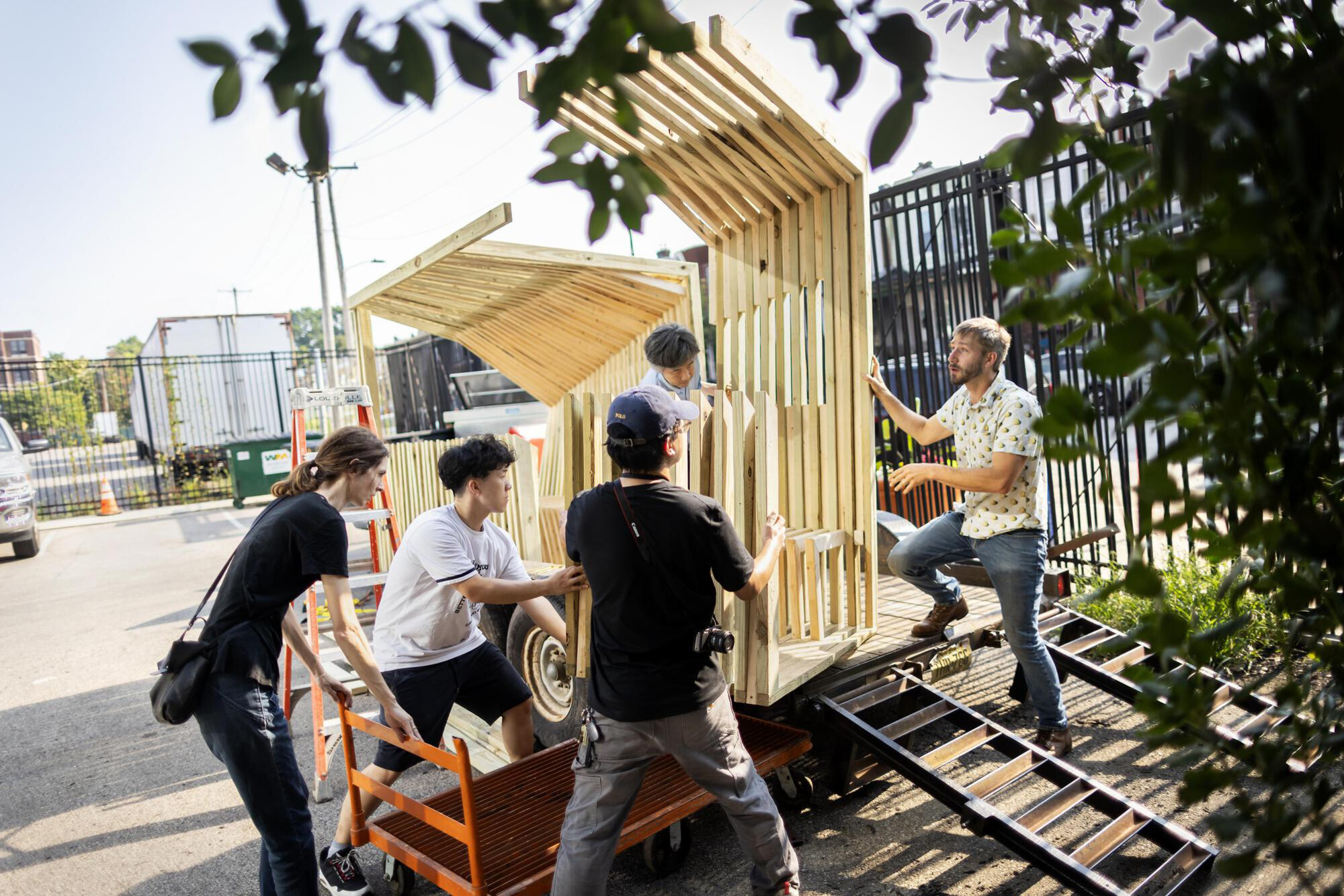
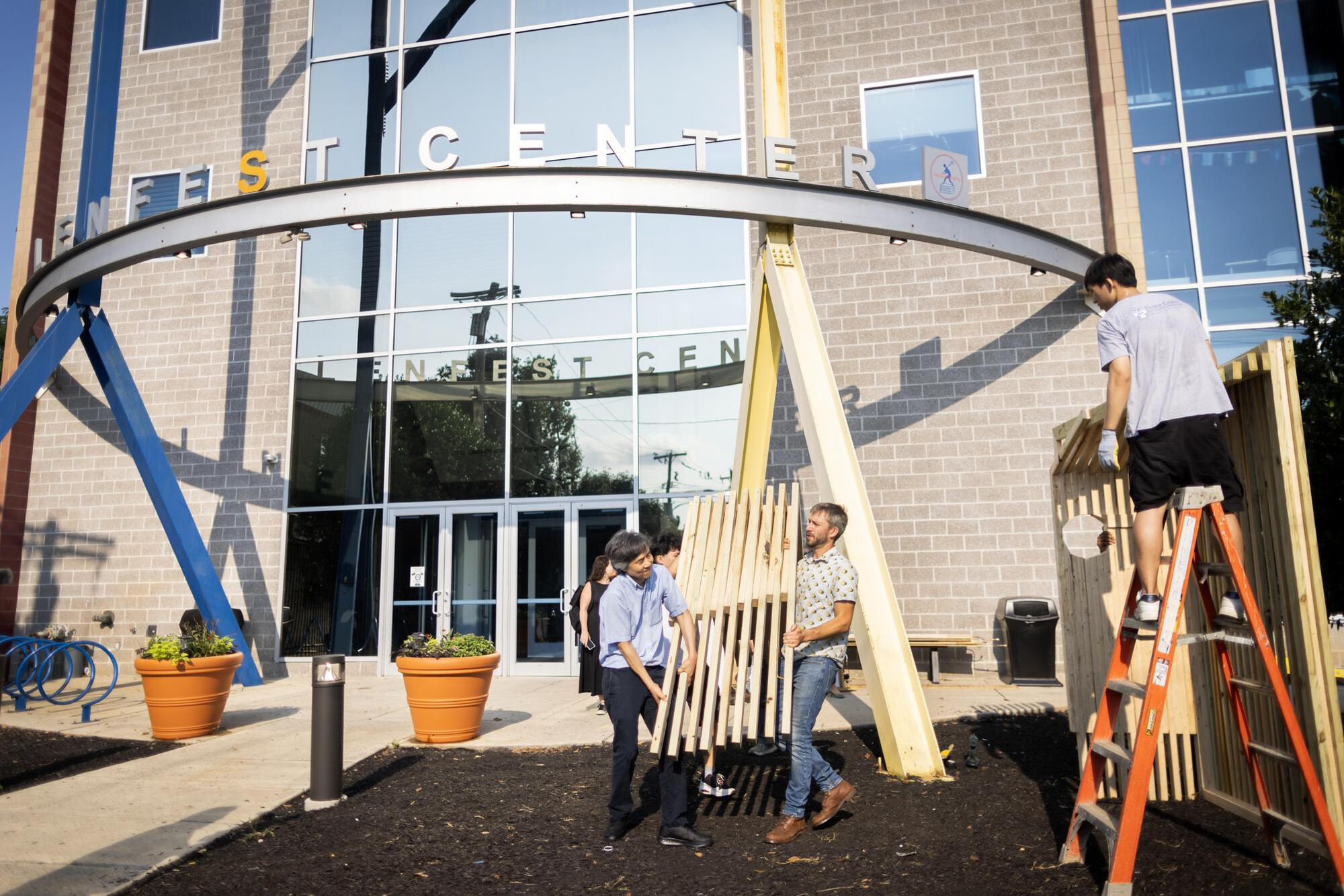
After transporting the Tenopy shelter from Pennovation to North Philadelphia, Penn researchers work on reassembling the structure.
According to a 2019 report from the Philadelphia Office of Sustainability, more than 75% of the land cover in Hunting Park is buildings, roads, and paved surfaces compared to 52% citywide, and the area is listed as “very high” on the Philadelphia Heat Vulnerability Index. “Very disadvantaged communities of color are always the ones that have all these inequities, and part of that issue is health inequities,” Bagby says.
Yim was familiar with Aviv’s work on sustainable cooling and asked her to lead the project. Jacoby says Demiris asked her to get involved because of her work in firearm injury prevention and neighborhood health, which focuses a lot on Philadelphia. There is evidence, she says, that increased heat increases the likelihood of firearm injuries.
Jacoby is also working on a second Penn4C project with North10, one focused on assessing the impact of street cleaning and land care and a tool to help remove debris in the North Tioga-East Huntington neighborhood.
“You have overlapping, prominent public health issues,” Jacoby says. “The reality in Hunting Park is that there are many social inequities and public health problems that you can see as layered onto one another: heat island effects, exposure to firearm injuries, unequal dumping, lack of trees, all of which play a role in shaping community health.”
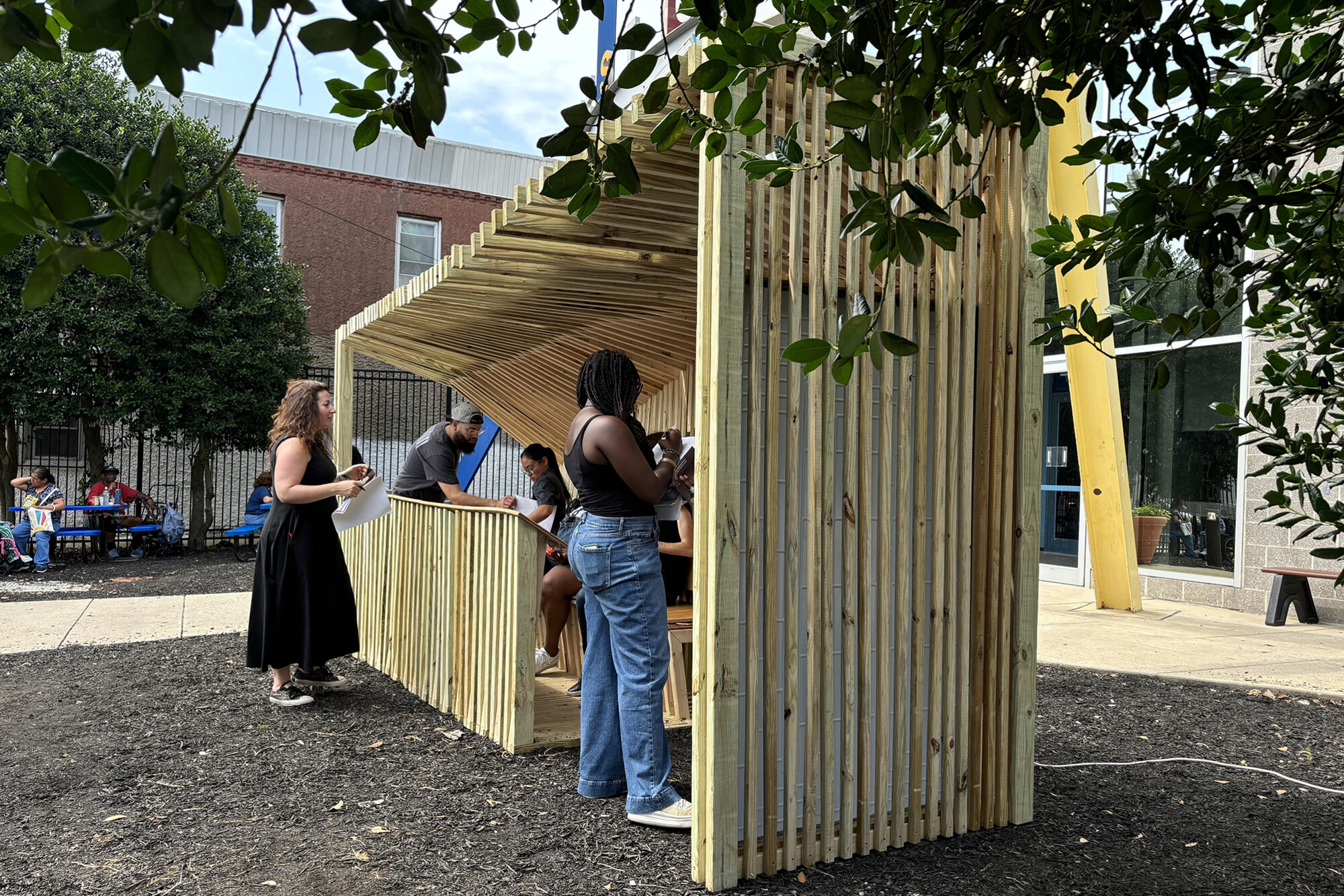
At left: Dorit Aviv talks to Nikki Bagby and Joshua Klaris, executive director of North10. At right: Sara Jacoby (left) worked with Penn students to survey community members on how they’re impacted by heat and their reactions after spending time in the Tenopy shelter.
(Images: Eric Sucar / Ji Yoon Bae)
Recent Penn Engineering graduates Ling Xu and Ming Zou demonstrated ShatterSweep, a lawnmower-like device they designed to pick up small sharp pieces like glass, to North10’s Neighborhood Promise Program, a crew conducting street cleaning and maintenance.
And one hot and humid Tuesday in August, the Penn researchers transported Tenopy from Pennovation to North10’s home at 3890 N. 10th St. for community members to try it out and provide feedback.
The team arrived early in the morning and began erecting the structure on site. By 11 a.m., when the sun was high in the sky and the humidity level was at 67%, the Tenopy shelter was ready to receive people. Residents of the Hunting Park neighborhood flowed into the structure, tried out the cooling bench and radiant cooling panels, and provided feedback via surveys conducted by Jacoby and students.
Jessi Jha, a fourth-year electrical engineering major, helped translate the survey for several Spanish-speaking residents. Some of the questions were about their experience with heat and whether it impacted their social wellbeing or health, she says, as well as asking for community members’ reactions after five minutes in the Tenopy.
Jha, who is from Mountain View, California, says one trend that stood out to her was that people expressed concern for the health of themselves and their family members and concern over rising energy costs. Jha says community members mentioned liking the graphics in the Tenopy that explained heat waves, how to stay cool, and how the structure works, and she observed that community members enjoyed the novel experience of being inside the cooling shelter.
Jacoby says after experiencing the Tenopy, one community member was reminded of the solar warming shelters she experienced in the Andes Mountains to protect from freezing temperatures, and she appreciated that the shelter would work similarly to cool people. Other community members saw the need for cooling shelters and made suggestions for making the Tenopy a space to protect public health more broadly, such as including a medical alert button to call for help if someone needed it.
“Often, when conducting research, you remain within the confines of your lab, and you might not see how your work impacts people outside of a limited circle of researchers who read your publications,” Aviv says. “Penn4C has provided an excellent opportunity to engage directly with a community affected by the problem my lab is addressing.”
Graduate students Hanzhong Luo, Ji Yoon Bae, and Shuo-Hsuan (Wayne) Chang work on the Tenopy shelter in Dorit Aviv’s fabrication workshop at Pennovation.
On the move: Water quality and antimicrobial resistance testing goes mobile
Penn researchers have developed a mobile field laboratory allowing them to test water quality and track antimicrobial resistance in and around San Cristóbal in the Galápagos.
Penn researchers Vanessa and Alexis North are studying one of the largest collections of Egyptian blue objects ever found in the ancient Near East, shedding new light on how the world’s first synthetic pigment may have traveled far beyond Egypt.
A new role for dental providers? Rethinking where vaccines are given
Vaccinations have traditionally been administered in primary care settings or pharmacies. However, for about a decade, some states have authorized dentists to administer vaccines, and many others did so during the COVID-19 pandemic. The effectiveness of this approach has led some countries and states to expand or consider expanding the role of dental providers in delivering routine vaccines, including those against COVID-19 and the human papillomavirus (HPV), and in providing vaccine education.
Penn student develops a way for computer chips to run more efficiently
Fluid Silicon, a platform from President’s Sustainability Prize winner Nhlanhla Mavuso, allows computer chips to continuously monitor their health and self-tune as their characteristics change. The technology has the potential to reduce energy usage in data centers and improve reliability in mission-critical applications.