Bioengineers on the brink of breaching blood-brain barrier
A team of researchers in the School of Engineering and Applied Sciences has devised a method to deliver mRNA into the brain using lipid nanoparticles, potentially advancing treatments for Alzheimer’s disease and seizures.
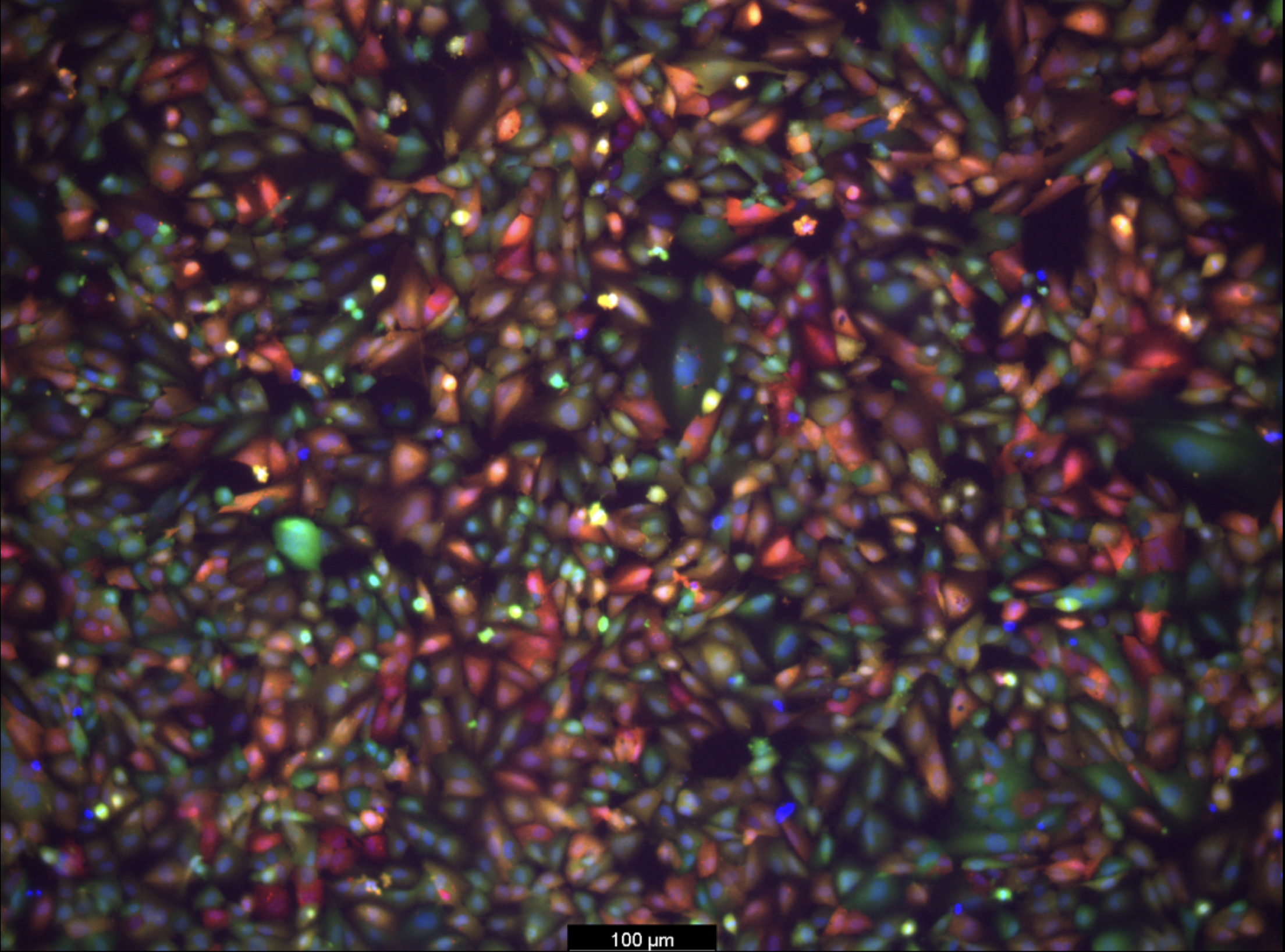
The blood-brain barrier, a protective cell layer guarding the brain, blocks foreign bodies but also hinders drug delivery, complicating treatment of neurological disorders. Michael Mitchell’s team at the School of Engineering and Applied Science has devised a method to deliver mRNA into the brain using lipid nanoparticles (LNPs), potentially advancing treatments for Alzheimer's disease and seizures. Pictured: Fluorescence microscopy image showing LNPs delivering fluorescent protein (mCherry) mRNA to brain endothelial cells. Cells are shown in green and their nuclei are shown in blue. Cells that are red were transfected by LNPs, where the newly expressed mCherry protein results in red fluorescence.
(Image: Courtesy of Emily Han)
Imagine the brain as an air traffic control tower, overseeing the crucial and complex operations of the body’s ‘airport.’ This tower, essential for coordinating the ceaseless flow of neurological signals, is guarded by a formidable layer that functions like the airport’s security team, diligently screening everything and everyone, ensuring no unwanted intruders disrupt the vital workings inside.
However, this security, while vital, comes with a significant drawback: sometimes, a ‘mechanic’—in the form of critical medication needed for treating neurological disorders—is needed inside the control tower to fix arising issues. But if the security is too stringent, denying even these essential agents entry, the very operations they’re meant to protect could be jeopardized.
Now, researchers led by Michael Mitchell of the University of Pennsylvania are broaching this long-standing boundary in biology, known as the blood-brain barrier, by developing a method akin to providing this mechanic with a special keycard to bypass security. Their findings, published in the journal Nano Letters, present a model that uses lipid nanoparticles (LNPs) to deliver mRNA, offering new hope for treating conditions like Alzheimer’s disease and seizures—not unlike fixing the control tower’s glitches without compromising its security.
“Our model performed better at crossing the blood-brain barrier than others and helped us identify organ-specific particles that we later validated in future models,” says Mitchell, associate professor of bioengineering at Penn’s School of Engineering and Applied Science, and senior author on the study. “It’s an exciting proof of concept that will no doubt inform novel approaches to treating conditions like traumatic brain injury, stroke, and Alzheimer’s.”
Search for the key
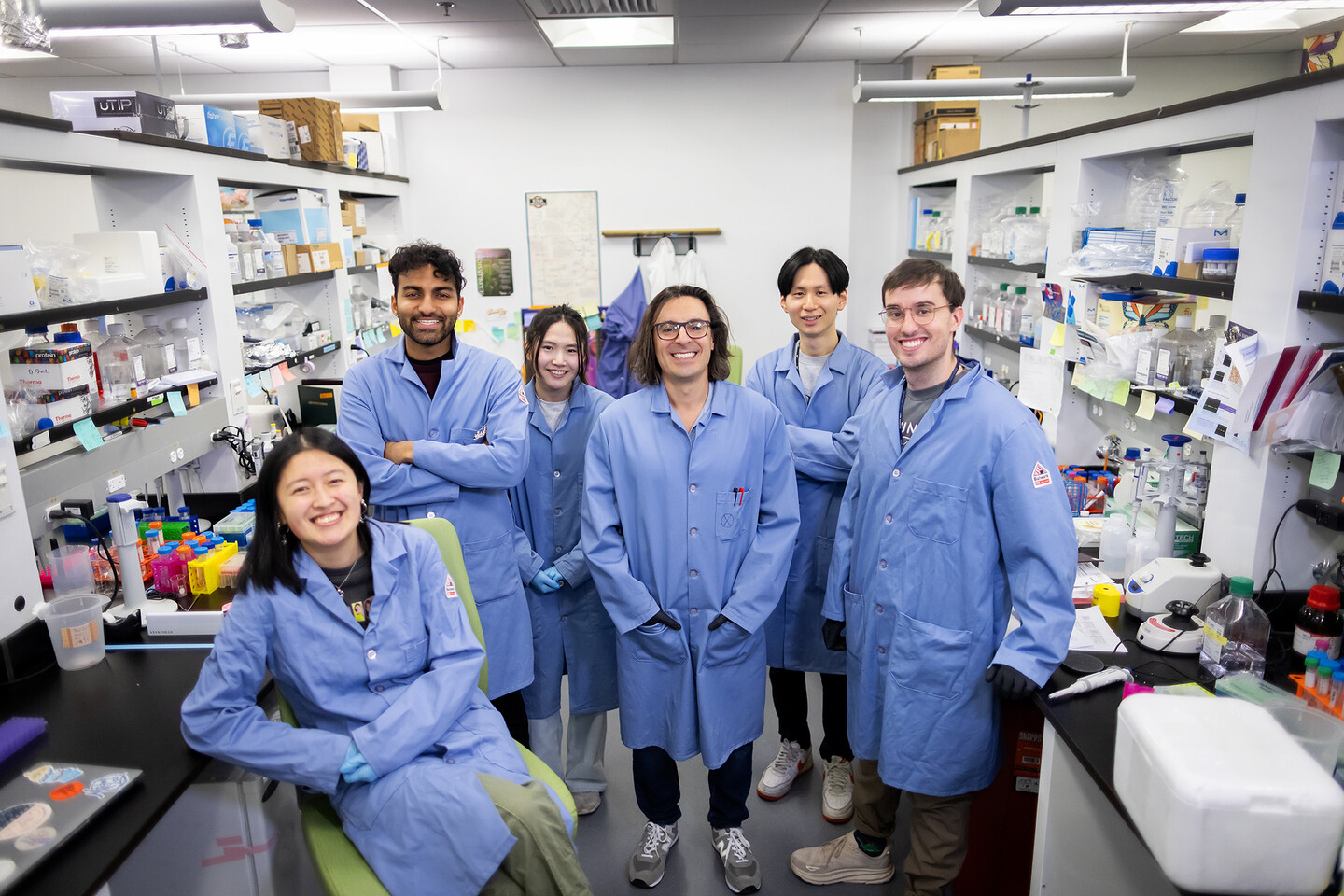
To develop the model, Emily Han, a Ph.D. candidate and NSF Graduate Research Fellow in the Mitchell Lab and first author of the paper, explains that it started with a search for the right in vitro screening platform, saying, “I was combing through the literature, most of the platforms I found were limited to a regular 96-well plate, a two-dimensional array that can’t represent both the upper and lower parts of the blood-brain barrier, which correspond to the blood and brain, respectively.”
Han then explored high-throughput transwell systems with both compartments but found they didn’t account for mRNA transfection of the cells, revealing a gap in the development process. This led her to create a platform capable of measuring mRNA transport from the blood compartment to the brain, as well as transfection of various brain cell types including endothelial cells and neurons.
“I spent months figuring out the optimal conditions for this new in vitro system, including which cell growth conditions and fluorescent reporters to use,” Han explains. “Once robust, we screened our library of LNPs and tested them on animal models. Seeing the brains express protein as a result of the mRNA we delivered was thrilling and confirmed we were on the right track.”
The team’s platform is poised to significantly advance treatments for neurological disorders. It’s currently tailored for testing a range of LNPs with brain-targeted peptides, antibodies, and various lipid compositions. However, it could also deliver other therapeutic agents like siRNA, DNA, proteins, or small molecule drugs directly to the brain after intravenous administration.
What’s more, this approach isn’t limited to the blood-brain barrier as it shows promise for exploring treatments for pregnancy-related diseases by targeting the blood-placental barrier, and for retinal diseases focusing on the blood-retinal barrier.
Next Steps
The team is eager to use this platform to screen new designs and test their effectiveness in different animal models. They are particularly interested in working with collaborators with advanced animal models of neurological disorders.
“We’re collaborating with researchers at Penn to establish brain disease models,” Han says. “We’re examining how these LNPs impact mice with various brain conditions, ranging from glioblastoma to traumatic brain injuries. We hope to make inroads towards repairing the blood-brain barrier or target neurons damaged post-injury.”
Emily Han is a Ph.D. candidate in the School of Engineering and Applied Science at Penn.
Other authors include Marshall Padilla, Rohan Palanki, Dongyoon Kim, Kaitlin Mrksich, Jacqueline Li, Sophia Tang, and Il-Chul Yoon of Penn Engineering.
This research was supported by the National Institute of Health (Award DP2 TR002776, Grant No. T90DE030854 and F30HL162465−01A1); a Burroughs Wellcome Fund Career Award at the Scientific Interface; and the National Science Foundation (Award CBET-2145491 and 1845298).
On the move: Water quality and antimicrobial resistance testing goes mobile
Penn researchers have developed a mobile field laboratory allowing them to test water quality and track antimicrobial resistance in and around San Cristóbal in the Galápagos.
Penn researchers Vanessa and Alexis North are studying one of the largest collections of Egyptian blue objects ever found in the ancient Near East, shedding new light on how the world’s first synthetic pigment may have traveled far beyond Egypt.
A new role for dental providers? Rethinking where vaccines are given
Vaccinations have traditionally been administered in primary care settings or pharmacies. However, for about a decade, some states have authorized dentists to administer vaccines, and many others did so during the COVID-19 pandemic. The effectiveness of this approach has led some countries and states to expand or consider expanding the role of dental providers in delivering routine vaccines, including those against COVID-19 and the human papillomavirus (HPV), and in providing vaccine education.
Penn student develops a way for computer chips to run more efficiently
Fluid Silicon, a platform from President’s Sustainability Prize winner Nhlanhla Mavuso, allows computer chips to continuously monitor their health and self-tune as their characteristics change. The technology has the potential to reduce energy usage in data centers and improve reliability in mission-critical applications.