Heather Sharkey and her students worked to transcribe the feminist trailblazer’s dissertation for her 1912 Penn doctoral degree.
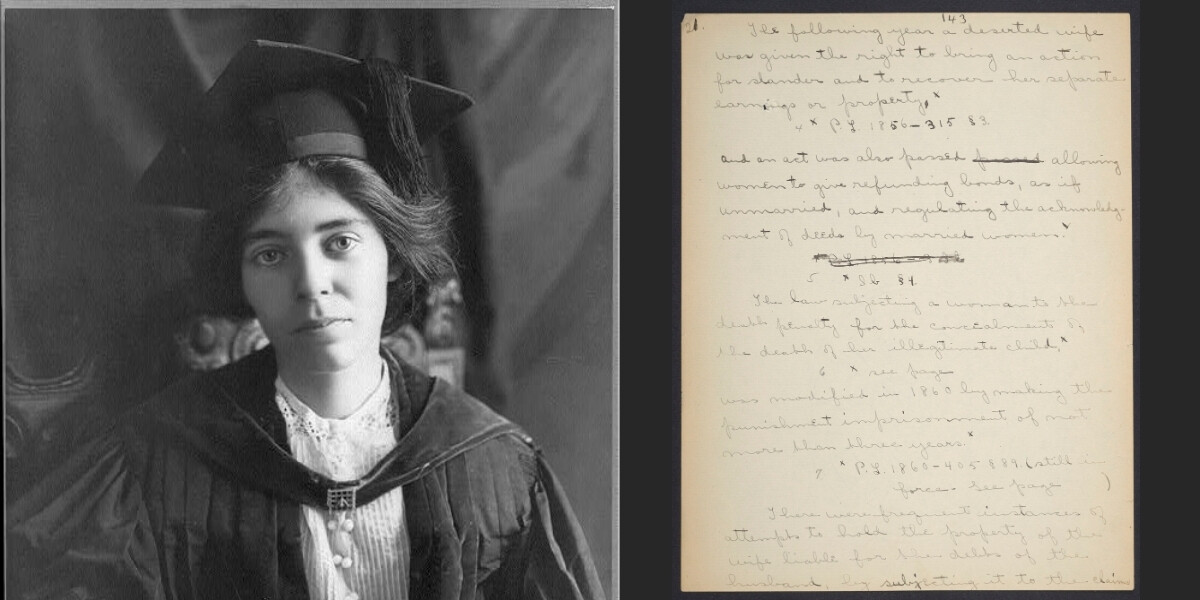
Alice Paul received her Ph.D. from the University of Pennsylvania in 1912. Professor Heather Sharkey and three students have spent the past year transcribing a manuscript of Paul’s doctoral dissertation that is held in the Penn Libraries collection. (Left image: Courtesy of the National Museum of American History, Smithsonian Institute, and the Alice Paul Centennial Foundation, circa 1912) (Right image: Courtesy of the Penn Libraries)
“It was a magical experience, going to the beautiful sixth floor space of Penn’s Van Pelt Library with its views of West Philadelphia and Center City beyond, and leafing through the dissertation’s handwritten pages,” Sharkey said. “We kept mentioning the experience over the semester and marveling over what we had seen.”
The manuscript is a late-stage draft, with some pages hand-written, some typed, and it includes notes scribbled in the margins. The library had made a basic scan of the manuscript from an older photocopy. When the pandemic hit and classes went online, Sharkey and three of her students decided to transcribe the dissertation, which surveys the legal history of women in Pennsylvania from 1638 to 1912.
“That’s how it all started,” Sharkey said. “We divided the pages and worked remotely as a team through the months of the pandemic, conferring regularly by Zoom.”
Pollack and the students joined Sharkey in presenting their work at the March symposium.
During a virtual symposium in March, the Penn team described their project to transcribe Alice Paul’s doctoral dissertation manuscript. Clockwise from top left: John Pollack of the Penn Libraries, senior Maria Murad, Professor Heather Sharkey, sophomore Lindsey Perlman, and Graduate School of Education student Ellen Miller.
“The dissertation of Alice Paul casts light on the struggle of women for rights, not only in the Commonwealth of Pennsylvania but at the University of Pennsylvania itself from her experiences,” Sharkey said. “We can see how Penn in Alice Paul's day was offering an education that simultaneously advanced and restricted opportunities for women, along with members of other under-represented communities.”
The team recently completed the transcription, and they are continuing their research. The Libraries completed a high-quality scan of the 266-page manuscript, now available free to the public on the Libraries’ digital repository. The University Archives has digitized other materials relating to Alice Paul’s time at Penn, including her academic transcript. The team is discussing publication of the thesis in a modern edition, along with the transcription.
“Their voices have given new voice to Alice Paul herself,” Pollack said. “This is now a scholarly publishing project, an editorial challenge we continue to wrestle with. It’s now also a lasting legacy.”
The two undergraduate students on the project, both in the College of Arts and Sciences, are senior Maria Murad from Hazard, Kentucky, and sophomore Lindsey Perlman from Armonk, New York. Ellen Miller, a second-year master’s student in the Graduate School of Education, is also part of the team.
They took the course Sharkey taught last spring, designed to mark the 100th anniversary of the 19th Amendment to the Constitution and critically assess its impact on U.S. society. They also investigated the history of women at the Penn Museum, in fields such as archaeology, anthropology, and epigraphy.
Paul played a decisive role in securing passage of the 19th Amendment giving women the right to vote, and so it was natural that Sharkey included her in the course. Penn is also home to the Alice Paul Center for Research on Gender, Sexuality & Women.
“This class really provided some amazing perspective, and an experience that I can talk about for the rest of my life, that I was able to handle a physical document that Alice Paul wrote by hand,” said Perlman, a political science major.
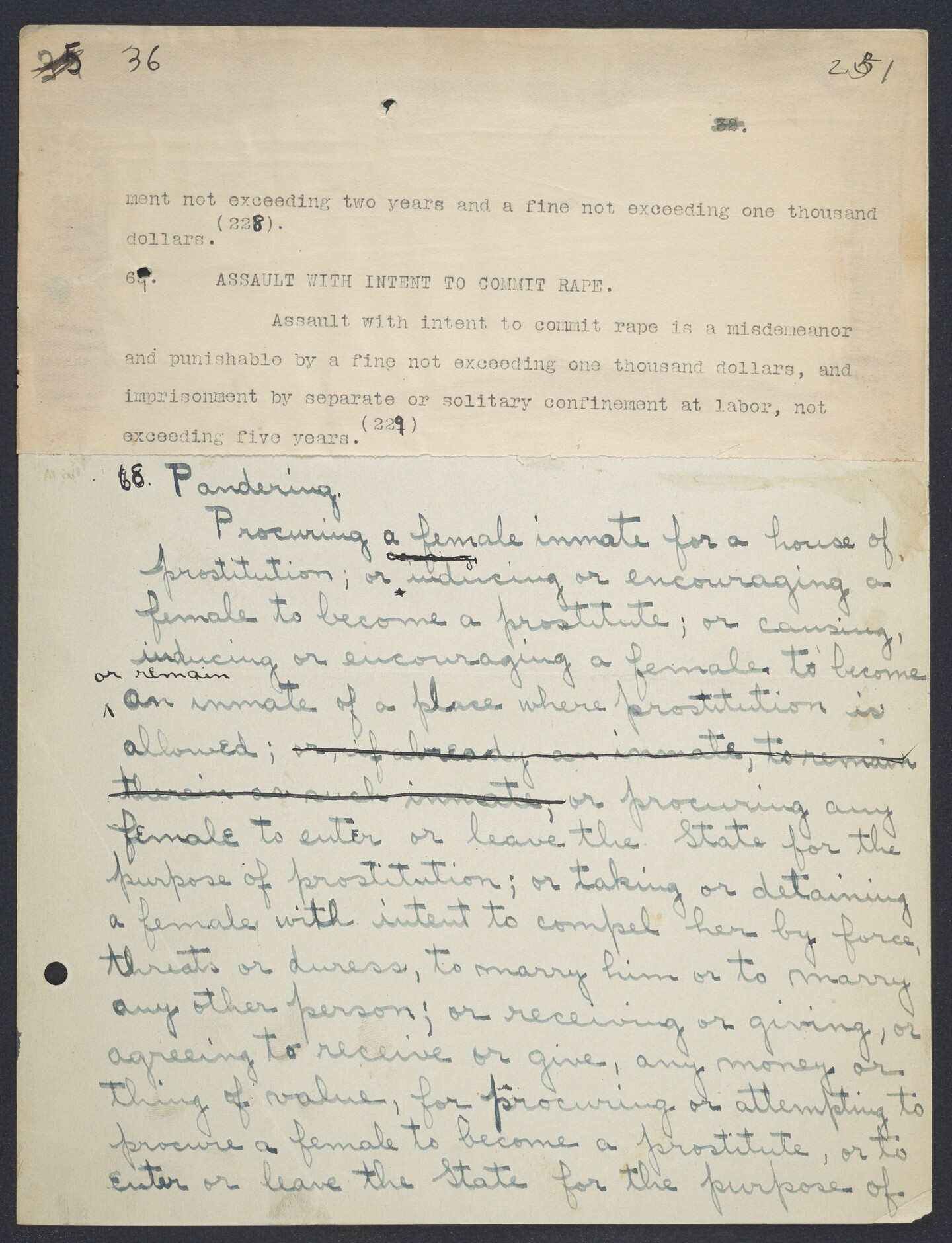
The manuscript itself is unusual, Pollack said, clearly a working document, not completely revised, with handwriting by three or four people, as well as a mixture of typewritten pages. He and University Archivist Jim Duffin have studied it closely.
The 266-page manuscript that is a draft of Paul's doctoral dissertation is unusual in that the handwritten pages are by three or four different hands, and some pages are typewritten. (Image: Page 251 of the manuscript, courtesy of the Penn Libraries.)
The date of acquisition was 1922, a donation from Herman Vandenburg Ames, a professor of American constitutional history and dean of the graduate school. “Ames would still have been teaching at this point because he retired in 1928,” said Pollack. “It is interesting that this scholar of American history seems to have recognized the importance of Alice Paul's work, acquired this copy, and presented it to the library.”
Sharkey said it is not surprising that Ames was the donor. He was an expert on constitutional amendments and wrote a major book called “The Proposed Amendments to the Constitution of the United States during the First Century of Its History,” which appeared in 1897.
The transcribing effort is in the tradition of the Penn Manuscript Collective, an informal and changing group of students dedicated to investigating through transcription the vast manuscript holdings in Penn’s libraries, Pollack said.
“Transcribing, whether it's a one-page letter or an over-250-page thesis like this one, is actually an act of re-reading a document in profound ways, a seemingly simple editorial act in which transcription choices become an interpretive project,” he said. “And the engagement with these words and their meanings that these four scholars have undertaken is profound.”
What the dissertation itself cannot answer is a mystery Sharkey is still pursuing. Where is the final, approved copy of the dissertation? Rules in 1912 required at least two final copies be deposited at Penn’s library, she said, yet neither the Libraries nor the University Archives has a copy.
“The dissertation itself is a really solid work, so one of the mysteries for me is why she didn't publish it, considering that it is such a rigorous work of scholarship,” Sharkey said. “As the work of a person who many of us regard as one of the University’s most illustrious graduates, the lack of a polished dissertation is especially surprising.”
Sharkey speculated that the work may have been intentionally kept “under wraps” because of Paul’s research and assertions.
“Alice Paul was definitely a radical in her dissertation, as in her suffrage activities,” said Sharkey. “Her research for the Ph.D. scrutinized oppressive laws against women, traced changes in or efforts to change such laws, and called for more sweeping reforms, with the focus, above all, on property rights, including the rights of women to own and control property independently of their husbands.”
Each of the three students detailed their own research related to Paul’s dissertation during the symposium. Perlman focused on Paul’s research into the inequities between men and women in the law, ranging from property rights to inheritance to child custody. Divorce law, she said, is the section in Paul’s dissertation that “most clearly and effectively illustrated the sexism and double standards that existed in the legal system.”
Miller’s research on Paul’s life was designed to put the dissertation in context. When Paul came to Penn in 1906 to pursue her master’s degree, Miller said, women were less than 15% of the graduate student population, and Paul was one of only two studying political science. Ultimately, she pursued her Ph.D. in sociology.
Miller said the title Paul chose for her master’s thesis, “Towards Equality,” referenced the inequalities experienced by women in Pennsylvania at the time. “This is a theme that really resonated with her, as it's something that she returned to in her doctoral work,” she said.
For her senior thesis Murad, who is majoring in cultural and linguistic anthropology with minors in ancient history and cinema and media studies, researched the life and career of Florence Shotridge (Kaatxwaaxsnéi), a Native American Tlingit weaver born in Haines, Alaska, in 1882. Murad explores Shotridge’s work as a Penn Museum educator-guide at the same time that Paul was writing her dissertation. She contrasted Shotridge’s volunteer position with her husband’s full-time Museum employment.
“Women were just starting to get foothold in the University,” said Murad. “Hopefully the work we have done in this group helps ensure that these women’s stories become much more recognizable, not just to our own Penn community but the world beyond.”
Sharkey said she hopes the transcription project will bring renewed attention to Paul and her legacies at Penn and in the history of the women’s movement. “There’s abundant material for us all to study as we try to assess her legacy in light of the history of women's activism and the 19th Amendment and the social mobility of women,” she said.
On the move: Water quality and antimicrobial resistance testing goes mobile
Penn researchers have developed a mobile field laboratory allowing them to test water quality and track antimicrobial resistance in and around San Cristóbal in the Galápagos.
Penn researchers Vanessa and Alexis North are studying one of the largest collections of Egyptian blue objects ever found in the ancient Near East, shedding new light on how the world’s first synthetic pigment may have traveled far beyond Egypt.
A new role for dental providers? Rethinking where vaccines are given
Vaccinations have traditionally been administered in primary care settings or pharmacies. However, for about a decade, some states have authorized dentists to administer vaccines, and many others did so during the COVID-19 pandemic. The effectiveness of this approach has led some countries and states to expand or consider expanding the role of dental providers in delivering routine vaccines, including those against COVID-19 and the human papillomavirus (HPV), and in providing vaccine education.
Penn student develops a way for computer chips to run more efficiently
Fluid Silicon, a platform from President’s Sustainability Prize winner Nhlanhla Mavuso, allows computer chips to continuously monitor their health and self-tune as their characteristics change. The technology has the potential to reduce energy usage in data centers and improve reliability in mission-critical applications.