Penn Vet researcher helps boost yields on small farms in China
Despite tremendous effort and good intentions, many international agricultural development endeavors efforts fail when the implementing agency leaves and the local farmers go back to their old practices. That’s why a new type of intervention, involving Zhengxia Dou of Penn’s School of Veterinary Medicine and a team from China Agricultural University (CAU), tried a different tack: staying put.
Beginning in 2009, researchers from CAU embedded in small villages in China’s Quzhou County and have been working directly with farmers to provide education and training and to help implement science-based agricultural practices. The framework, known as the Science and Technology Backyard (STB), helped substantially boost yields in the region, improving farmers’ bottom lines and making more efficient use of natural resources.
“What makes the STB model unique is the zero distance: the STB staff living among the farmers in the village,” says Dou, a professor of agricultural systems at Penn Vet. “That way they built trusting and intimate relationships with farmers. Such a trust goes a long way, it motivates the participants, it accelerates knowledge transfer, and it sustains the results.”
Farmers in Quzhou County, who grow primarily maize and wheat, suffered relatively low yields at the turn of the 21st century, averaging roughly 63 percent of what researchers could attain on equivalent plots. To help address and narrow this so-called “yield gap,” the STB researchers living in Quzhou villages surveyed 150 farmers and conducted experiments on the ground to identify several factors that could be improved, compiling a set of 10 recommended practices. After discussing these practices with leading farmers, they received feedback on which of these could be implemented and which were not practical.
One recommendation, for example, involved deep plowing to break up a compacted soil layer for better root development and improved water and nutrient efficiency. But the farmers rejected the idea because their field plots were too small to easily operate the plow machines. To solve this problem, the STB scientists assisted the farmers in setting up quasi-cooperatives, which enabled 30 to 40 individual households with adjacent crop fields to operate together, therefore resolving the deep plowing issue while bringing about other benefits such as sharing the burden of irrigation and fertilization tasks. The co-ops dissolved for harvest so each household maintained private ownership of their crops and profits.
As the researchers reported in the journal Nature, under the STB platform, the five-year average yield among leading farmers increased from 67.9 percent of the attainable level to 97 percent; the countywide figure increased from 62.8 percent to 79.6 percent.
Dou and colleagues are currently expanding the STB to other areas of China. Together with another project to improve the health and efficiency of China’s dairy industry, supported by one of Penn’s inaugural China Research and Engagement Fund grants, Dou hopes to strengthen food security in China, providing a blueprint that can be followed elsewhere around the world.
On the move: Water quality and antimicrobial resistance testing goes mobile
Penn researchers have developed a mobile field laboratory allowing them to test water quality and track antimicrobial resistance in and around San Cristóbal in the Galápagos.
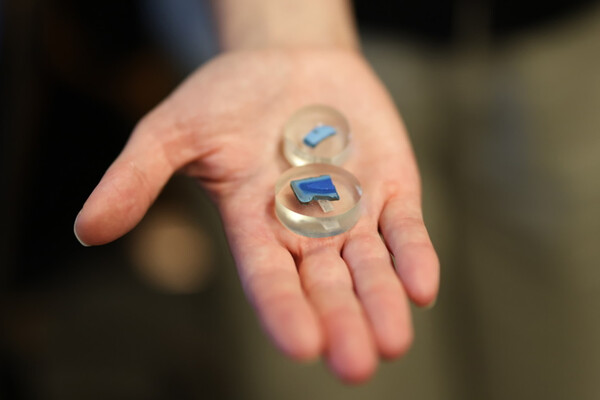
Penn researchers Vanessa and Alexis North are studying one of the largest collections of Egyptian blue objects ever found in the ancient Near East, shedding new light on how the world’s first synthetic pigment may have traveled far beyond Egypt.
A new role for dental providers? Rethinking where vaccines are given
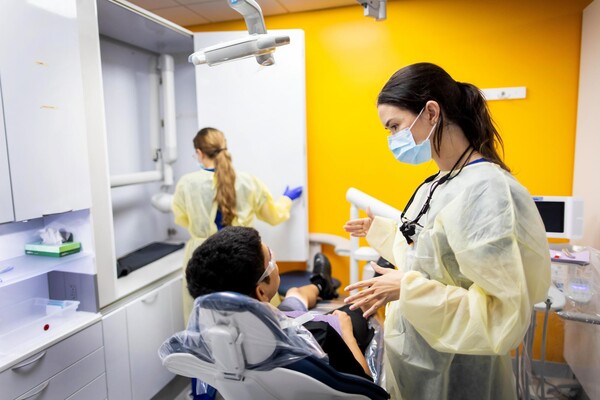
Vaccinations have traditionally been administered in primary care settings or pharmacies. However, for about a decade, some states have authorized dentists to administer vaccines, and many others did so during the COVID-19 pandemic. The effectiveness of this approach has led some countries and states to expand or consider expanding the role of dental providers in delivering routine vaccines, including those against COVID-19 and the human papillomavirus (HPV), and in providing vaccine education.
Penn student develops a way for computer chips to run more efficiently
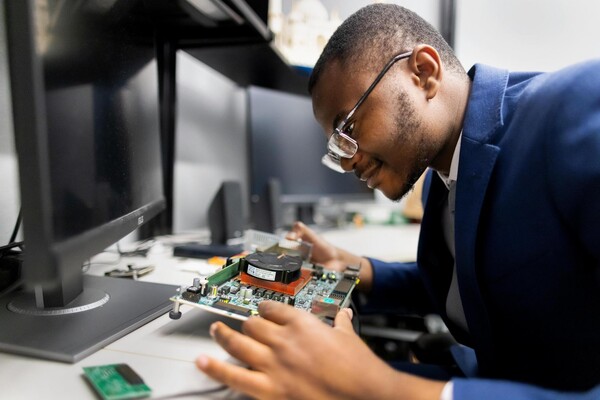
Fluid Silicon, a platform from President’s Sustainability Prize winner Nhlanhla Mavuso, allows computer chips to continuously monitor their health and self-tune as their characteristics change. The technology has the potential to reduce energy usage in data centers and improve reliability in mission-critical applications.