The world’s first general purpose computer turns 75
The Electronic Numerical Integrator and Computer (ENIAC), built at the Moore School of Electrical Engineering, sparked the ‘birth of the computer age’ thanks to a team of women programmers.
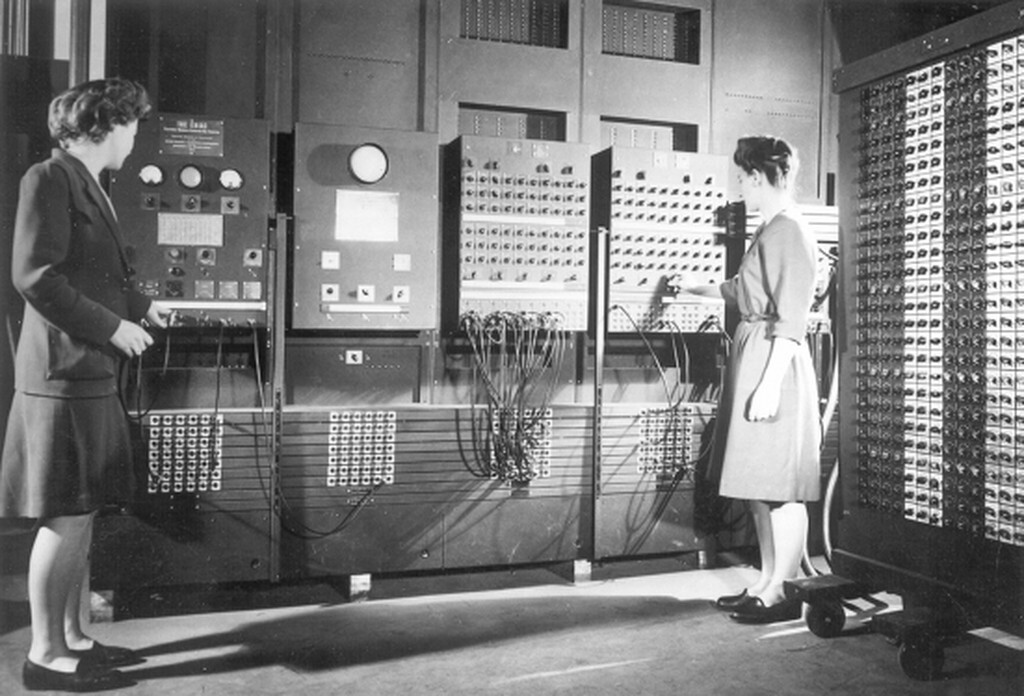
Jean Bartik (left) and Frances Spence operating the ENIAC’s main control panel. Bartik was present on the day of ENIAC’s unveiling to the world, and even helped troubleshoot a switch issue the night before its unveiling, but her efforts, and those of ENIAC’s five other women programmers, were nearly forgotten.
(Image: University Archives)
On Feb. 14, 1946, the world’s first general purpose electronic computer was introduced to the world. The Electronic Numerical Integrator and Computer (ENIAC), constructed at the Moore School of Electrical Engineering (now Penn’s School of Engineering and Applied Science), was touted as “an amazing machine which applies electronic speeds for the first time to mathematical tasks hitherto too difficult and cumbersome for solution.”
While the abilities of this “amazing machine” have since been surpassed by 75 years of progress in electronics and computers, ENIAC’s development was instrumental in sparking a revolution in computer science and electrical engineering that continues to this day. This lasting legacy is thanks in part to a team of women programmers who, despite their significant contributions to ENIAC’s success, were only recently recognized for their efforts.
To mark ENIAC’s 75th anniversary, Penn Today delves into the history of the world’s first general purpose computer, the women “computers” who were instrumental to its success, and how ENIAC continues to shape technology and computer science to this day.
The early days of computing
Before ENIAC’s time, “computers” referred to the people who worked on complex math equations. During World War II, computers relied on “function tables,” detailed information used to predict a shell’s path using metrics like air density, temperature, and wind, to calculate one part of a ballistics equation that would then be completed by a team of computers.
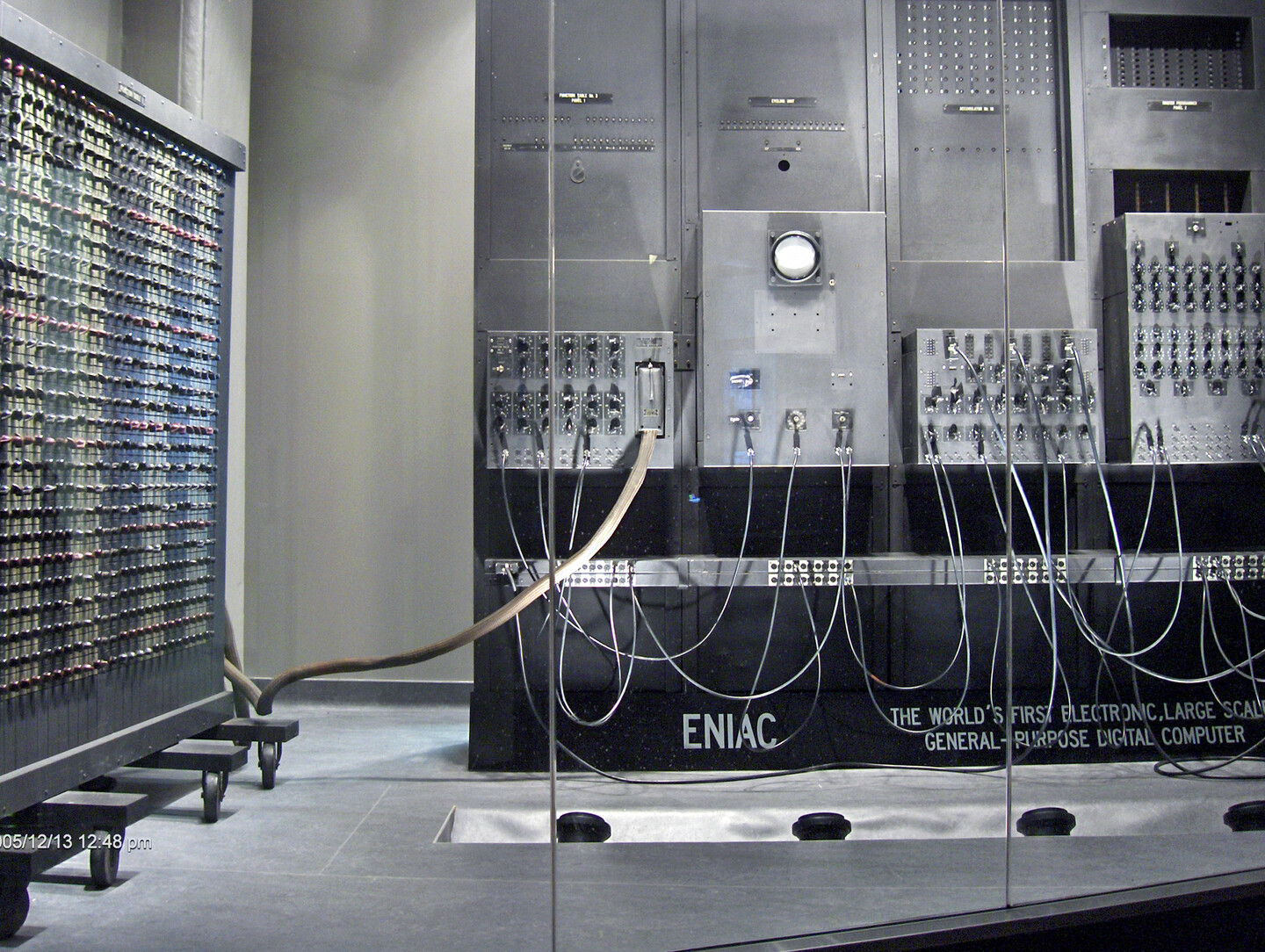
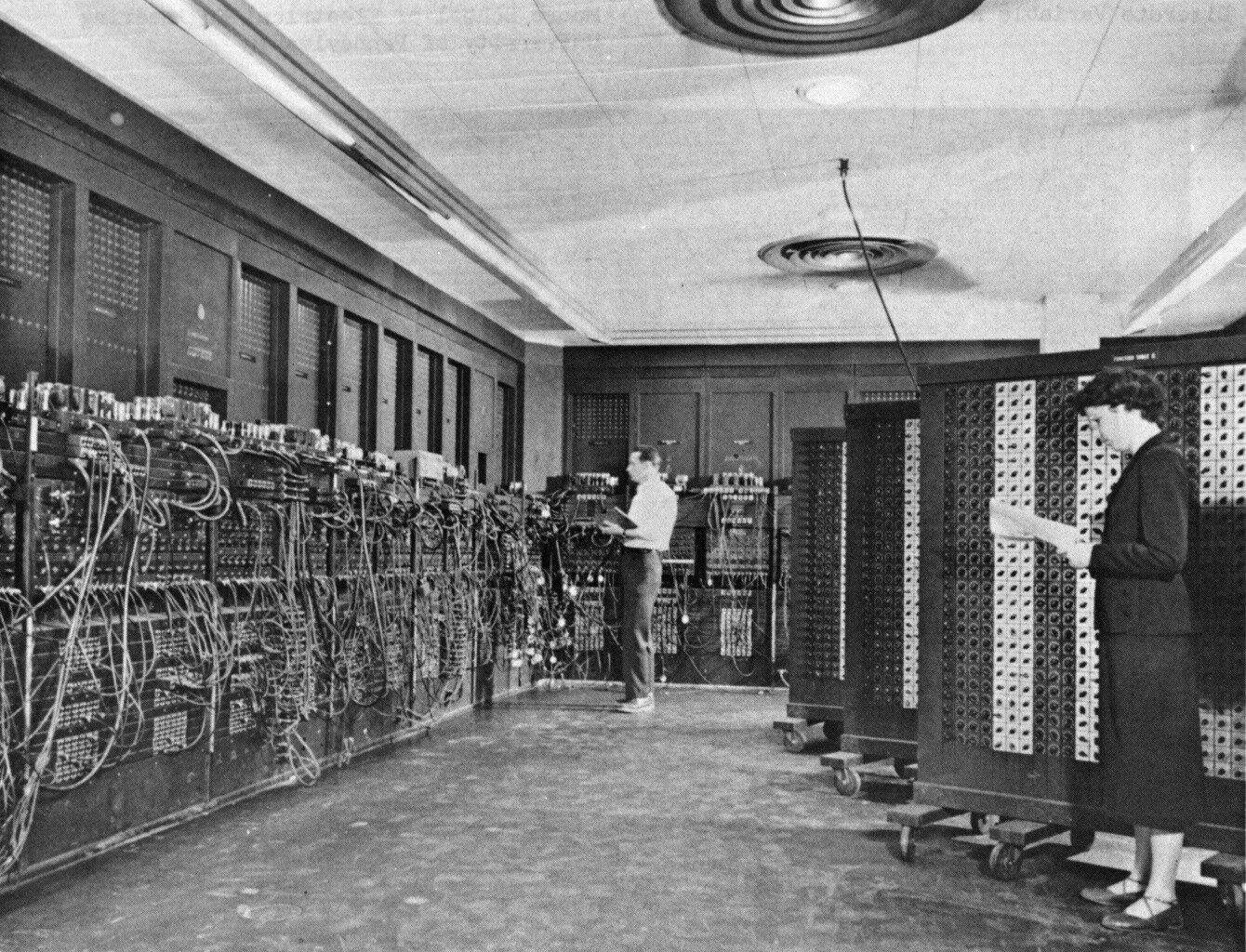
ENIAC on display at the Moore School Building in the School of Engineering and Applied Science.
Starting in the late 1920s, devices known as differential analyzers were developed to help automate the process of solving the differential equations used in ballistics calculations. These wheel-and-disc devices could perform integrations, and one such device was built and used in the Moore School building in the mid-1940s to compute artillery firing tables. The challenge, explains emeritus professor Mitch Marcus, is that these devices were difficult to work with. “Setting up a problem involves putting gears of the right size together, and once you set up a problem on a differential analyzer, it’s very hard to change it,” he explains. “You program it once and get it into an alignment, but if the wheels slip then you’ve got big problems.”
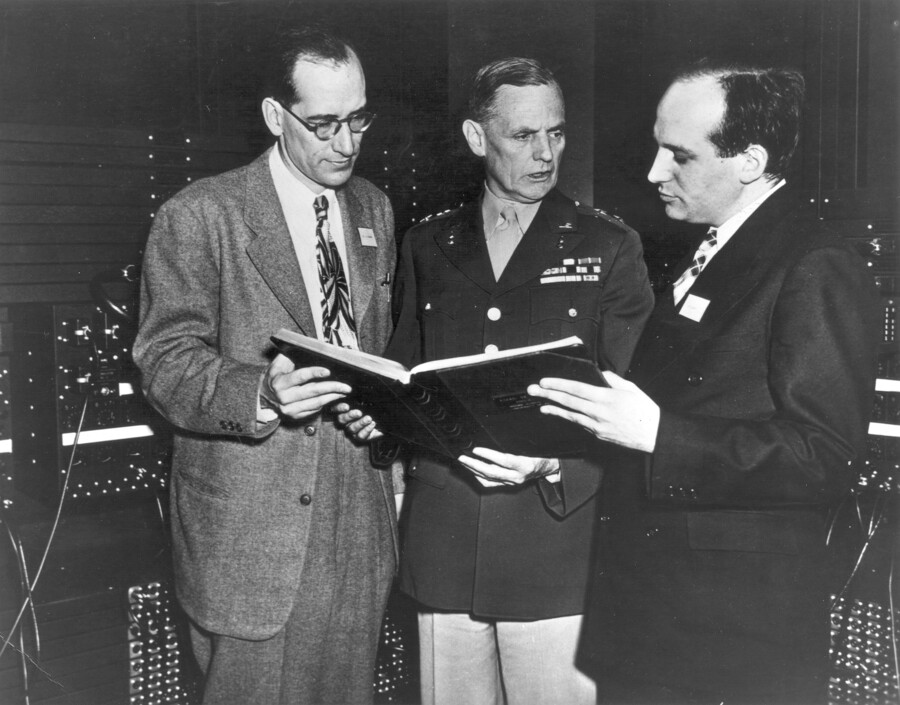
ENIAC’s design and construction was financed by the U.S. Army, led by Major General Gladeon M. Barnes (middle) and was designed by engineers John Mauchly (right) and J. Presper Eckert.
To improve upon the differential analyzer’s limitations, work on an alternative began in secret at the Moore Building in 1943. Designed by John Mauchly and J. Presper Eckert, ENIAC was the fastest computational device of its time, able to do 5,000 additions per second, but because it had no internal storage, it had to be programmed manually for each new set of calculations.
The task of “programming” ENIAC was given to a group of women who had all previously been working as computers at the Moore School: Kathleen Antonelli, Jean Bartik, Frances “Betty” Holberton, Marlyn Meltzer, Frances Spence, and Ruth Teitelbaum. Although their contributions were instrumental to ENIAC’s success, their stories were nearly lost to history and only more recently was their work formally recognized.
The ‘ENIAC six’ rise to the occasion
Antonelli earned a degree in mathematics from Chestnut Hill College in 1942. As one of the few math majors from her class, she saw the U.S. civil service as a pathway to do work in math without becoming a teacher and was hired for a position as a computer at the Moore School.
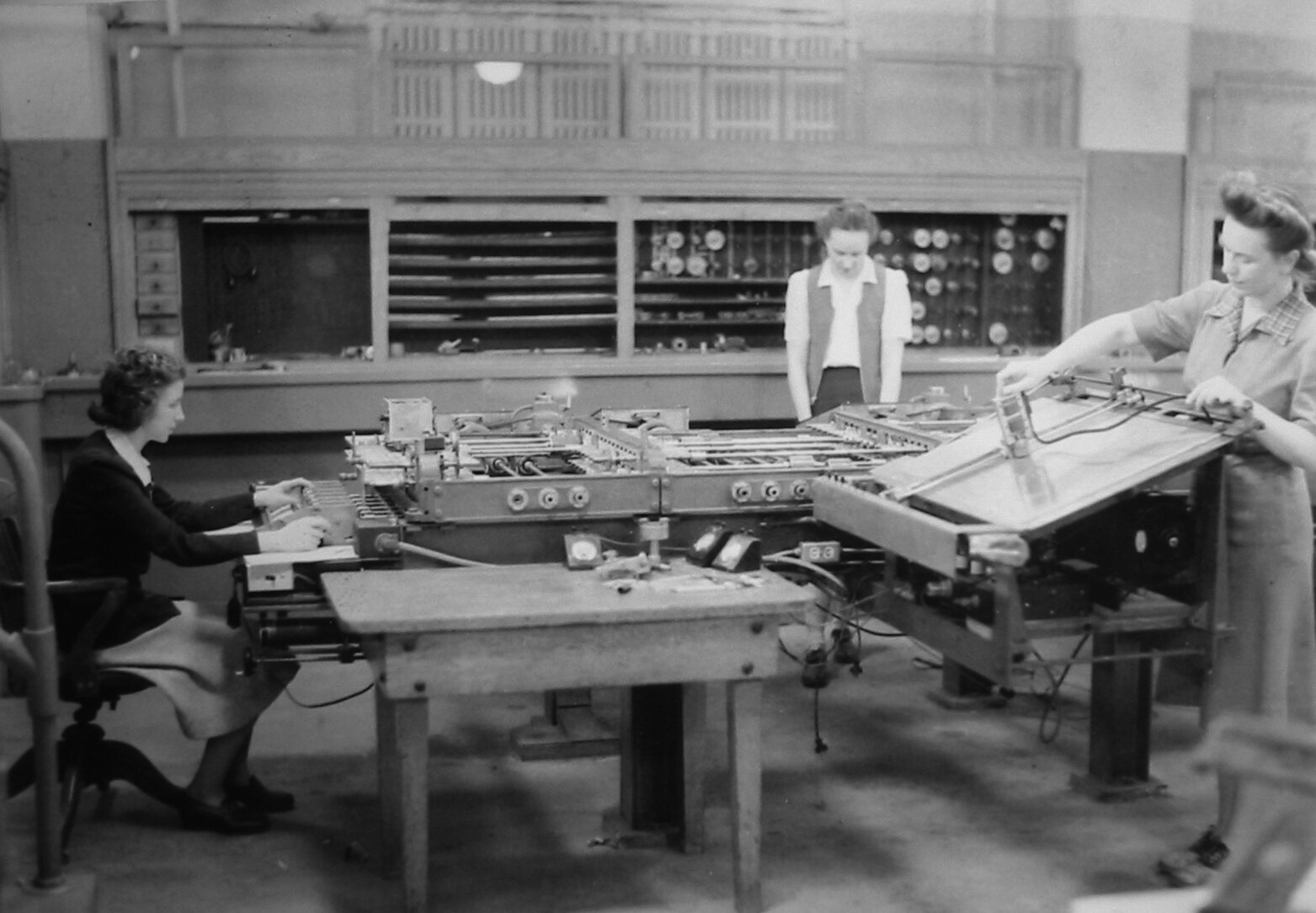
Kathleen Antonelli (far left), Alyse Snyder, and Sis Stump operate the differential analyzer in the basement of the Moore School of Electrical Engineering in the years leading up to ENIAC’s construction.
Bartik was the only mathematics major from what is now Northwest Missouri State University when she graduated in 1942. Bartik learned about the need for math-savvy individuals at Moore and came to Philadelphia toward the end of ENIAC’s construction.
Holberton, who was from Philadelphia, graduated from Penn with a degree in journalism in 1939. She also got involved working as a computer before ENIAC was built and, with Bartik, would go on to become one of its co-lead programmers.
Meltzer was also from Philadelphia and graduated from Temple with a degree in social studies in 1942. Because she could operate an adding machine, Meltzer was brought into the Moore School to work on weather calculations. After her unit was disbanded, she was encouraged to apply to the U.S. civil service so she could stay on at Moore doing ballistics work.
Spence, also born in Philadelphia, graduated from Chestnut Hill the same year as Antonelli, who told Spence about the effort to recruit math majors to work at Penn for the U.S. Army.
Teitelbaum, from Far Rockaway Beach, New York, graduated from Hunter College with a degree in mathematics and came to the Moore School to work on ballistics calculations shortly before the ENIAC project began.
Because of the classified nature of their work, ENIAC’s six programmers only had access to blueprints and were not even allowed into the same room as the device. Despite these challenges, the women learned about ENIAC using schematics and interviews with its engineers and were able to figure out how to design algorithms and adjust ENIAC’s switches for programming calculations.
“The biggest advantage of learning the ENIAC from the diagrams was that we began to understand what it could and what it could not do. As a result we could diagnose troubles almost down to the individual vacuum tube,” Bartik told IEEE in 1996. “Since we knew both the application and the machine, we learned to diagnose troubles as well as, if not better than, the engineer.”
ENIAC’s legacy is this whole computerized world we have now, and the world we live in is a better place for all of the automated and computational technologies that have come out of this.
Computer science professor Andre DeHon
Computer science professor and Penn ENIAC Mini-Symposium organizer Andre DeHon says what the programmers did was far more than adjusting switches: The programmers had to develop logic behind how to program, use, and debug ENIAC, work that required a massive amount of innovation and problem solving. “Reading their stories, you realize how much they made it happen,” says DeHon. “They were handed a new field, perhaps by people who underestimated the intellectual requirements of that field, who simply said ‘We built it and you program it.’ It was more sophisticated than that, and they rose to the occasion.”
Despite the significance of their efforts in programming ENIAC, much of the early recognition and credit was given solely to Mauchly and Eckert. Then, when ENIAC was moved to Aberdeen Proving Ground, its six original programmers’ paths varied and their contributions were nearly lost to history. Thanks to Kathy Kleiman, who learned about the ENIAC six while doing research for her undergraduate thesis, the stories of the ENIAC programmers were finally brought to life and all six women were inducted into the Women in Technology Hall of Fame in 1997.
ENIAC weighed 30 tons, took up 1,800 square feet of space, and was made of 17,468 vacuum tubes, 1,500 relays, 70,000 resistors, 10,000 capacitors, and nearly five million hand-soldered joints.
ENIAC’s legacy, 75 years later
ENIAC’s introduction to the world was lauded as “birth of the computer age,” and Marcus says that ENIAC’s continued legacy is due to the programmers who developed ideas around stored programs and conditional programming that remain a cornerstone of computer science.
RELATED
“The first half of every chapter is electronics and the second half is modern computer science—and these women invented it,” says Marcus. “Women rediscovered things that men forgot about, and by talking theoretically and mathematically, they abstracted all of these ideas.”
For DeHon, ENIAC’s impacts can also be found in modern-day computer science research. In his work on programmable media, architectures that resemble ENIAC processors are becoming more attractive due to the limits of Moore’s law.
More broadly, he says, “ENIAC’s legacy is this whole computerized world we have now, and the world we live in is a better place for all of the automated and computational technologies that have come out of this.”
Glen Beck (background) and Betty Holberton (foreground) program the ENIAC in building 328 at the Ballistic Research Laboratory.
Homepage image: Two of ENIAC’s six women programmers, Ruth Teitelbaum (left, crouching) and Marlyn Meltzer, helped design algorithms for running ENIAC’s complex calculations.
On the move: Water quality and antimicrobial resistance testing goes mobile
Penn researchers have developed a mobile field laboratory allowing them to test water quality and track antimicrobial resistance in and around San Cristóbal in the Galápagos.
Penn researchers Vanessa and Alexis North are studying one of the largest collections of Egyptian blue objects ever found in the ancient Near East, shedding new light on how the world’s first synthetic pigment may have traveled far beyond Egypt.
A new role for dental providers? Rethinking where vaccines are given
Vaccinations have traditionally been administered in primary care settings or pharmacies. However, for about a decade, some states have authorized dentists to administer vaccines, and many others did so during the COVID-19 pandemic. The effectiveness of this approach has led some countries and states to expand or consider expanding the role of dental providers in delivering routine vaccines, including those against COVID-19 and the human papillomavirus (HPV), and in providing vaccine education.
Penn student develops a way for computer chips to run more efficiently
Fluid Silicon, a platform from President’s Sustainability Prize winner Nhlanhla Mavuso, allows computer chips to continuously monitor their health and self-tune as their characteristics change. The technology has the potential to reduce energy usage in data centers and improve reliability in mission-critical applications.