A Sept. 18 panel hosted by the Environmental Innovations Initiative and the Center for Latin American and Latinx Studies discussed local and global initiatives.
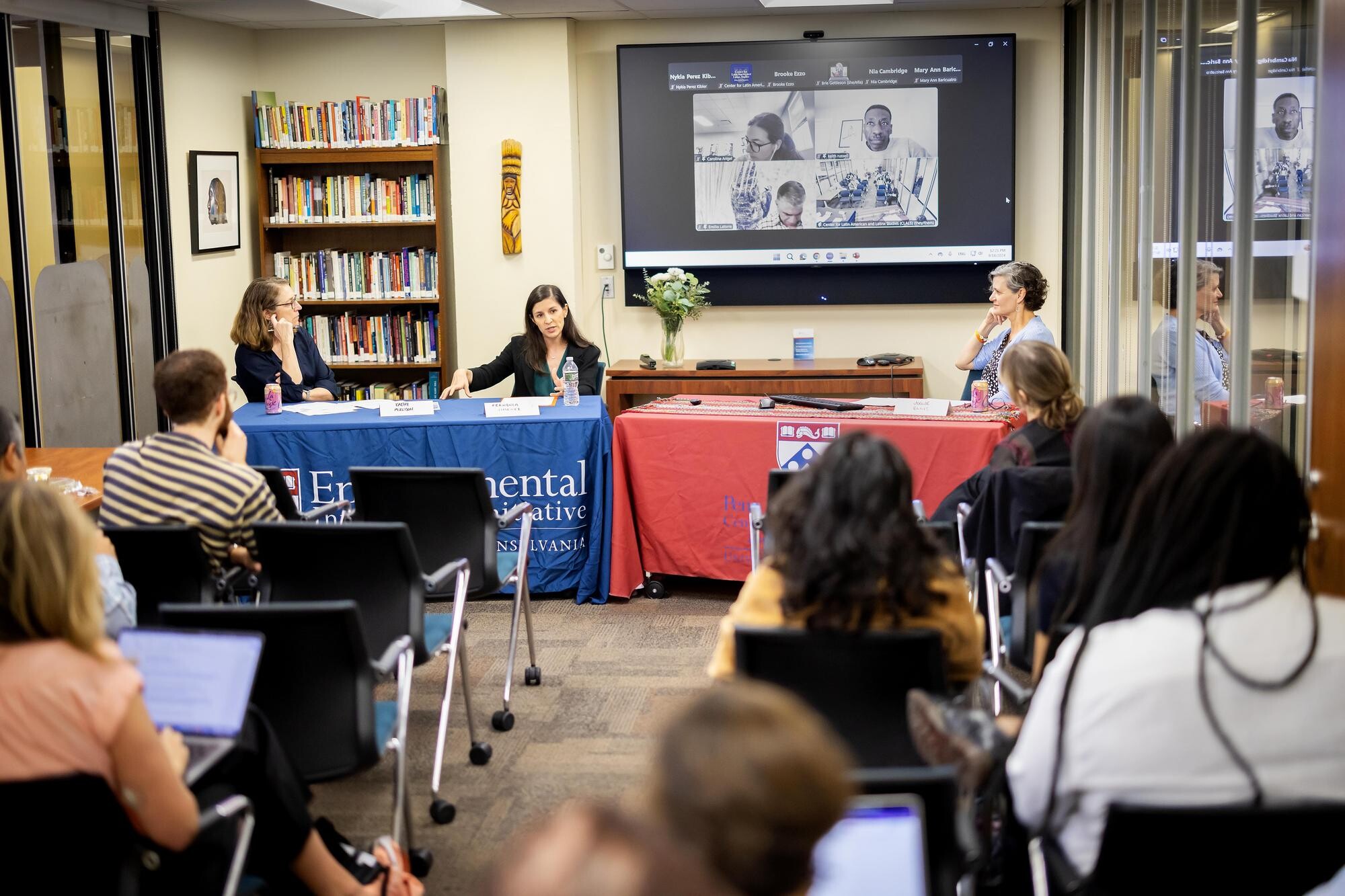
Kathleeen Morrison, Fernanda Jiménez, and Julie Ellis present to the Penn community at CLALS. The program was also available to online participants; behind them, Carolina Angel Botero, Emilio Latorre, and Keith Russell present via Zoom.
Extinction, habitat loss, pollution, and climate change in the Anthropocene epoch are signs the natural world is under threat. Some studies predict additional species loss, with between 13-27% of vertebrate species extinct by 2100.
In a global effort aimed at protecting biodiversity, the United Nations Biodiversity Conference (COP16), will meet in Cali, Colombia, beginning Oct. 21. The Conference of Parties includes almost 200 countries that will meet to review progress and set new goals. For the first time this year, Penn will be sending an official delegation to the UN Biodiversity Conference, having secured observer status in an effort coordinated by the Environmental Innovations Initiativeand Penn Global.
To answer that question, panelists discussed initiatives near and far aimed at protecting biodiversity at a Sept. 18 talk. Panelists were Carolina Angel Botero, a CLALS postdoctoral fellow; Julie Ellis, adjunct associate professor of pathobiology at Penn Vet; Emilio Latorre, director of the Sustainable Campus Office at Unicatólica in Cali, Colombia; Fernanda Jiménez, a Costa Rican environmental lawyer and visiting scholar at CLALS; Kathleen Morrison, the Sally and Alvin V. Shoemaker Professor of Anthropology in the School of Arts & Sciences and faculty director of EII; and Keith Russell, program manager for urban conservation at Audubon Pennsylvania.
Angel Botero first outlined the Convention on Biological Diversity (CBD). She discussed the previous UN Biodiversity Conference, held in Montreal in 2022, the convention’s member parties adopted what’s known as the Kunming-Montreal Global Biodiversity Framework, with the vision of a world living in harmony with nature by 2050. To work towards this goal, the biodiversity framework has 23 targets for 2030 and four goals for 2050: to protect and restore natural resources; to prosper with nature, including the sustainable management of biodiverse resources; to share benefits fairly, including compensating Indigenous communities for their ancestral knowledge; and to invest and collaborate, including technical and scientific cooperation.
The convention hopes to reduce pollution, hold back extinction, and mobilize funding, Angel Botero said, and has a “30 by 30” target of conserving at least 30% of land, waters, and seas by 2030.
Morrison, the event moderator, asked each panelist to address the question, “How is the world working to save biodiversity?” from the perspective of their own work.
Jiménez said that as a Costa Rican lawyer specializing in biodiversity and conservation she has been working on a policy and regulatory framework that supports the equitable sharing of benefits. She said Indigenous communities are often happy to share seeds and botanical knowledge with researchers. Those researchers may then go back to laboratories in their home countries, where they extract the materials’ biological and genetic information and develop products that can be used for industrial, commercial, or pharmaceutical purposes. The Indigenous communities do not have a share in these profits and are not compensated for their knowledge and for the plant materials, she said.
Jiménez has worked with Indigenous communities and national governments to establish mutually negotiated agreements to ensure that some of the benefits derived from local knowledge and materials will return to the home countries and local communities.
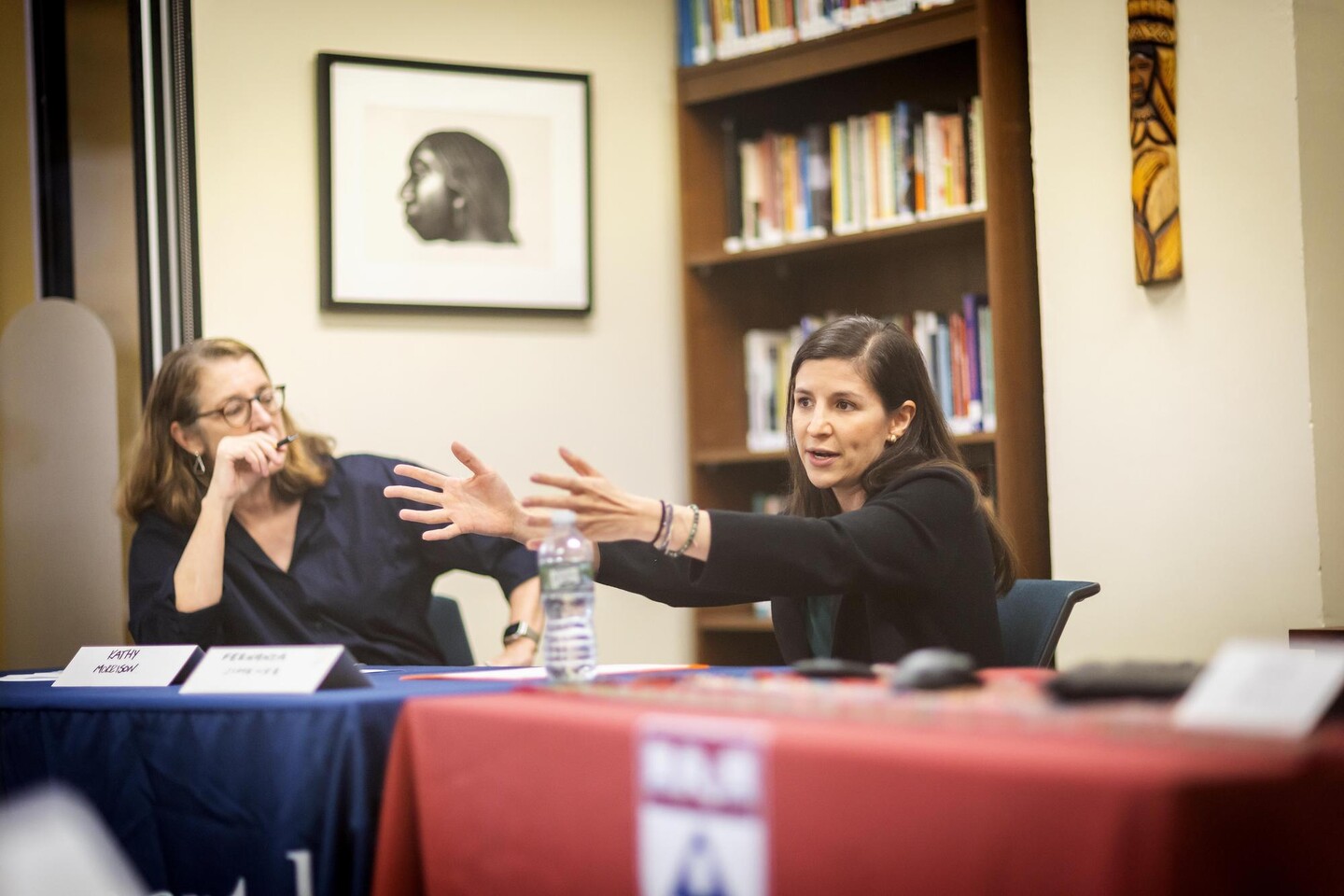
Fernanda Jiménez, a Costa Rican lawyer specializing in biodiversity and conservation, has been working on a policy and regulatory framework that supports the equitable sharing of benefits with Indigenous and local communities.
Technology is further complicating the situation, Jiménez said. Researchers can now extract a digital sequence from biological materials and share DNA information online or through databases, so that new researchers don’t need to be in the field to use the resources. It’s a work in progress to develop a framework that will ensure fair compensation, she said.
Latorre, who is located in Cali, Colombia, the site of the upcoming international meeting, promotes biodiversity and nature positivity at universities. “If we universities are speaking about biodiversity, our campuses should be biodiverse and should represent the biodiversity of the regions in which they are,” he said.
Following the model of the organization Nature Positive Universities, Latorre encourages universities to establish a baseline biodiversity inventory and put together a plan for how they are going to continue to cultivate native species on campus and not just focus on decorative gardens. Universities can be living laboratories, he said.
Protecting wildlife health is key to protecting biodiversity, said Ellis, who runs the Wildlife Futures Program, a partnership between Penn Vet and Pennsylvania Game Commission. “Animals play essential roles in their habitats and in promoting functional ecosystems, but wildlife health is being threatened by a variety of factors, including pathogens, climate change, contaminants, and habitat degradation,” she said. “Because the threats to wildlife are so complex, protecting it requires close partnerships across disciplines and organizations.”
Every state has a state wildlife action plan, Ellis said, and Pennsylvania has earmarked more than 600 species with the greatest conservation needs. The plans describe the habitats important to the species, their key threats, needed conservation actions, and strategies for research and monitoring.
Pennsylvania’s wildlife action plans are updated every 10 years, she said, and Wildlife Futures is currently working on the next iteration with their partners. “A synthesized summary of this work will inform the priorities for research surveillance and management actions through the next decade,” Ellis said.
Russell said that Audubon Pennsylvania concentrates on bird conservation, with a particular focus on the crisis of birds colliding with buildings, which is estimated to kill at least one billion birds each year in the United States. Birds are unfamiliar with glass and strongly attracted to artificial light at night, he said, noting that collisions are a particular concern for migratory species.
“This is a problem that’s now considered to be one of the most important conservation issues birds are facing worldwide,” Russell said. Interest in the issue is growing, he said. “It’s not just biologists. It’s now architects and planners and other types of people that are paying attention to this because birds are such important parts of our lives and we don’t want to lose them.”
During the Q&A session, Ellis had a question of her own for Russell, asking him how to address nature deficit disorder, a term which describes being alienated from nature and the negative effects that can have on children.
“It’s so interesting how our society has advanced and then gone backwards in certain respects,” Russell said. The key is providing transformational experiences, he said. “When someone is out and they see a centipede or something in the ground doing something incredible, or they see a bird that they just never thought existed, or they experience some sort of thing with nature, like seeing the stars unobstructed by lights, they just are transformed, and they never forget it. I think that’s a real key part of getting people to understand the magic and the wonder and the mystery and spirituality of nature. It’s something that they didn't create themselves. They just had nothing to do with and it’s beyond us and it teaches us many things.”
Nature is a sensory experience, Russell said. “It’s like being in a concert live versus listening to a record. You feel things and you see things that are just unique.”
On the move: Water quality and antimicrobial resistance testing goes mobile
Penn researchers have developed a mobile field laboratory allowing them to test water quality and track antimicrobial resistance in and around San Cristóbal in the Galápagos.
Penn researchers Vanessa and Alexis North are studying one of the largest collections of Egyptian blue objects ever found in the ancient Near East, shedding new light on how the world’s first synthetic pigment may have traveled far beyond Egypt.
A new role for dental providers? Rethinking where vaccines are given
Vaccinations have traditionally been administered in primary care settings or pharmacies. However, for about a decade, some states have authorized dentists to administer vaccines, and many others did so during the COVID-19 pandemic. The effectiveness of this approach has led some countries and states to expand or consider expanding the role of dental providers in delivering routine vaccines, including those against COVID-19 and the human papillomavirus (HPV), and in providing vaccine education.
Penn student develops a way for computer chips to run more efficiently
Fluid Silicon, a platform from President’s Sustainability Prize winner Nhlanhla Mavuso, allows computer chips to continuously monitor their health and self-tune as their characteristics change. The technology has the potential to reduce energy usage in data centers and improve reliability in mission-critical applications.