How mortgage lock-in is quietly pushing up house prices
A new paper co-authored by Wharton’s Lu Liu argues that homeowners stuck with low fixed mortgage rates aren’t just frozen in place—they’re propping up the housing market.
2 min. read
When the Federal Reserve raised interest rates between 2022 and 2024, U.S. existing home sales fell by roughly 40% to levels last seen after the Great Recession. By textbook standards, prices should have followed sales downward. They didn’t. Real house prices stayed remarkably stable.
A new paper, “Unlocking Mortgage Lock-In: Equilibrium Effects in a Spatial Housing Ladder Model,” explains the puzzle. Co-authored by Wharton finance professor Lu Liu, the study argues that a single feature of the U.S. mortgage market—the inability to take a low fixed mortgage rate with you when you move—turns rising interest rates into an unexpected source of housing demand.
The paper builds on the authors’ earlier work documenting “mortgage lock-in”: the phenomenon where homeowners who locked in cheap mortgages during the historically low-rate years of 2020 and 2021 refuse to sell, because doing so would force them to give up those rates. In the new paper, the authors push the analysis from individual behavior to the housing market as a whole—and to the prices and rents that follow.
On the move: Water quality and antimicrobial resistance testing goes mobile
Penn researchers have developed a mobile field laboratory allowing them to test water quality and track antimicrobial resistance in and around San Cristóbal in the Galápagos.
Penn researchers Vanessa and Alexis North are studying one of the largest collections of Egyptian blue objects ever found in the ancient Near East, shedding new light on how the world’s first synthetic pigment may have traveled far beyond Egypt.
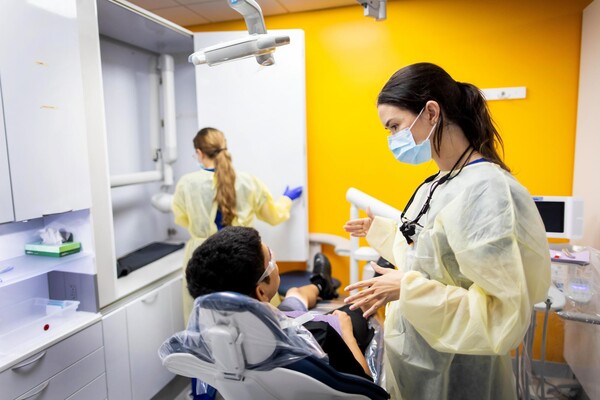
A new role for dental providers? Rethinking where vaccines are given
Vaccinations have traditionally been administered in primary care settings or pharmacies. However, for about a decade, some states have authorized dentists to administer vaccines, and many others did so during the COVID-19 pandemic. The effectiveness of this approach has led some countries and states to expand or consider expanding the role of dental providers in delivering routine vaccines, including those against COVID-19 and the human papillomavirus (HPV), and in providing vaccine education.
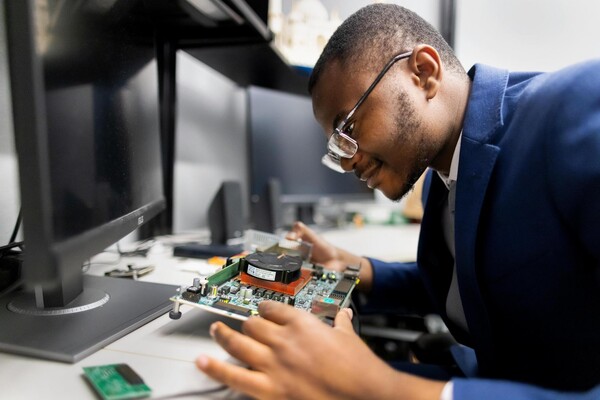
Penn student develops a way for computer chips to run more efficiently
Fluid Silicon, a platform from President’s Sustainability Prize winner Nhlanhla Mavuso, allows computer chips to continuously monitor their health and self-tune as their characteristics change. The technology has the potential to reduce energy usage in data centers and improve reliability in mission-critical applications.