Weitzman’s Xiaojiang Li is using artificial intelligence tools to provide more granular information about urban environments in order to optimize solutions for mitigating extreme heat.
2 min. read
The heat waves that have struck the U.S. and Europe this summer have killed thousands of people. While much is known about how extreme heat affects city dwellers, Xiaojiang Li says that widely used heat-modeling methods today are insufficient for policy makers to act on responsibly. Li is an assistant professor in the Department of City and Regional Planning at the Stuart Weitzman School of Design, who also teaches in the Master of Urban Spatial Analytics program and leads the Urban Spatial Informatics Lab.
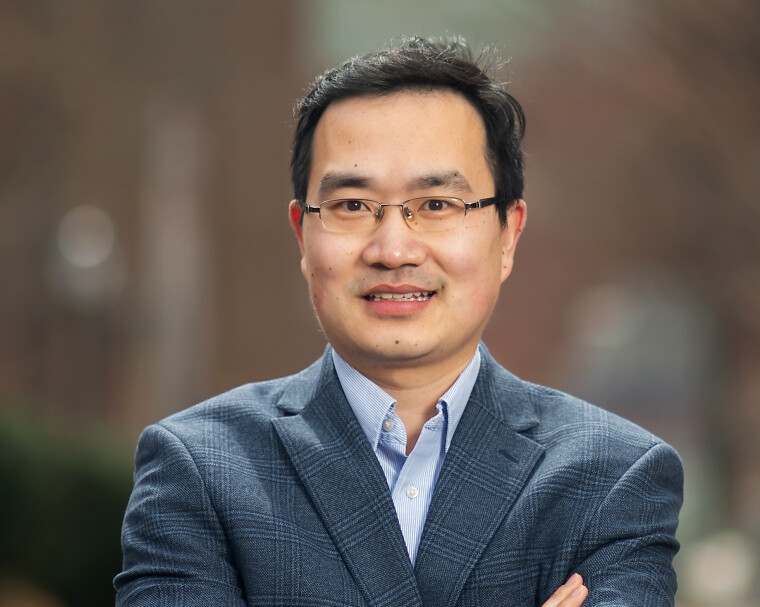
Xiaojiang Li is an assistant professor of urban spatial analytics in the Weitzman School.
(Image: Eric Sucar)
Li was recently awarded a prestigious Faculty Early Career Development (CAREER) grant from the National Science Foundation to advance his research into using artificial intelligence tools to provide more granular information about urban environments, to simulate thermal comfort for human beings in different parts of the city, and to optimize solutions for mitigating extreme heat.
Li describes the AI tools he’s using and how they help scale this model. “Nowadays when we talk about AI, people automatically think about generative AI, large language models. But AI is a broader concept. The AI tools I’m trying to use are to help accelerate models to generate faster results.
“You can use AI tools to get more accurate information for the ground surface,” he says. “AI can help us to generate this kind of information more accurately and more efficiently at a large scale. … AI can be used to accelerate the simulation. If you want to conduct a simulation at a large scale and also at a hyperlocal scale, you need a lot of computing.”
“Most cities are not using the right metrics or the right methods to quantify urban heat. A lot of cities are trying to use cool pavement. They basically repaint the pavement or the sidewalk, thinking that if you use cool pavement, you can reflect more radiation back into space and make the city cooler. The problem with that method is, even if you make the city cooler, it doesn’t make people feel cool. Radiation is reflected from the ground, so people may feel even hotter,” Li explains.
“So there are lots of other problems if you’re not using the right methods or metrics to quantify urban heat. I think using this kind of microclimate modeling at a hyperlocal level, you can refine your strategies to mitigate urban heat and also make people feel more thermally comfortable. It can also help the city to smartly allocate their resources.”
On the move: Water quality and antimicrobial resistance testing goes mobile
Penn researchers have developed a mobile field laboratory allowing them to test water quality and track antimicrobial resistance in and around San Cristóbal in the Galápagos.
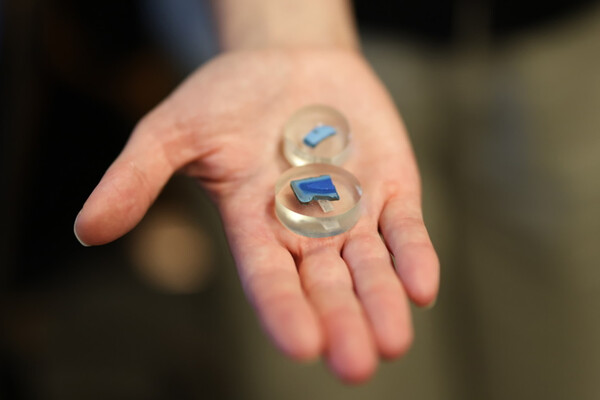
Penn researchers Vanessa and Alexis North are studying one of the largest collections of Egyptian blue objects ever found in the ancient Near East, shedding new light on how the world’s first synthetic pigment may have traveled far beyond Egypt.
A new role for dental providers? Rethinking where vaccines are given
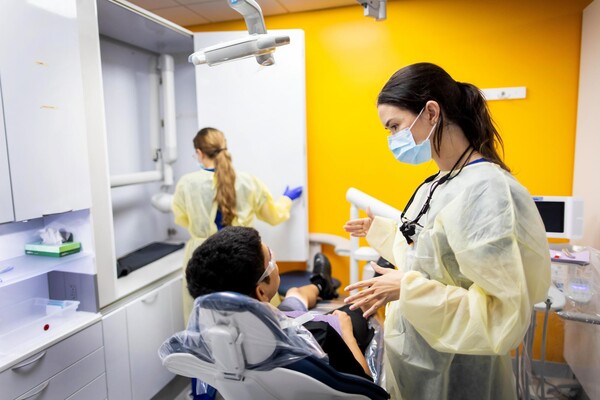
Vaccinations have traditionally been administered in primary care settings or pharmacies. However, for about a decade, some states have authorized dentists to administer vaccines, and many others did so during the COVID-19 pandemic. The effectiveness of this approach has led some countries and states to expand or consider expanding the role of dental providers in delivering routine vaccines, including those against COVID-19 and the human papillomavirus (HPV), and in providing vaccine education.
Penn student develops a way for computer chips to run more efficiently
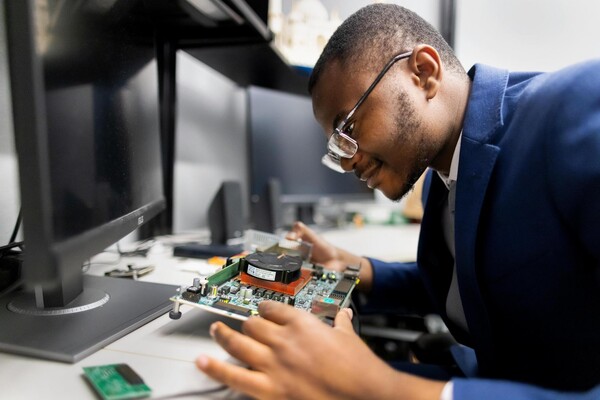
Fluid Silicon, a platform from President’s Sustainability Prize winner Nhlanhla Mavuso, allows computer chips to continuously monitor their health and self-tune as their characteristics change. The technology has the potential to reduce energy usage in data centers and improve reliability in mission-critical applications.