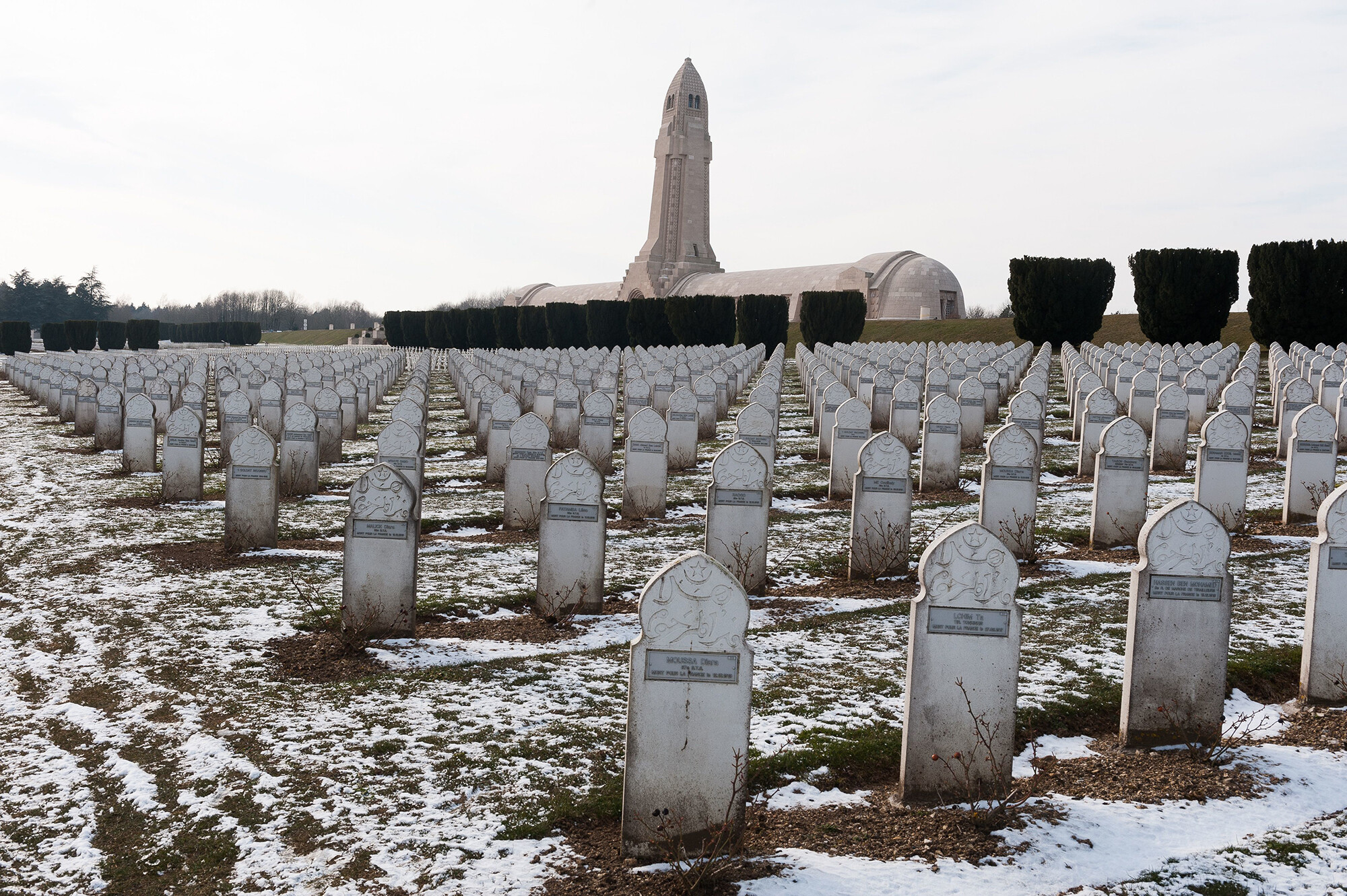
A new paper from political scientist Melissa M. Lee finds that veteran benefits were distributed unequally between citizens and colonized subjects.
The ossuary of Douaumont is a memorial to the soldiers of the Battle of Verdun of 1916, located on the border of the communes of Douaumont and Fleury-devant-Douaumont, a few kilometers from Verdun. It houses the remains of 130,000 unknown soldiers, French and Germans. In front of the ossuary, the national necropolis of Douaumont gathers 16,142 graves of French soldiers, mainly Catholic, including a square of 592 steles of Muslim soldiers.
(Image: Sipa via AP Images)
“War made the state, and state made the war,” wrote the late Charles Tilly, a well-known sociologist. This bellicist, or war-centered theory, has become widespread in the social sciences, says Melissa M. Lee, the Klein Family Presidential Assistant Professor of Political Science. The idea is that the state extracts taxes and conscripts labor from a populace in order to form, feed, and equip armies, which then demand goods and services in return: medical care, education, and pensions for veterans and their families.
But these benefits have been unevenly distributed, Lee says. In a recently published paper from Cambridge University Press, Lee and co-author Gabriel Koehler-Derrick of NYU Abu Dhabi examined “War and Welfare in Colonial Algeria,” finding that Algerian subjects were less likely to be rewarded for their wartime sacrifices than their French-citizen counterparts.
“This paper examines the spatial variation in social and welfare provision by asking for whom warfare increased welfare,” the authors write. “We build on but depart from the influential bellicist incentives that states have to shirk this basic bargain between rulers and the ruled in settler colonies.”
The transition to mass-mobilization wars, which rely on large amounts of manpower and conscription, is said to have led to democratic developments, producing things that we now value in the modern state, including the invention of parliaments and democratic consent and the rewards for service in terms of redistributive policies, Lee says.
But the history that inspires this thesis is largely drawn from Europe, she says. “Does it actually break down in the colonial context?” Lee and Koehler-Derrick ask. “And if so, how, and for what reasons? And can we actually estimate the degree to which this the war does or does not contribute to the expansion of social welfare?”
In order to examine the breakdown, the researchers turned to the former French colony of Algeria in and after World War I. In the colonial period, Algeria was populated by a small number of white French settlers who were citizens and a majority population of Muslim Algerians who were subjects. Following the outbreak of WWI, both populations were conscripted.
“France is unusual, in that it keeps really extensive bureaucratic records, as well as an incredible collection of death cards” for almost every individual who died during World War I, Lee says. This allowed the authors to compare Muslim population shares and death rates, along with taxes and public assistance.
Across the board, localities with higher amounts of Muslim subjects saw lower rewards for service, even in places that sustained heavy losses among Algerian soldiers, Lee says. Algerian Muslims had less bargaining power to demand social services in exchange for military service, and fewer mechanisms to hold the state accountable. “They’re locked out of the legislative mechanisms that were available to settlers,” she says. “They’re simply not able to access power and advocate for themselves.”
Areas with high numbers of Muslim veterans did receive some level of benefits but at lower levels compared to places with more white settlers, Lee says. “There was some increase relative to before, it’s just not at all what you would expect if the sacrifices were recognized appropriately.”
Showing that evidence, quantifying the outcome, and thinking about the mechanisms that produce it are important, Lee says. “Theories about the welfare state based on white male citizens can’t be generalized to other places and cultures.”
Although the authors focused on a specific region for their analysis, Lee says there are parallels throughout the Western world. The United States made promises to Filipino soldiers that were later rescinded after World War II, she says. “It’s not just Algeria. It’s not just a French experience. It’s so easy to say that these are forgotten sacrifices, but they’re only forgotten from the perspective of the dominant group.”
Theories of state building often overlook the fact that states develop unevenly, both regionally and in comparison with one another, Lee says. But “who the state chooses to reach and who it chooses to neglect in pivotal moments of state building can have serious repercussions for welfare and well-being for generations,” she and Koehler-Derrick write.
Millions of colonial subjects served honorably, only to realize that their sacrifices were less valuable to the service of citizens, Lee says. “It’s so easy to get lost in the beauty of the data and the analytical work, but this is about real issues that are still relevant today.”
On the move: Water quality and antimicrobial resistance testing goes mobile
Penn researchers have developed a mobile field laboratory allowing them to test water quality and track antimicrobial resistance in and around San Cristóbal in the Galápagos.
Penn researchers Vanessa and Alexis North are studying one of the largest collections of Egyptian blue objects ever found in the ancient Near East, shedding new light on how the world’s first synthetic pigment may have traveled far beyond Egypt.
A new role for dental providers? Rethinking where vaccines are given
Vaccinations have traditionally been administered in primary care settings or pharmacies. However, for about a decade, some states have authorized dentists to administer vaccines, and many others did so during the COVID-19 pandemic. The effectiveness of this approach has led some countries and states to expand or consider expanding the role of dental providers in delivering routine vaccines, including those against COVID-19 and the human papillomavirus (HPV), and in providing vaccine education.
Penn student develops a way for computer chips to run more efficiently
Fluid Silicon, a platform from President’s Sustainability Prize winner Nhlanhla Mavuso, allows computer chips to continuously monitor their health and self-tune as their characteristics change. The technology has the potential to reduce energy usage in data centers and improve reliability in mission-critical applications.