New research on the X chromosome from the School of Veterinary Medicine points to an abnormality in the immune system’s T cells as a possible contributing factor in lupus and other autoimmune diseases.
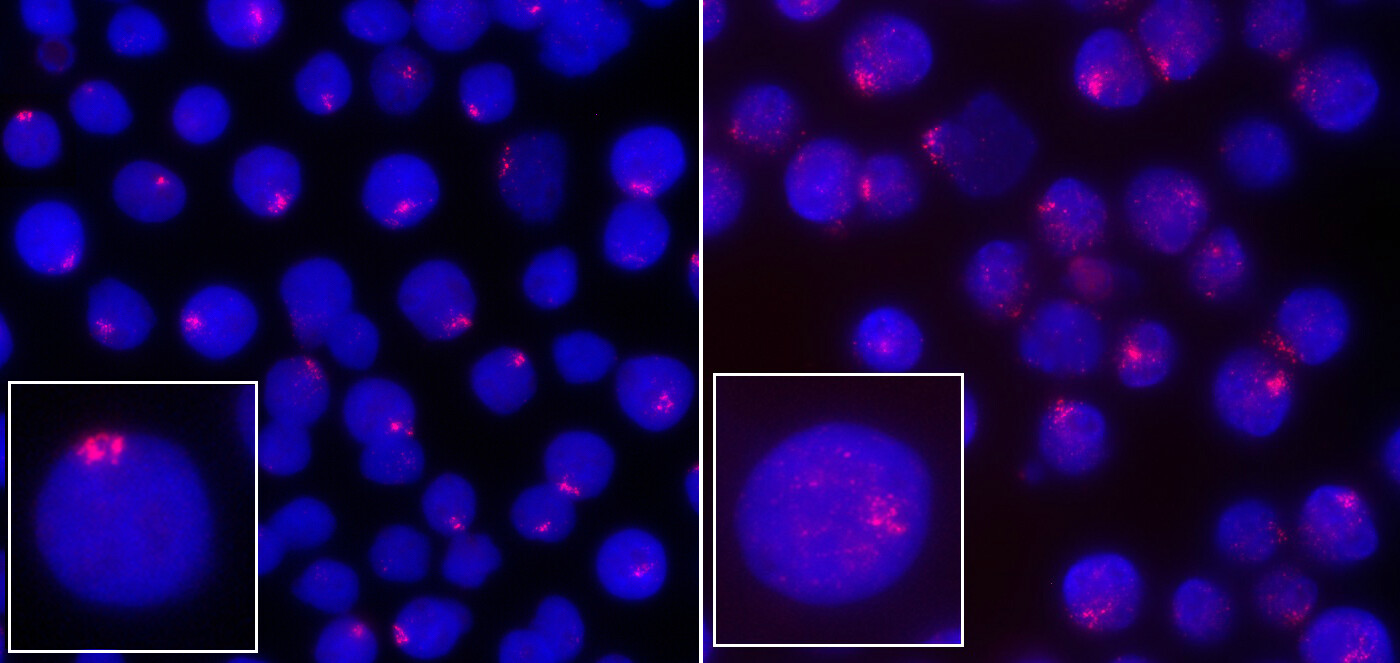
Patterns of the RNA molecule Xist (labeled pink), which is responsible for X chromosome inactivation, differed between healthy patients' T cells and T cells from lupus patients. In female lupus patients, Xist appeared in a diffuse cloud, rather than in a targeted pattern, across the nuclei of activated T cells. This mislocalization, Penn researchers say, may lead to abnormal gene expression that contributes to the autoimmune disease. (Image: Anguera lab)
The autoimmune disease lupus, which can cause fatigue, a facial rash, and joint pain, strikes females far more often than males. Eight-five percent of people with lupus are female, and their second X chromosome seems partly to blame. According to a new study by Penn researchers, females with lupus don’t fully “silence” their second X chromosome in the immune system’s T cells, leading to abnormal expression of genes linked to that chromosome.
The work, led by Montserrat Anguera of the School of Veterinary Medicine and published in the journal JCI Insight, is the first to connect disruptions in maintaining X chromosome inactivation in T cells to lupus. It also suggests that changes to the nuclear structure in the inactive X chromosome of T cells may play a part in the genetic missteps that can arise in lupus—the first time that nuclear organization has been noted as a feature of this disease.
“In normal circumstances, the inactive X should be silenced, and what we show is, in lupus, it’s not,” says Anguera, a biologist at Penn Vet. “And it’s ultimately affecting gene expression.”
Anguera’s lab has paid close attention to the link between X chromosome inactivation, an epigenetic process that balances gene expression between males and females, and autoimmune disease. In earlier studies, the team found that, in females, both T cells and B cells have incomplete inactivation of the second X chromosome due to changes in the patterns of Xist, an RNA molecule that is necessary for X inactivation.
In the new work, Anguera and colleagues wanted to more closely examine this process in T cells and specifically in the context of an autoimmune disease, in this case, lupus.
They first tracked the process of X inactivation in T cells from healthy mice. Their observations revealed that, as T cells develop, Xist temporarily diffuses away from the inactive X chromosome. But when a T cell is activated, as it would be upon encountering a potential pathogen, for example, then Xist RNA returns to this chromosome.
To see what happens in autoimmune disease, the researchers used a mouse model that spontaneously develops lupus in a female-biased manner, similar to the human disease. All female mice of this strain develop the disease, while only 40 percent of males do. Examining the animals’ T cells, the researchers discovered that those at early stages of disease resembled healthy controls in their patterns of Xist localization. But those in the later stages of disease had a dramatically different pattern.
“The only differences we detected happened at late stages of disease,” Anguera says. “What this means is that abnormal X inactivation is a consequence of the disease; it’s not predisposing the animal to develop the disease.”
Interestingly, when the researchers looked at T cells from pediatric lupus patients, provided by study co-author Edward M. Behrens of the Perelman School of Medicine and Children’s Hospital of Philadelphia, they found the same mislocalization of Xist that they had seen in the mice with lupus, even though the children were in remission from their disease.
Even stimulating those patients’ cells in vitro wasn’t enough to coax Xist into the normal pattern. “Even though they don’t have active disease, there’s something missing that’s preventing the RNA from staying targeted at that inactive X chromosome,” Anguera says.
As a next step, the scientists wanted to drill deeper into which genes might be altered in expression from the X chromosome of lupus patients. Comparing additional data from female and male lupus patients with either severe or mild disease, as well as healthy controls, they found a subset of genes altered only in the females with lupus, but not in the healthy females or the males with lupus. And while roughly a quarter of genes from the inactive X chromosome escape inactivation even in healthy individuals, the research team found that a subset of the altered genes in the lupus patients belonged to regions of the X chromosome that didn’t normally escape inactivation.
Of this smaller group of genes, they determined that some that were lower in expression in lupus patients are involved in controlling nuclear organization and structure.
“What we think is happening is that in lupus, this Xist RNA is diffusing all over the place, these chromosomal proteins are changing their expression, and nuclear organization in the territory of the inactive X is changing,” Anguera says. “And that may also be contributing to the relaxed silencing of the inactive X and the changes in gene expression that we’re seeing.”
No one has yet attributed changes in nuclear structure to lupus or other autoimmune diseases, and Anguera and her team hope to dig further into the causes and consequences of the altered nuclear DNA organization. “This is taking our research and the field into a whole new direction for understanding the female bias with lupus disease,” she says.
In the future, the researchers plan to use single-cell sequencing technology to probe questions about the maintenance and disruption of X inactivation. And though the research is in early days, Anguera is hopeful that further work will lead to new approaches for treating autoimmune diseases such as lupus.
“I think it’s really promising,” she says. “If you can get Xist RNA to look like it should, then perhaps you can fix the aberrant X-linked gene expression.” Exploring the role of RNA binding proteins, which help to tether Xist to the X chromosome and keep it in place, she says, may be a fruitful area for further study.
Anguera and Behrens’s co-authors on the paper were lead author Camille M. Syrett, as well as Bam Paneru, Donavon Sandoval-Heglund, Jianle Wang, Sarmistha Banerjee, Vishal Sindhava, and Michael Atchison, all from Penn Vet.
On the move: Water quality and antimicrobial resistance testing goes mobile
Penn researchers have developed a mobile field laboratory allowing them to test water quality and track antimicrobial resistance in and around San Cristóbal in the Galápagos.
Penn researchers Vanessa and Alexis North are studying one of the largest collections of Egyptian blue objects ever found in the ancient Near East, shedding new light on how the world’s first synthetic pigment may have traveled far beyond Egypt.
A new role for dental providers? Rethinking where vaccines are given
Vaccinations have traditionally been administered in primary care settings or pharmacies. However, for about a decade, some states have authorized dentists to administer vaccines, and many others did so during the COVID-19 pandemic. The effectiveness of this approach has led some countries and states to expand or consider expanding the role of dental providers in delivering routine vaccines, including those against COVID-19 and the human papillomavirus (HPV), and in providing vaccine education.
Penn student develops a way for computer chips to run more efficiently
Fluid Silicon, a platform from President’s Sustainability Prize winner Nhlanhla Mavuso, allows computer chips to continuously monitor their health and self-tune as their characteristics change. The technology has the potential to reduce energy usage in data centers and improve reliability in mission-critical applications.