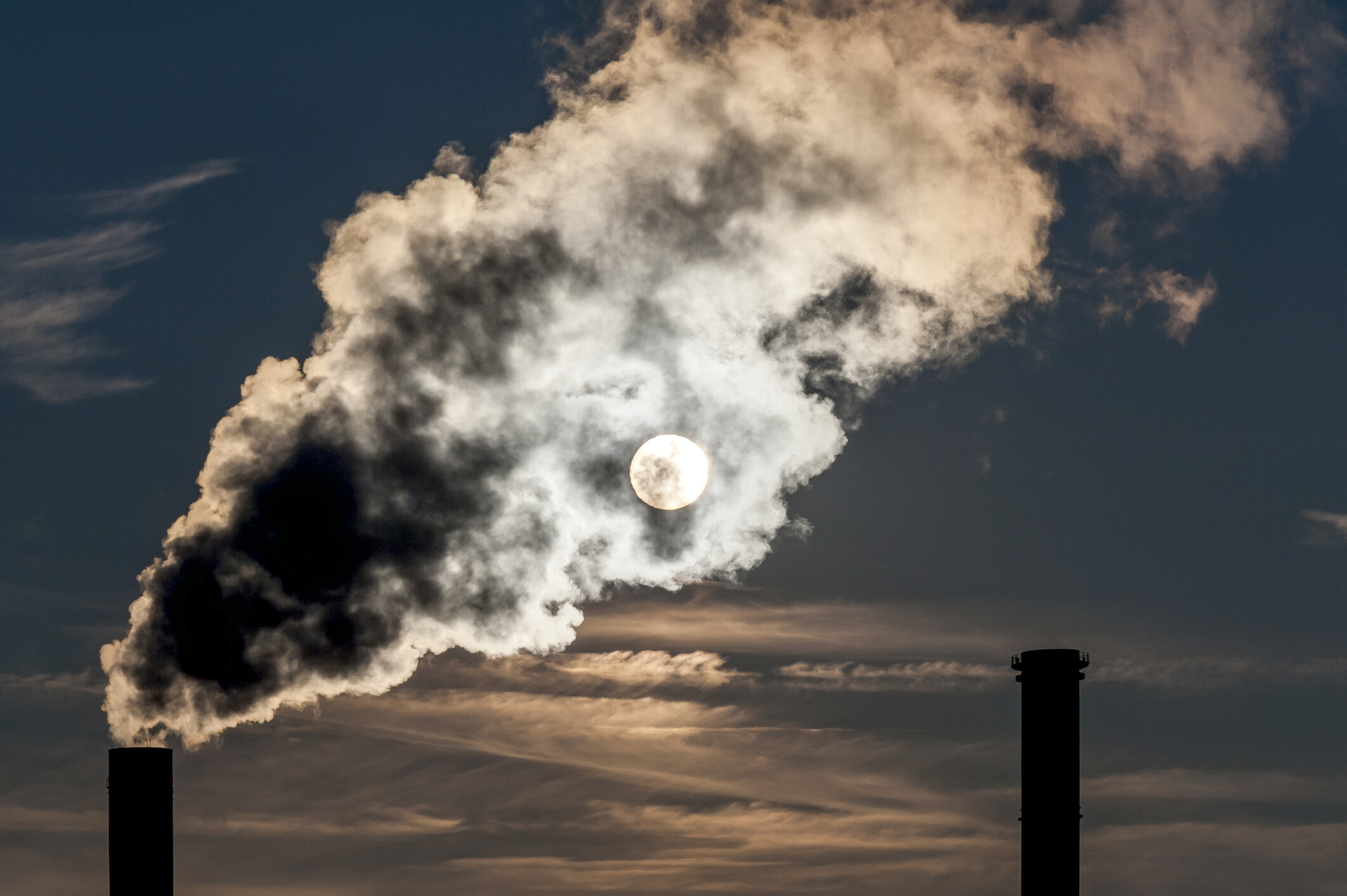
The Supreme Court restricts the EPA’s power to curb climate change
Shelley Welton, a new faculty member with Penn Carey Law and the Kleinman Center for Energy Policy, calls the decision ‘devastating,’ even if expected. She explains the ruling and its implications for action on climate change.
With the decision in West Virginia v. the U.S. Environmental Protection Agency, the Supreme Court ruled to limit the EPA’s capacity to regulate power plant emissions under the Clean Air Act. The move hamstrings efforts by the federal government to regulate a major contributor to climate change.
In one of the final decisions of a consequential term, the Supreme Court ruled today to limit the ability of the U.S. Environmental Protection Agency (EPA) to regulate power plant emissions, a major contributor to climate change.
The case, West Virginia v. EPA, concerned the agency’s ability to devise a broad system by which to reduce power plant emissions. As it has in many recent decisions, the court split 6 to 3, the majority acting to limit the agency’s authority. Chief Justice John Roberts authored the majority opinion, which states that the move to “force a nationwide transition away from the use of coal to generate electricity may be a ‘sensible solution to the crisis of the day.’” But he goes on to write, “A decision of such magnitude and consequence rests with Congress itself, or an agency acting pursuant to a clear delegation from that representative body.”
To delve into some of the details and implications of today’s ruling, Penn Today spoke with Shelley Welton, who joined the Penn faculty this week as Presidential Distinguished Professor of Law and Energy Policy with the Kleinman Center for Energy Policy and Penn Carey Law.
Shelley Welton is Presidential Distinguished Professor of Law and Energy Policy with the Kleinman Center and Penn Carey Law.
Can you explain the background of the case?
I think a lot of people were quite surprised that the Court took this case at all, because it concerns a rule that isn’t currently in place.
In 2015, the Obama administration put out the Clean Power Plan to deal with greenhouse gases emitted by power plants. When the Trump administration came in, they scrapped that plan and instead put in place the Affordable Clean Energy Rule, which functionally did almost nothing. If carried out, I think it would have reduced emissions by something like 1%.
That rule then got challenged as resting on a flawed interpretation of the Clean Air Act. It went to the D.C. Circuit Court, which struck it down.
At that point, the Biden administration indicated that they were not going back to the Clean Power Plan. The world had changed and the emissions reductions goals that plan had put in place had already been mostly achieved, so they were going to craft a new strategy.
The Biden administration requested that this case, seeking to overturn the D.C. Circuit Court ruling, be put aside, as it was functionally moot, concerning the Clean Power Plan which is no longer in effect. Normally courts would listen to the executive branch and say it doesn’t make sense to rule on this if there is no live controversy. But here the Supreme Court decided to rule on it anyway.
Will there be immediate effects as a result of this decision?
The immediate effects are that, as the Court has been tortuously winding its way through its impactful decisions this term, the Biden administration has been trying to figure out, What are we going to do to act on climate?
Power plants account for 25% of total U.S. emissions, so this is a huge, critical piece of solving the climate puzzle. And the Biden administration has had to sit on their hands, waiting for the Court to give them guidance on what they can do.
I imagine that people in the administration are now going to be working very hard to creatively craft some kind of policy that will work within the bounds of this guidance.
It may also have reverberating implications in other agencies, like the Federal Energy Regulatory Commission and the Securities and Exchange Commission, as they think through what steps they’re willing to take on climate change and how legally risky taking action on climate change might be.
Given the speculation about this ruling and how extreme it might be in hamstringing the EPA, where do you think it landed?
I would say it’s not as sweeping as it could have been. Certainly, it limits the tools that the EPA has to address emissions, but it doesn’t strip them away entirely.
But I don’t want to sugarcoat it. I think it’s a devastating decision overall. The decision is bad for climate change and bad for people in the administration who are working creatively on solutions to the big, important problems that are facing the nation.
What are some of the details of what the case considered and how that might impact the EPA and other agencies?
One way to understand what the Court is doing here is that they’re really solidifying what is known as the ‘major questions’ doctrine. That doctrine, as articulated by this Court, says that when an agency is working on a big and important problem, Congress is required to give a super clear statement that the agency has the authority to deal with this problem.
What’s interesting here is that, in 2007, in Massachusetts v. EPA, the Court already held that the EPA has the authority to regulate greenhouse gases. There’s a deep irony here. The more an agency tries to take big action to solve the major problems they’re tasked with solving, the less likely it is that the Court will find that they have the authority to take that action.
Here, the consequence is that the Court says the EPA cannot enact what’s called a generation-shifting strategy when it comes to regulating power plant emissions. Section 111 of the Clean Air Act says that when the EPA is regulating a source of pollution, it’s supposed to come up with the ‘best system of emissions reduction.’ In writing the Clean Power Plan, the Obama administration determined that the best system was to shift energy production away from heavily polluting coal-fired power plants toward cleaner energy sources, like solar- or wind-powered plants.
In this case, what the court was asking is, is this generation-shifting strategy a ‘system?’ It revolves around the definition of system. The majority said no because the strategy is too big and does too much. The dissent says hogwash; system is a broad term, and this clearly fits in the notion of a system.
Was there anything about how the decision was written that surprised you?
One thing that interested me about the majority opinion is that they spent basically no time talking about climate change as a problem. In contrast, the dissent started off their opinion with it.
But right at the end, in the last paragraph of the majority opinion, Roberts refers to climate change as ‘the crisis of the day.’ It seems flippant, given what’s at stake here. It’s not the ‘crisis of the day,’ it’s an existential crisis. The EPA has been charged by Congress to address air pollution, and here you have maybe the biggest air pollution crisis that the world and country has ever faced. There seems to be a callous, intentional disregard of that fact.
What avenues remain open for addressing climate change through law and policy?
The EPA can still do something, and maybe even something significant, with respect to power plant emissions. But they can’t do generation-shifting. They could require technologies at particular plants to reduce emissions, and perhaps even do something more. The majority’s opinion leaves these boundaries somewhat unclear, and that’s the question that confronts the EPA now, just how far they can go.
There is also room for action on the state level, and this opinion doesn’t take away too much from states’ authority to address climate change. Around two dozen states have adopted 100% clean energy targets or goals or laws. Those cover the majority of the U.S. population at this point.
There is also the possibility to target other huge sources of emissions aside from power plants, like the transportation sector. But it’s important to note, the current strategy to clean those up centers on electrification. So, there’s a funny way in which all the other sectors are bound up with what happens at power plants. If we want to clean everything else up through electrification, then it puts even more weight on what we do with power plants. So, this decision has reverberations across sectors.
On the move: Water quality and antimicrobial resistance testing goes mobile
Penn researchers have developed a mobile field laboratory allowing them to test water quality and track antimicrobial resistance in and around San Cristóbal in the Galápagos.
Penn researchers Vanessa and Alexis North are studying one of the largest collections of Egyptian blue objects ever found in the ancient Near East, shedding new light on how the world’s first synthetic pigment may have traveled far beyond Egypt.
A new role for dental providers? Rethinking where vaccines are given
Vaccinations have traditionally been administered in primary care settings or pharmacies. However, for about a decade, some states have authorized dentists to administer vaccines, and many others did so during the COVID-19 pandemic. The effectiveness of this approach has led some countries and states to expand or consider expanding the role of dental providers in delivering routine vaccines, including those against COVID-19 and the human papillomavirus (HPV), and in providing vaccine education.
Penn student develops a way for computer chips to run more efficiently
Fluid Silicon, a platform from President’s Sustainability Prize winner Nhlanhla Mavuso, allows computer chips to continuously monitor their health and self-tune as their characteristics change. The technology has the potential to reduce energy usage in data centers and improve reliability in mission-critical applications.