As part of a new interdisciplinary Penn Global Seminar, 16 undergraduates traveled to Jamaica to test and refine robotic rehabilitation devices for patients in need.
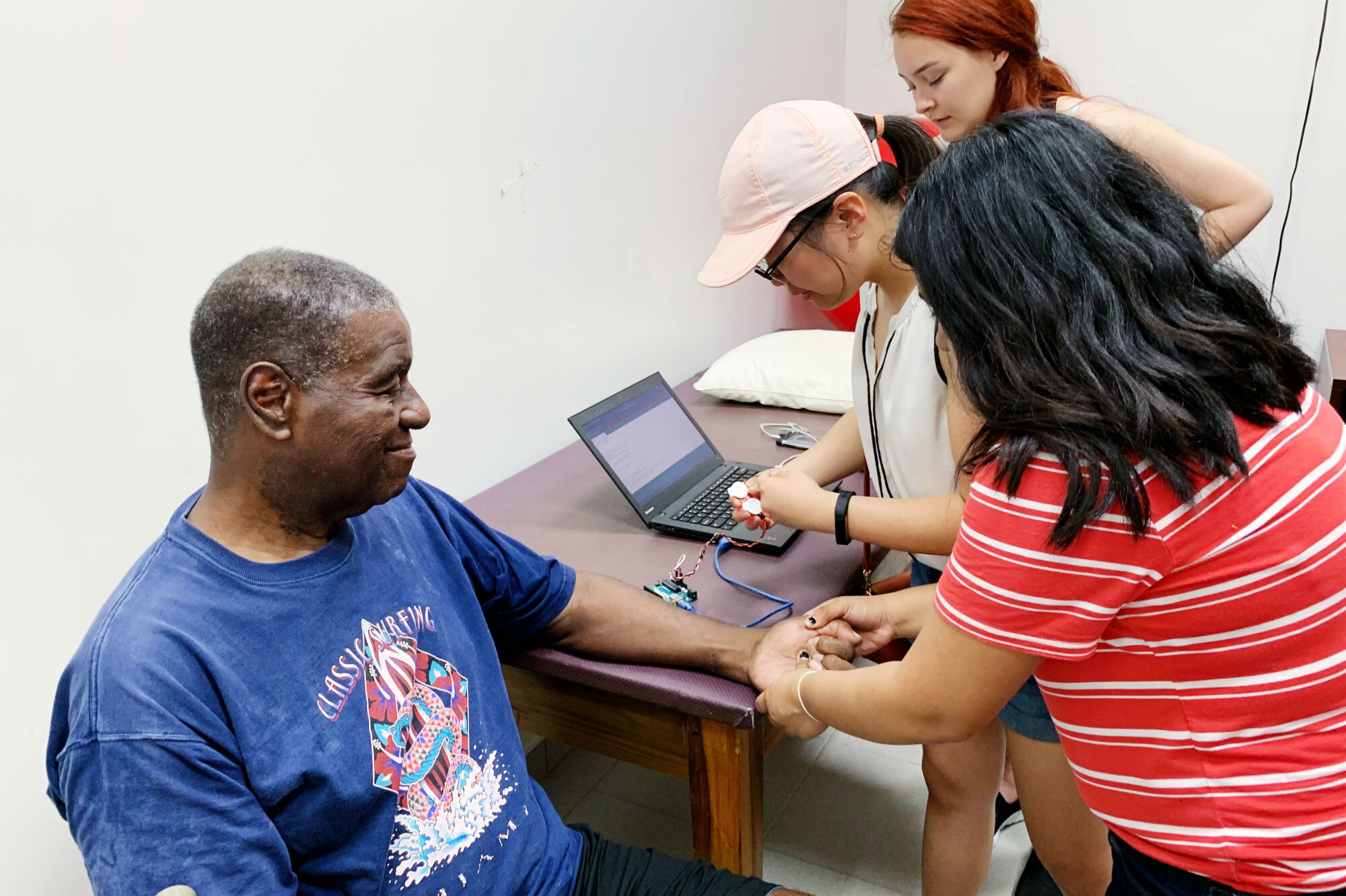
Three students in the Penn Global Seminar “Robotics and Rehabilitation” fit a Jamaican man (left) with a robotic device that may help him grasp objects in a hand that lost some capabilities following a stroke. (Photo: Jacob Gross)
At the end of May, 16 students landed in Kingston, Jamaica. Amidst their warm-weather clothes, they carried blueprints, gears, and miscellaneous metal parts because they weren’t there to sunbathe. They had arrived as part of a Penn Global Seminar called “Robotics and Rehabilitation,”prepared to build and adjust robotic devices to improve the quality of life for people with physical disabilities.
The class was the idea of Camillo J. Taylor, professor of computer and information science in Penn Engineering, and Michelle Jillian Johnson, assistant professor of physical medicine and rehabilitation in the Perelman School of Medicine. Both hail from Jamaica and share an interest in using robotic devices to help those with physical injuries or disabilities. Johnson also has a long-standing relationship with several rehabilitation centers on the island.
In conjunction with the University of the West Indies at Mona, Jamaica (UWI), the University of Technology, Jamaica (UTech), and local physical therapists, Taylor and Johnson identified seven patients who might benefit from robotic assistance with limitations brought on by spinal cord injuries, strokes, cerebral palsy, or related issues. In groups, the students worked on designs meant to address the specific challenges of each individual patient.
For example, a stroke had caused one person to lose partial use of his left hand, so students were tasked with constructing robotic gloves that would allow him to extend and contract his fingers. A second team built a knee-ankle-foot orthosis, similar to a brace, for another stroke patient, and a third retrofitted a wheelchair to allow a patient with a spinal cord injury to stand and play basketball.
Not all course participants had engineering backgrounds, and that was intentional. The students’ majors ranged from chemical and biomolecular engineering to health and societies. Taylor and Johnson wanted the experience open to anyone, so they accepted students from across Penn and trained them in what they needed to know, alternating subjects. One week, for instance, Taylor would teach robotic engineering skills, and then the next Johnson would teach medical engineering skills.
“We structured the course to focus on this introduction to robotics,” Taylor says. “We covered topics like 3D fabrication and mechanical design. We did a little bit of electronics and circuitry and electric engineering, plus a little bit of programming, signal processing. It was a series of topics designed to get students to the point where they could design autonomous systems.”
He doesn’t mean just Penn students; participants from UWI and UTech would often join classes by video call, and each student group included at least one Jamaican participant who met with the patient in person and helped with device design. The trip abroad represented the culmination of the partnership. On the ground, the teams got straight to work testing and honing the devices they had created.
“It was eye-opening to meet my patient for the first time,” says Zoeb Mohammedshah, a senior from Edison, New Jersey, who worked on the knee-ankle-foot orthosis. “Not only because I got an idea of what his situation really was and how much he was struggling with his current device, but because you get constant, in-person patient feedback.”
Taylor considers the trip a great success. “Some of the projects got to the point where they were very, very usable by the actual patient,” he says. “Hopefully, we’ll be able to build on some of those successes.”
In light of those accomplishments, Taylor and Johnson plan to run the seminar annually, with a few tweaks to make the skill-building and design portions of the curriculum even smoother. Taylor says he is grateful for the patience and generosity of his colleagues in Jamaica and looks forward to working with them again. According to Taylor and Johnson, there’s no shortage of people who could benefit from robotic devices, so the scientists will continue to harness the eagerness of Penn students to create them.
On the move: Water quality and antimicrobial resistance testing goes mobile
Penn researchers have developed a mobile field laboratory allowing them to test water quality and track antimicrobial resistance in and around San Cristóbal in the Galápagos.
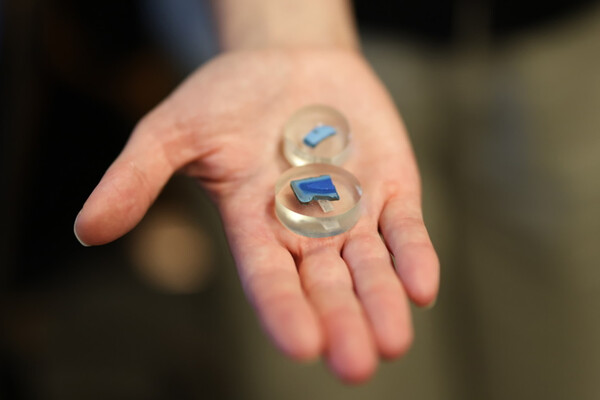
Penn researchers Vanessa and Alexis North are studying one of the largest collections of Egyptian blue objects ever found in the ancient Near East, shedding new light on how the world’s first synthetic pigment may have traveled far beyond Egypt.
A new role for dental providers? Rethinking where vaccines are given
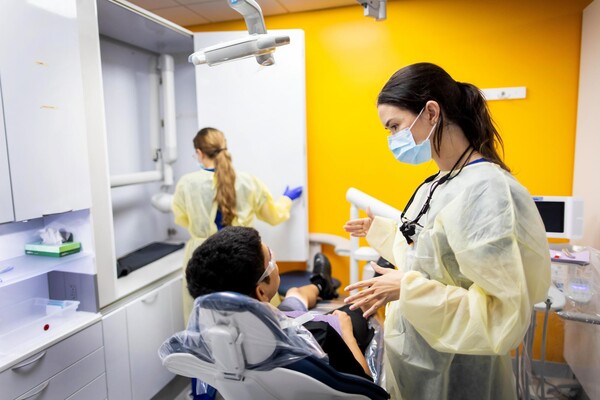
Vaccinations have traditionally been administered in primary care settings or pharmacies. However, for about a decade, some states have authorized dentists to administer vaccines, and many others did so during the COVID-19 pandemic. The effectiveness of this approach has led some countries and states to expand or consider expanding the role of dental providers in delivering routine vaccines, including those against COVID-19 and the human papillomavirus (HPV), and in providing vaccine education.
Penn student develops a way for computer chips to run more efficiently
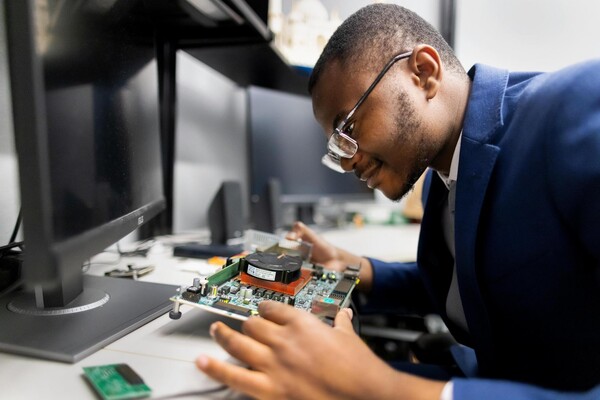
Fluid Silicon, a platform from President’s Sustainability Prize winner Nhlanhla Mavuso, allows computer chips to continuously monitor their health and self-tune as their characteristics change. The technology has the potential to reduce energy usage in data centers and improve reliability in mission-critical applications.