Uniting passions for architecture, preservation, and the Near East
Marc Marín Webb, who studied architecture in Berlin and Barcelona, is studying the impact of genocide on the built heritage of the Yezidi community in Iraq.
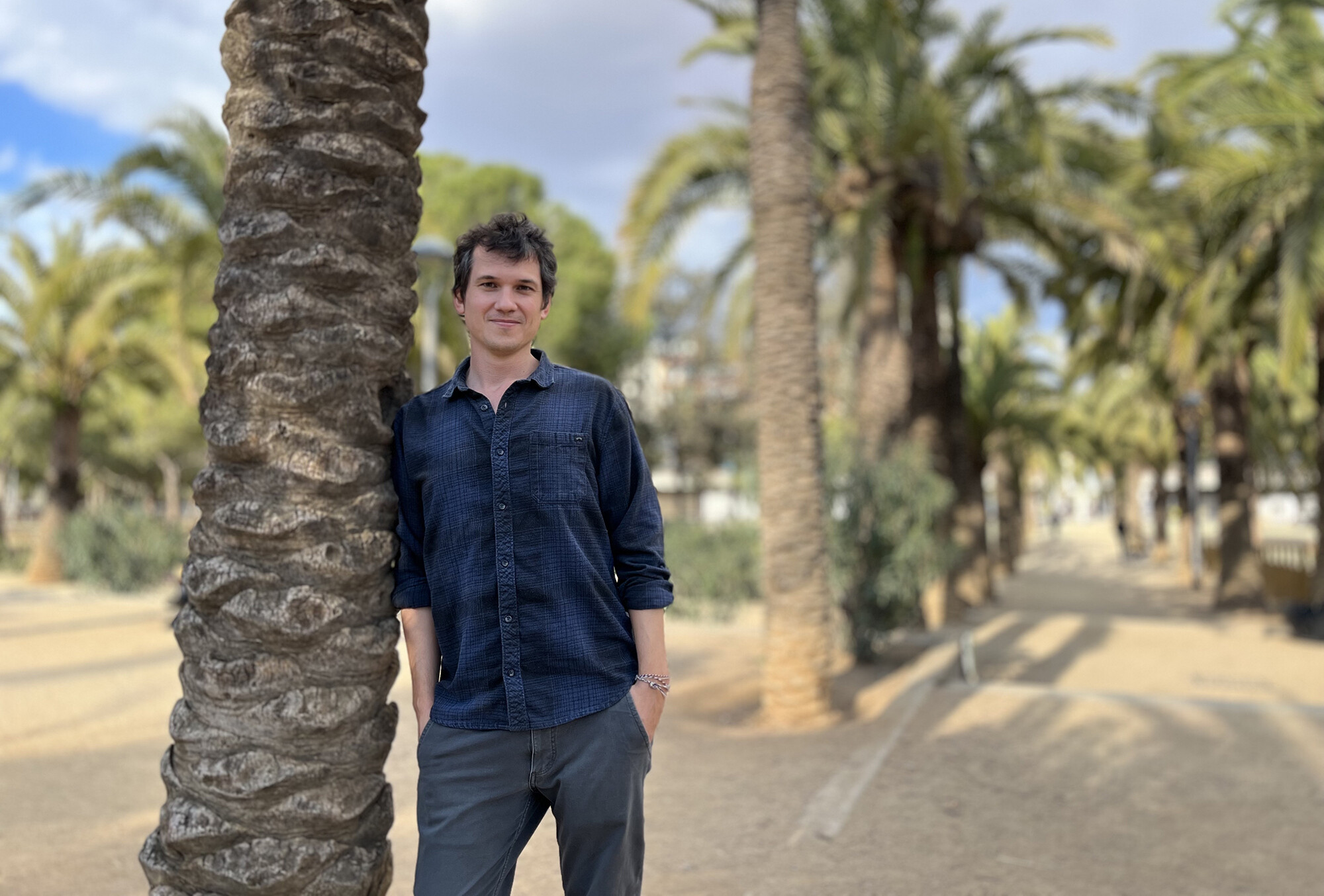
Sixth-year Ph.D. student Marc Marín Webb of the School of Arts & Sciences in his home city of Barcelona, while waiting for a visa to travel to Iraq where he is researching the built heritage of the Yezidi community.
(Image: Courtesy of Marc Marín Webb)
After working on an archaeological excavation of a Neo-Assyrian site in northeastern Syria, assessing the preservation of Sumerian sites in southern Iraq, completing two architecture degrees, and writing another master’s thesis on how the Spanish painter and sculptor Joan Miró was influenced by Mesopotamian art, Marc Marín Webb found himself back in Iraq.
A sixth-year Ph.D. student in the Department of Near Eastern Languages & Civilizations (NELC) at Penn, Marín Webb is currently conducting fieldwork for his dissertation research on the built heritage of the Yezidi community. The Yezidis are a religious minority indigenous to northern Iraq, southeastern Turkey, northern Syria, and western Iran, who experienced genocide at the hands of the Islamic State from 2014 to 2016.
Marín Webb explains that the Islamic State destroyed around 68 of their shrines, and he is trying to understand whether—or how—destruction and reconstruction efforts have shaped Yezidi religious landscapes.
“My dissertation aims to understand the ways in which Yezidi communities are currently managing, preserving, modifying, and erasing the physical remains of the last genocide and how violence and post-violence heritage-making shape the significance of sites of collective memory,” he says.
It was a long journey for him to get to this point and an unconventional one: Marín Webb says architecture is an uncommon background for people in NELC compared to archaeology, ancient and modern languages, or history. But he entered with experience in archaeological fieldwork, teaching, and museum exhibitions.
Marín Webb says that at Penn he initially wanted to research Near Eastern architecture and archaeology, “and I’m still keeping some approach to material culture, but I’m focused more now on heritage preservation. I aim to contribute my training in architecture and experience researching architectural history and archaeology.”
Archaeologist Lynn Meskell, a Penn Integrates Knowledge University professor and member of Marín Webb’s thesis committee, says his unique training and international experience sets him apart from many heritage practitioners in that he is equally comfortable in architectural, archaeological, and ethnographic fields.
“Marc’s research is timely and ethical, working with peoples and histories that have been both sidelined and violently targeted. It’s a story that needs to be told,” Meskell says, adding that Marín Webb’s commitment to being in the community long-term and asking what they need is exemplary. “It’s work that bridges religion, heritage, and preservation from the ground up. Penn should be very proud; it’s really the best of a global education in action.”
Marín Webb talked to Penn Today about his path and current research from Spain, his home country, while waiting for a difficult-to-obtain visa required to do the fieldwork he is now conducting in Iraq. In the meantime, he was transcribing and analyzing interviews from his last visit to Iraq, digitizing sketches and measurements he took of shrines, and reading and writing.
Flexibility, perseverance, and pursuing different paths
Growing up interested in technical and social science courses, Marín Webb saw architecture as a tool to understand the ways of past and present communities, he says. He was interested in the “possibility of engaging with historians, archaeologists, and anthropologists, exploring what I could bring to the table while stepping outside of my area of intellectual comfort.”
He studied architecture in Barcelona and in Berlin while collaborating in the Department of Theory and History of Architecture at the Polytechnic University of Catalonia (UPC). He and colleagues lent their architectural knowledge to an archaeological excavation at a Neo-Assyrian site—from the early 9th to late 7th century BCE—in northeastern Syria led by French and Syrian excavators in 2010.
The following year, the onset of the Syrian civil war halted archaeological activity in the country. Marín Webb says the most feasible way to continue working in the Neo-Assyrian period was to travel to the Kurdistan region of Iraq, where the team continued their projects between 2012 and 2014. But in June 2014 they had to stop because the Islamic State invaded Mosul and it was no longer safe to be at the site, located between Mosul and Erbil.
During the years in which archaeological practice in Iraq was halted due to the ongoing conflict with the Islamic State, Marín Webb collaborated in various heritage preservation and museum exhibition projects led by his department at UPC. These experiences culminated in an exhibition on the architectural imagery of Early Mesopotamian cities, which combined archaeological artifacts and visual documentation of the current state of archaeological sites, Marín Webb says.
“Those initial experiences drew my attention toward everything related to archeology, heritage, and conservation,” he says. But, since he couldn’t return to Iraq and he finished his master’s degree in architecture in 2013, he was looking for something else to do. He worked in an architecture studio while pursuing a master’s degree in ancient Mediterranean studies from the Open University of Catalonia and Autonomous University of Barcelona, focusing on Mesopotamia and Egypt.
Marín Webb worked on documentation for an exhibition at the Institute for the Study of the Ancient World at New York University (NYU) about the modern reception of ancient Near Eastern art. It focused on how contemporary artists looked at Mesopotamian art and how certain archaeological artifacts, after being excavated, interpreted, and disseminated in both specialized and general media, can eventually achieve a status of ancient “works of art.”
“We selected a few artists, and it was beautiful because we were exhibiting ancient art and modern art at the same space and analyzed how this dialogue triggered questions of aesthetics and art theory,” he says. “We also considered how the same exhibition of these objects could affect their meaning, redefined according to 21st century uses of the past.”
Shortly after the exhibit closed in the summer of 2015, Marín Webb visited the museum dedicated to the 20th century Spanish artist Joan Miró in Palma de Mallorca as part of the documentation for another exhibition on ceramics and architecture. On the whitewashed walls of one of Miró’s workshops, he noticed photographs of the same Mesopotamian objects included in the NYU exhibit.
He ended up completing his master’s thesis on the influence of Mesopotamian art on Miró. The Joan Miró Foundation, which funded the documentation Marín Webb did with his mentor, architect and aesthetics professor Pedro Azara, ran an exhibition on the topic, which Marín Webb saw as “a beautiful addendum of the previous exhibition in New York.”
He was teaching history of architecture in Barcelona but says the job prospects weren’t very good, and so he was looking for Ph.D. programs “that allowed me to establish a bridge between different disciplines,” he says. “I wanted to explore how architecture, when used as a community-driven practice, could bring together local communities and international experts to foster engagement, critical thinking, and academic research.”
Marín Webb entered a Ph.D. program in NELC in 2018, drawn to its faculty and their projects but also eager to explore collaboration with the Penn Museum and with the Weitzman School of Design, specifically its Department of Historic Preservation. He joined workshops and seminars on ancient Near Eastern archaeology, art history, and languages along with courses that Frank Matero, chair of the Department of Historic Preservation, offered on architectural conservation science and conservation of archaeological sites.
He initially wanted to build on his experience excavating Assyrian and Neo-Assyrian sites. But in 2019, the Department of State gave Penn’s Iraq Heritage Stabilization Program funding for restoration work on the Sanctuary of Sheikh Adi in the Holy Valley of Lalish, the most sacred place and principal center of pilgrimage for the Yezidis.
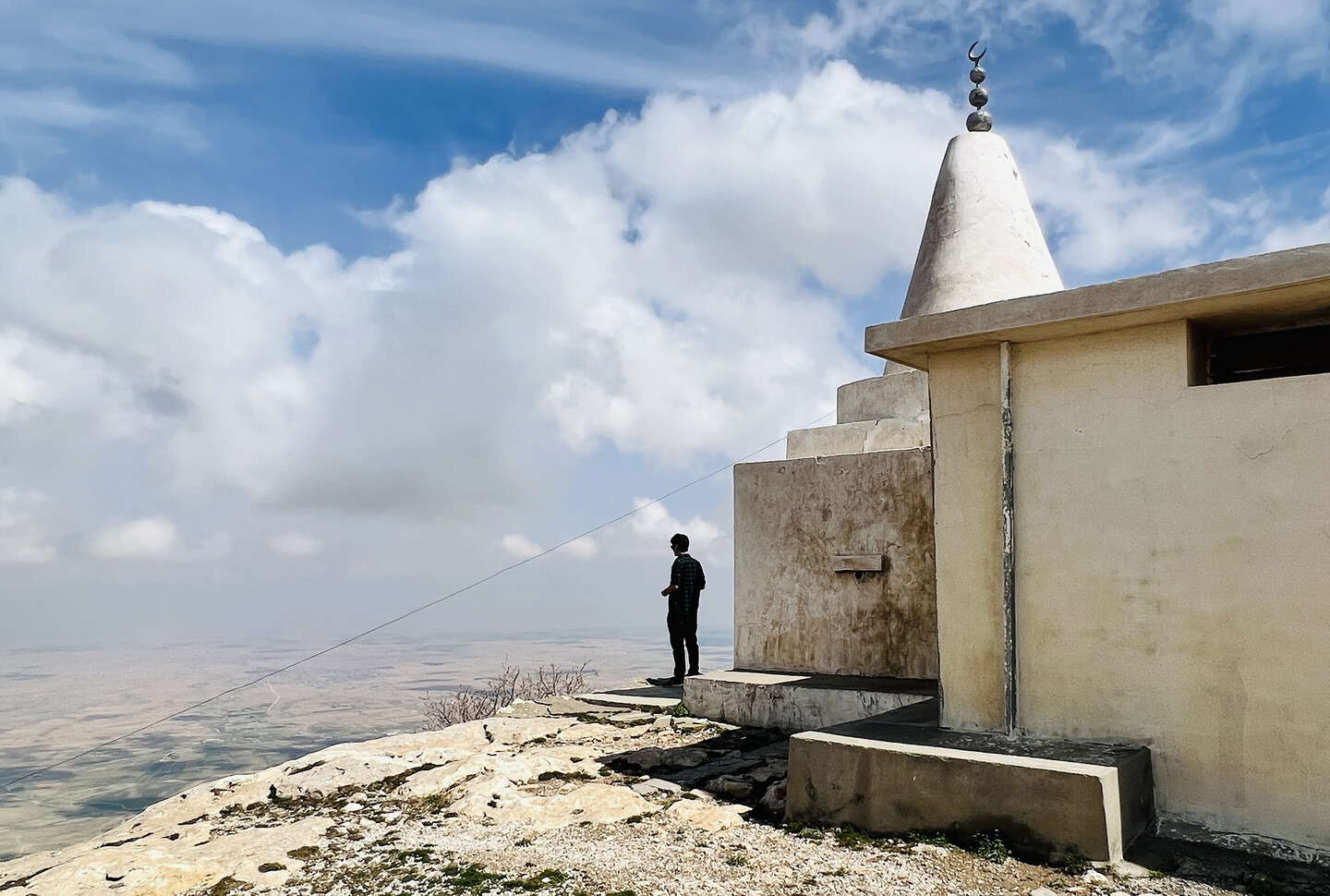
The Shrine of Çil Mêra on the peak of Mount Sinjar in Iraq is one of more than 70 shrines Marc Marín Webb is studying in his dissertation research. During his first month of fieldwork in March 2023, he examined the state of preservation of the site.
(Image: Courtesy of Marc Marín Webb)
Marín Webb says his adviser, Richard Zettler, invited him to collaborate on this project as an architectural consultant. He traveled to Lalish in 2019, but, when the COVID-19 pandemic halted conservation work, he helped explore the history of the site through travelers’ accounts. He eventually resumed travel and grew more interested in how centuries of conflict with other communities impacted Yezidi shrines.
Marín Webb says he started off wanting to study what happened to the shrines and why people involved in their reconstruction feel it’s important to rebuild. But after spending more time in the region, his interests shifted toward investigating how the preservation of Yezidi heritage sites could influence the community’s politics, social structures, and post-traumatic healing. “There was a genocide against this community, and I am trying to understand how this violence has reshaped sacred landscapes,” he says.
Looking ahead past the completion of his doctoral studies, Marín Webb is keeping his options open and hopes he can continue to work across fields. “I would love to continue the academic path, doing a postdoc in heritage studies, but I also like being in the field and doing either archaeological or architectural conservation projects, so I will be open to whatever options I have,” he says. “I think it’s not exclusive; hopefully I will be able to do a bit of both.”
On the move: Water quality and antimicrobial resistance testing goes mobile
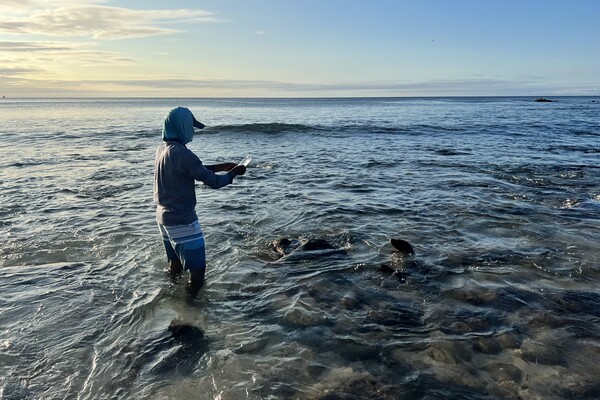
Penn researchers have developed a mobile field laboratory allowing them to test water quality and track antimicrobial resistance in and around San Cristóbal in the Galápagos.
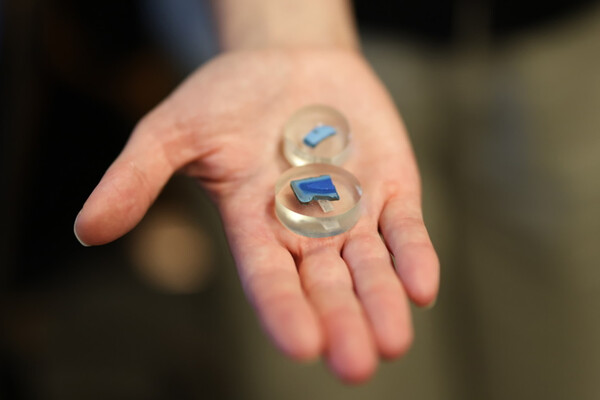
Penn researchers Vanessa and Alexis North are studying one of the largest collections of Egyptian blue objects ever found in the ancient Near East, shedding new light on how the world’s first synthetic pigment may have traveled far beyond Egypt.
A new role for dental providers? Rethinking where vaccines are given
Vaccinations have traditionally been administered in primary care settings or pharmacies. However, for about a decade, some states have authorized dentists to administer vaccines, and many others did so during the COVID-19 pandemic. The effectiveness of this approach has led some countries and states to expand or consider expanding the role of dental providers in delivering routine vaccines, including those against COVID-19 and the human papillomavirus (HPV), and in providing vaccine education.
Penn student develops a way for computer chips to run more efficiently
Fluid Silicon, a platform from President’s Sustainability Prize winner Nhlanhla Mavuso, allows computer chips to continuously monitor their health and self-tune as their characteristics change. The technology has the potential to reduce energy usage in data centers and improve reliability in mission-critical applications.