A hands-on education of Pennsylvania and New Jersey ecology
Sally Willig has been teaching Regional Field Ecology at Penn since 1999, educating students about plants, soils, and more at sites such as Ringing Rocks County Park and the Pine Barrens.
4 min. read
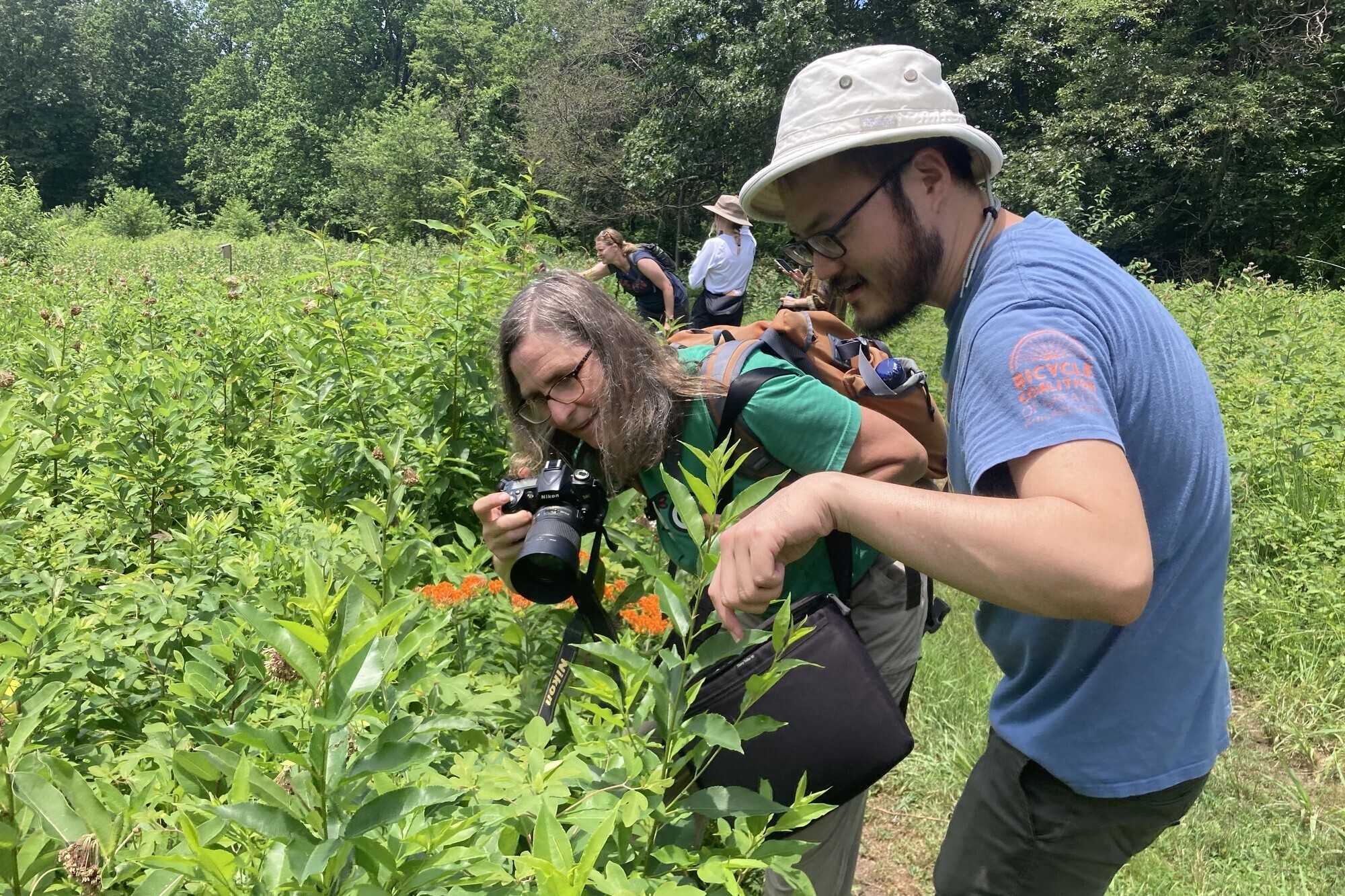
With her Regional Field Ecology class, Sally Willig photographed an insect Chi-Hyun Kim pointed out in the meadow at Natural Lands’ Mariton Wildlife Sanctuary. In the meadow, Willig also pointed out butterfly weed, milkweed, and woodland sunflowers to her students.
(Image: Erica Moser/University Communications)
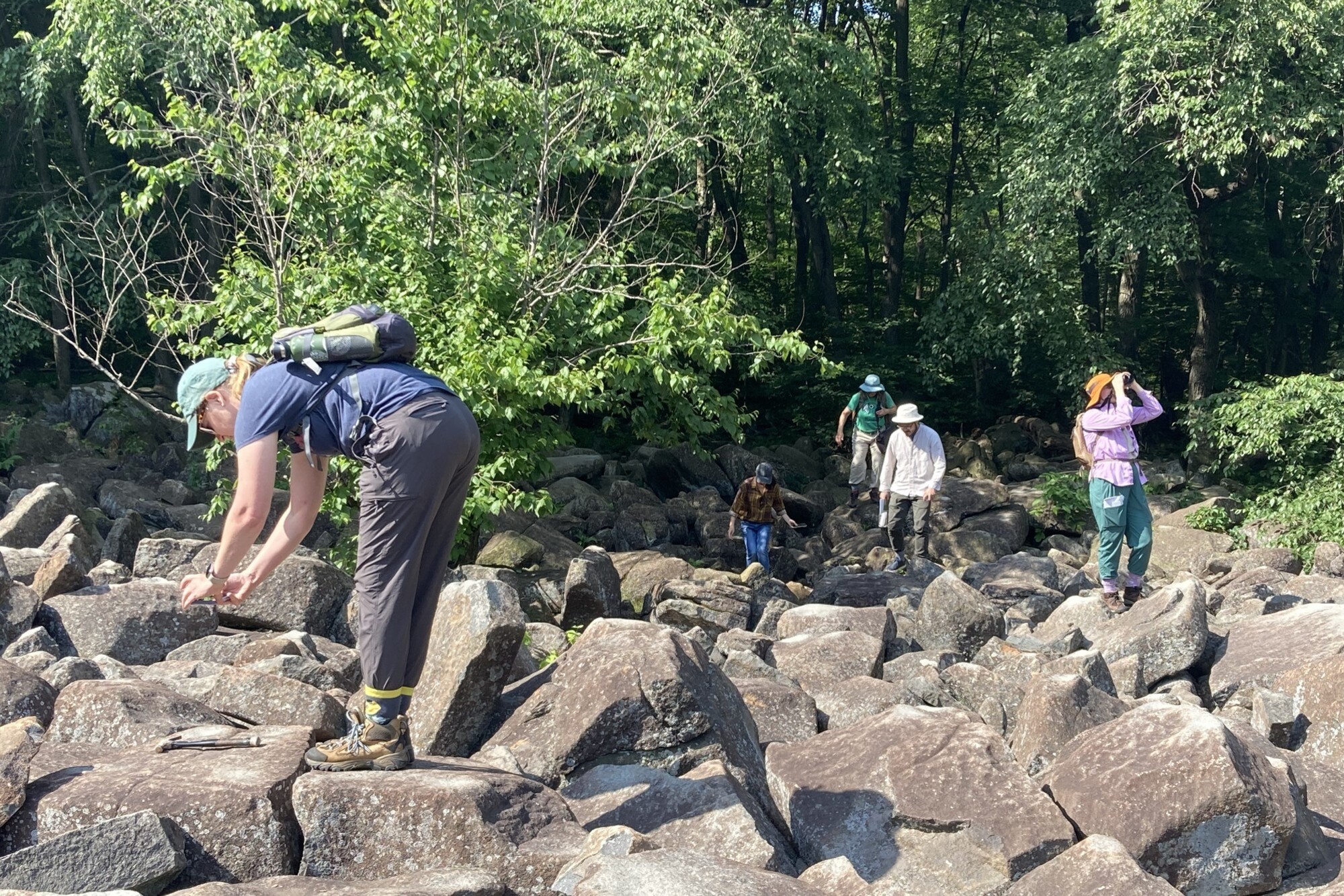
On a humid, 81-degree Sunday morning in late June, Sally Willig and the students in her Regional Field Ecology course emerged from a wooded trail at Ringing Rocks County Park in upper Bucks County onto a sea of sunlit boulders.
Willig, a lecturer and academic advisor in the Master of Environmental Studies (MES) program, provided an overview of the weathering and erosion that gave rise to the diabase—igneous rock—boulder field. With hammers and pliers, students then tapped the rocks and created a euphony of tones—some reverberant, some tinny, and some sounding like a locomotive bell.
It was an interlude in a walk where Willig pointed out myriad plants and showed students how to identify them: white oak, sour gum, spicebush, sugar maple, hog-peanut, Japanese barberry, musclewood, hop-hornbeam, autumn olive, chestnut oak, mugwort, wineberry, wild sarsaparilla, black snakeroot, moonseed, bitternut hickory, and rosebay rhododendron.
This trip to Ringing Rocks and Natural Lands’ Mariton Wildlife Sanctuary in Easton, Pennsylvania, was the fifth of six Sunday field trips for Regional Field Ecology, as the class moved along a transect from the Atlantic Ocean in New Jersey to the first prominent ridge of the Appalachian Mountains. It provides hands-on, foundational knowledge for students, some of whom don’t have much prior experience in ecology.
“Our approach of moving along different gradients in each natural area to see the changing structure and species composition of the plant communities and associated wildlife allows students to recognize patterns and associated processes,” Willig says. The aims of the course are to introduce students to the varied environments and plants of the region and to get them thinking about connections between climate, geology, topography, hydrology, soils, vegetation, wildlife, and disturbances to the environments.
Whether examining how the 2022 Mullica River Fire impacted different tree species in the Pine Barrens or exploring how Hurricane Sandy severely eroded and breached parts of the primary dune at Island Beach State Park, students see the effects of disturbances to nature first-hand.
“Going with Sally, you have your own personal tour guide, and you can ask her anything,” says Sarah Luddy, an MES student with a dream of working in environmental education. Luddy says whereas she previously saw “a blend of green” in nature, now “things pop out more.”
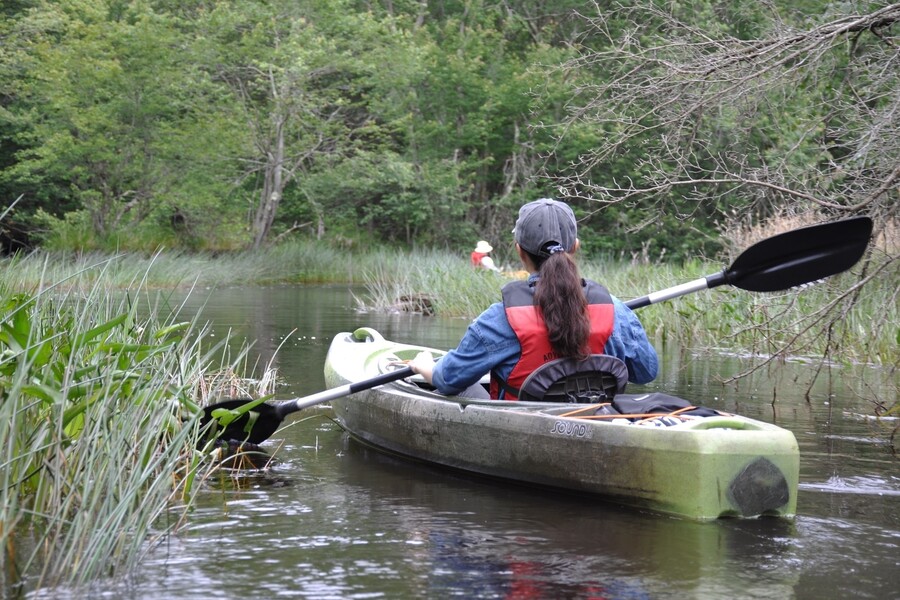
Danielle Ma kayaked along the Batsto River during a field trip to the New Jersey Pine Barrens.
(Image: Sally Willig)
During their Wednesday evening classes, students present their observations from the previous trip—such as geological formations and how certain plants only grow in certain soils—and discuss various ecological topics. Two MES grads who previously took the course, Grace Jeschke and Natalie Howe, visited the class as guest speakers to speak about their respective fields of advanced study: butterflies and lichens.
Each student has also been working toward a final paper on a topic related to the field trips—such as trees and environmental education—and are comparing their findings across sites. The students are learning from one another and have become attuned to others’ topics on field trips, helping them understand how different elements of an ecosystem work together.
MES student Danielle Ma is writing her paper on wildflower distributions and their corresponding soil types. Ma says her favorite flower was the mountain laurel she saw on the group’s six-mile kayaking trip along the Batsto River at the Pine Barrens—a flower she never saw in her native China.
Kate La Spina, an MES student who works as the program coordinator of Penn’s Environmental Innovations Initiative, is comparing and contrasting birds at different sites for her final project, focusing on the presence of aerial insectivores. She identified different birds—such as wood thrushes, ovenbirds, and blue grosbeaks—for her classmates on their field trips. La Spina also uses the app Merlin Bird ID, which Willig says is helpful in the dense habitat of the thicket.
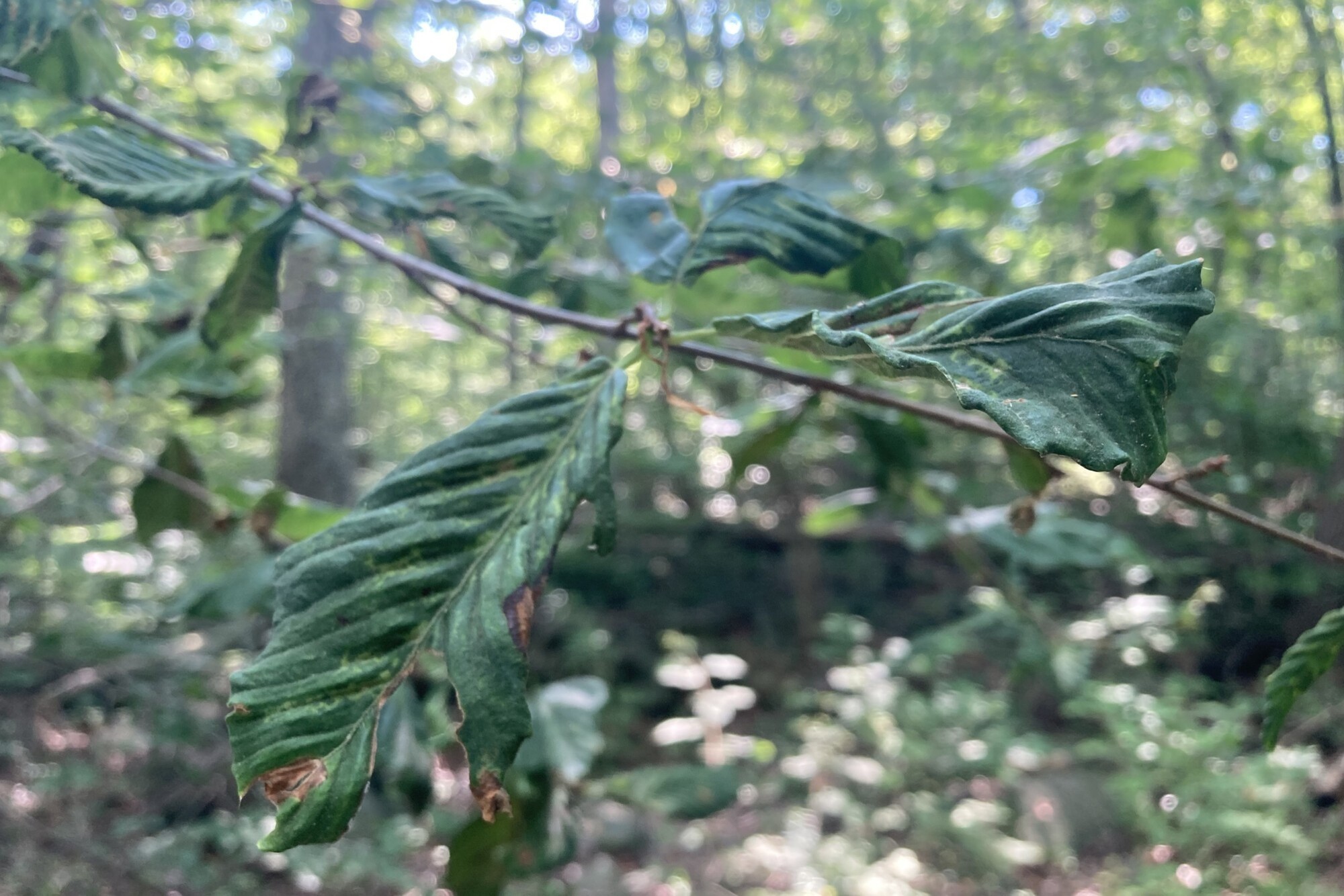
She has been teaching Regional Field Ecology since 1999, giving her a window into natural and anthropogenic changes over time. Walking toward the waterfall at Ringing Rocks, she commented on how the hemlocks that once filled the creek valley have died due to the hemlock woolly adelgid, a sap-sucking insect. And she couldn’t get over a new development: how terrible the beech trees looked from beech leaf disease.
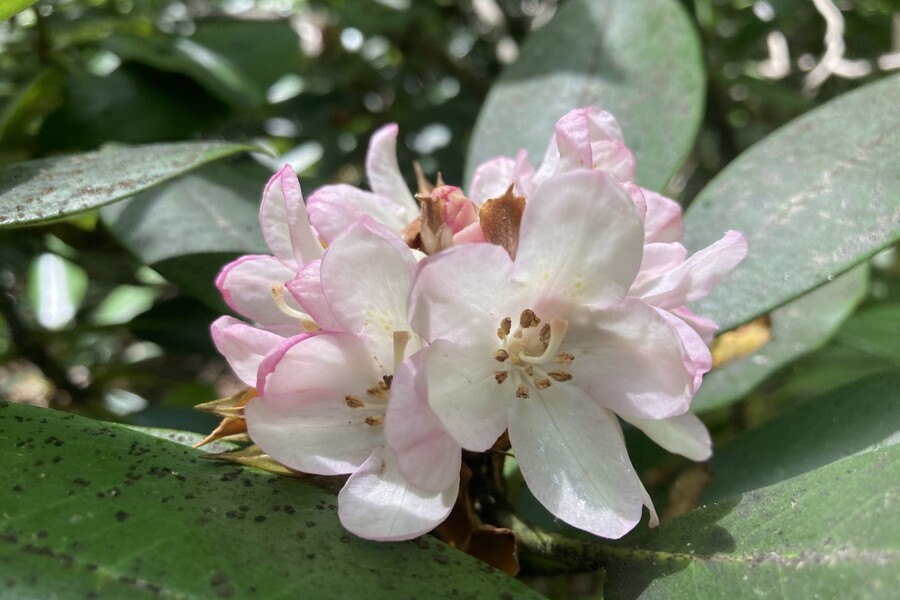
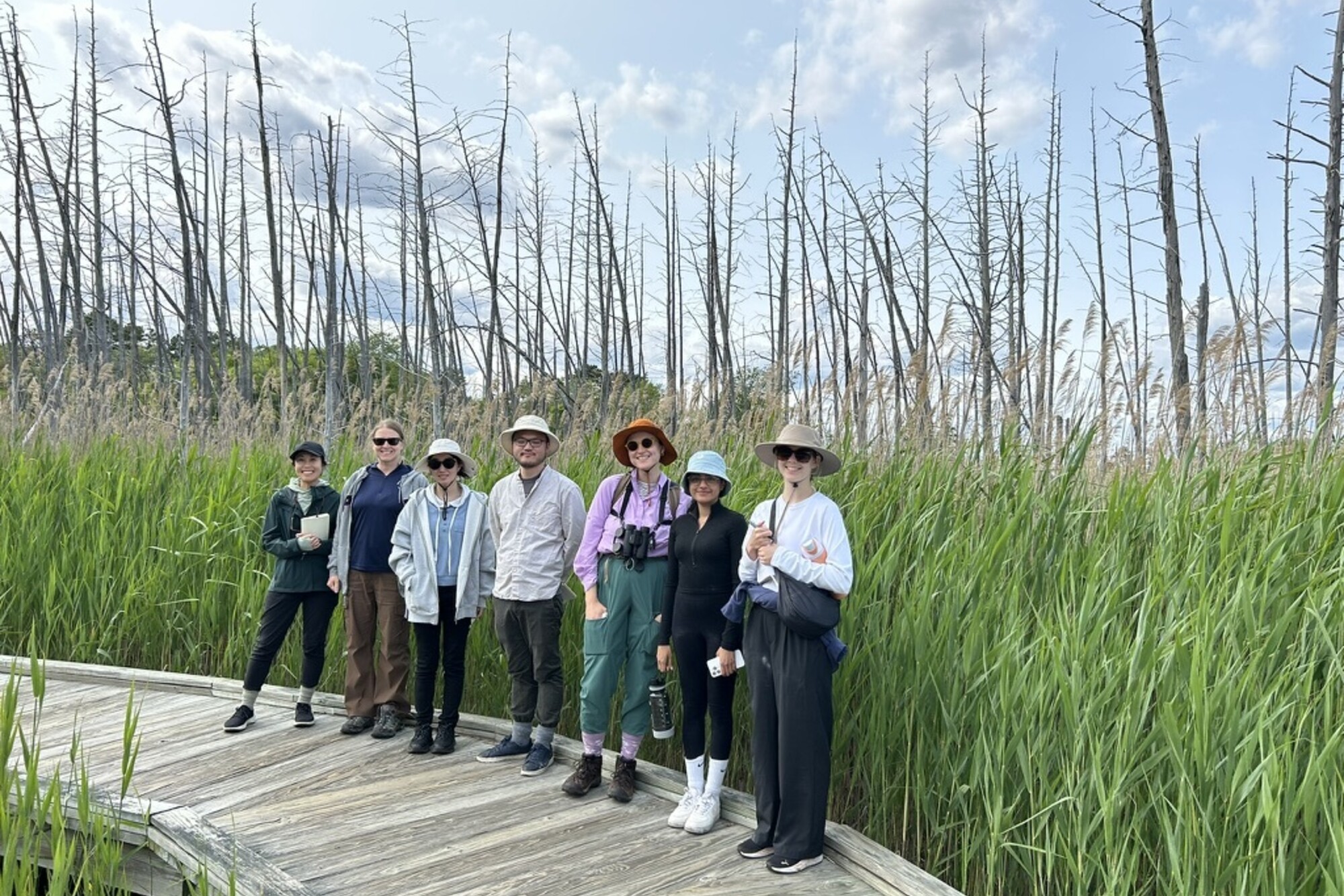
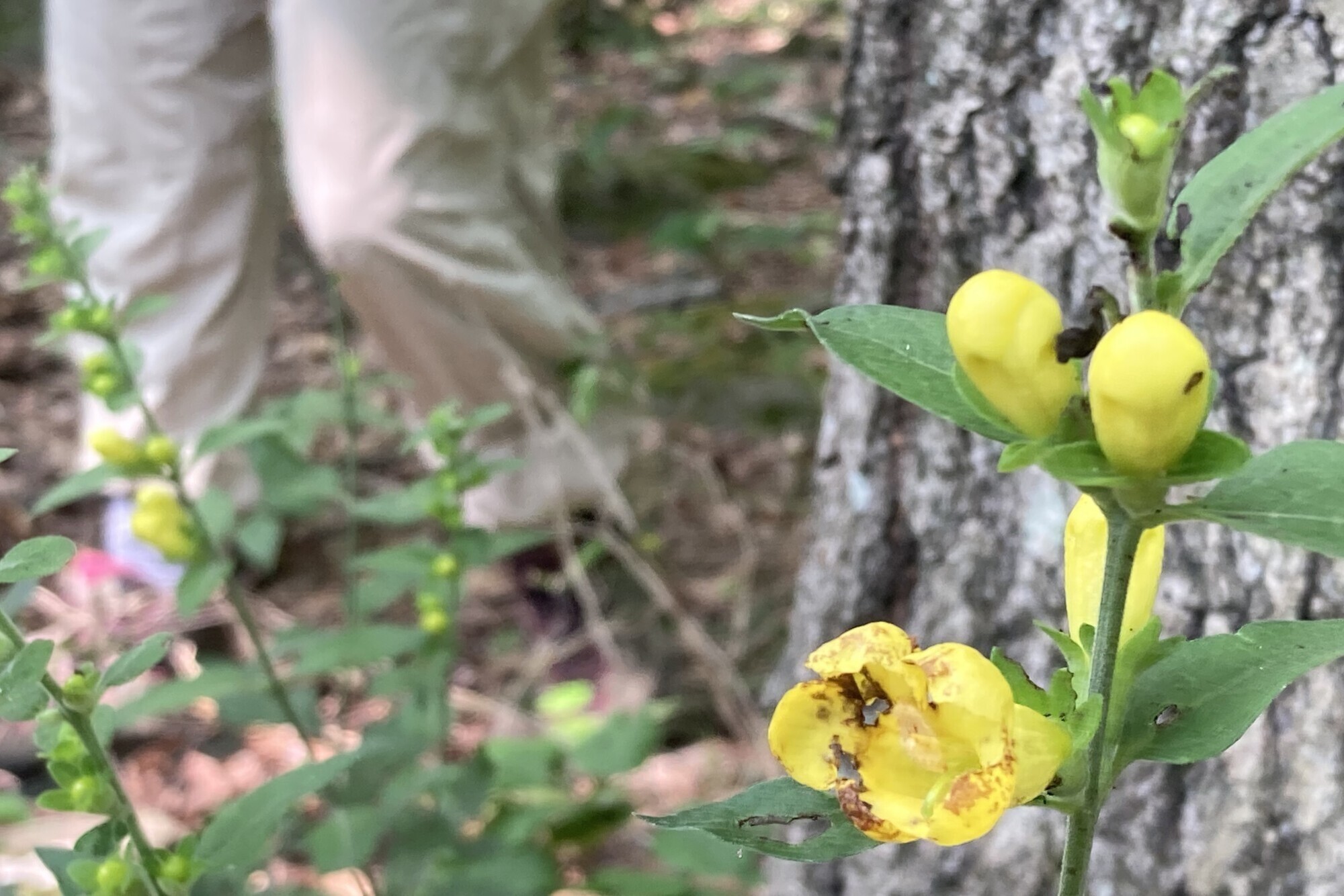
(Clockwise from top left) At Ringing Rocks County Park, students tapped on the diabase boulders amid a walk through the woods. Sally Willig pointed out how beech trees have been infected by beech leaf disease and highlighted what she said "may be the most interesting flower of the day"—the downy false yellow foxglove, which is parasitic on the roots of oaks. On another field trip to Cattus Island County Park, students walked through “ghost forests.”
(Images: Courtesy of Erica Moser and Sally Willig)
Going to Cattus Island County Park in New Jersey for another field trip, she has seen the formation of “ghost forests”—former freshwater swamps dominated by trees that die due to increasing salinity from sea level rise. On the positive side, she points to successful efforts to reestablish vegetation around the Lehigh Gap Nature Center, which is impacted by decades of zinc smelting.
Willig shares facts about the flora students encounter on field trips, like how downy false foxglove is parasitic on the roots of oak trees and witch hazel likes rocky areas. Whether encouraging students to smell horsebalm—a perennial herb in the mint family—or feel the rough leaves of the woodland sunflower, she highlights the multisensory experience of being in nature. Smell and touch, Willig says, are valuable for determining different plant species.
Gabrielle McGrath, who started the MES program in the spring and is pursuing Penn’s multi-master’s degree in international environmental management, also has a background in urban studies. She says an interest in ecology plus being “a hands-on-learning person” led her to take Willig’s class. "Here I am, and I’m loving it," McGrath says.
On the move: Water quality and antimicrobial resistance testing goes mobile
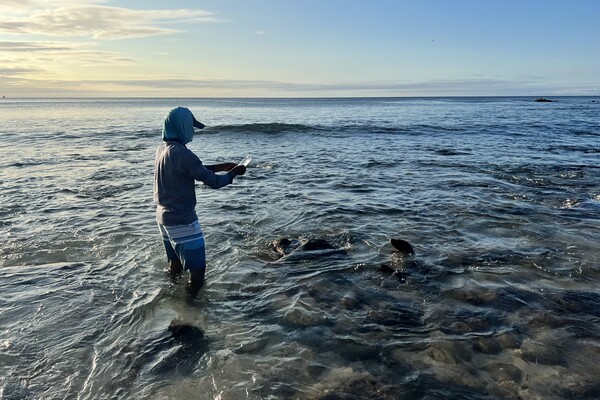
Penn researchers have developed a mobile field laboratory allowing them to test water quality and track antimicrobial resistance in and around San Cristóbal in the Galápagos.
Penn researchers Vanessa and Alexis North are studying one of the largest collections of Egyptian blue objects ever found in the ancient Near East, shedding new light on how the world’s first synthetic pigment may have traveled far beyond Egypt.
A new role for dental providers? Rethinking where vaccines are given
Vaccinations have traditionally been administered in primary care settings or pharmacies. However, for about a decade, some states have authorized dentists to administer vaccines, and many others did so during the COVID-19 pandemic. The effectiveness of this approach has led some countries and states to expand or consider expanding the role of dental providers in delivering routine vaccines, including those against COVID-19 and the human papillomavirus (HPV), and in providing vaccine education.
Penn student develops a way for computer chips to run more efficiently
Fluid Silicon, a platform from President’s Sustainability Prize winner Nhlanhla Mavuso, allows computer chips to continuously monitor their health and self-tune as their characteristics change. The technology has the potential to reduce energy usage in data centers and improve reliability in mission-critical applications.