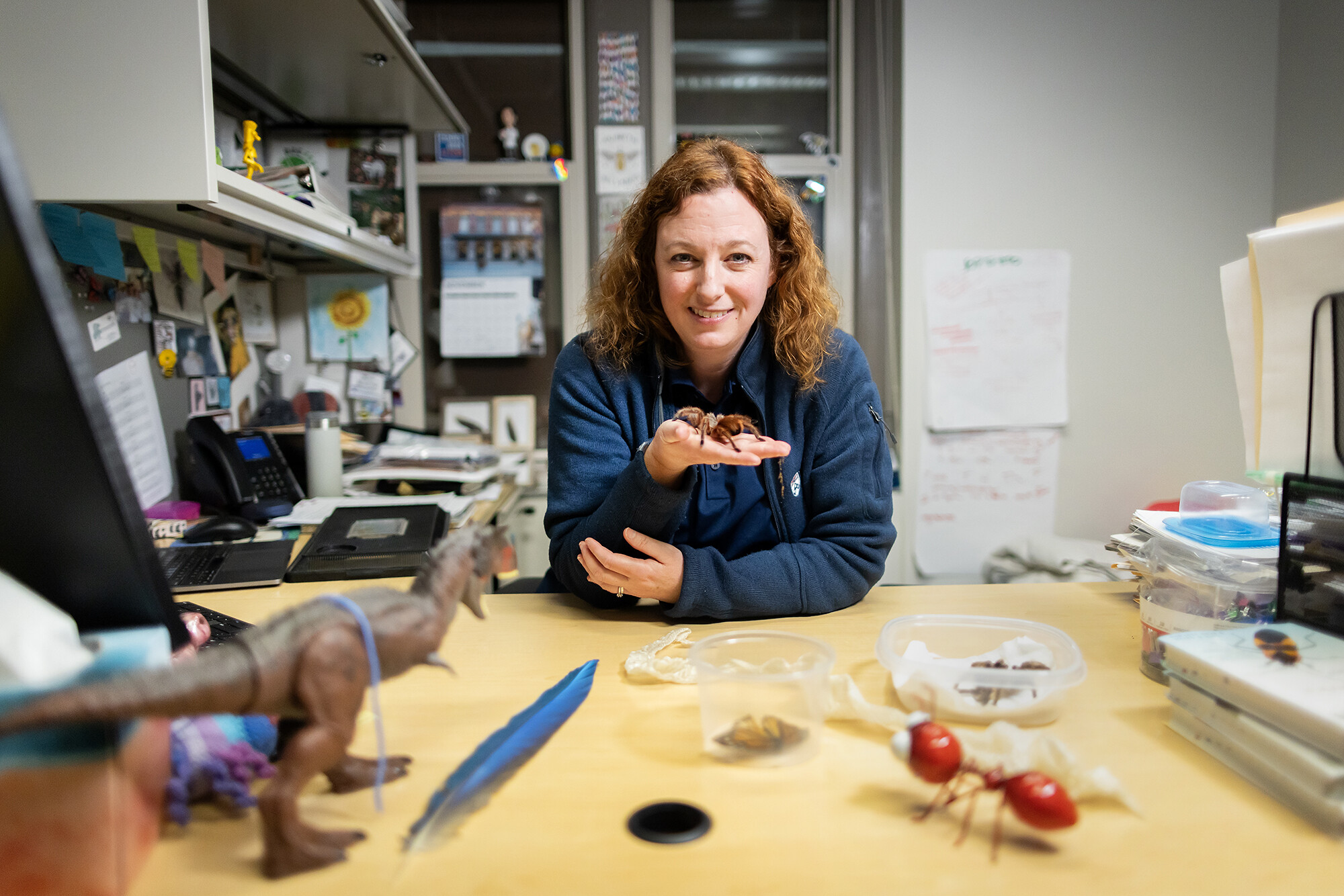
Verderame, an outreach educator at the School of Veterinary Medicine, discusses her kinship with misunderstood animals, introducing students to veterinary medicine, the black market for insects, her favorite part of her job, and the dreaded spotted lanternfly.
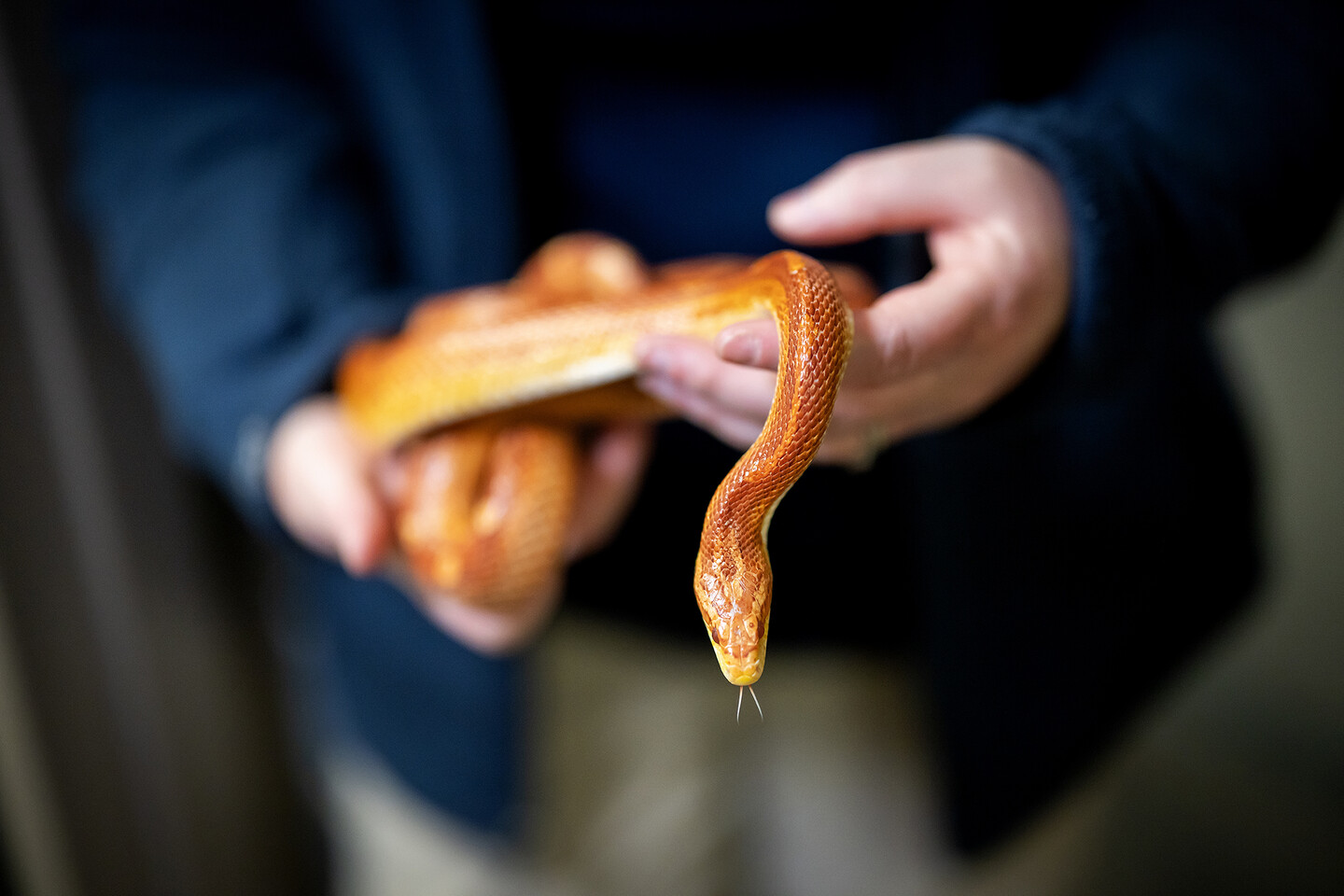
Penn Vet’s Karen Verderame has 17 tarantulas, vinegaroons (whip-tail scorpions), true scorpions, hissing cockroaches, giant cockroaches, three bearded dragons, a snake, hermit crabs, chinchillas, two dogs, and three cats.
It all started with worms.
As a child, when her dad would buy worms for fishing, Karen Verderame would take them all, give them a home, and name them George. Caring for the squirmy little creatures roused a fascination with worms, insects, and animals, a lifelong passion she now imparts to and shares with students from grade school to college.
Assistant director for outreach education at the School of Veterinary Medicine, Verderame grew up in the Wissinoming section of Philadelphia. She did not have a garden at her home but began reading about the wildlife that inhabited her city block: squirrels, pigeons, and what Philadelphians call waterbugs (technically, she says, they are oriental cockroaches). She had the standard run of pets—a cat, a dog, a parakeet—but also kept a colony of hissing cockroaches in a tank in her closet.
“My mom wasn’t too happy about it, nor was my dad and my brother, but they knew I was very excited by it and I enjoyed learning about them, so I was allowed to keep them,” Verderame says. “I wanted to have a lot more animals, but my dad always said when I got my own place, I could have as many animals as I want. I think that’s to the detriment to my husband now, because I took that to heart.”
Currently, Verderame, a self-described “bug nerd,” has 17 tarantulas, vinegaroons (whip-tail scorpions), true scorpions, hissing cockroaches, giant cockroaches, three bearded dragons, a snake, hermit crabs, chinchillas, two dogs, and three cats.
“I’ve always been very interested in animals,” she says. “I just was always drawn to them.”
Penn Today buzzed into the Old Vet Suite to chat with Verderame about her kinship with misunderstood animals, introducing students to veterinary medicine, the black market for insects, her favorite part of her job, and the dreaded spotted lanternfly.
Did your interest in animals influence your educational upbringing?
I’m neurodiverse. Being dyslexic, I didn’t always like reading, but I was fascinated by worms and other animals and wanted to know more about them. That’s how my parents encouraged me to practice reading, through my interest in animals. I started to enjoy reading about animals in encyclopedias rather than chapter books. My mom would sit with me and go through the encyclopedia and help me learn more about animals.
I was fascinated by all animals, but I was really drawn to those that were very misunderstood or underestimated. As I got older, I feel like that kinship I felt towards the more misunderstood creatures was because I think I always felt misunderstood and underestimated, having challenges with my dyslexia, so I think that’s what drew me more towards the arthropods. I used to be very shy, but learning about the bugs and telling people about them is what helped pull me out of my shell.
You have a very unique collection of pets. How did you amass such an eclectic bunch?
At my previous job [at the Academy of Natural Sciences], animals would sometimes come in that could not be housed in our institution’s collection for various reasons. If I had the capacity to care for them at home, I would take them in. All of my animals in my care at home are from rehoming situations or rescues. I also have some animals in my care that were from confiscations that I’d gotten called to help care for from some animal shelter because not many people know how to care for them. I did a lot of work through my career with the USDA [United States Department of Agriculture] and the U.S. Fish and Wildlife Service with black-market wildlife trafficking, specifically with insects and other invertebrates.
I knew there was a black market for exotic animals, but I didn’t know there was one for insects.
There is, yes. It’s quite lucrative and can have many negative impacts including threatening decline of popular species and introduction of invasive species. A lot of insects are regulated and require a permitting from the USDA. There’s a huge hobby interest, especially in praying mantids, beetles, and walking stick insects. You see a lot of those animals being smuggled in. There’s also a lot of interest in tarantulas, which has caused some species to become endangered from over-collecting. There’s a big trade market for them that is surprising to many.
Can you talk a little bit about what you do as an outreach educator on the Shelter Medicine team at Penn Vet?
My audience is mostly middle school, high school, and veterinary students. In our Educational Pipeline program, I work in partnership with the Netter Center in our University-Assisted Community Schools to introduce students to different aspects of veterinary medicine and STEM learning. I meet with teacher-partners to review their curriculum and find ways to support their curriculum in weekly lessons. The lessons offer a different point of entry for students through user-led programming, like in inquiry-based and project-based learning models. It really helps reinforce the concepts in the curriculum and build an inclusive learning environment for different types of learners.
I also work with undergraduate student TAs, who come into the classroom with me through the Education Pipeline Program. I help train and guide them in how to engage with students in the classroom and building the weekly lessons. We are currently in three schools weekly including Sayre, West Philadelphia, and Robeson. I also have a partnership with Saul High School where I work with a teacher partner to support their 11th and 12th grade animal science curriculum. All of our lessons throughout our partnering schools are centered on animal welfare and humane education.
You are also in charge of the bi-annual Penn Vet BioBlitz, which involves undergraduates, graduate students, faculty, and staff conducting an inventory of wildlife at the BioPond and surrounding campus areas. What are the goals of the BioBlitz?
The goals are twofold. It gives us a snapshot of what animals are utilizing our campus so we can be more mindful in sustainability practices and how we share our space with the urban wildlife and live within an urban ecosystem. It also is a great way to connect Penn Vet with the greater Penn community. From an elementary and high school student level, the BioBlitzes create a way to help encourage the students to become active stewards of the environment and foster an appreciation for an urban ecosystem.
In what ways have you noticed your programming resonate with students?
I think they’re looking closer at the world, and at systems that they don’t normally stop to really look at or have exposure to. They have an opportunity to explore potential careers that they haven’t been exposed to before in veterinary sciences and animal sciences. Many of the students have said they never knew these types of jobs were out there. Just recently, there was a student who was absolutely petrified of the snake and lizard we brought to class. By the end of the lesson they were taking pictures of the animals, taking a closer look and asking lots of questions about them.
You have called invertebrates one of the most misunderstood animal groups in the world. Why do you think that is?
I think because humans tend to relate to things that are more similar to them and they can identify with right away, so we tend to go with the cute and fuzzy animals, like mammals. Many reptiles are also often misunderstood. When you say ‘snake’ to people, right away some people will turn away. And we see that a lot with invertebrates just because they are unknown and make people uneasy. We tend to fear more what we don’t understand. That’s one of the things I’ve always been very passionate about throughout my career, trying to connect people with nature in a positive way.
What are your thoughts on the dreaded spotted lanternfly?
I’ve done a lot of talks and a lot of work on spotted lanternfly. They’re very beautiful, so my first thought is how pretty they are. However, they are an invasive species and can cause an imbalance in the ecosystem and really wreak havoc on it. When they were first found in Berks County in 2013, there were just swarms of them and there was uncertainty of the impact they would have on the native species of trees, as well as the wine industry, like grape vines, and hops for beer, which they like to feed on. They tend to dwindle in numbers as they become established in an area, so we don’t really see the same swarm numbers as when they first were introduced.
It is still good to control their numbers and is recommended to kill them when found. They are not causing as much damage as initially projected, but they can still impact some of those industries and cause prices to go up and damage native trees. It is still important to monitor them because they are an invasive species. Some entomologists think they will be like the Japanese beetle and be more of a nuisance than really causing huge damage. I am fascinated by them. From an entomological standpoint, we don’t have any insect quite like the spotted lanternfly in this area. They are not dangerous to humans; they don’t bite or sting. They are clumsy fliers. I can literally spot one blocks away and know from its flight that it’s a spotted lanternfly. There’s nothing that flies like that around here. I do nerd out about them, but they are still an invasive species and something to be monitored.
What is your favorite part of your job?
I love all the different pathways I get to explore and working with a wide variety of partners. I love that I can create accessible and inclusive learning programs for a variety of audiences. I enjoy that every day is something different, and that I am able to share my passion for animals, especially those that are a little misunderstood or unknown. I look forward to building more programs and connecting more people with nature and animals. We’re always looking for ways to expand and improve our reach and our impact, and that’s very exciting. There is still a lot of work to be done and room for growth. I look forward to expanding our programs and impact, connecting more people to veterinary and animal sciences.
On the move: Water quality and antimicrobial resistance testing goes mobile
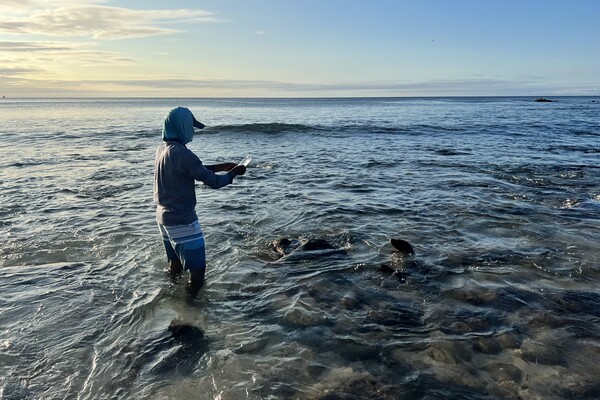
Penn researchers have developed a mobile field laboratory allowing them to test water quality and track antimicrobial resistance in and around San Cristóbal in the Galápagos.
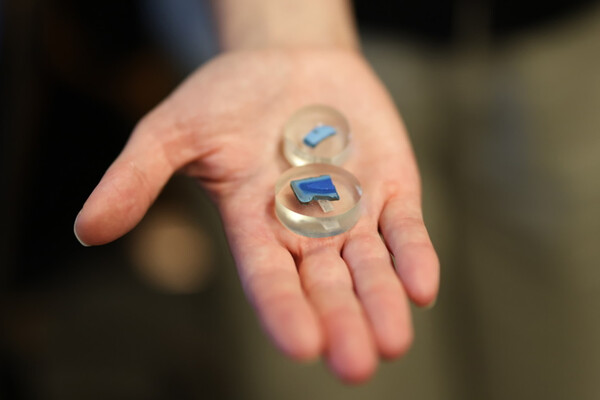
Penn researchers Vanessa and Alexis North are studying one of the largest collections of Egyptian blue objects ever found in the ancient Near East, shedding new light on how the world’s first synthetic pigment may have traveled far beyond Egypt.
A new role for dental providers? Rethinking where vaccines are given
Vaccinations have traditionally been administered in primary care settings or pharmacies. However, for about a decade, some states have authorized dentists to administer vaccines, and many others did so during the COVID-19 pandemic. The effectiveness of this approach has led some countries and states to expand or consider expanding the role of dental providers in delivering routine vaccines, including those against COVID-19 and the human papillomavirus (HPV), and in providing vaccine education.
Penn student develops a way for computer chips to run more efficiently
Fluid Silicon, a platform from President’s Sustainability Prize winner Nhlanhla Mavuso, allows computer chips to continuously monitor their health and self-tune as their characteristics change. The technology has the potential to reduce energy usage in data centers and improve reliability in mission-critical applications.