The potential role of vaccine certificates in the next phase of the pandemic
Public health law expert Eric Feldman and medical ethicist Emily Largent discuss the legal and ethical implications of companies and organizations requiring proof of vaccination to reengage with different sectors of the economy.
In light of reduced restrictions for those who are fully vaccinated, will vaccine certificates become part of everyday life? What are the implications for requiring proof of vaccination to reengage with certain sectors of the economy?
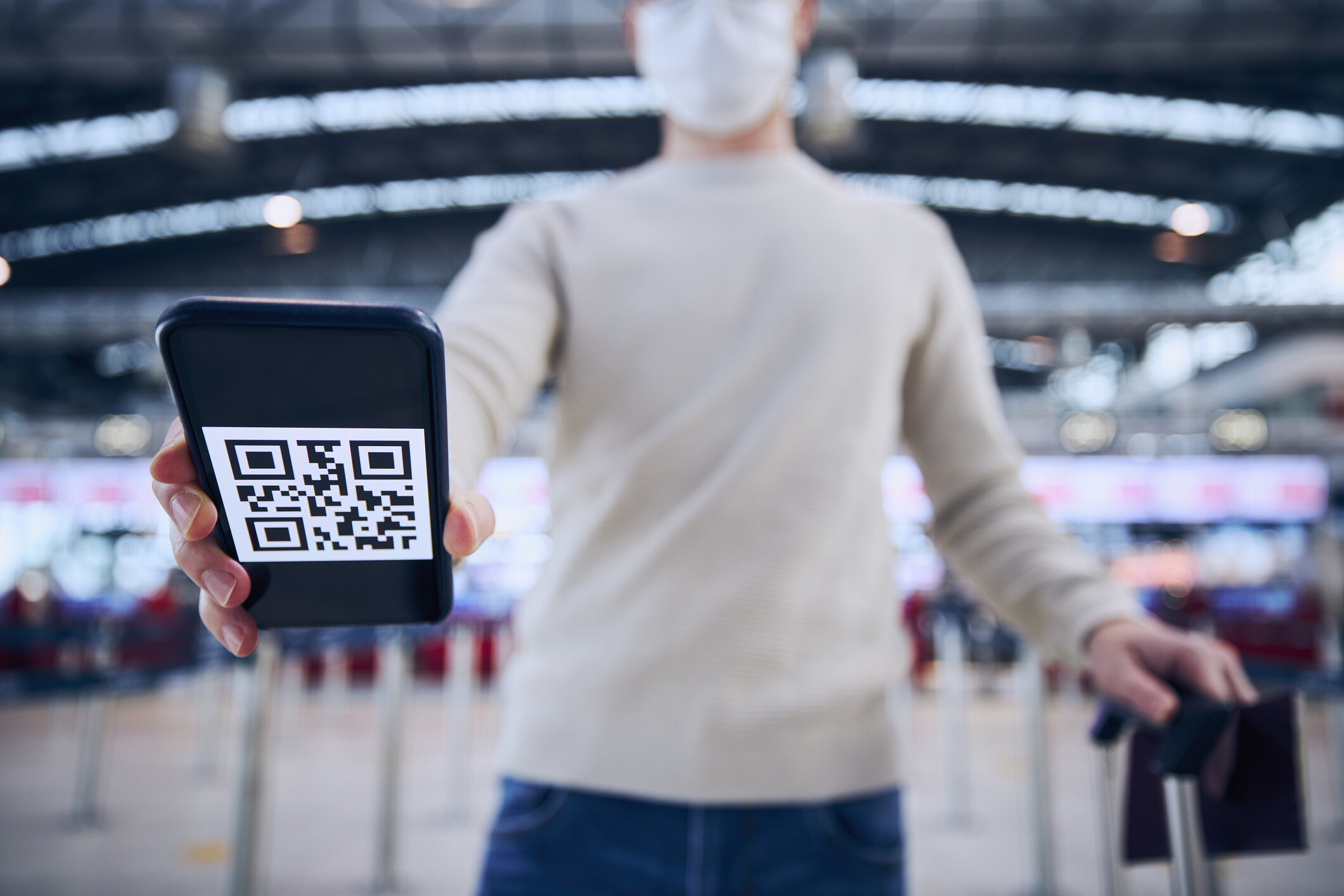
The CDC says that fully vaccinated individuals can resume many day-to-day activities without a mask, leading many states and businesses to rescind year-long mask mandates. The news brought renewed attention to the idea of vaccine certificates, sometimes referred to as “passports,” a digital version of a person’s COVID-19 vaccination card that provides an easy way to prove vaccination.
While countries like Israel and Denmark are widely using digital COVID-19 vaccination and negative-test certificates, the U.S. has no plans for a federal vaccine mandate or verification system. This has left individual states and businesses to forge their own paths, with several states rejecting the idea outright while others, like Hawaii and New York, are actively developing their own legislation and digital vaccine certification platforms.
In light of reduced restrictions for those who are fully vaccinated—currently 39% of the U.S. population, although 49% have received the first of a two-dose series—will vaccine certificates become part of everyday life? What are the implications for requiring proof of vaccination to reengage with certain sectors of the economy? Penn Today spoke with experts in public health law and medical ethics to understand the potential role of vaccine certifications in the next phase of the pandemic.
Proving one’s vaccination status is not, by definition, a ‘passport’
Both public health law expert Eric Feldman and medical ethicist Emily Largent dislike the term “passport” when talking about platforms designed to prove one’s vaccination status, such as New York’s Excelsior pass. These types of systems are only designed to provide ease of entry into any places that require proof of vaccination and don’t contain any other personal information akin to a government-issued ID.
“My understanding is that if you have to show that you’ve been vaccinated, it’s an easy way to do that if you live in New York,” says Feldman about the Excelsior pass. “If you don’t live in New York, you’d have to have to bring your vaccination card, for example.”
States’ and businesses’ rights and vaccine certificates
The idea of a vaccine being required to do something, such as going to school, is not a new concept, Feldman says. In addition, businesses are free to choose who they serve as long as they are not denying service to a constitutionally-protected group of people.
“We take for granted what private organizations can limit—‘no shoes, no shirt, no service’ is not unusual,” he says. “And while it’s more personal and significant to get a vaccine than to put on shoes, it falls under the same legal category because it’s not constitutionally protected.”
What is new and uncertain, he says, is how the nature of COVID-19 vaccine approvals, which are currently only approved under an emergency use authorization (EUA), might impact litigation. Because of this, Feldman does not anticipate that any individual states, for example, will mandate that its residents get the COVID-19 vaccine. “The question of whether or not a state could mandate a COVID-19 vaccine that’s been approved under an EUA but has not received final approval from the FDA is, from a legal perspective, totally novel,” he says.
Another potential area of litigation could involve vaccine exemptions. “Medical exemptions are relatively straight-forward, but religious exemptions raise difficult questions. If there’s a vaccine certification requirement, do we allow people to exempt themselves from vaccination based on their religious beliefs? How do we know if those beliefs are sincerely held or just a pretext for avoiding vaccination? Not providing a religious exemption may be good public health policy, but it is also likely to result in litigation that could end up in the Supreme Court,” says Feldman.
Vaccine certifications and questions around ethics, equity, and privacy
Largent, whose research includes the ethics of vaccine allocation and the public acceptability of mandates, says that finding safe and secure ways to document vaccination is both technically and ethically challenging. This is true whether COVID-19 vaccines are mandated broadly or are only required for certain businesses or venues.
She adds that any digital vaccine certificate system also has to take into account data privacy, security, how personal health data is used, and equity, especially since all children younger than 12 are not yet eligible for any vaccines. “We also have to think about fairness in terms of how we might provide medical exemption certifications for people who cannot be vaccinated so that they can get where they might need or want to go, and there are open questions around what we do for people with religious or philosophical objections,” says Largent.
An indirect incentive for getting vaccinated
While those who are vaccinated can already access perks like free donuts or beer, Largent says that, if other activities that people are interested in require getting vaccinated, that could create a strong incentive for those who haven’t done so yet to get vaccinated.
The new CDC guidelines themselves might also be a source of motivation, depending on how businesses decide to implement them. “If robust vaccine tracking systems are adopted, and people find they are being kept out of places they want to go—restaurants, concerts, museums—that might be an incentive for some people to get vaccinated,” says Largent.
The future of a widespread vaccine certification rollout is uncertain
The CDC’s new guidelines brought vaccine certification back into the spotlight, and Feldman says that some businesses might institute and require proof of vaccination for entering an establishment without masks or for not social distancing. But before that announcement, several states already had no mask mandates, so it’s possible that the guidelines might not have any substantial impact on the coming months in terms of how people can reengage with various sectors of the economy.
“The CDC guidance is significant, but it does not represent an overnight change in policy or practice. Instead, it makes clear the benefit of vaccination to those who are vaccinated, will incentivize some people who are not vaccinated to get vaccinated, and signals what the CDC and everyone else hopes is a slow return to pre-pandemic levels of social and economic interaction,” says Feldman.
Largent agrees that the new guidelines could motivate some to get vaccinated, but without a robust tracking system in place it also allows the guidance to be exploited by those who want to neither wear masks nor get vaccinated. “In the absence of proof of vaccination, we will largely be reliant on individuals to be truthful about their vaccine status and responsible in their masking. Unfortunately, we have evidence from throughout the pandemic that people won’t always act in the best interests of others,” she says.
As with previous public health challenges, societal change often requires a combination of both legal and cultural shifts, says Feldman. He cites changes around smoking in bars and restaurants, a gradual evolution from allowing smoking by default to being banned indoors once the impacts of secondhand smoke were clear. With COVID-19, figuring out how to balance individual freedoms with measures that keep others safe is also likely to take time.
“Any time we have one of those shifts, we need to come to an agreement as to what constitutes an appropriate behavior,” says Feldman. “It’s a mix of legal and cultural, but the huge issue is what constitutes a shared sense of public appropriateness and what is it we all agree we should be doing both for our own good and others.”
On the move: Water quality and antimicrobial resistance testing goes mobile
Penn researchers have developed a mobile field laboratory allowing them to test water quality and track antimicrobial resistance in and around San Cristóbal in the Galápagos.
Penn researchers Vanessa and Alexis North are studying one of the largest collections of Egyptian blue objects ever found in the ancient Near East, shedding new light on how the world’s first synthetic pigment may have traveled far beyond Egypt.
A new role for dental providers? Rethinking where vaccines are given
Vaccinations have traditionally been administered in primary care settings or pharmacies. However, for about a decade, some states have authorized dentists to administer vaccines, and many others did so during the COVID-19 pandemic. The effectiveness of this approach has led some countries and states to expand or consider expanding the role of dental providers in delivering routine vaccines, including those against COVID-19 and the human papillomavirus (HPV), and in providing vaccine education.
Penn student develops a way for computer chips to run more efficiently
Fluid Silicon, a platform from President’s Sustainability Prize winner Nhlanhla Mavuso, allows computer chips to continuously monitor their health and self-tune as their characteristics change. The technology has the potential to reduce energy usage in data centers and improve reliability in mission-critical applications.