Physicians, engineers, and scientists from Penn are working with The Philadelphia Orchestra to study the aerosol droplets that wind and brass musicians produce when playing. Their findings, aimed at reducing the risk of COVID-19 transmission, could help the Orchestra once again play together in person.
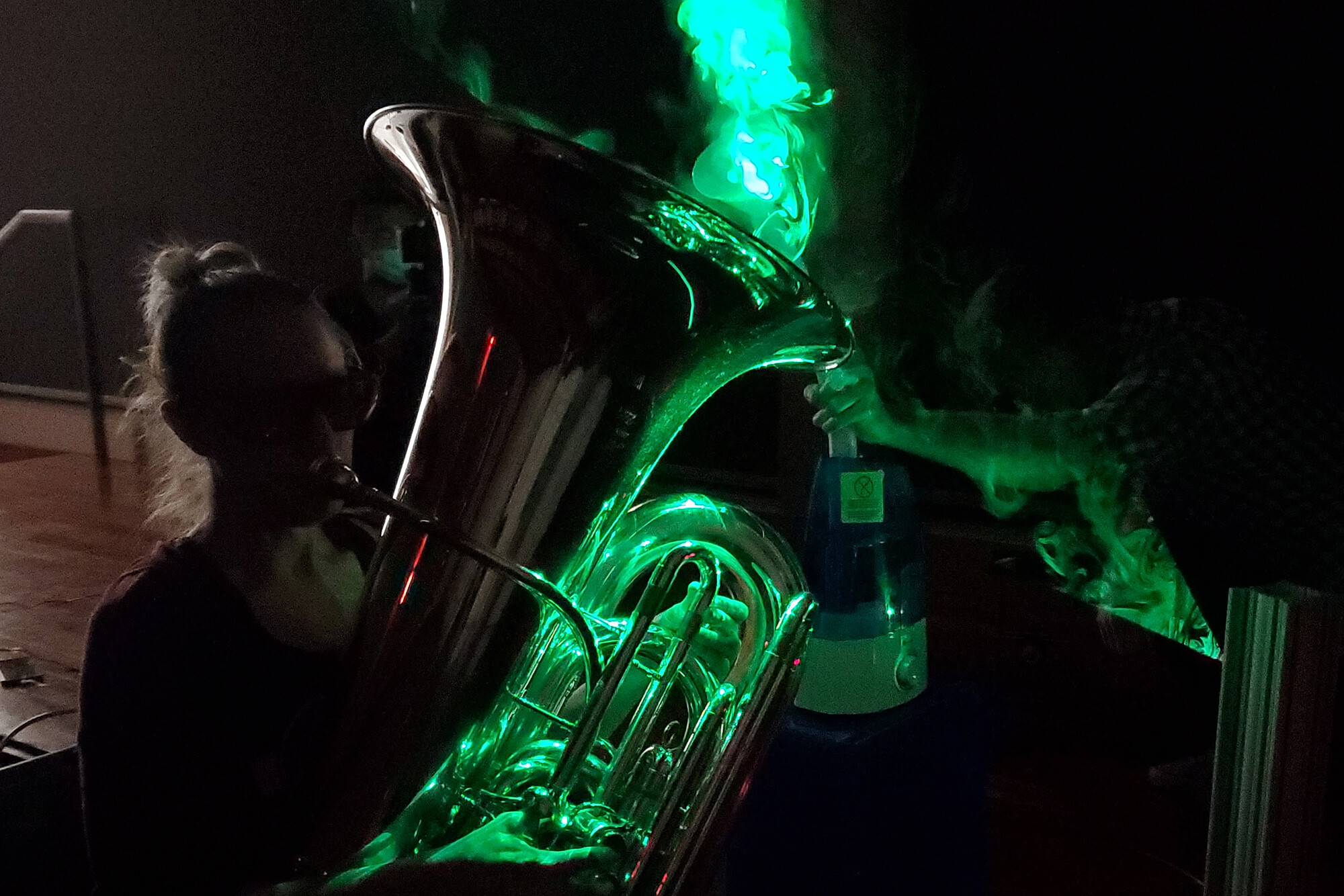
A green laser and a drug store humidifier are part of an experiment that will shed light on how musicians produce aerosols when they play. As part of it, members of The Philadelphia Orchestra, including Carol Jantsch, principal tuba player, have taken part in studies led by Penn scientists Paulo Arratia and Douglas Jerolmack. (Image: Courtesy of Paulo Arratia)
On stage at The Mann Center for the Performing Arts, one of The Philadelphia Orchestra’s summer homes, flutist Olivia Staton bent over her instrument, brought it to her mouth, and made her way through a steady, sonorous scale.
Dressed casually in jeans, sneakers, and a light down jacket, Staton wasn’t there for a public performance. Rather, with a high-tech camera aimed at her exhalations, and a simple humidifier exuding mist toward her face, scientists captured the movement of aerosol droplets produced as she played. The experiment, led by researchers from Penn, is part of an effort to answer a timely question: Amid the COVID-19 pandemic, how can the Orchestra safely play together?
“What has been fascinating about this is that we thought we lived in a world with greater certainty,” says Matías Tarnopolsky, president and chief executive officer of The Philadelphia Orchestra. “We thought we understood our music, our work. But what we’ve found is that we needed to learn about how our breathing behaves, how wind and brass instruments behave, how air circulation works in our concert hall, in order to carry on with our mission.”
The last time The Philadelphia Orchestra played as a full ensemble in the 2,500 seat Verizon Hall was on March 12, 2020. Tarnopolsky remembers the lead-up vividly.
“I was driving back from a dinner in New York on Wednesday, March 11, and heard the news that the NBA was shutting down,” he says. “I realized then and there that there was no way to continue with our concert the next day.”
On March 12, the city banned gatherings of more than 1,000 people and strongly recommended canceling any of more than 250. And while Music Director Yannick Nézet-Séguin and the Orchestra didn’t play before an audience that night, they proceeded with a performance captured on camera and shared digitally. After that it wasn’t until August that the Orchestra came together again, “in a very different configuration,” Tarnopolsky says.
In the interim months of uncertainty, Tarnopolsky says the Orchestra was motivated by three priorities: “To take care of our people, to ensure the integrity of the ensemble and the business, and to make sure we were playing our role, through music, in helping Philadelphia thrive on the other side of this.”
At that point, still early in the pandemic, the future was hazy. People were thinking in intervals of weekslong shutdowns, not a full year of quarantining, masking, and closures. So it was with hope that Ralph Muller, former chief executive officer of the University of Pennsylvania Health System and board chair of The Philadelphia Orchestra, encouraged P.J. Brennan, the health system’s chief medical officer, to advise the Orchestra of a path forward.
Play on
On a Saturday in late May, Brennan sat at his kitchen table speaking with Tarnopolsky on the phone about what the future held. The first step, as they saw it, was resuming performances without audiences over the summer.
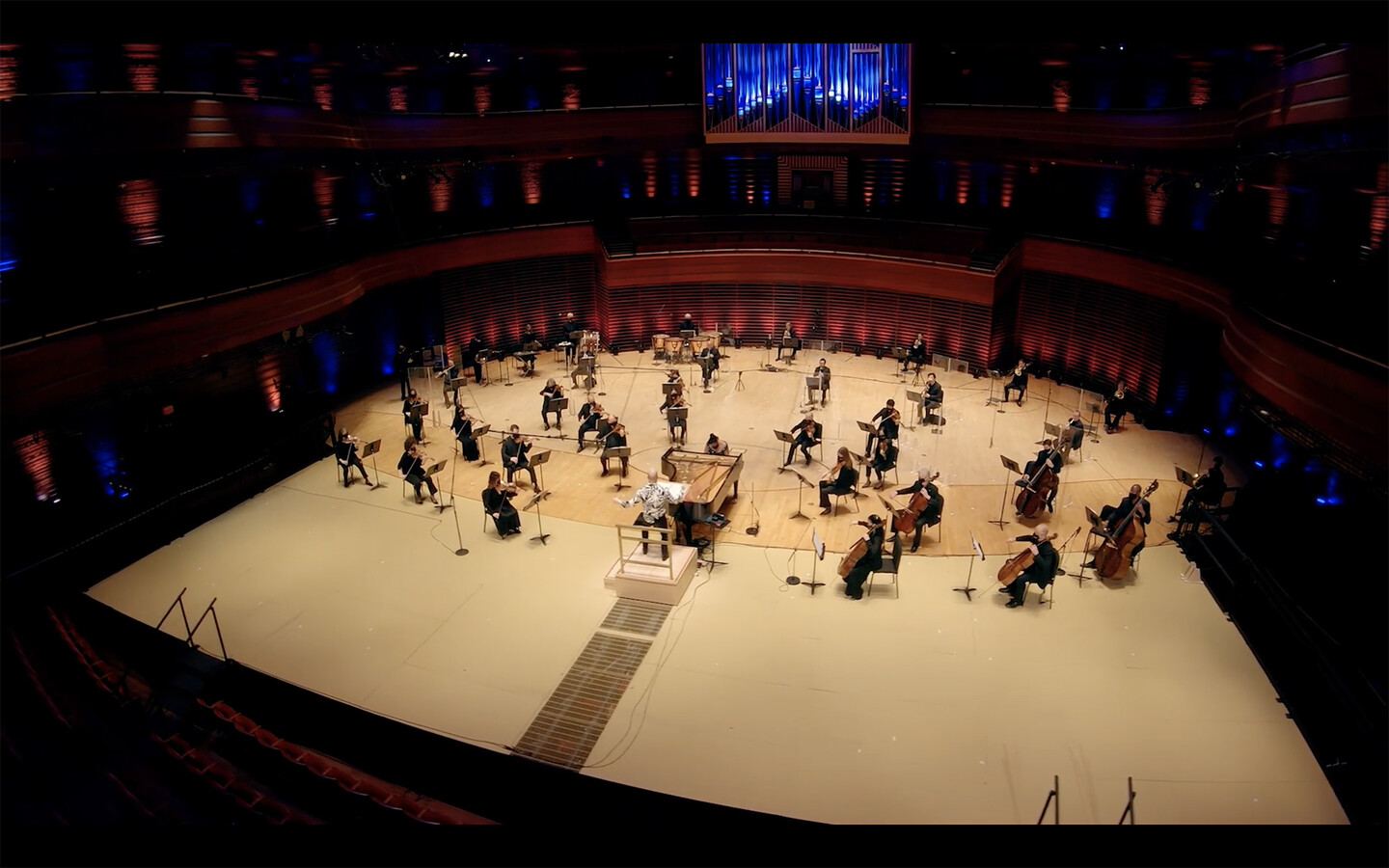
By August, that was what they did in the outdoor venue of the Mann Center in Philadelphia’s Fairmount Park. Brennan arranged for each member of the Orchestra to be tested for COVID-19 at Penn prior to performances and worked with Orchestra leadership on a seating arrangement and protective equipment that would keep the musicians safe. Rather than the full ensemble on stage in close quarters, musical pieces for smaller numbers of the ensemble were selected. Musicians playing wind and brass instruments were nearly enclosed in plexiglass, as these musicians could not wear masks while playing.
I’m so pleased that through the Orchestra’s efforts—the musicians and the leadership—and all of the infection control measures we were able to put in place—they were able to complete their season digitally.
P.J. Brennan, University of Pennsylvania Health System chief medical officer
The arrangement, with social distancing, masking where possible, and protective barriers, helped the musicians feel safe. But it wasn’t ideal from a musical point of view. The plexiglass in some cases distorted the musicians’ view of the conductor. And some noticed their perception of their colleagues’ instruments was dampened, the plexiglass rebounding the sound of their own instruments back to their ears.
In this way, the Orchestra continued playing at the Mann for the first part of the fall season, recording the performances and streaming them at a later date on its new “Digital Stage.”
“This project was born out of, ‘How can we help keep at least some joy alive during this time?’” Arratia says. “Doug and I are experimentalists, so figuring this out was something we could do.”
RELATED
They started by looking through the emerging COVID-related literature on music-making and aerosol production, as well as pre-COVID studies done on the subject.
“At that point in the summer and early fall, there were already studies coming from Europe, particularly in Berlin, in which they had been able to play masked and with social distancing, though there was no audience,” says Arratia. There were also a limited number of studies of school bands documenting transmission—or lack thereof—“but there wasn’t much in terms of why the precautionary measures were working or not working,” he says.
Those details were what Arratia and Jerolmack hoped to pin down.
Experimental sound
To do so, the researchers took a trip to a local drugstore.
“You know when you take a steamy shower, and light comes in, you see this mist of water droplets,” Arratia says. “And if the light shines just right, you see them glowing and sparkling. What we did is took a humidifier from CVS and produced this mist, then shined a laser through the mist so the droplets start glowing. We used that as a marker for the movement of aerosols.”
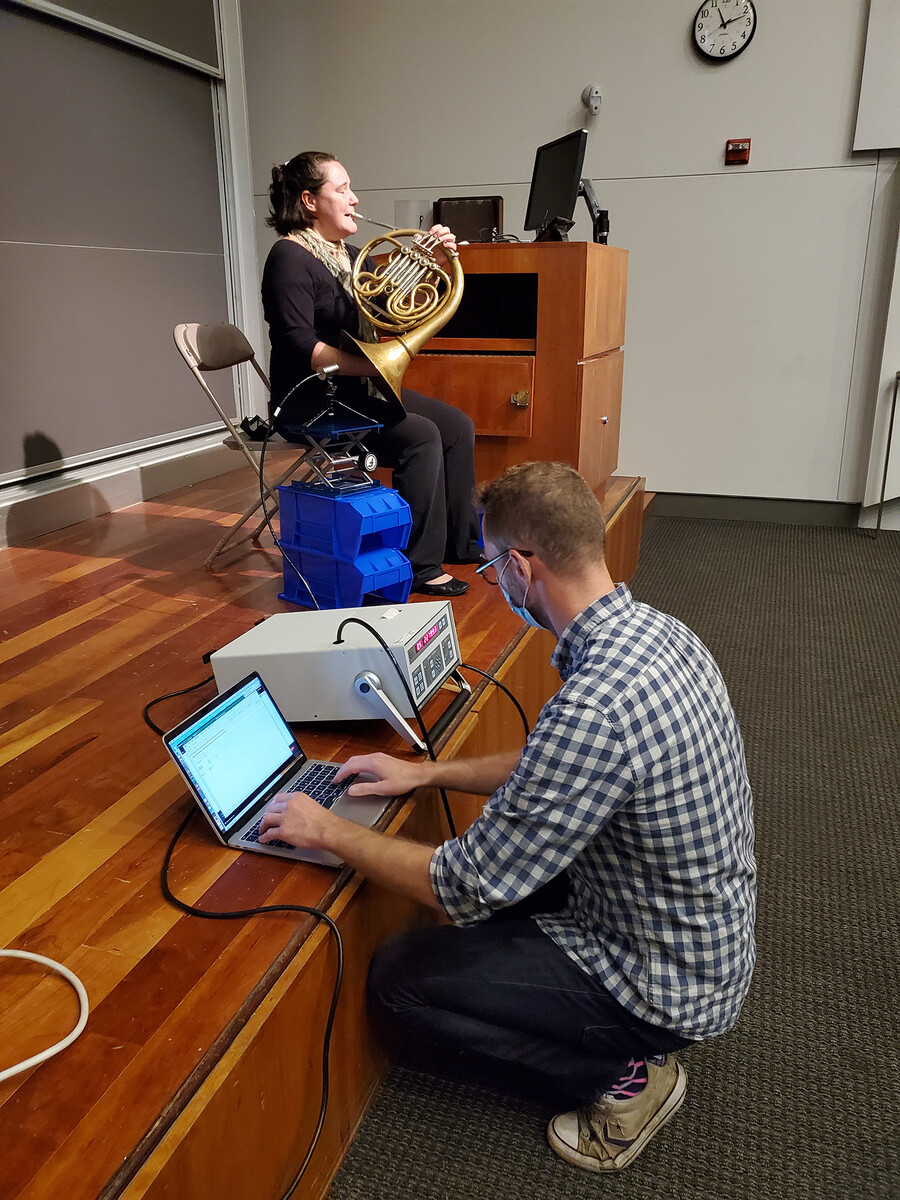
Brass and wind instrument players were of particular concern when it came to positioning orchestra members close together during performances, and were thus the focus of the Penn scientists’ investigations. (Image: Courtesy of Paulo Arratia)
First at the Mann Center, and later in auditoriums at Penn, Arratia and Jerolmack, together with lab members Quentin Brousseau, Ian Graham, and Ranjiangshang Ran invited musicians with oboes, flutes, French horns, trombones, and the like, to individually come and play their instruments. They then used the humidifier-laser setup to put their aerosol production on display, creating undulating clouds of particles glowing neon green. Ultrafast cameras captured hundreds of images per second to track the aerosol movement. Parsing the images of the droplets with statistical correlations, they were able to calculate the quantity of aerosols the musicians’ produced, the speed at which they traveled, and thus calculate how far they would disperse before falling to the ground.
“The first thing we noticed was that outside, at the Mann Center, you can get relatively close because even if you don’t feel a breeze, it’s there,” Arratia says. Aerosols from all the wind and brass musicians tended to disperse within a foot or two, posing little risk to those around them.
Those findings led the Orchestra to make adjustments in their performances at the Mann. “We were able to make alterations in terms of the plexiglass so they had a better view and could hear their cues and see the conductor and so on,” Brennan says.
Inside, the results were not as straightforward. Over three days, Arratia and Jerolmack and colleagues invited musicians to come to Penn’s campus and test their aerosol production as they played for about half an hour.
In these indoor spaces at the engineering school, aerosols traveled farther, about four feet—though considerably less than a forceful sneeze, for example, which can propel particles nearly 20 feet, Brennan says. The researchers noticed that although aerosol production around the mouthpiece was significant, the instruments themselves “acted like a mask,” Arratia says, preventing the dispersion of particles. The only instrument for which this didn’t hold true? The flute, as flutists blow over the mouthpiece rather than into it, negating the “masking” effect.
Planning a grand return
As a next step, Arratia says he and Jerolmack hope to take aerosol measurements within Verizon Hall, studying not just individual musicians but “the Orchestra as a system,” determining the interactions of musicians’ aerosol production and factoring in the influence of air flow within the concert hall. With this complex understanding, they could move to thinking about protecting the entire orchestra, plus a theoretical in-person audience.
Brennan has worked with engineers who operate the mechanical systems at Verizon Hall to evaluate its ventilation, and has been impressed by its sophistication. “Every seat in the audience has a unit that provides an individual air supply,” he says. “You can manipulate the heating ventilation and air conditioning systems separately. We developed a lot of confidence in that HVAC system.”
Arratia says the goal would be to create a “curtain” of air between the performance space and the audience, akin to a fume hood in a scientific laboratory. And though certain insights will be unique to the space, the researchers are also hopeful their findings will inform the efforts of other musical groups, from other orchestras to high school bands, as they seek to perform while reducing the risk of spreading infection.
This project was born out of, ‘How can we help keep at least some joy alive during this time?’
Paulo Arratia, a fluid mechanics engineer in the School of Engineering and Applied Science
“I’m so pleased that through the Orchestra’s efforts—the musicians and the leadership—and all of the infection control measures we were able to put in place—they were able to complete their season digitally,” says Brennan, who now sits on the board of The Philadelphia Orchestra. “And I think it’s wonderful that two schools at Penn were a key part of supporting that effort.”
Brennan is a self-described “failed piano student.” And Arratia, whose mother was a professional opera singer in Chile, claims “all that musical talent went somewhere else.” Yet their expertise and that of colleagues at Penn is helping sustain the rich music of The Philadelphia Orchestra—and all who derive joy from listening.
“The Philadelphia Orchestra has been able to be a leader nationally in gathering again,” says Tarnopolsky, “and we are very grateful to Penn for that.”
Results of the experiments so far, along with insights from Penn Medicine’s P.J. Brennan, have helped inform the arrangement of members of The Philadelphia Orchestra as they have resumed performances that are captured and later streamed on their new “Digital Stage.” (Image: The Philadelphia Orchestra)
Paulo Arratia is professor of chemical and biomolecular engineering and mechanical engineering and applied mechanics in the University of Pennsylvania School of Engineering and Applied Science.
P.J. Brennan is chief medical officer of the University of Pennsylvania Health System.
Douglas Jerolmack is a professor in the Department of Earth and Environmental Science in the School of Arts & Sciences and in chemical and biomolecular engineering and mechanical engineering and applied mechanics in the School of Engineering and Applied Science at the University of Pennsylvania.
Matías Tarnopolsky is president and chief executive officer of The Philadelphia Orchestra.
On the move: Water quality and antimicrobial resistance testing goes mobile
Penn researchers have developed a mobile field laboratory allowing them to test water quality and track antimicrobial resistance in and around San Cristóbal in the Galápagos.
Penn researchers Vanessa and Alexis North are studying one of the largest collections of Egyptian blue objects ever found in the ancient Near East, shedding new light on how the world’s first synthetic pigment may have traveled far beyond Egypt.
A new role for dental providers? Rethinking where vaccines are given
Vaccinations have traditionally been administered in primary care settings or pharmacies. However, for about a decade, some states have authorized dentists to administer vaccines, and many others did so during the COVID-19 pandemic. The effectiveness of this approach has led some countries and states to expand or consider expanding the role of dental providers in delivering routine vaccines, including those against COVID-19 and the human papillomavirus (HPV), and in providing vaccine education.
Penn student develops a way for computer chips to run more efficiently
Fluid Silicon, a platform from President’s Sustainability Prize winner Nhlanhla Mavuso, allows computer chips to continuously monitor their health and self-tune as their characteristics change. The technology has the potential to reduce energy usage in data centers and improve reliability in mission-critical applications.