Promising inhibitor combination for hard-to-treat leukemia subtypes
Researchers from Penn Vet and other institutions have identified a novel inhibitor combination of molecules that induce terminal differentiation for the treatment of human non-APL subtypes of AML.
2 min. read
In a new study co-authored by assistant professor of biomedical sciences at Penn’s School of Veterinary Medicine M. Andrés Blanco, along with investigators from the Universities of Oxford, Helsinki, and California at San Diego, researchers have identified a promising strategy to overcome treatment resistance in acute myeloid luekemia (AML), one of the most aggressive forms of blood cancer.
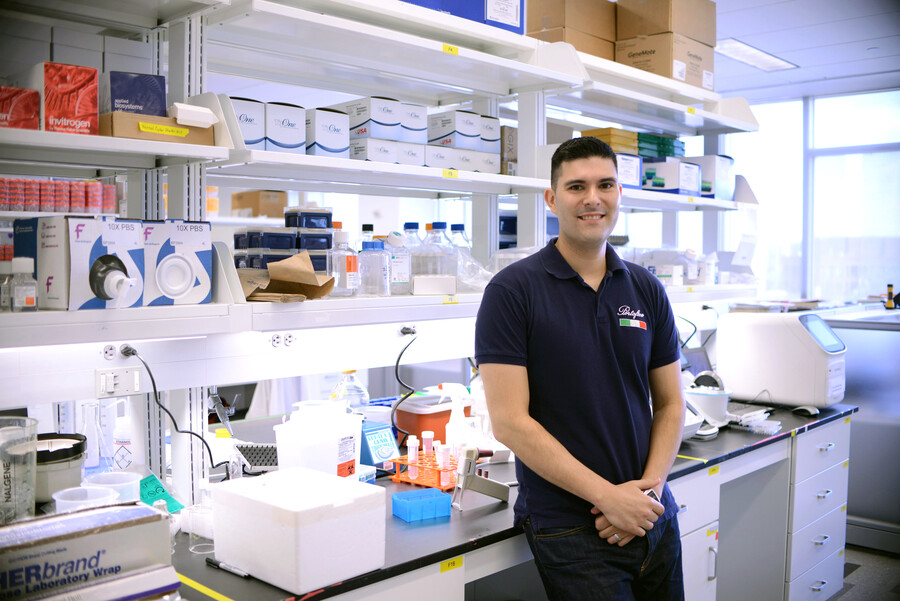
Andrés Blanco is an assistant professor of biomedical science at Penn’s School of Veterinary Medicine.
(Image: John Donges)
AML occurs when bone marrow produces substantial amounts of abnormal white blood cells. Differentiation therapy, a cancer treatment that prompts cancer cells to become less aggressive thereby reducing or stopping their proliferation, is curative for the acute promyelocytic leukemia (APL) subtype of AML, but not for the other eight non-APL subtypes.
The novel inhibitor combination of histone demethylase LSD1 and glycogen synthase kinase 3 (GSK-3) induce terminal differentiation for the treatment of human non-APL subtypes of AML.
“These findings present a potential new avenue for differentiation therapy in AML subtypes that have resisted such approaches,” says Blanco. “This study provides a compelling rationale for testing dual LSD1 and GSK-3 inhibition as a therapeutic technique for humans with non-APL AML subtypes, offering hope for better outcomes with this disease.”
On the move: Water quality and antimicrobial resistance testing goes mobile
Penn researchers have developed a mobile field laboratory allowing them to test water quality and track antimicrobial resistance in and around San Cristóbal in the Galápagos.
Penn researchers Vanessa and Alexis North are studying one of the largest collections of Egyptian blue objects ever found in the ancient Near East, shedding new light on how the world’s first synthetic pigment may have traveled far beyond Egypt.
A new role for dental providers? Rethinking where vaccines are given
Vaccinations have traditionally been administered in primary care settings or pharmacies. However, for about a decade, some states have authorized dentists to administer vaccines, and many others did so during the COVID-19 pandemic. The effectiveness of this approach has led some countries and states to expand or consider expanding the role of dental providers in delivering routine vaccines, including those against COVID-19 and the human papillomavirus (HPV), and in providing vaccine education.
Penn student develops a way for computer chips to run more efficiently
Fluid Silicon, a platform from President’s Sustainability Prize winner Nhlanhla Mavuso, allows computer chips to continuously monitor their health and self-tune as their characteristics change. The technology has the potential to reduce energy usage in data centers and improve reliability in mission-critical applications.