Penn’s newest collaborative institution is the U.S. National Science Foundation Artificial Intelligence-driven RNA BioFoundry (NSF AIRFoundry) which uses AI to improve, accelerate, and scale the design, manufacture, and delivery of RNA.
2 min. read
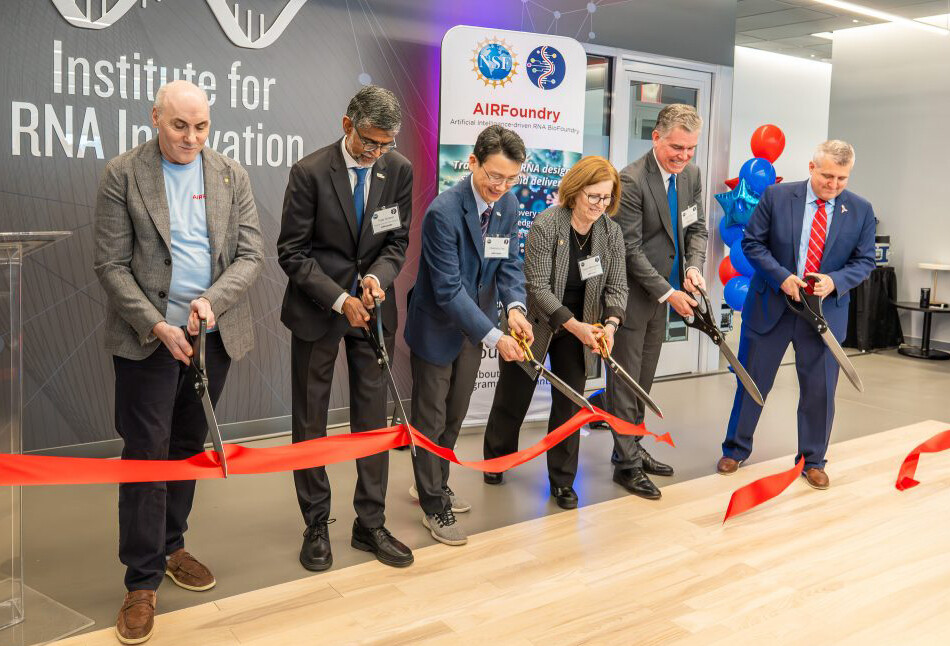
(From left) Drew Weissman, Roberts Family Professor in Vaccine Research; Vijay Kumar, Nemirovsky Family Dean of Penn Engineering; Daeyeon Lee, Russell Pearce and Elizabeth Crimian Heuer Professor in Chemical and Biomolecular Engineering and the facility’s director; Susan Marqusee, head of NSF’s Biological Sciences Directorate; David F. Meaney, Solomon R. Pollack Professor in Bioengineering and Penn’s Vice Provost for Research; and Pennsylvania State Senator Frank A. Farry.
(Image: Courtesy of Penn Engineering)
Researchers from across the University of Pennsylvania and beyond gathered in early April to celebrate the opening of the U.S. National Science Foundation Artificial Intelligence-driven RNA BioFoundry (NSF AIRFoundry), an $18-million effort to leverage AI to improve, accelerate, and scale the design, manufacture, and delivery of RNA.
The facility’s grand opening, which took place at One uCity Square, drew attendees from across the NSF AIRFoundry’s partner institutions, as well as Susan Marqusee, who heads NSF’s Biological Sciences Directorate, and Pennsylvania State Senator Frank A. Farry.
“The real work begins today,” said Daeyeon Lee, Russell Pearce and Elizabeth Crimian Heuer Professor in Chemical and Biomolecular Engineering and the facility’s director. “I cannot wait to see what we build together.”
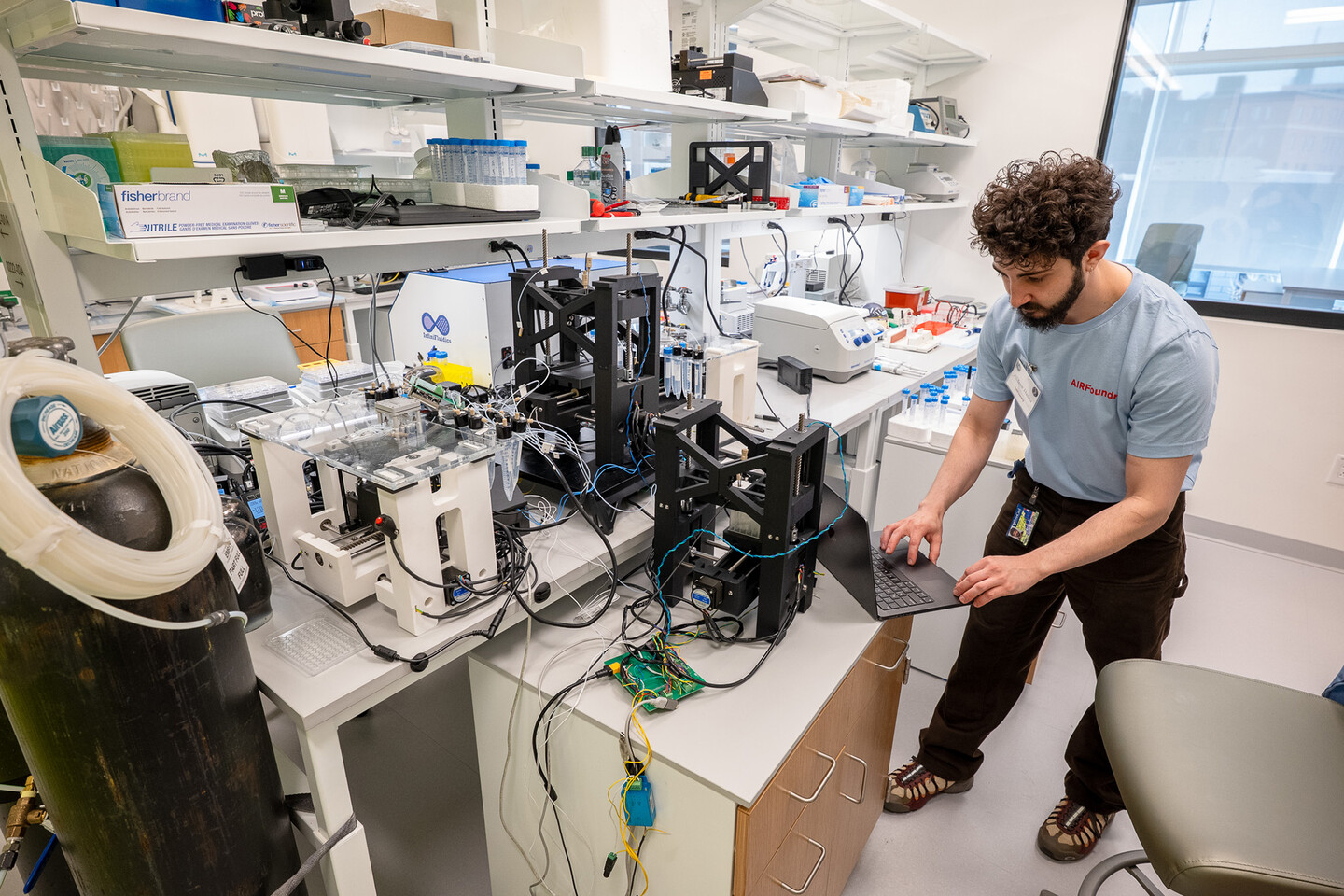
Andrew Hanna, a doctoral student in bioengineering, demonstrates some of the equipment at AIRFoundry, which brings together RNA and AI.
(Image: Sylvia Zhang)
By now, the therapeutic potential of RNA is beyond dispute: The COVID-19 vaccines, built using mRNA technology developed at Penn, saved millions of lives. But RNA—a molecule cells use to convey the instructions to manufacture proteins and to catalyze biochemical reactions—has applications far beyond medicine.
“This tool kit now can transform agriculture, environmental sustainability and animal health,” said Lee, noting that J. Oriol Sunyer, professor of immunology and pathobiology at Penn’s School of Veterinary Medicine, is already working with the NSF AIRFoundry to better understand the immune systems of fish, which could shed light on the oldest parts of the human immune system.
“This is a cross-directorate effort,” said Marqusee, describing how NSF conceived of the BioFoundries—there are four others, led by universities in California, Delaware, Georgia, and Illinois—as standing at the intersection of multiple fields. “This is about biotechnology in the service of humanity.”
The power of AI and RNA
Prior to the facility’s grand opening, more than 70 researchers from a variety of fields had already used the NSF AIRFoundry to generate 300-plus types of RNA and more than 50 different variants of lipid nanoparticles (LNPs), the tiny delivery vehicles that ferry RNA into cells.
As researchers conduct experiments, their data will be used to train AI models. Those models, in turn, will be used to predict the effects of different structural and chemical changes to RNA and LNPs in a virtuous cycle in which each new experiment improves the models, moving toward a future where every aspect of RNA can be optimized for particular applications.
“That’s going to unleash the power of science at a rate we’ve never experienced,” said David F. Meaney, Solomon R. Pollack Professor in Bioengineering and Penn’s Vice Provost for Research, who encouraged researchers to bring their moonshot ideas to the NSF AIRFoundry.
“If you’re at another institution, come here to Philadelphia,” he said. “Have a cheesesteak, and let’s talk about it. We can do a prototype for you.”
Training the next generation
Scattered around the room, doctoral students and postdoctoral fellows wore blue T-shirts to indicate their membership in the NSF AIRFoundry. “They are the next generation of scientists and engineers fluent across biology, engineering and AI,” said Lee. “We do not know exactly what problems they’ll be faced with. But we know that they’ll be better prepared.”
Indeed, one key part of the NSF AIRFoundry’s mission is educational. This summer, the facility will host its second cohort of interns, who will conduct research and participate in seminars on RNA science. For the last two years, in collaboration with the Penn Institute for RNA Innovation, the facility hosted undergraduates from both four-year institutions and community colleges to learn more about cutting-edge RNA science and how AI can aid RNA discovery.
And, in Puerto Rico, Claribel Acevedo-Vélez, associate professor in chemical engineering at UPR-M and the NSF AIRFoundry’s associate director of education, represented the facility at an island-wide conference to introduce RNA and LNPs to schoolchildren.
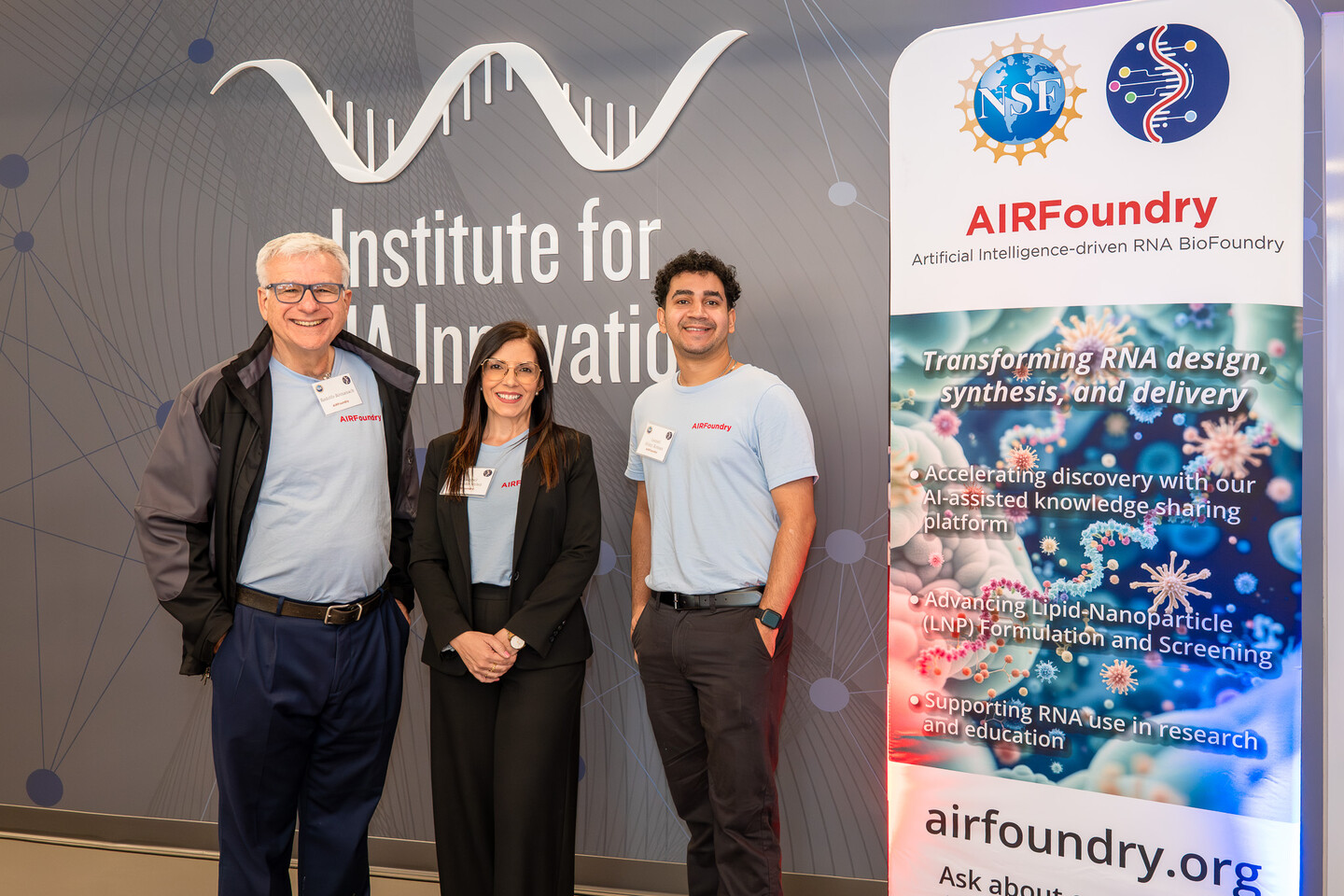
Members of NSF AIRFoundry co-lead institution The University of Puerto Rico-Mayagüez. (From left) Rodolfo Romañach, professor in chemistry; Claribel Acevedo-Vélez, associate professor in chemical engineering and the facility’s associate director of education; and doctoral student Leonel Velez.
(Image: Sylvia Zhang)
Democratizing RNA science
For Vijay Kumar, Nemirovsky Family Dean of Penn Engineering, the grand opening recalled the ideals that pushed Benjamin Franklin to found Penn. “He believed in innovation, but always in the service of society,” noted Kumar. “This project truly embodies that, by making it easy for others to innovate.”
Indeed, the NSF AIRFoundry is already providing researchers who might not otherwise have had the necessary expertise or infrastructure with the ability to experiment with RNA. “I never worked with RNA until a few years ago,” said Jonathan A. Epstein, Robert G. Dunlop Professor and dean of the Perelman School of Medicine.
It wasn’t until he spoke with Drew Weissman, Roberts Family Professor in Vaccine Research and one of the NSF AIRFoundry’s leaders, who won a Nobel Prize for his work on RNA with Katalin Karikó, that Epstein was able to turn his idea—using the body’s own machinery to develop a potential cancer treatment—into reality.
Now, that same level of expertise is available to researchers everywhere. “The potential for RNA is enormous,” said Weissman. “And to me, that’s the most important thing, to democratize it, to make it available to the entire world.”
The facility encourages potential industry partners to connect for recruitment, collaborative projects and membership in the facility’s Emerging Corporate Alliances Program (ECAP), which offers use of the NSF AIRFoundry’s equipment and services at discounted rates.
On the move: Water quality and antimicrobial resistance testing goes mobile
Penn researchers have developed a mobile field laboratory allowing them to test water quality and track antimicrobial resistance in and around San Cristóbal in the Galápagos.
Penn researchers Vanessa and Alexis North are studying one of the largest collections of Egyptian blue objects ever found in the ancient Near East, shedding new light on how the world’s first synthetic pigment may have traveled far beyond Egypt.
A new role for dental providers? Rethinking where vaccines are given
Vaccinations have traditionally been administered in primary care settings or pharmacies. However, for about a decade, some states have authorized dentists to administer vaccines, and many others did so during the COVID-19 pandemic. The effectiveness of this approach has led some countries and states to expand or consider expanding the role of dental providers in delivering routine vaccines, including those against COVID-19 and the human papillomavirus (HPV), and in providing vaccine education.
Penn student develops a way for computer chips to run more efficiently
Fluid Silicon, a platform from President’s Sustainability Prize winner Nhlanhla Mavuso, allows computer chips to continuously monitor their health and self-tune as their characteristics change. The technology has the potential to reduce energy usage in data centers and improve reliability in mission-critical applications.