Safe driving habits boosted by insurance plans that reward safe driving
Popular insurance programs offering discounts for driving safely can reduce risky behaviors like speeding and hard braking, Penn Medicine researchers show.
2 min. read
Drivers whose car insurance rates are based on data of their driving habits and who then also get tips about improving them are less likely to speed, brake hard, or rapidly accelerate than those who don’t participate in the program, according to a recent test by a team from the Perelman School of Medicine. Their work is published in Accident Analysis & Prevention.
Speeding declined by up to 13%, and hard braking and rapid acceleration declined by up to 25%. In addition, drivers continued their improved habits after the incentives ended.
“Insurance companies are happy to give discounts to customers who drive safer because it means they will have fewer crash claims later on,” says lead author Jeffrey Ebert, director of Behavioral Science in the Penn Medicine Nudge Unit.
In a nation with more than 6 million vehicle crashes leading to 2 million injuries each year, Ebert says that if everyone were to enroll in a program like what they tested, there could be 300,000 fewer crashes and 100,000 fewer injuries.
On the move: Water quality and antimicrobial resistance testing goes mobile
Penn researchers have developed a mobile field laboratory allowing them to test water quality and track antimicrobial resistance in and around San Cristóbal in the Galápagos.
Penn researchers Vanessa and Alexis North are studying one of the largest collections of Egyptian blue objects ever found in the ancient Near East, shedding new light on how the world’s first synthetic pigment may have traveled far beyond Egypt.
A new role for dental providers? Rethinking where vaccines are given
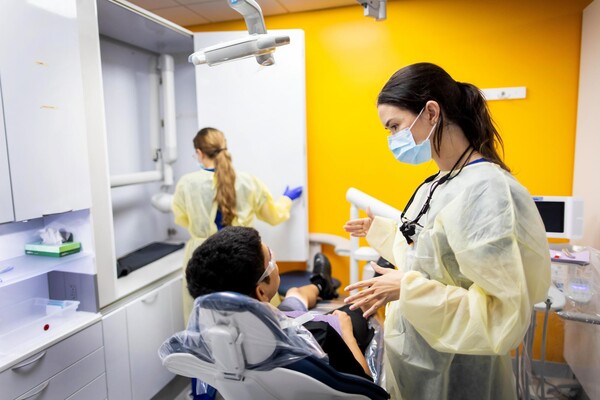
Vaccinations have traditionally been administered in primary care settings or pharmacies. However, for about a decade, some states have authorized dentists to administer vaccines, and many others did so during the COVID-19 pandemic. The effectiveness of this approach has led some countries and states to expand or consider expanding the role of dental providers in delivering routine vaccines, including those against COVID-19 and the human papillomavirus (HPV), and in providing vaccine education.
Penn student develops a way for computer chips to run more efficiently
Fluid Silicon, a platform from President’s Sustainability Prize winner Nhlanhla Mavuso, allows computer chips to continuously monitor their health and self-tune as their characteristics change. The technology has the potential to reduce energy usage in data centers and improve reliability in mission-critical applications.