A meeting of the minds drives discovery in the brain
A Penn Medicine couple’s mission to advance brain research using organoids lies in cross-disciplinary partnerships.
2 min. read
In the lab of Hongjun Song and Guo-li Ming, something like a clinical trial is underway—except that no human patients are involved.
Instead, hundreds of “mini brain tumors” immersed in cocktails of culture media and chemotherapies are the study subjects. “We call these avatars for testing cancer treatment,” Song says.
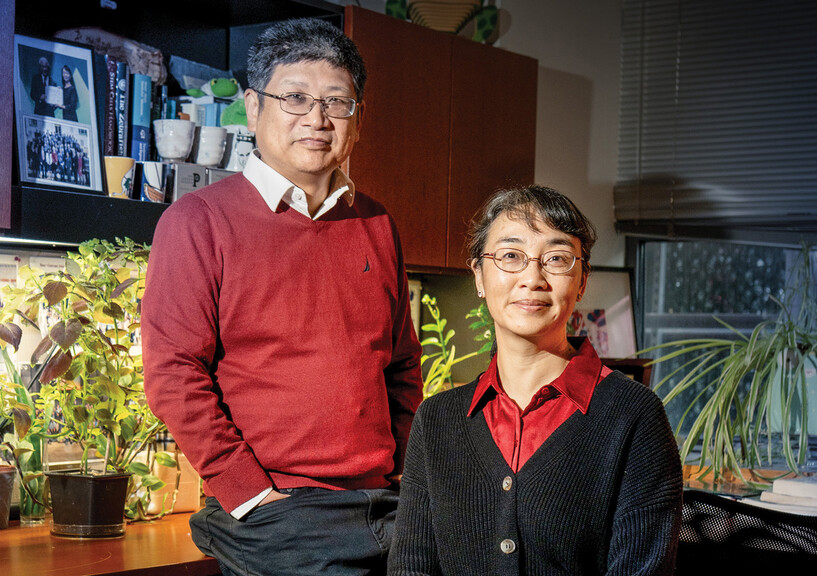
Penn Medicine’s Hongjun Song (left) and Guo-li Ming.
(Image: Courtesy of Penn Medicine News)
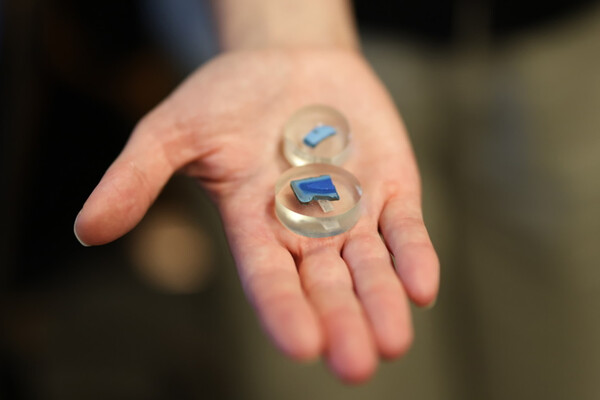
These micro-sized organoids—three-dimensional cultures of brain cells—contain cells from surgical tumor samples of patients at Penn Medicine’s Abramson Cancer Center with recurrent glioblastoma, a type of aggressive brain tumor that returns after treatment.
In a recent paper, Song, Ming, and other collaborators at Penn show that the organoids they developed could serve as a real-time mimic of patients’ brain tumors. In other words, if the treatment works in the organoid, it works in the human patient as well. “The assumption here is that only certain treatments can work on certain patients,” Song says. “The key is to find a match.”
Song became chair of the Department of Neuroscience at Penn Medicine in November 2025, and is the David J. Mahoney Professor of Neurological Sciences. Both he and Ming, who is a Perelman Professor of Neuroscience and associate director of the Institute for Regenerative Medicine, have been at Penn’s Perelman School of Medicine since 2017. The two share more than 250 peer-reviewed articles and the mentorship of numerous talented early-career scientists.
But long before Song and Ming were research partners, they were high school sweethearts in Wuhan, China.
In the early 2000s, it became clear to both Song and Ming that effective disease modeling is the gateway to not just understand how diseases develop in the body, but also to discover new treatments that are likely to be effective in human patients.
At the time of the 2015-2016 Zika outbreak, many conflicting theories had spread on why the virus caused microcephaly, a condition where infants born to an infected mother had smaller-than-normal head sizes. They were able to grow Zika-infected brain organoids that grew at the same pace as real developing human brains—meaning they could monitor each step that a fetal brain would go through. Within days, they found a clue: The virus attacks the neural stem cells.
Since coming to Penn not long after their Zika discovery, Song and Ming have focused on improving their brain organoids to model neural circuitry in the hope of recapitulating how different parts of the brain interact.
Their individual expertise made the partnership so effective, Song says. “I was trained purely as a basic scientist. But because of Guo-li’s clinical training, that allows us to think not only about the mechanisms of brain development, but also how they contribute to disease, and what treatment strategies we can come up with.”
At Penn, Song and Ming continued to collaborate across disciplines. They developed a sophisticated organoid model of the human neocortex containing six distinct layers, each with specific functions. With H. Isaac Chen, an associate professor of neurosurgery at Penn and the Veterans’ Administration Medical Center, they also showed that these organoids can be transplanted and seamlessly integrated into the brain of an injured rat to restore visual functions.
“In the next frontier,” Ming says, “we want to study how brain organoids can be involved in brain repair in larger animals.” Song and Ming also continue to push the boundaries of understanding and treating aggressive brain cancers based on work with organoid models.
On the move: Water quality and antimicrobial resistance testing goes mobile
Penn researchers have developed a mobile field laboratory allowing them to test water quality and track antimicrobial resistance in and around San Cristóbal in the Galápagos.
Penn researchers Vanessa and Alexis North are studying one of the largest collections of Egyptian blue objects ever found in the ancient Near East, shedding new light on how the world’s first synthetic pigment may have traveled far beyond Egypt.
A new role for dental providers? Rethinking where vaccines are given
Vaccinations have traditionally been administered in primary care settings or pharmacies. However, for about a decade, some states have authorized dentists to administer vaccines, and many others did so during the COVID-19 pandemic. The effectiveness of this approach has led some countries and states to expand or consider expanding the role of dental providers in delivering routine vaccines, including those against COVID-19 and the human papillomavirus (HPV), and in providing vaccine education.
Penn student develops a way for computer chips to run more efficiently
Fluid Silicon, a platform from President’s Sustainability Prize winner Nhlanhla Mavuso, allows computer chips to continuously monitor their health and self-tune as their characteristics change. The technology has the potential to reduce energy usage in data centers and improve reliability in mission-critical applications.