Could ‘cyborg’ transplants replace pancreatic tissue damaged by diabetes?
A new electronic implant system developed by Penn Medicine researchers prompts lab-grown pancreatic cells to mature, and suggests a new way to treat diabetes.
2 min. read
A new electronic implant system can help lab‑grown pancreatic cells mature and function properly, potentially providing a basis for novel, cell-based therapies for diabetes. The approach, developed by researchers at the Perelman School of Medicine and Harvard, incorporates an ultrathin mesh of conductive wires into growing pancreatic tissue, according to a study published in Science.
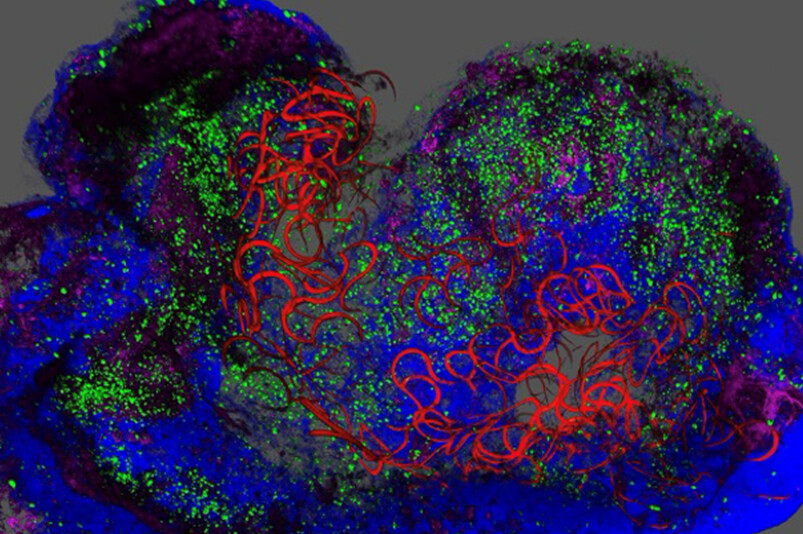
The researchers grew pancreatic tissue (above) so it incorporated a mesh-like electronic network (red). Cells within the tissue produce insulin (green), the blood-sugar-lowering hormone lost in type 1 diabetes.
(Image: Courtesy of Penn Medicine)
“The words ‘bionic’, ‘cybernetic’, ‘cyborg’, all of those apply to the device we’ve created,” says Juan Alvarez, an assistant professor of cell and developmental biology. While these terms may sound futuristic, he noted this approach is already in use in the form of deep brain stimulation, which treats neurological conditions. “What we’re doing is like deep stimulation for the pancreas. Just like pacemakers help the heart keep rhythm, controlled electrical pulses can help pancreatic cells develop and function the way they’re supposed to,” he says.
Researchers in Alvarez’s lab partnered with the Jia Liu lab at Harvard to implant a fine, electrically conductive mesh into pieces of developing pancreatic tissue, capable of detecting the electrical signals from the islet cells. They then introduced a natural, 24-hour rhythm in electrical activity, prompting the cells to mature and respond properly to sugar—overcoming a major challenge to growing fully functional pancreatic tissue outside the body. Such alternative transplants promise to dramatically expand the supply of new tissue and, if engineered properly, reduce the risk of rejection.
This approach of coaxing human stem cells to produce beta and other hormone secreting cells is already being tested in clinical trials. Still, a key challenge remained: Even with this electrical boost, the lab-grown cells often don’t fully mature and may not release insulin and other hormones as reliably as natural ones.
On the move: Water quality and antimicrobial resistance testing goes mobile
Penn researchers have developed a mobile field laboratory allowing them to test water quality and track antimicrobial resistance in and around San Cristóbal in the Galápagos.
Penn researchers Vanessa and Alexis North are studying one of the largest collections of Egyptian blue objects ever found in the ancient Near East, shedding new light on how the world’s first synthetic pigment may have traveled far beyond Egypt.
A new role for dental providers? Rethinking where vaccines are given
Vaccinations have traditionally been administered in primary care settings or pharmacies. However, for about a decade, some states have authorized dentists to administer vaccines, and many others did so during the COVID-19 pandemic. The effectiveness of this approach has led some countries and states to expand or consider expanding the role of dental providers in delivering routine vaccines, including those against COVID-19 and the human papillomavirus (HPV), and in providing vaccine education.
Penn student develops a way for computer chips to run more efficiently
Fluid Silicon, a platform from President’s Sustainability Prize winner Nhlanhla Mavuso, allows computer chips to continuously monitor their health and self-tune as their characteristics change. The technology has the potential to reduce energy usage in data centers and improve reliability in mission-critical applications.