Penn Engineering’s Danaé Metaxa on AI audits and how their lab at Penn Engineering is working to make AI systems more accountable.
2 min. read
As AI reshapes human affairs, there is an emerging need to measure the outputs and understand the impacts of socially influential AI systems including large language models, algorithmic recommendations, and other automated systems.
AI audits offer a way to evaluate how systems behave in the real world, determining whether they function as designed, whether that design is flawed, and whether the systems produce harms their creators did not anticipate.
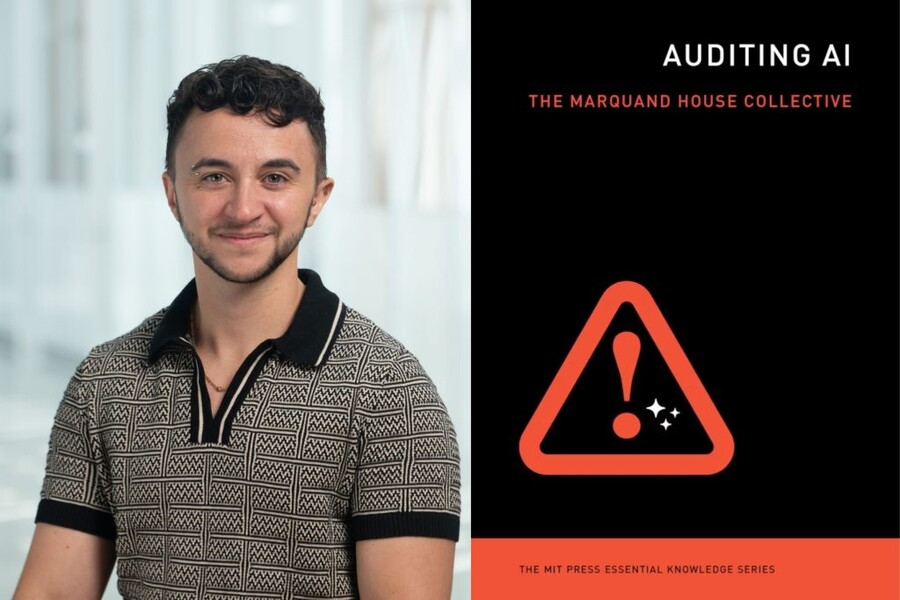
Danaé Metaxa is the Raj and Neera Singh Term Assistant Professor in Computer and Information Science at Penn Engineering.
(Image: Courtesy of Penn Engineering)
Danaé Metaxa, Raj and Neera Singh Term Assistant Professor in Computer and Information Science at Penn’s School of Engineering and Applied Science, and co-authors have published “Auditing AI,” a new, open-access book that explains how AI audits can help policymakers and everyday users better understand AI systems.
“AI audits are a process for understanding how an AI system is working behind the scenes, without direct access to the internals of that system,” explains Metaxa. “It’s a rigorous scientific method of systematically probing those systems and measuring their outputs to make inferences about how they work and what social impact they are having.”
Metaxa explains the impetus for their book. “A few years ago, a lawyer from a prominent human rights organization contacted me regarding a legal settlement his firm was negotiating with a large social media platform whose AI-powered content filters were allegedly discriminating against some user groups. He explained to me that the platform was telling him that it wasn’t possible to improve the bias of their tools or to track such improvement over time.”
They add, “As an expert in AI auditing, I could confirm that improving these tools was possible, and describe to him the kind of evaluations that he should ask the company to provide over time to demonstrate improvement.”
On the move: Water quality and antimicrobial resistance testing goes mobile
Penn researchers have developed a mobile field laboratory allowing them to test water quality and track antimicrobial resistance in and around San Cristóbal in the Galápagos.
Penn researchers Vanessa and Alexis North are studying one of the largest collections of Egyptian blue objects ever found in the ancient Near East, shedding new light on how the world’s first synthetic pigment may have traveled far beyond Egypt.
A new role for dental providers? Rethinking where vaccines are given
Vaccinations have traditionally been administered in primary care settings or pharmacies. However, for about a decade, some states have authorized dentists to administer vaccines, and many others did so during the COVID-19 pandemic. The effectiveness of this approach has led some countries and states to expand or consider expanding the role of dental providers in delivering routine vaccines, including those against COVID-19 and the human papillomavirus (HPV), and in providing vaccine education.
Penn student develops a way for computer chips to run more efficiently
Fluid Silicon, a platform from President’s Sustainability Prize winner Nhlanhla Mavuso, allows computer chips to continuously monitor their health and self-tune as their characteristics change. The technology has the potential to reduce energy usage in data centers and improve reliability in mission-critical applications.