The aim of the temporary structures is to identify and sort patients before they enter the hospitals. Those with mild symptoms can get tested and sent home, leaving the space inside for more severe cases.
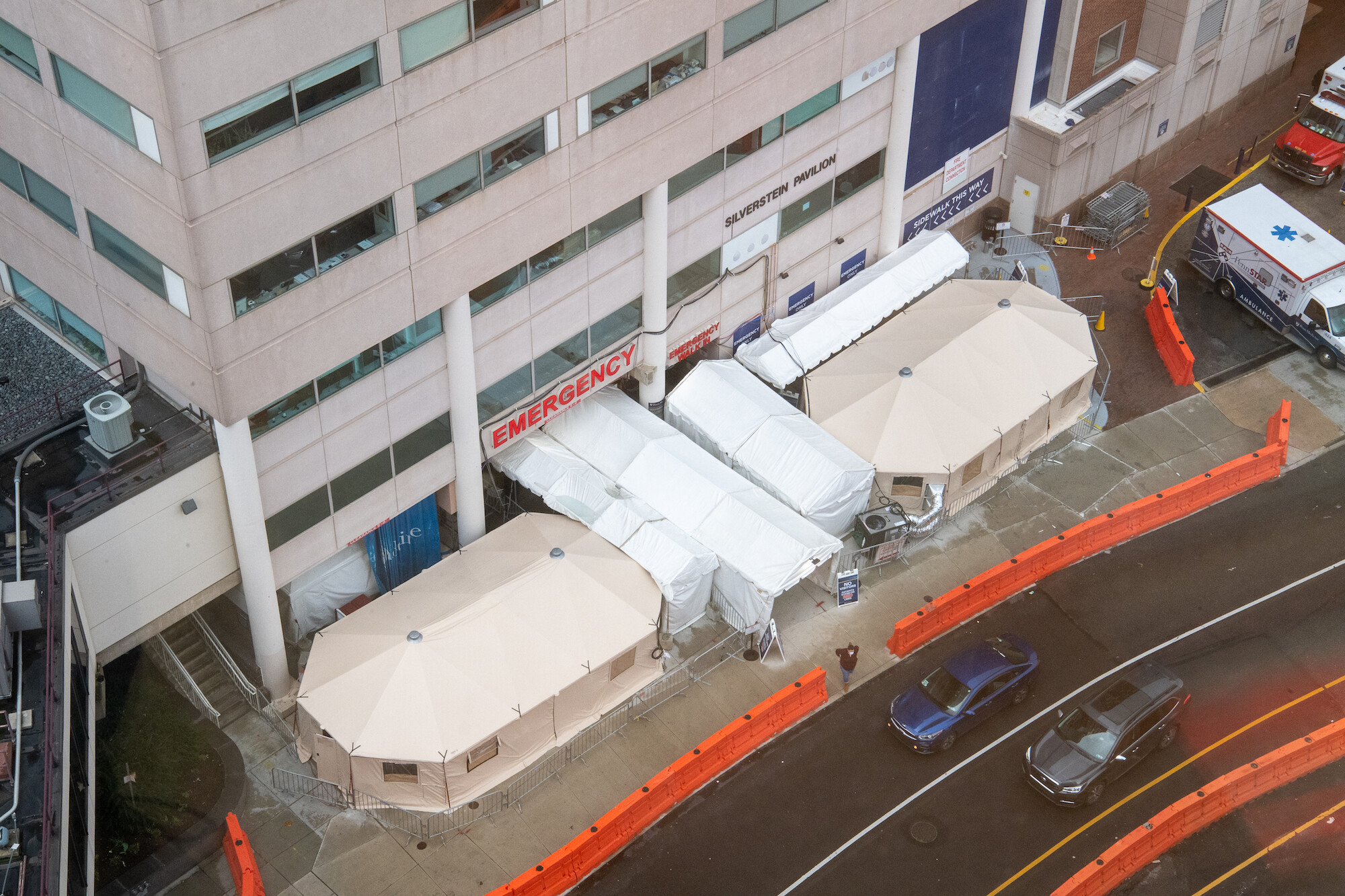
The ambulance bays immediately outside the Hospital of the University of Pennsylvania ED on 34th Street became home to its exterior screening facility, which comprises more than 1,200 square feet—currently Penn’s largest ED triage setup. As at other hospitals, the operation there replaces the triage efforts taking place inside the ED. (Image: Courtesy of Penn Medicine)
The middle of March can seem like ages ago during this rapidly evolving global pandemic.
Back then, Pennsylvania reported fewer than 100 cases of COVID-19, with half of them in the Philadelphia region. Many businesses were still open, social distancing wasn’t in full swing, and stay-at-home mandates had yet to be issued.
Meanwhile, response efforts across Penn Medicine were already set in motion by medical staff and leaders bracing for a large influx of patients potentially infected with the novel coronavirus, with many expected to come through the emergency department doors. Now was the time for the EDs to get ahead of the impending storm and step up the action already happening inside.
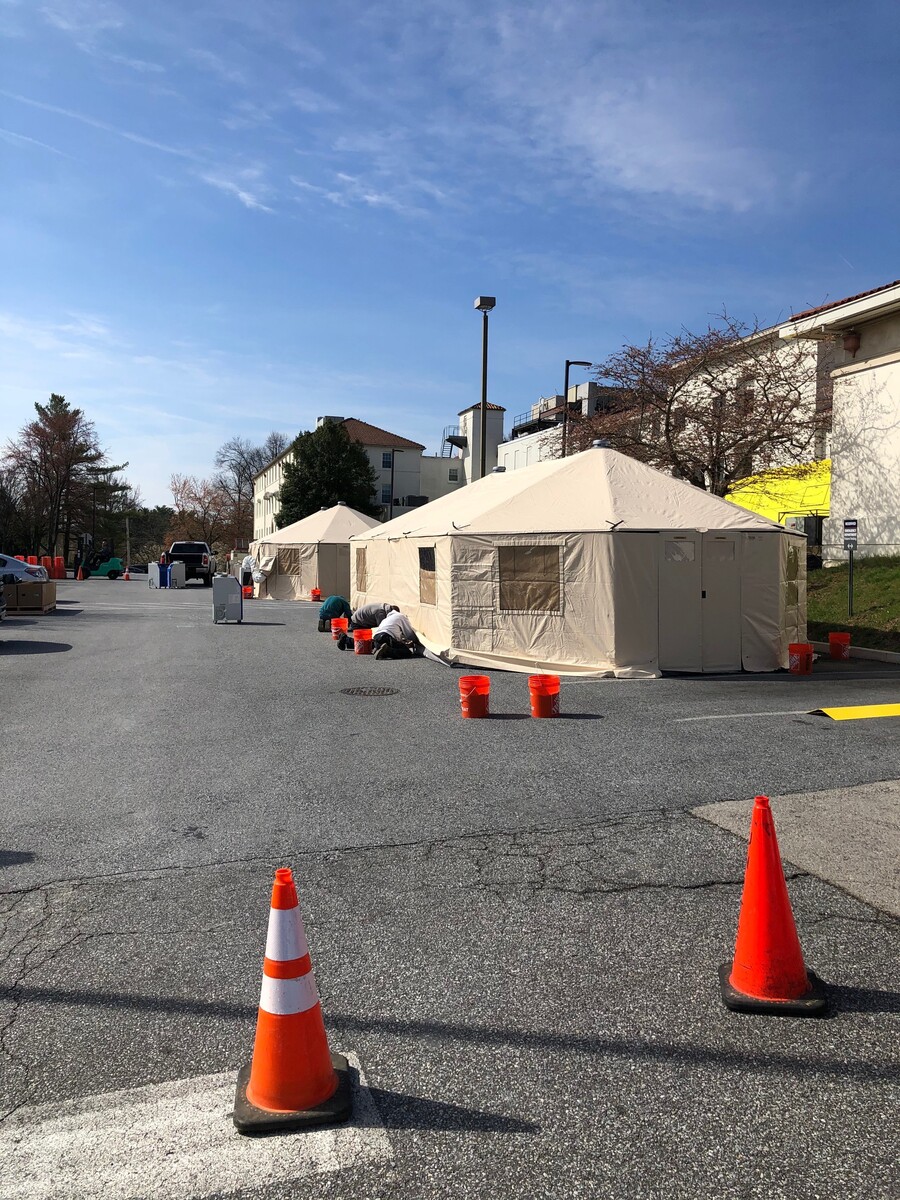
In just eight hours, on March 17, a team erected a tent to triage ED patients outside of Penn Presbyterian Medical Center (PPMC). The idea: A staging area would help reduce the risk of infection in the hospital by identifying and sorting patients before they entered. And testing those with milder symptoms and discharging them home to self-quarantine would take a strain off the ED, opening up space for the more severe cases.
Over the following days, the PPMC team tirelessly worked out the functions—from systems to staffing—laying the groundwork for two more ED tents, one at Pennsylvania Hospital (PAH), another at the Hospital of the University of Pennsylvania (HUP) shortly thereafter. Outside the city, Penn’s regional hospitals, including Princeton Medical Center, Lancaster General Hospital, and Chester County Hospital, would pitch their own versions of what’s referred to as “influenza-like illness” or ILI tents, too.
“Early on, we said, ‘Let’s start putting these up now, knock one obstacle down after another and take care of this as much as we can while we’re not under water,’” says Peter D. Sananman,director of Disaster Preparedness and an ED physician who led the PPMC tent effort. “It has given us this grace period that’s allowing us the luxury that other cities and the other doctors, nurses, teams, and patients didn’t have.”
In just eight hours, on March 17, a team erected a tent to triage ED patients outside of Penn Presbyterian Medical Center, the first of several tents now up at hospitals across Penn Medicine. (Image: Courtesy of Penn Medicine)
All-out blitz
The timing for the PPMC ILI tent benefitted from a fortunate coincidence.
A few weeks before Sananman talked with and received the greenlight from John C. Flamma,chief of Emergency Medicine at PPMC, and Kevin M. Fosnocht,PPMC’s chief medical officer, he had just finished a drill from his popular Wilderness and Disaster Medicine course, which teaches Perelman School of Medicine medical students how to respond and lead during emergencies and natural disasters. This one was a mock mass casualty event from biological and dirty bomb warfare that called for a decontamination tent, a command center, security protocols, hot and cold zones—everything that a triage tent would need.
Sananman had not only just rolled out the same equipment they would end up using for the COVID-19 tent, but he and two emergency department residents, Jonathan Bar and Seth Merker, had also spent months planning and writing protocols around this latest response drill.
With the drill still fresh in their minds, they all arrived the morning of March 17 and pulled in PPMC hospital staff—nurses, technicians, environmental management service workers, physicians—to help mobilize the blow-up tent. They wired electricity and gathered up computers, personal protective equipment, a hand sanitizer stand, and other supplies needed for the tent. The 10 to 15 dry runs told them what was missing and worked out the kinks. By 4 p.m. that day, they accepted their first patient.
“It’s normally a two-week process to build a tent like this during a pandemic,” Sananman says. “This was an all-out blitz.”
A week later, a sturdier, climate-controlled tent from Western Shelter arrived on site, an effort spearheaded by Phil Okala, chief operating officer for the University of Pennsylvania Health System, and extended to all Penn hospital EDs.
It’s normally a two-week process to build a tent like this during a pandemic. This was an all-out blitz.
Peter D. Sananman, director of Disaster Preparedness who led the PPMC tent effort
That tent is where patients now arrive when they come to the hospital for emergency care between 9 a.m. and 4 p.m. They’re first greeted outside the tent at registration and then screened by medical staff to determine the best pathway. There are four categories labeled by colors: blue for patients not suspected of COVID-19 who can be directed right to the ED (fractured ankle, for instance) or who have a minor issue that can be dealt with in the tent; red for a “patient under investigation” (PUI) who is actively coughing, highly suspected of infection, and needs to be sent to a negative pressure room in the ED; yellow for a PUI who doesn’t need that level of care but still needs to be seen in the ED; and green for a PUI who isn’t coughing or showing other symptoms and can be tested and discharged home to self-quarantine. Clinical staff either follow up or patients are given a phone number to text to learn the results.
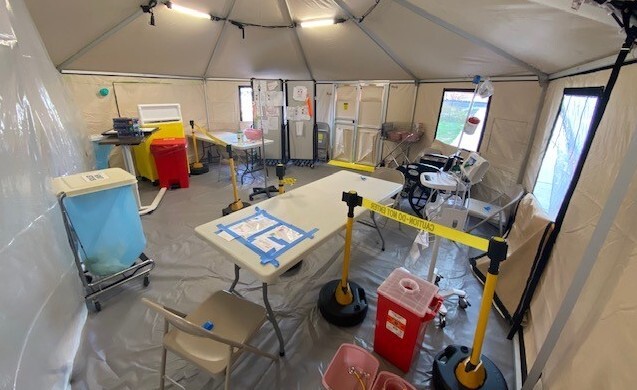
One at a time, after registration, the patients move through the 500-square-foot tent in less than five minutes, assisted by no more than five people donned in protective gear, including gloves, suits, and face shields. In an unprecedented move, health care workers from beyond the ED—including ambulatory care services and other clinical departments—have also stepped in to help work this front line. Soon, they’ll be taking over for the ED staff.
“I consider it pretty heroic that they have come here to do this,” Sananman says. “Because it hasn’t been done before, we are troubleshooting and working together as a team to develop a culture and systems that will help patients and preserve our own safety.”
“There is a pride and unity amongst us,” he adds, “that we are in this together.”
Ready and able
By the third week of March, communication about the ILI tents among the emergency department teams and leadership in the health system was in full force, with phone conversations and site visits to exchange ideas and best practices. The effort has evolved together but each hospital remains autonomous to fit the needs of its respective communities and abilities.
“HUP was inspired by Presby’s tent, and we did something even bigger,” says Jeffrey C. Moon,medical director of HUP’s ED who led the tent effort there.
A week after PPMC’s tent was built, the ambulance bays immediately outside HUP’s ED on 34th Street, became home to its exterior screening facility. Two Western Shelter tents and a few other small tents put it well over 1,200 square feet. As at other hospitals, the operation replaced the triage efforts taking place inside the ED. It’s currently Penn’s largest ED triage tent.
The temporary ED tents outside Chester County Hospital. (Image: Courtesy of Penn Medicine)
“The first page of a medical disaster textbook would say be proactive, not reactive,” Moon says. “So, we are taking that seriously.”
HUP can currently process about 15 emergency patients an hour and provide a high level of care for non-COVID-19 patients that allows many of them to avoid going inside altogether. Pharmacy has a presence in the tent, with several medications on hand to treat patients for a variety of common emergency and urgent-care needs. It runs from 8 a.m. to midnight and also relies on staff from both inside and outside the ED.
Unlike other hospital tents seen around the city, which are mostly testing sites, Penn’s ED tents act as emergency-care treatment clinics, Moon says, where patients receive the same high quality of care they’d get inside, even with asphalt beneath their feet rather than the hospital’s tiled floor.
“The more we can do in a tent, the more we can offload the emergency department,” he says.
Kevin Baumlin,chair of the department of Emergency Medicine at PAH, and his team made the early decision to acquire a tent to be prepared. By March 9, an open-air tent at PAH was erected.
“When things started to happen, it started really quickly and people were renting all kinds of equipment for various purposes, so we stood it up and got it going,” Baumlin says.
Two new tents from Western Shelter were eventually added to create a larger space, which is set up on the sidewalk on Spruce Street, between 8th and 9th Streets. Though it stands at the ready, the tent is not yet open. When it does, the flow and process will be similar to the other hospitals, with staff testing and discharging lower-risk patients from the tent to minimize traffic to the ED. Non-COVID-19 patients will also have access to virtual providers from internal medicine and surgery, who will come down from the hospital for care.
The tent will be activated if needed as volume increases, Baumlin says.
“I think the social distancing in Philadelphia will be effective, and I am hopeful that our peak won’t be as high as the worst-case predictions. But that doesn’t mean that we shouldn’t plan for that,” Baumlin says. “I think we are prepared. Our team has been great, and I’m proud of them. Now, of course, our plans are fluid because we don’t know what’s going to happen.”
All of the hospital ED leaders see this time as one of learning and preparation, expecting the peak demand for pandemic emergency care to come in the days or weeks ahead.
These past few weeks have allowed the teams to mobilize, streamline their processes, obtain new equipment, and train more staff. Christine O’Malley, an innovation manager for the Acceleration Lab at the Penn Center for Health Innovation, is also leading an effort to find new ways to reduce the registration time, which currently takes anywhere from five to 15 minutes, to move patients through the process even faster.
“It’s the quiet,” Moon says. “But I believe that when the storm hits, we will look back and say thank goodness we were aggressive back then to prepare us for now.”
On the move: Water quality and antimicrobial resistance testing goes mobile
Penn researchers have developed a mobile field laboratory allowing them to test water quality and track antimicrobial resistance in and around San Cristóbal in the Galápagos.
Penn researchers Vanessa and Alexis North are studying one of the largest collections of Egyptian blue objects ever found in the ancient Near East, shedding new light on how the world’s first synthetic pigment may have traveled far beyond Egypt.
A new role for dental providers? Rethinking where vaccines are given
Vaccinations have traditionally been administered in primary care settings or pharmacies. However, for about a decade, some states have authorized dentists to administer vaccines, and many others did so during the COVID-19 pandemic. The effectiveness of this approach has led some countries and states to expand or consider expanding the role of dental providers in delivering routine vaccines, including those against COVID-19 and the human papillomavirus (HPV), and in providing vaccine education.
Penn student develops a way for computer chips to run more efficiently
Fluid Silicon, a platform from President’s Sustainability Prize winner Nhlanhla Mavuso, allows computer chips to continuously monitor their health and self-tune as their characteristics change. The technology has the potential to reduce energy usage in data centers and improve reliability in mission-critical applications.