Partnering with local digital leaders to promote violence prevention
A team of Philadelphia-based content creators is collaborating with Penn public health experts to develop a comprehensive anti-violence campaign tailored for youth across the City, with youth-focused workshops and educational materials to be piloted in select Philadelphia public schools this fall.
5 min. read
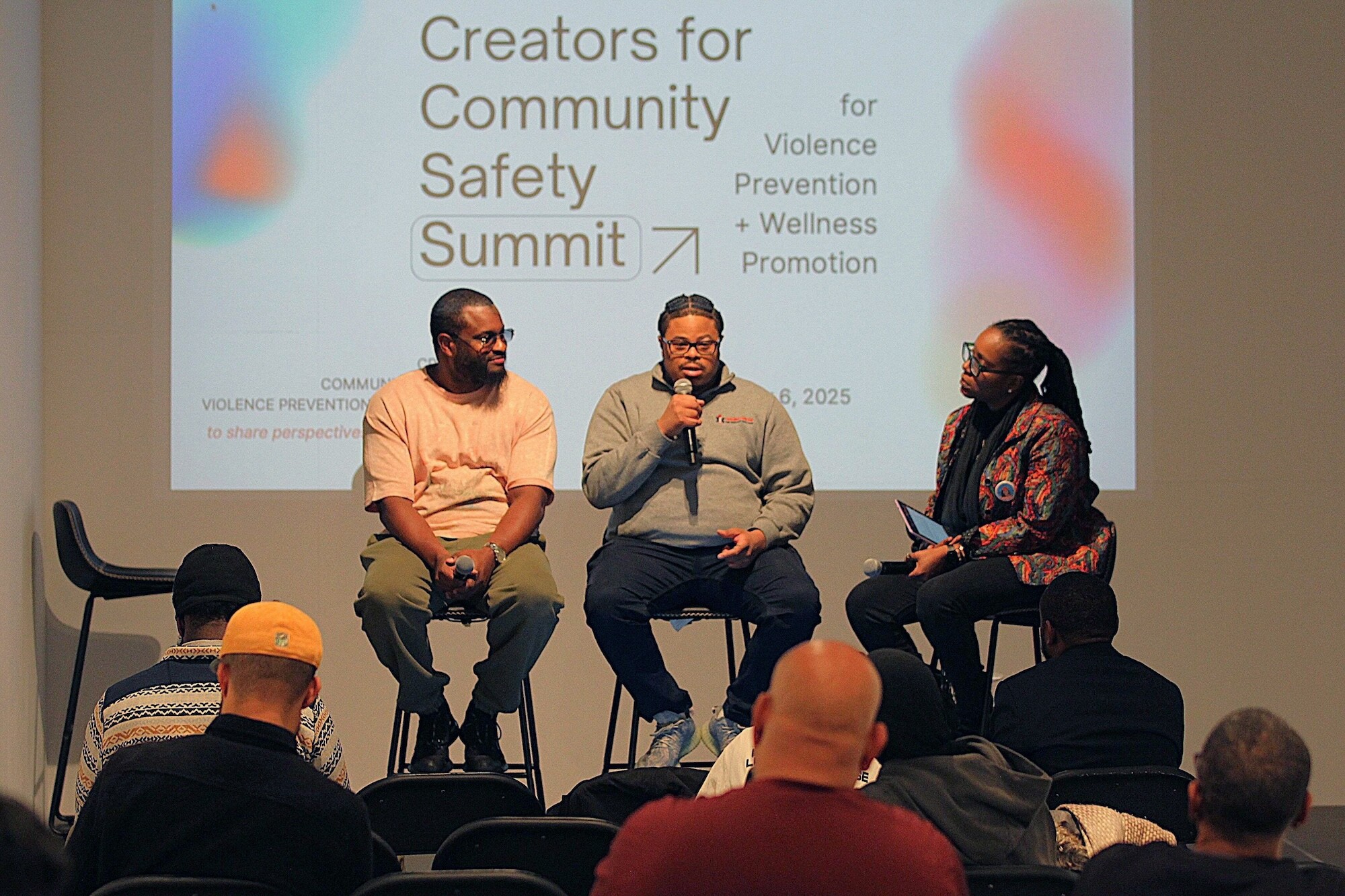
Creators for Community Safety Summit panelists Jaime Meekins (left) and Rodney Babb (center)—one of three Penn staff members who helped train the content creators—speaking with facilitator Tamara Russell (right) about how social media creators can advance gun violence prevention.
(Image: Courtesy of the School of Social Policy & Practice and the Annenberg School for Communication)
“One of the things I think has been missing from gun violence research and intervention has been the role of social media—and how folks who have a strong understanding of social media can play an active role” in this work, says Patton, referring to social networking sites as the “new neighborhood” for promoting violence prevention.
The Institute—part of SP2 and Annenberg’s research-driven SAFELab, and involving partnerships between Penn Medicine, the Penn Injury Science Center, and Brown’s Philadelphia-based violence prevention campaign ABRO—equips creators across the city with trauma-informed research, training, and resources to advance youth-relevant anti-violence advocacy. The Institute has hosted two summits convening digital creators to explore how social media storytelling, trauma-informed best practices, and research-based approaches can elevate violence prevention.
From these summits arose the Creator Institute for Violence Prevention, a new SAFELab initiative—part of the broader Creators for Community Safety program and formed in partnership with the Perelman School of Medicine—designed to engage students in Philadelphia public schools in creator-led conversations about how gun violence and the social determinants of health (i.e. the conditions in which people are born, grow, work, play, live, and age) are communicated online. The project unites content creators with Penn public health and safety experts to develop a comprehensive anti-gun-violence campaign—including the “CUREiculum,” a series of youth-focused workshops exploring how violence, online safety, and social determinants are intertwined.
“Creative young people really deserve a space in public health and public safety,” says Brown, emphasizing that many creators are skilled at translating complex topics into relatable language and “naturally know how to see the unseen.”
Creating the CUREiculum: How the process works
A team of Philadelphia-based creators, selected and led by Brown, will deliver the CUREiculum workshops at three pilot sites this fall: Overbrook High School and Bluford Elementary School in West Philadelphia, and Bethune Elementary School in North Philadelphia. Participating creators include Zay Money, Bruce Johnson, Fis Banga, Manny215, and Tacori, among other high-profile influencers.
(From left) Social media creators Manny 215 [Manny Clark], Prince Dre, Fis Banga, and Ant Brown on stage with facilitator Tamara Russell at the Creators for Community Safety Summit.
(Image: Courtesy of the School of Social Policy & Practice and the Annenberg School for Communication)
“It’s important to have people directly from here as the credible messengers to [engage] with these young kids from Philadelphia,” says Brown, a lifelong Philadelphia resident.
In the spring, three Penn staff members—Lisa Christian, the ortho/trauma social worker at Penn Medicine; Rodney Babb, lead violence recovery specialist at TVRP; and Paulette Branson, the Netter Center for Community Partnerships director of student engagement and community building—trained the content creators on relevant topics.
The trainings helped prepare the creators to develop relatable films, stage plays, and interactive CUREiculum content tailored for Philadelphia youth. Online influencers, says Christian, have a unique ability “to understand youth and present the information in ways that they can take hold of.”
“We are tapping into the brilliance of community members and understanding that their lived experience is lived expertise,” says Patton. The CUREiculum project, he says, “exemplifies the kind of translational work that Penn can continue to do and should be uplifting.”
The program will start with a school-wide assembly, followed by selected students being immersed in a six-week series of creator-led workshops, and will culminate with students presenting their takeaways.
Addressing identity crises and conflict resolution
Often, Christian says, kids in disadvantaged social contexts “don’t see past the moment because they don’t think they have a future to look forward to,” noting how social media can exacerbate both internal and external conflicts that lead to violence. These identity-driven outcomes in school-aged kids, she adds, can have ripple effects on their families, neighborhoods, and communities.
Christian noticed that nearly all the creators found the training personally relatable in some way, igniting fruitful conversation around how to curate the CUREiculum content and promote youth conflict resolution. “It was amazing to see their creative process,” recalls Christian, born and raised in West Philadelphia. “You could see the wheels turning—they had all kinds of interesting things to add.”
Discussing social determinants and complex traumas
During his session, Babb discussed how social determinants—i.e. age, race, ZIP code, housing, education, access to healthcare, etc.—directly and indirectly affect trauma in children and young adults, including how such factors can affect whether youth partake in public violence. He shared Philadelphia-based resources for people affected by gun violence, examined how creators can leverage& social media to support public safety, and offered practical tips for identifying for identifying how trauma can manifest in youth and contribute to broader cycles of violence.
“The goals of the Creator Institute are to provide creators with the essential learning tools to create content [that helps] make Philadelphia safer,” says Babb, who is from West Philadelphia. He notes that leaning on the insight and reach of social influencers can enable Penn and local institutions to better “provide support and safety for our young community members.”
Promoting after-school programs and community initiatives
Branson provided insight into how various social determinants can systemically heighten the risk of youth ending up involved with violence and facing incarceration. To help address these problems through social media, she prompted the creators to build content that invites youth to engage with after-school programs and community initiatives.
In her training, Branson, a longtime West Philadelphia resident, invited the influencers to share candidly about their lived experiences. One creator, she recalls, shared that their loved one had passed due to violence. “Sharing our personal stories was really impactful in this space,” Branson says.
Inviting content creators into the fold
As the creators prepare to pilot the CUREiculum workshops and school campaign, Brown and team are formalizing their approach for measuring program impact. This will involve surveying students and school staff before and after the assemblies, workshops, and final presentations—evaluating content effectiveness and student learning outcomes.
The team will also conduct interviews with select participants, says Patton, to assess how students and staff experienced the program and help determine how it could be improved.
Patton has had preliminary conversations with schools in Chester, Pennsylvania, about potential CUREiculum implementation, as well as school officials in neighboring cities to explore possibilities for eventually scaling the initiative. “I’ve already had beginning conversations with different cities that are excited about this work,” he says.
In the long term, Brown notes this project can build institutional and policymaker support for involving creators with public safety initiatives both in Philadelphia and beyond.
The CUREiculum and the Creator Institute, Brown says, “open up the door for more creators like me to become leaders in this space.”
On the move: Water quality and antimicrobial resistance testing goes mobile
Penn researchers have developed a mobile field laboratory allowing them to test water quality and track antimicrobial resistance in and around San Cristóbal in the Galápagos.
Penn researchers Vanessa and Alexis North are studying one of the largest collections of Egyptian blue objects ever found in the ancient Near East, shedding new light on how the world’s first synthetic pigment may have traveled far beyond Egypt.
A new role for dental providers? Rethinking where vaccines are given
Vaccinations have traditionally been administered in primary care settings or pharmacies. However, for about a decade, some states have authorized dentists to administer vaccines, and many others did so during the COVID-19 pandemic. The effectiveness of this approach has led some countries and states to expand or consider expanding the role of dental providers in delivering routine vaccines, including those against COVID-19 and the human papillomavirus (HPV), and in providing vaccine education.
Penn student develops a way for computer chips to run more efficiently
Fluid Silicon, a platform from President’s Sustainability Prize winner Nhlanhla Mavuso, allows computer chips to continuously monitor their health and self-tune as their characteristics change. The technology has the potential to reduce energy usage in data centers and improve reliability in mission-critical applications.
![(from left to right): Social media creators Manny 215 [Manny Clark], Prince Dre, Fis Banga, and Ant Brown on stage with facilitator Tamara Russell at the Creators for Community Safety Summit. Brown is speaking and holding a microphone. The slideshow in the background reads: "Panel: Violence Prevention and Conflict Resolution"](/sites/default/files/styles/900px_wide_with_focal_crop/public/2026-08/CreatorInstitute-Ant-Brown-inset-612x408.jpg?h=279670ce&itok=00_NqLSD)