By the numbers: First-ever image of black hole’s event horizon
An overview of how scientists were finally able to see the unseeable and what it means for the future of astronomy.
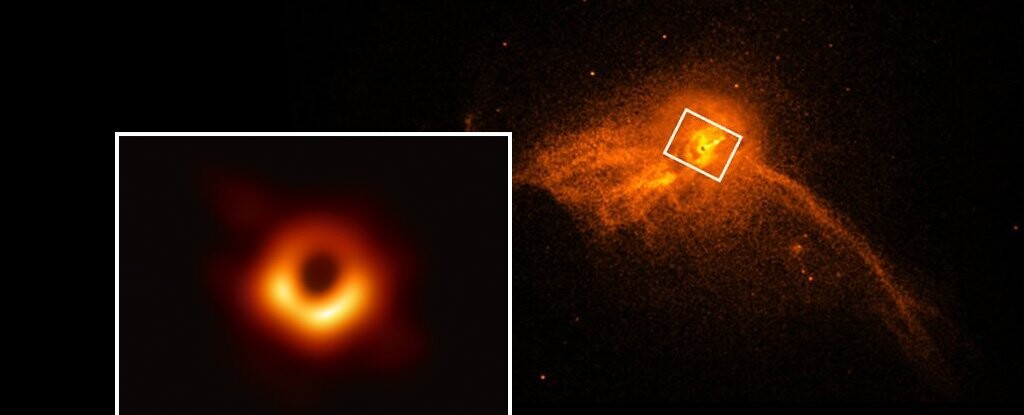
Scientists working with the Event Horizon Telescope collaboration have taken the first-ever image of a black hole. This supermassive black hole (left inset) at the center of the Messier 87 galaxy (location of black hole marked with a white box) is surrounded by a ring of swirling hot gas and dust that sits just outside of the gravitational pull of the event horizon. (Photo: EHT collaboration; NASA/CXC/Villanova University)
On April 10th, researchers from the Event Horizon Telescope (EHT) collaboration released the first image collected of a black hole’s event horizon. The breakthrough image of a supermassive black hole and its shadow at the center of the Messier 87 galaxy was collected using a series of radio telescopes spread across the globe to create an “Earth-sized virtual telescope.”
The black hole, nicknamed Pōwehi, which means “embellished dark source of unending creation” in Hawaiian, has already generated a lot of excitement in the news and in the scientific community, even becoming immortalized in meme form.
Here are some key facts and figures to better understand what went into collecting this first-ever image and what it means for the future of astronomy.
6.5 billion
The number of suns equal to the mass of the Messier 87 black hole. This meets the criteria for being a supermassive black hole, where such a large amount of matter has been squeezed into such a small area that the resulting force of gravity becomes so strong that nothing can escape, not even light.
Based on indirect observations, scientists thought that black holes would look like spherical regions of darkness surrounded by a halo of gases, dust, and stellar debris that form a band just outside the center of the black. The image released last week confirms that what scientists previously thought about the structure of a black hole was true.
55 million
The distance in light years that the Messiers 87 galaxy is from the solar system. The M87 galaxy, which contains several trillion stars, is located in the constellation Virgo, and can be best seen from Earth using a standard telescope in May.
Eight
The number of radio telescopes used to image the black hole at the center of M87. Using a global network of specialized telescopes that collect data on radio waves, in contrast to optical telescopes, which use visible light to observe the universe, observatories across the world synchronized with one another using atomic clocks in order to time their observations precisely.
200
The number of researchers involved in the EHT collaboration, representing institutions from Africa, Asia, Europe, North America, and South America.
The data was stored in a literal half-ton of hard drives, and it was faster to physically ship the hard drives across the world to the lab where the data were analyzed than it would have been to transfer the 5000 terabytes of data digitally.
20 micro-arcseconds
The resolution required to visualize the black hole, about 3 million times sharper than 20/20 vision. In a previous TED talk about the ETH collaboration, astronomer Katie Bouman commented that because of how far away the black hole was from Earth, the resolution had to be equivalent to something that would allow a person to see an orange on the surface of the Moon.
People can increase the resolution of objects by bringing things closer to their field of view, for example, walking towards someone standing in the distance who looks familiar or holding a book closer to see words more clearly.
But since ground-based radio telescopes can’t move closer to a black hole that’s 55 million light years away, they improved the resolution by linking together an array of radio telescopes to create the first-ever “Earth-sized” telescope. This approach is known as very-long-baseline interferometry, which involves synchronizing the measurements of a series of radio telescopes so that they collect measurements across space as a single unit.
1915
The year Einstein published the theory of general relativity, which predicted the existence of black holes. The structure of the black hole at the center of M87 that was revealed in last week’s image matches what Einstein’s theory predicted, providing even more support for his now-100-year-old theory that much of modern-day physics research relies on.
2020
The year speculated for a possible Nobel prize for the black hole photographers. But, even without the award, the future of astronomy research looks promising, with more images and breakthroughs likely in the coming years.
The EHT has already expanded to include 11 radio telescopes, with the hopes that improved resolutions will be able to collect images of hundreds more black holes. More telescopes in the array will also mean being able to collect even better images of the large black holes that astronomers know about already.
In the future, placing radio telescopes in space in either a medium-Earth orbit or on the moon could improve image resolution even further.
On the move: Water quality and antimicrobial resistance testing goes mobile
Penn researchers have developed a mobile field laboratory allowing them to test water quality and track antimicrobial resistance in and around San Cristóbal in the Galápagos.
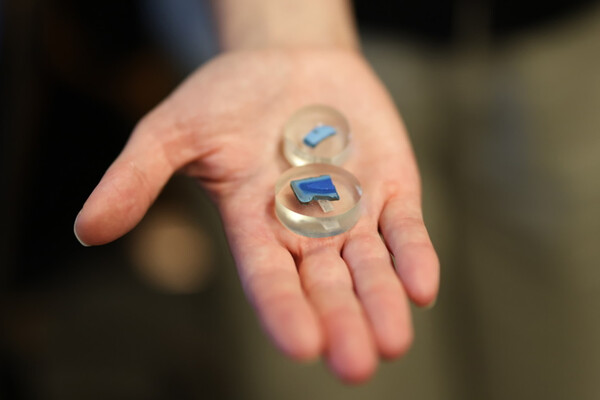
Penn researchers Vanessa and Alexis North are studying one of the largest collections of Egyptian blue objects ever found in the ancient Near East, shedding new light on how the world’s first synthetic pigment may have traveled far beyond Egypt.
A new role for dental providers? Rethinking where vaccines are given
Vaccinations have traditionally been administered in primary care settings or pharmacies. However, for about a decade, some states have authorized dentists to administer vaccines, and many others did so during the COVID-19 pandemic. The effectiveness of this approach has led some countries and states to expand or consider expanding the role of dental providers in delivering routine vaccines, including those against COVID-19 and the human papillomavirus (HPV), and in providing vaccine education.
Penn student develops a way for computer chips to run more efficiently
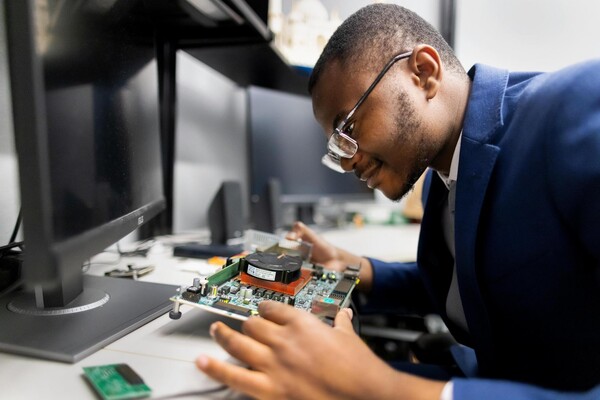
Fluid Silicon, a platform from President’s Sustainability Prize winner Nhlanhla Mavuso, allows computer chips to continuously monitor their health and self-tune as their characteristics change. The technology has the potential to reduce energy usage in data centers and improve reliability in mission-critical applications.